
How to Calculate Cash Out Refinance Affordability the Right Way
How to Calculate Your Cash-Out Refinance Equity and Payments
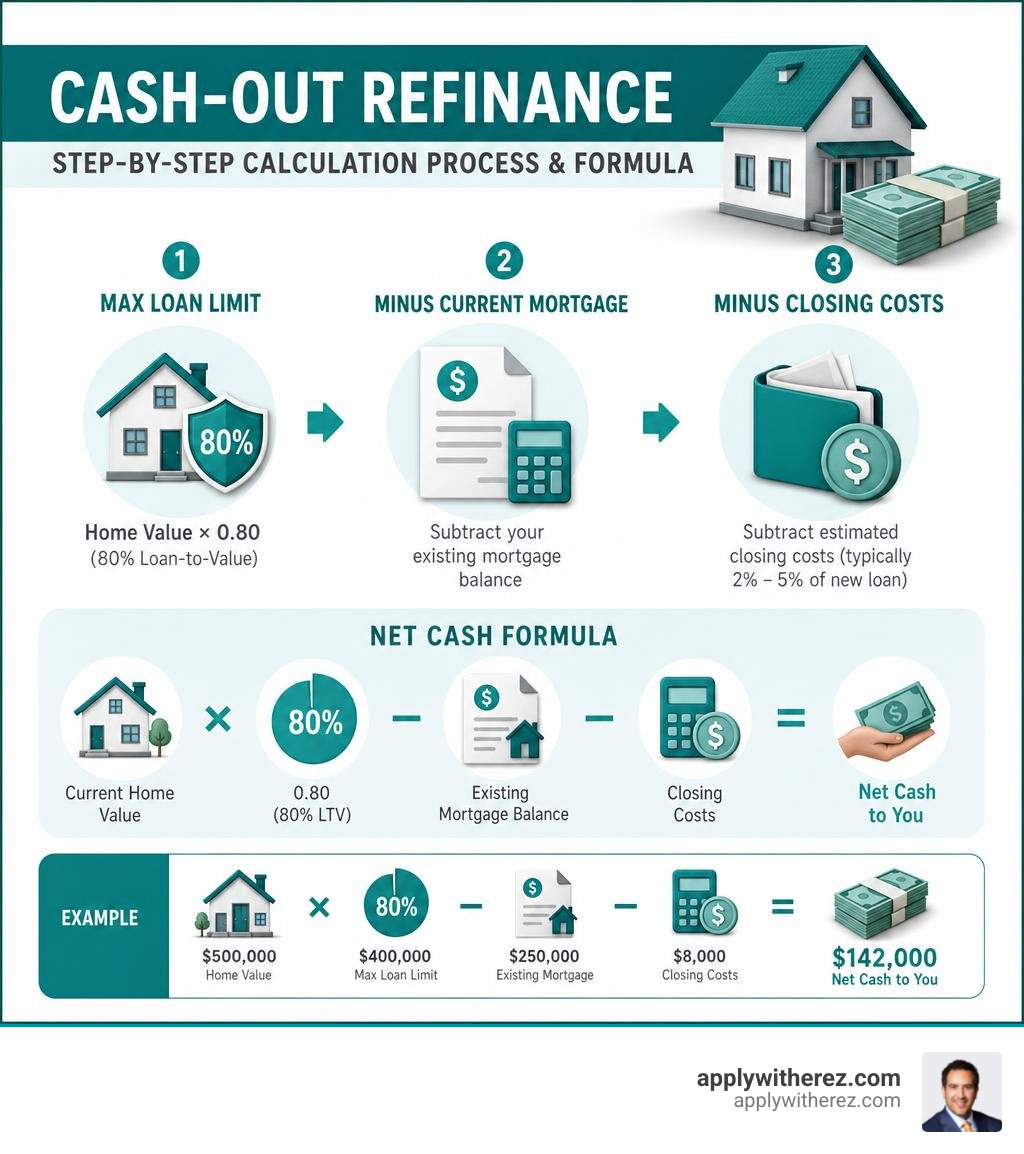
To estimate how much money you can pull from your home with a calculator for cash out refinance, use the standard 80% loan-to-value (LTV) formula:
Calculate your maximum loan limit: Multiply your home's current market value by 80% (0.80).
Subtract your current mortgage: Deduct your remaining unpaid principal balance from that maximum limit.
Deduct closing costs: Subtract estimated closing fees, which typically run between 2% and 5% of the new loan amount.
Net Cash Formula:
(Current Home Value × 0.80) − Existing Mortgage Balance − Closing Costs = Net Cash to You
For example, if your home is worth $500,000, your 80% maximum borrowing cap is $400,000. If you currently owe $250,000 and pay $8,000 in closing costs, your net cash in hand is $142,000.
I'm Erez Shimoni (NMLS #460222), and over the past 26 years I've guided thousands of homeowners through using a calculator for cash out refinance to pinpoint their exact borrowing power without financial surprises. Let's look at the specific underwriting rules, interest rates, and loan structures that determine your true take-home cash.
Understanding Cash-Out Refinancing and Core Eligibility
A cash-out refinance replaces your existing home loan with a brand-new, larger mortgage. The new loan pays off your old balance, and your lender deposits the remaining difference into your bank account as a lump sum after closing. While pulling equity out to remodel an outdated kitchen or eliminate high-interest credit cards sounds straightforward, lenders evaluate several strict qualification requirements before handing over the funds.
For our clients in New York, New Jersey, and Pennsylvania, underwriting revolves around three primary metrics:
Loan-to-Value (LTV) Ratio: For most conventional mortgages, lenders enforce an 80% maximum LTV limit. That means you must leave at least 20% equity in the property as an equity cushion.
Debt-to-Income (DTI) Ratio: Standard guidelines require a total DTI of 43% or lower. This calculation compares your gross monthly income against all recurring debts, including your new estimated mortgage payment (principal, interest, property taxes, and homeowners insurance). Some lenders may extend approvals up to 50% for borrowers with exceptional credit profiles or significant liquid reserves.
Credit Score Benchmarks: Your credit history directly dictates your approval odds and interest pricing. Higher credit scores yield significantly better rates, while lower scores increase mandatory lender fees.
Independent Property Appraisal: To determine your true market value, lenders require a full interior and exterior appraisal. The appraiser inspects recent neighborhood comps and property condition to verify that the home supports your target loan amount.
To explore every underwriting milestone across the full loan lifecycle, review our comprehensive cash out refinance guide 2026.
Conventional, FHA, and VA Program Guidelines
Different loan programs maintain distinct underwriting thresholds for cash extraction. Here is how conventional, FHA, and VA options compare:
Conventional Loans (Fannie Mae / Freddie Mac): Conventional programs require a minimum credit score of 620. Primary residences are capped at 80% LTV, while second homes and investment properties are generally capped at 70% to 75% LTV.
FHA Cash-Out Refinance: Insured by the Federal Housing Administration, this program allows a minimum credit score of 580. Following updated federal guidelines, FHA cash-out loans carry an 80% maximum LTV ceiling. While more lenient on lower credit scores, FHA loans require both upfront mortgage insurance (UFMIP) and ongoing monthly mortgage insurance premiums (MIP).
VA Cash-Out Refinance: Backed by the Department of Veterans Affairs, this program offers the industry's most flexible equity terms. Eligible active-duty military members, veterans, and surviving spouses can access up to 100% LTV of their home's appraised value. Qualifying borrowers looking to fast-track their equity payoff often structure this as a 15 year VA cash out refinance to combine lower long-term interest costs with significant equity release.
Using a Calculator for Cash Out Refinance to Estimate Available Equity
Relying on rough mental math often leads to disappointed expectations at the closing table. A dedicated online mortgage calculator provides clarity by simulating the exact amortization schedule, payment variance, and net equity release before you formally apply.
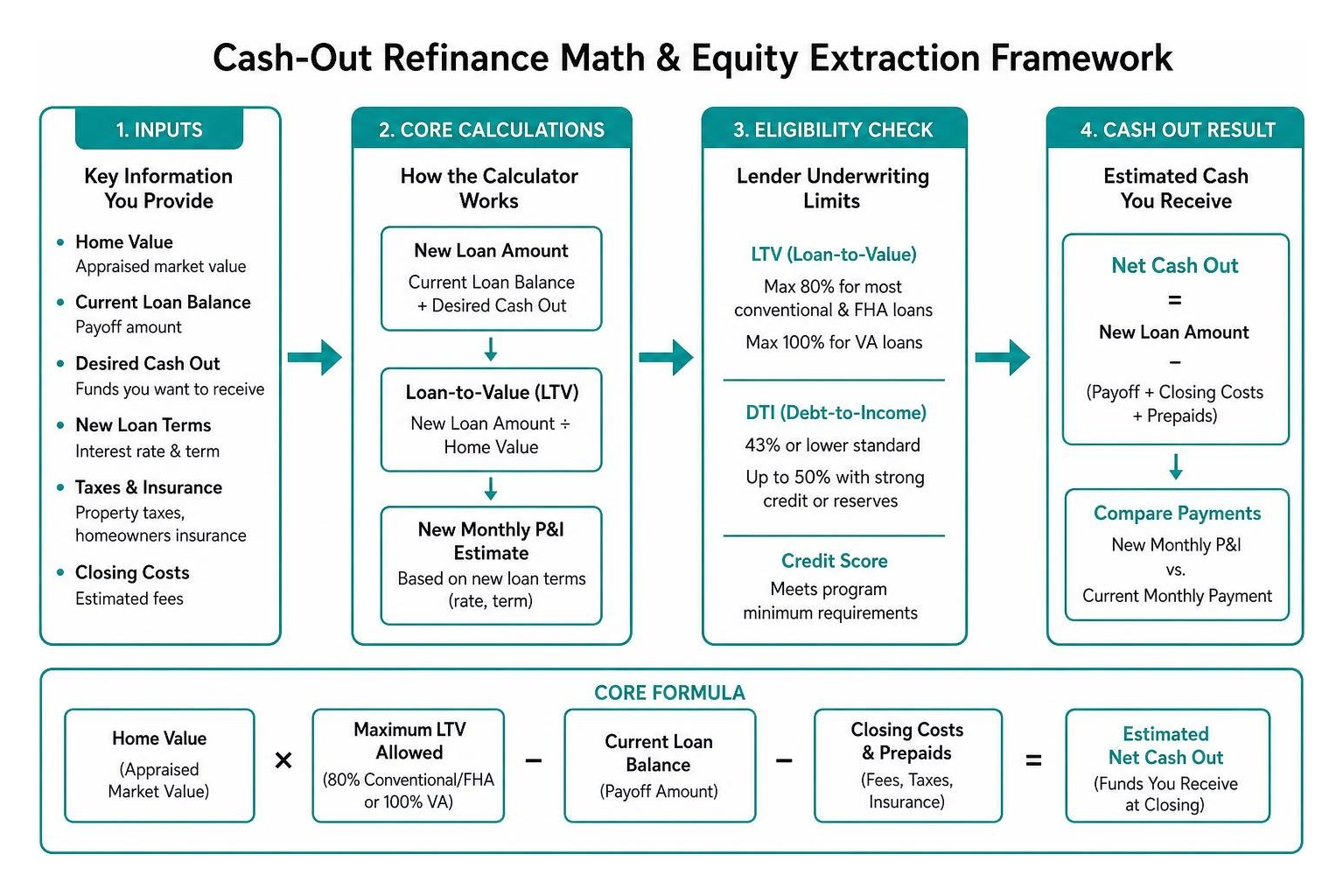
When using an equity tool, gross equity does not equal liquid cash. A calculator factors in your principal balance payoff, adjusts for state-level property taxes, estimates required title insurance, and shows how your new monthly principal and interest (P&I) payment compares to your existing mortgage.
Essential Inputs Needed for a Calculator for Cash Out Refinance
To get precise figures from our interactive mortgage calculator, gather these key data points from your recent mortgage statement and local records:
Estimated Property Market Value: Use recent comparable home sales in your immediate neighborhood rather than an aspirational number.
Current Unpaid Principal Balance: Check your latest monthly statement to identify your exact remaining loan balance.
Target Cash-Out Amount: Define how much cash you want to pull for your planned expenses.
New Interest Rate and Term Length: Choose between common terms such as 15, 20, or 30 years and input current market interest rates.
Annual Property Taxes and Homeowners Insurance: In high-tax states like New Jersey and New York, escrow reserves significantly alter your monthly payment obligations. Inputting accurate annual tax bills prevents payment shock.
Step-by-Step Math Behind a Calculator for Cash Out Refinance
Let us walk through an end-to-end example using a homeowner with a primary residence in Pennsylvania:
Appraised Value: $450,000
Existing Mortgage Balance: $220,000
Target Post-Refi LTV: 80% (0.80)
Calculate Maximum Allowable Loan:
$$\$450,000 \times 0.80 = \$360,000$$Determine Gross Available Cash:
$$\$360,000 - \$220,000 = \$140,000$$Deduct Refinance Closing Costs (Estimated at 3% of new loan amount):
$$\$360,000 \times 0.03 = \$10,800$$Calculate Net Liquid Cash Received:
$$\$140,000 - \$10,800 = \$129,200$$
With this calculation, the homeowner replaces their existing $220,000 mortgage with a new $360,000 loan, receives $129,200 in net cash at funding, and maintains a healthy 20% ($90,000) equity stake in their home.
How Closing Costs and Interest Rates Impact Net Cash Received

Closing costs represent the single largest deduction from your gross cash-out proceeds. On average, total settlement fees range between 2% and 5% of your new total loan amount. On a $400,000 mortgage, you can expect closing fees to run between $8,000 and $20,000 depending on your property's jurisdiction and loan profile.
Typical settlement fees include:
Lender Origination and Underwriting Fees: Standard administration charges for processing your loan file.
Appraisal Fees: Usually $500 to $900 for a licensed residential appraiser to value the property.
Title Search and Lender's Title Insurance: Mandatory legal coverage ensuring no outstanding liens exist against the property.
State and County Recording Fees: Local administrative transfer fees. In New York, for instance, the state-mandated Mortgage Recording Tax can represent a noticeable closing cost item.
Prepaid Escrows: Prorated property taxes and homeowners insurance reserves required to fund your new escrow account.
To see what you can expect to pay based on regional underwriting norms, see our breakdown of the average closing costs for cash out refinance.
Beyond administrative fees, cash-out transactions carry a slight pricing premium. Because lenders take on higher risk when you borrow against equity, Fannie Mae and Freddie Mac apply Loan-Level Price Adjustments (LLPAs). Consequently, average cash out refinance rates are typically 0.25% to 0.50% higher than plain rate-and-term refinance rates.
Calculating the True Break-Even Point
If your primary motivation for refinancing is securing a lower interest rate alongside cash extraction, you must calculate your break-even timeline. The break-even point is the exact number of months required for your monthly interest savings to offset your total upfront closing costs.
Use this simple formula:
$$\text{Break-Even Period (Months)} = \frac{\text{Total Upfront Closing Costs}}{\text{Monthly Payment Savings}}$$
For example, if you pay $7,200 in closing costs to lower your overall monthly housing payment by $180, your break-even timeline is:
$$\frac{\$7,200}{\$180} = 40\text{ months (3.3 years)}$$
If you plan to live in your home for five years or more, this refinance makes clear financial sense. However, if your new monthly mortgage payment increases—which frequently happens when borrowing significant additional principal—the mathematical break-even based purely on monthly payment reduction becomes infinite. In that scenario, you must justify the transaction based on the utility and return on investment of the extracted cash (such as paying off 24% credit cards or funding essential home repairs).
For a complete look at taking cash in hand at settlement, read our guide on cash back at closing refinance.
Comparing Cash-Out Refinances to Alternative Equity Options
A cash-out refinance is not your only path to tapping home equity. Depending on your current mortgage rate, taking out a second mortgage—such as a Home Equity Line of Credit (HELOC) or a fixed-rate Home Equity Loan—might save you money by keeping your low-rate primary mortgage intact.
Loan Feature Cash-Out Refinance Home Equity Loan (HELOAN) Home Equity Line of Credit (HELOC) Lien Position 1st Mortgage (Replaces Old Loan) 2nd Mortgage (Subordinate) 2nd Mortgage (Subordinate) Interest Rate Type Fixed (or ARM) Fixed Rate Variable (Tied to Prime Rate) Closing Costs 2% – 5% of Total Loan Low to Moderate ($500–$2,500) Minimal to None ($0–$1,000) Payout Structure Single Lump Sum Single Lump Sum Revolving Credit Line Impact on First Mortgage Resets First Mortgage Terms Leaves First Mortgage Untouched Leaves First Mortgage Untouched Standard LTV Cap 80% (100% for VA) 80% – 85% Combined LTV 80% – 85% Combined LTV
When evaluating cash out refinance vs home equity loan strategies, consider both the upfront closing costs and the total lifetime interest. If your primary mortgage carries a sub-4% interest rate, replacing that entire balance with a higher modern rate could cost thousands more over 30 years. In that case, adding a standalone second lien is often the best way to get cash out of home equity.
Tax Deductibility Considerations (IRS Pub 936)
Before committing to a cash extraction plan, understand the federal tax rules. Under IRS Publication 936 guidelines, mortgage interest on cash-out funds is only tax-deductible if used to buy, build, or substantially improve the home securing the loan (up to the standard $750,000 mortgage debt limit).
If you use cash-out funds to consolidate high-interest credit cards, pay college tuition, or buy a new car, the interest attributable to that cash-out portion cannot be itemized on your federal tax return.
Frequently Asked Questions About Cash-Out Refinance Calculations
How much cash can I realistically take out of my home?
Under standard conventional and FHA guidelines, you can borrow up to 80% of your home's current appraised market value, minus your existing mortgage payoff and closing costs. For instance, on a home appraised at $600,000 with a remaining balance of $300,000, your maximum new loan limit is $480,000 ($600,000 × 0.80). After paying off your $300,000 loan balance and approximately $10,000 in closing costs, you could receive roughly $170,000 in net cash proceeds. Eligible military borrowers using a VA cash-out loan may borrow up to 100% LTV depending on credit and entitlement.
Does a cash-out refinance reset my 30-year amortization schedule?
Yes, unless you specifically select a shorter loan term (such as a 15- or 20-year fixed loan). Refinancing into a new 30-year mortgage restarts your amortization timeline from Year 1. During the initial years of any new 30-year mortgage, the bulk of your monthly payments goes toward interest rather than principal reduction. If you are already 10 years into an existing 30-year mortgage, resetting to a new 30-year term means you will be paying interest over a total span of 40 years. To understand how loan structure changes affect your net worth, explore our detailed analysis of cashing out finance.
How do closing costs reduce my final cash payout?
Closing costs are deducted directly from your gross loan proceeds at the settlement table, or they are rolled into the total principal balance of your new loan. Typical closing fees range between 2% and 5% of the new loan amount. If your gross equity cash-out allowance is $60,000 and your itemized closing costs total $8,000, your final check or direct deposit at closing will be exactly $52,000. Review the overall benefits of cash out refinance to determine if the liquidity advantages outweigh the upfront settlement charges.
Conclusion
Calculating your cash-out refinance numbers accurately is the most important step before tapping your home equity. By applying the standard 80% LTV rule, budgeting for 2% to 5% in closing costs, and understanding the impact of loan-level pricing adjustments, you can make a confident, financially sound decision for your household.
Whether you are looking to eliminate high-interest debt, fund a major home addition, or restructure your primary mortgage, we are here to guide you every step of the way. If you live in New York, New Jersey, or Pennsylvania, connect directly with Erez Shimoni and the Apply with Erez mortgage team today to explore custom cash-out refinance options tailored to your personal financial goals.