
How to turn your house into a giant piggy bank
Your Home Is Sitting on a Gold Mine — Here's How to Tap It
The best way to get cash out of home equity depends on your goals, your current mortgage rate, and how much flexibility you need. Here's a quick breakdown:
Method Best For Rate Type Touches First Mortgage? Cash-out refinance Large lump sum + lower existing rate Fixed or adjustable Yes — replaces it Home equity loan One-time expense, predictable payments Fixed No HELOC Ongoing or flexible draws over time Variable No Reverse mortgage Homeowners 62+, no monthly payments needed Fixed or adjustable No Sale-leaseback / HEI No income/credit qualification, debt-free access N/A No
American homeowners are sitting on roughly $34 trillion in home equity as of 2026. The average homeowner has about $299,000 in equity built up. That's a lot of financial power — locked inside your walls.
But unlocking it the wrong way can cost you thousands. Or worse, put your home at risk.
The good news? You have more options than ever. And the right one for you probably isn't the same as the right one for your neighbor.
I'm Erez Shimoni, a mortgage professional with 26 years of experience helping homeowners navigate exactly these kinds of decisions — and finding the best way to get cash out of home equity without leaving money on the table. Read on for a clear, no-fluff breakdown of every major strategy available to you in 2026.
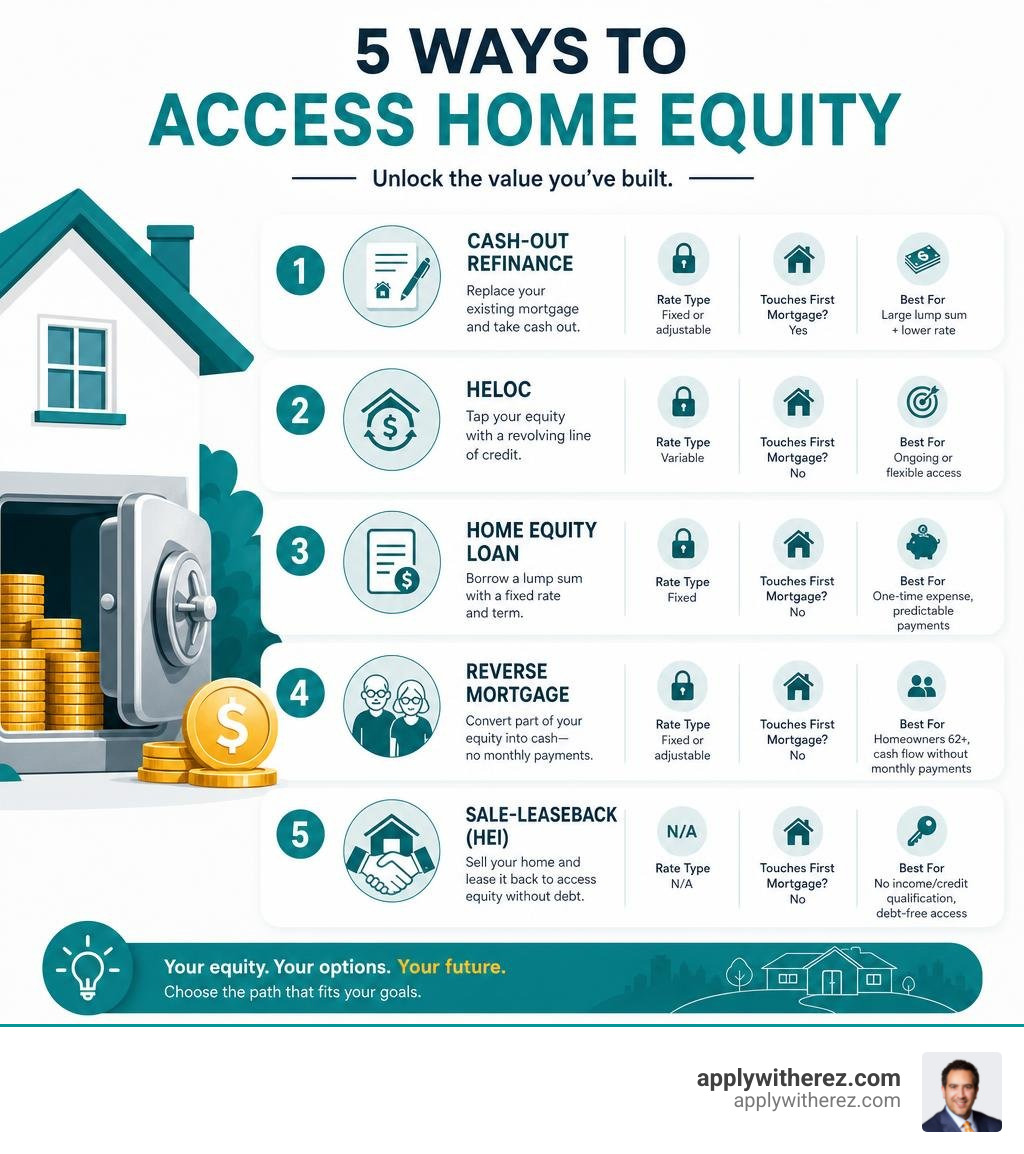
Evaluating the Best Way to Get Cash Out of Home Equity
Before we pull back the curtain on the specific financial tools at your disposal, we need to talk about how lenders decide how much cash you can actually walk away with. You can't simply treat your home like an ATM and withdraw every last dollar. Lenders want to make sure your home remains a safe asset for them and a stable roof over your head.
To determine your borrowing power, we look at three critical factors: your Loan-to-Value (LTV) ratio, your credit score, and your debt-to-income (DTI) ratio.

The absolute golden rule of home equity is the 80% LTV cap. Most traditional lenders require you to maintain at least 20% equity in your home after taking cash out. This means your combined outstanding loans (your primary mortgage plus whatever equity product you choose) cannot exceed 80% of your home's current appraised value.
For example, if your home is appraised at $400,000 in today's 2026 market, the maximum total debt a lender will typically allow on the property is $320,000 (80% of $400,000). If you still owe $220,000 on your first mortgage, the maximum amount of cash you can extract is $100,000. To get a highly personalized estimate of your borrowing capacity, check out this guide on How To Access Your Home Equity.
Beyond LTV, your credit score and DTI will dictate your interest rate and approval odds. Lenders typically prefer a credit score of 720 or higher to secure the best rates, though options exist for lower scores. Your DTI — the percentage of your monthly pre-tax income that goes toward paying debts — should ideally remain under 43% to show you can comfortably handle the new payments.
Why a Cash-Out Refinance Might Be the Best Way to Get Cash Out of Home Equity
A cash-out refinance is a complete financial do-over. Instead of keeping your current mortgage and adding a second loan on top, you replace your existing first mortgage with an entirely new, larger first mortgage. We use the new loan to pay off your old mortgage, and the remaining balance is handed to you as a lump sum of cash at closing.
This strategy is often the best way to get cash out of home equity when current market interest rates are lower than (or very close to) your existing mortgage rate. Because you are replacing the entire loan, a cash-out refinance resets your interest rate on the whole balance, not just the cash you are taking out.
If you locked in an ultra-low mortgage rate of 3% or 4% back in 2020 or 2021, refinancing into a 2026 rate of around 6.9% just to get some cash is rarely a smart move. You would be raising the interest rate on your entire remaining principal. However, if your current mortgage rate is sitting above 7.5%, refinancing can secure you a lower rate while simultaneously putting cash in your pocket.
To see if the math works in your favor, we highly recommend using our Cash-Out Refinance Calculator to run your numbers. Additionally, keep in mind that cash-out refinancing comes with standard mortgage closing costs, which typically range from 2% to 5% of the total loan amount. On a $340,000 refinance, this means you could pay between $6,800 and $17,000 in fees. You can read more about what to expect in our detailed breakdown of the Average Closing Costs for Cash-Out Refinance.
For a complete look at requirements, seasoning rules, and timelines, dive into this Cash-Out Refinance Guide 2026: How It Works, Rates & When It's Worth It.
When a HELOC is the Best Way to Get Cash Out of Home Equity
If you have a fantastic low rate on your primary mortgage and want to leave it completely untouched, a Home Equity Line of Credit (HELOC) is often the superior choice.
A HELOC functions like a giant credit card secured by your home. Instead of receiving a lump sum of cash on day one, you are approved for a maximum credit limit. You can borrow against this limit as needed during what is known as the draw period (typically 5 to 10 years). During the draw period, you are usually only required to make interest-only payments on the amount you have actually borrowed, making it incredibly budget-friendly in the short term.
Once the draw period ends, you enter the repayment period (usually 10 to 20 years). During this phase, you can no longer withdraw funds, and your monthly payments will increase significantly because you must now pay back both the principal and interest.
HELOCs typically carry variable interest rates tied to the U.S. Prime Rate. In 2026, we have seen some relief in borrowing costs. In fact, the monthly cost to borrow $50,000 through a HELOC has dropped by more than $100 compared to early 2024, thanks to the Federal Reserve's easing cycle.
HELOCs are ideal for ongoing, multi-stage projects where you don't need all the cash upfront — such as a rolling home renovation, recurring college tuition payments, or an emergency safety net. To see how experts view these products in the current market, read more at HELOCs vs. cash-out refinancing: Which one will be better in 2026? What experts say - CBS News.
The Home Equity Loan: A Fixed-Rate Lump Sum Alternative
For homeowners who want a lump sum of cash but refuse to touch their low-rate first mortgage, the traditional home equity loan is the perfect middle ground. Often referred to as a "second mortgage," a home equity loan allows you to borrow a specific amount of money all at once, which you repay over a fixed term (typically 5 to 30 years) at a fixed interest rate.
The beauty of a home equity loan lies in its payment predictability. Because the interest rate is locked in, your monthly installment will never change. This makes budgeting incredibly simple. It is a fantastic option for one-time, fixed-cost expenses such as consolidating high-interest credit card debt, paying off a major medical bill, or funding a specific home improvement project with a set contract price.
In 2026, home equity loan interest rates are averaging around 7.36%. While this is slightly higher than cash-out refinance rates, it is significantly cheaper than personal loans or credit cards, which frequently carry double-digit APRs. If you are looking to access a large sum of money without disturbing your primary mortgage, we recommend reading the expert strategies outlined in How to borrow $100,000 worth of home equity without refinancing - CBS News.
Comparing Traditional Equity Extraction Methods
Choosing the best way to get cash out of home equity requires balancing several moving parts. To make the right decision, we must weigh how each option impacts your interest rates, closing costs, payment predictability, and your existing first mortgage.

Here is a side-by-side comparison of how these three traditional methods stack up in 2026:
Feature Cash-Out Refinance Home Equity Line of Credit (HELOC) Home Equity Loan Loan Structure Replaces your first mortgage Second lien (revolving line of credit) Second lien (one-time lump sum) Payout Type One-time lump sum Flexible draws as needed One-time lump sum Interest Rate Fixed or adjustable (typically ~6.9% in 2026) Variable (typically ~7.26% in 2026) Fixed (typically ~7.36% in 2026) Closing Costs High (2% to 5% of total loan amount) Low or none Moderate Payment Predictability High (if fixed-rate chosen) Low (variable rates and interest-only draw) High (fixed monthly payments) Impact on First Mortgage Resets entire loan balance and rate No impact No impact
As a rule of thumb, if you have a primary mortgage rate below 5%, you should strongly protect it. Refinancing your entire loan just to access cash is rarely worth the long-term interest costs. In this scenario, a second-lien product like a HELOC or home equity loan is almost always more advantageous.
For a deeper dive into choosing between these three pathways, check out this comprehensive decision matrix.
Niche and Non-Traditional Alternatives to Access Equity
What if you don't qualify for traditional loans due to credit challenges, or you simply do not want to take on new monthly debt payments? In 2026, a growing number of niche and non-traditional alternatives have emerged to help homeowners tap into their wealth.
Reverse Mortgages (HECM): Available exclusively to homeowners aged 62 or older, a reverse mortgage allows you to convert a portion of your equity into tax-free cash (as a lump sum, monthly payments, or a line of credit) without making any monthly mortgage payments. The loan balance increases over time and is repaid only when you sell the home, move out permanently, or pass away.
Home Equity Investments (HEIs) / Shared Appreciation: With an HEI, an investor gives you a lump sum of cash in exchange for a share of your home's future value appreciation. There are no monthly payments and no income requirements. When you sell the home or the contract term ends (usually 10 to 30 years), you pay the investor back their initial investment plus their agreed-upon percentage of the home's growth.
Sale-Leaseback Agreements: Companies allow you to sell your home to them, unlocking 100% of your equity in cash, while allowing you to remain in the home as a tenant paying market rent. This is an excellent option for those who want to cash out fully without the hassle of moving immediately.
Fractional Ownership: Similar to an HEI, you can sell a partial stake in your property to unlock equity while retaining full rights to occupy and use the home.
To explore these modern financial products in detail, check out the guide on 12 Ways to Cash Out Home Equity Without Moving in 2026.
Key Risks, Eligibility, and Tax Implications
While home equity can feel like "free money," it is vital to remember that traditional equity products are secured loans. Your home is the collateral.
If you fail to make your payments on a cash-out refinance, HELOC, or home equity loan, the lender has the legal right to foreclose on your property. This risk cannot be overstated. We always advise clients to only borrow what they are 100% confident they can repay through various market cycles.
There are also important tax implications to consider. Under current IRS rules, the interest paid on home equity loans and HELOCs is only tax-deductible if the funds are used to buy, build, or substantially improve the home that secures the loan. If you use the cash to consolidate credit card debt, pay for a wedding, or take a vacation, that interest is not deductible.
If you are a veteran or active-duty service member, you may have access to highly favorable terms through a VA Home Loan cash-out refinance, which sometimes allows you to borrow up to 90% or even 100% of your home's value.
For those looking to minimize the upfront costs of refinancing, you may want to explore options from the Best Mortgage Refinance Companies with No Closing Costs to avoid paying thousands of dollars out of pocket on day one.
Frequently Asked Questions about Home Equity
Can you take equity out of your house without refinancing?
Yes, absolutely! You do not need to touch your existing first mortgage to access your equity. You can use second-lien products such as a Home Equity Line of Credit (HELOC) or a home equity loan. Alternatively, you can look into non-debt options like Home Equity Investments (HEIs) or sale-leaseback agreements, which allow you to trade future appreciation or home ownership for cash without adding a new monthly payment.
Is the cash from a cash-out refinance taxable?
No. The IRS treats the cash you receive from a cash-out refinance as loan proceeds, not income. Because it is debt that you must repay, it is completely tax-free upon receipt. However, the interest you pay on that loan is only tax-deductible if the funds are used for qualifying home improvements.
How much equity do I need to keep in my home?
For almost all conventional and FHA loans, you must retain at least 20% equity in your home (an 80% LTV cap) after taking cash out. Lenders require this buffer to protect themselves against falling home values. VA loans are a rare exception and may allow qualified borrowers to tap into more than 80% of their equity.
Conclusion
At the end of the day, the best way to get cash out of home equity is the one that aligns perfectly with your long-term financial goals and cash flow needs. Whether you want to preserve an ultra-low mortgage rate with a HELOC, secure predictable fixed payments with a home equity loan, or start fresh with a cash-out refinance, we are here to guide you every step of the way.
At applywitherez.com, we believe in making home finance simple, transparent, and tailored to your life. If you are ready to explore your options and see how much cash you can unlock from your home in 2026, take the first step today and check out our personalized Refinance solutions. Let's make your home work for you!