
Getting Your Hands on Home Equity at the Closing Table
What Is a Cash Back at Closing Refinance — and How Much Can You Get?
A cash back at closing refinance lets you tap into your home's equity by replacing your existing mortgage with a larger one — and pocketing the difference at closing.
Here's a quick breakdown of what to expect:
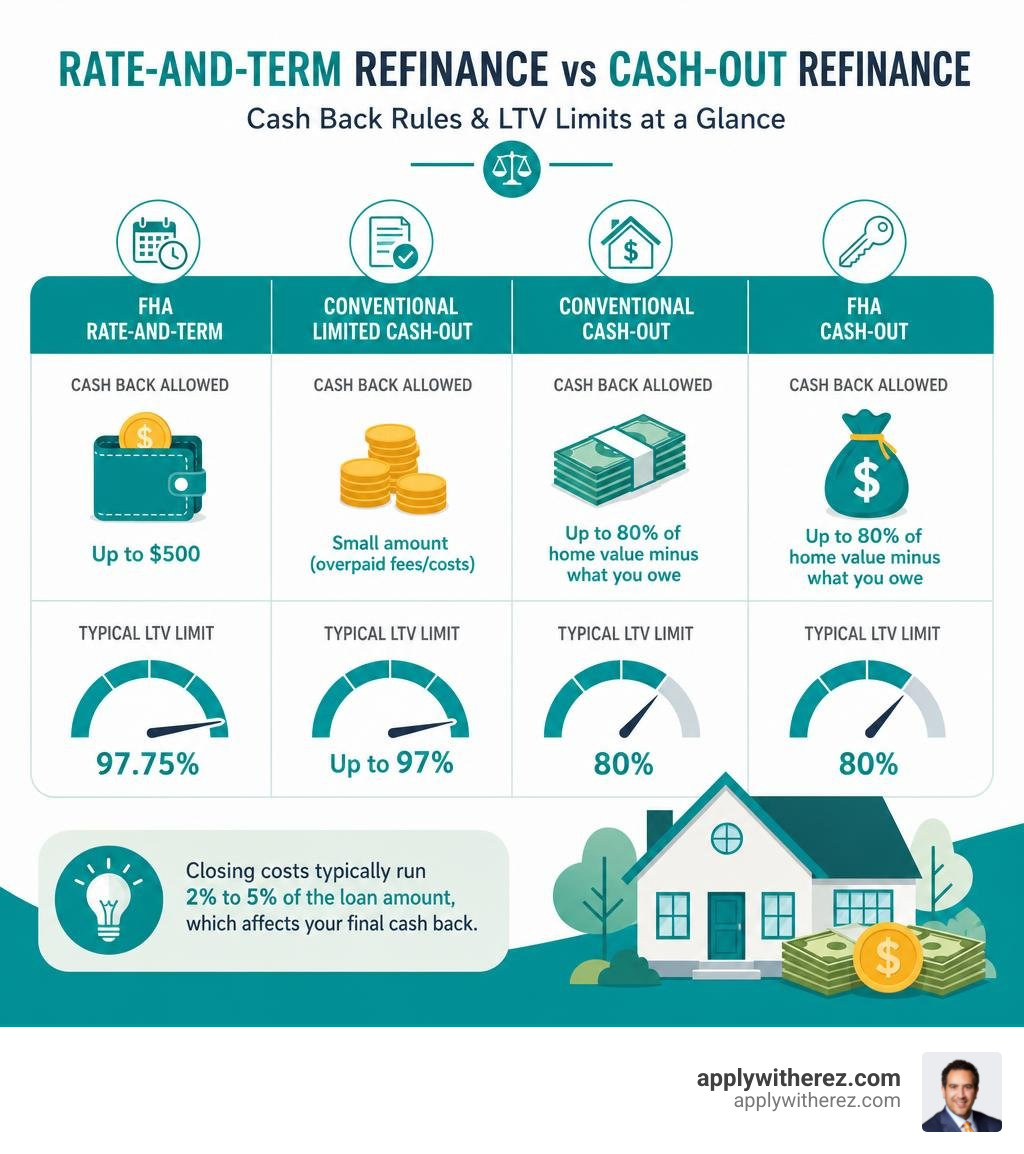
Refinance Type Cash Back Allowed Typical LTV Limit FHA Rate-and-Term Up to $500 97.75% Conventional Limited Cash-Out Small amount (overpaid fees/costs) Up to 97% Conventional Cash-Out Up to 80% of home value minus what you owe 80% FHA Cash-Out Up to 80% of home value minus what you owe 80%
The rules vary a lot depending on your loan type. An FHA rate-and-term refinance caps cash back at just $500. A full cash-out refinance, on the other hand, can put tens of thousands of dollars in your pocket — as long as you have enough equity and meet the lender's requirements.
Closing costs typically run 2% to 5% of the loan amount, so it's important to know how those factor into what you actually walk away with.
Whether you're trying to consolidate debt, fund a renovation, or just build some financial breathing room, understanding how this works before you apply can save you time, money, and surprises at the closing table.
I'm Erez Shimoni, a mortgage broker with 26 years of experience helping homeowners navigate options like the cash back at closing refinance — from understanding equity limits to comparing loan types side by side. I'll walk you through exactly how this works so you can make a confident, informed decision.
How a Cash Back at Closing Refinance Works
When you seek a cash back at closing refinance, you are essentially reorganizing your home's debt structure. Rather than just changing your interest rate, you are choosing to borrow more than your current outstanding mortgage balance.
According to industry resources, this transaction completely replaces your existing mortgage with a brand-new loan. This means your old loan is paid off in full, and you start fresh with a new interest rate, a new loan term, and a reset amortization schedule.
Because you are rewriting your loan's timeline, you will pay more interest in the early years of the new term, as the amortization schedule resets and prioritizes interest payments over principal reduction. However, the trade-off is immediate access to a lump sum of cash.
Depending on the loan program, you may encounter different terms for these transactions:
Cash-Out Refinance: A standard transaction where you purposefully borrow against your accumulated equity to receive a significant cash disbursement at closing.
Limited Cash-Out (or Rate-and-Term with minor cash back): A transaction designed primarily to improve your loan terms, where you are only permitted to receive a very small, restricted amount of cash back to cover minor mathematical overages or overpaid fees.
To learn more about how the mechanics of refinancing can work for your specific financial profile, check out this detailed guide.
Rate-and-Term vs. Cash-Out Refinancing
The choice between these two pathways comes down to your primary goal: do you want a lower payment, or do you need liquid capital?
Rate-and-Term Refinance: Often called a "no cash-out refinance," this option is used to secure a lower interest rate, change the loan term (such as moving from a 30-year to a 15-year mortgage), or convert an adjustable-rate mortgage (ARM) into a stable fixed-rate mortgage. You can learn more about these adjustments on our Refinance page. In this scenario, you do not walk away with a large pile of cash; any cash back is strictly limited to minor administrative refunds.
Cash-Out Refinance: This option allows you to leverage your home's appraised value to borrow up to 80% of its worth. The new loan pays off your existing mortgage, covers the transaction's closing costs, and provides the remaining balance directly to you in cash.
FHA Rules for a Cash Back at Closing Refinance
If your current or future loan is backed by the Federal Housing Administration (FHA), you must follow strict guidelines regarding cash disbursements.
According to official FHA Rules on Cash Back at Closing Time, the borrower may not receive cash back in excess of $500 on FHA rate-and-term refinance loans. This limit is designed to prevent borrowers from using a standard rate-and-term transaction as a backdoor cash-out loan without meeting stricter cash-out underwriting criteria.
If you choose an FHA streamline refinance (which allows you to refinance with minimal documentation and sometimes without a new appraisal), the mortgage amount is strictly limited. For streamline refinances without an appraisal, the new mortgage cannot exceed the original principal balance plus the Upfront Mortgage Insurance Premium (UFMIP), ensuring that no cash-back options are triggered.
Qualifying for Your New Mortgage
Lenders view cash-out transactions as higher risk than standard rate-and-term refinances. Because you are increasing your overall debt load, the underwriting process is thorough. Lenders will examine your debt-to-income (DTI) ratio, credit history, employment stability, and the length of time you have owned the home (seasoning requirements).

Eligibility Requirements for a Cash Back at Closing Refinance
To qualify for a cash back at closing refinance, you must meet several key benchmarks:
Credit Score: While standard refinances might allow lower scores, cash-out options typically require a minimum credit score of 620. To secure the most competitive interest rates, lenders generally prefer a score of 700 or higher.
Loan-to-Value (LTV) Limits: Most lenders generally allow you to borrow up to 80% of your home’s value with a cash-out refinance. This means you must leave at least 20% equity untouched in your home.
Debt-to-Income (DTI) Ratio: Your DTI ratio—the percentage of your gross monthly income that goes toward paying debts—should ideally remain at 36% or lower, though some lenders will allow up to 43% under strong qualifying circumstances.
Seasoning Requirements: Most conventional and FHA guidelines require you to have owned and occupied the property as your primary residence for at least 12 months before you can execute a cash-out refinance.
Occupancy Status: Primary residences offer the highest LTV limits and lowest rates. Vacation homes and investment properties typically carry stricter LTV caps (often 70% to 75%) and higher interest rates.
To calculate how much equity you can safely access based on your current home value and mortgage balance, try our Cash-Out Refinance Calculator.
Appraisal and Loan-to-Value (LTV) Calculations
Your maximum loan amount is directly tied to a professional home appraisal. If you believe your home is worth $500,000, but the appraiser values it at $450,000, your maximum cash-out limit will drop accordingly.
For example, let's look at the math on a conventional 80% LTV cash-out refinance:
Appraised Value: $400,000
Maximum Loan Amount (80% LTV): $320,000
Current Mortgage Balance: $220,000
Estimated Closing Costs (3%): $9,600
Potential Cash Back to You: $90,400 ($320,000 - $220,000 - $9,600)
If you have subordinate financing, such as a second mortgage or a home equity line of credit (HELOC), the lender will calculate your Combined Loan-to-Value (CLTV) ratio. For standard cash-out refinances, the CLTV must also fit within strict limits unless the subordinate lender agrees to re-subordinate their loan behind your new first mortgage.
Managing Closing Costs and Fees
Refinancing is not free. Closing costs for a cash-out refinance typically range from 2% to 5% of the loan amount. These fees cover the appraisal, title search, title insurance, lender origination charges, credit reports, and state recording fees. You will also need to fund a new escrow account for prepaid items like homeowners insurance and property taxes.
Rolling Closing Costs Into Your Loan
If you do not want to pay these expenses out of pocket at the closing table, you can choose to roll them into your new mortgage balance.
According to industry experts, financing these costs increases your total loan balance. While this preserves your liquid cash, it also means you will pay interest on those closing fees over the entire life of your mortgage.
Alternatively, you can look for a "no-closing-cost" option where the lender pays the closing costs in exchange for charging you a slightly higher interest rate. To compare your options, take a look at our guide on the Best Mortgage Refinance Companies with No Closing Costs.
Beyond rolling costs into the loan, some real estate programs offer credits or structured commission savings that can reduce upfront transaction costs. Programs like this commission savings program and this cash back realty service demonstrate how commission reductions can be applied as credits on a closing disclosure to reduce cash-to-close requirements during purchases.
Similarly, products like this cashback program or this cash back mortgage option highlight how cash-back incentives can provide post-closing financial flexibility, though these products often carry higher base interest rates or strict clawback terms if paid out early. For structured rewards programs, some real estate firms outline specific tiered closing credits in their rewards terms and conditions, showing how using affiliated services can offset transaction fees.
Documenting Subordinate Liens and Energy Improvements
If you are pursuing a conventional limited cash-out refinance (which allows higher LTV ratios than a standard cash-out loan), you cannot use the proceeds to pay off standard second mortgages.
However, Fannie Mae and Freddie Mac make exceptions if you can document that the subordinate lien was used entirely to purchase the property. You must provide the original settlement statement (Closing Disclosure) from when you bought the home to prove this.
Additionally, you can use a limited cash-out refinance to pay off energy-related debt, such as Property Assessed Clean Energy (PACE) loans. To do this, you must provide clear invoices and payoff statements showing the funds were used solely for energy-efficient home improvements.
Cash-Out Refinance vs. Home Equity Alternatives
Before you commit to replacing your primary mortgage, it is wise to compare a cash back at closing refinance with other ways to access your home's equity, such as a Home Equity Line of Credit (HELOC) or a Home Equity Loan.
Feature Cash-Out Refinance HELOC Home Equity Loan Loan Structure Replaces your first mortgage Second mortgage (line of credit) Second mortgage (lump sum) Interest Rate Fixed or adjustable Variable (tied to Prime Rate) Fixed Closing Costs High (2% to 5% of loan) None or very low Low to moderate Disbursement Lump sum at closing Draw as needed Lump sum at closing Amortization Resets (usually 15 or 30 years) 10-year draw / 20-year repay Fixed term (5 to 20 years)
A home equity line of credit (HELOC) usually has no (or relatively small) closing costs compared to a cash-out refinance, as noted in this comprehensive comparison. However, HELOCs typically feature variable interest rates, which means your monthly payment can fluctuate over time.
If you want to run the numbers to see which path makes the most sense for your monthly budget, check out Should You Refinance Your Mortgage? Use This Calculator To Find ... on YouTube.
Frequently Asked Questions About Cash-Back Refinancing
Are there tax implications for cash-back refinance proceeds?
Because the cash you receive from a refinance is considered borrowed money (debt) rather than earned income, it is tax-free cash at the time of receipt. You do not need to report it as income on your tax returns.
However, the rules for the mortgage interest deduction are strict. Under IRS guidelines, you can only deduct the interest on your refinanced mortgage up to the amount of your old loan balance, unless the cash-out proceeds were used specifically to buy, build, or substantially improve the home securing the loan (capital improvements). If you use the cash to pay off credit cards or buy a car, the interest on that portion of the loan is not tax-deductible.
How long does the cash-back refinance process take?
The typical processing timeline for a cash-back refinance ranges from 30 to 45 days from the initial application to final funding. This timeline includes pulling your credit, verifying your income documents, performing a professional home appraisal, and completing the underwriting review.
Once you sign your closing documents, federal law mandates a three-day right of rescission for primary residences. This means the lender cannot disburse your cash-back funds until three business days have passed, giving you a final window to cancel the transaction if you change your mind.
What are the alternatives if I don't qualify for a cash-back refinance?
If you do not have enough equity or do not meet the credit requirements for a cash-out refinance, you have other options:
Personal Loans: These are unsecured loans that do not require using your home as collateral, though they carry higher interest rates and shorter repayment terms.
VA Streamline Refinance (IRRRL): If you are a veteran with an existing VA loan, you can refinance to a lower rate with minimal documentation. You can check current market conditions at 30-Year VA Streamline Refinance Rates and find qualified lenders through our list of the Best VA Streamline Refinance Lenders. VA streamline refinances do not allow cash back at closing, but they can lower your monthly housing expenses significantly.
Conclusion
A cash back at closing refinance is a powerful tool to convert your hard-earned home equity into liquid cash. Whether your goal is to consolidate high-interest debt, fund home renovations, or establish a financial safety net, we are here to help you navigate the guidelines, calculate your equity limits, and find the right loan structure for your long-term goals.
Ready to explore your refinancing options? Contact us at applywitherez.com or visit our Refinance portal today to start your home equity evaluation.