
Stop guessing which loan is better for your equity
Which Loan Wins? Cash-Out Refinance vs Home Equity Loan, Explained
Quick Answer: Cash-Out Refinance vs Home Equity Loan
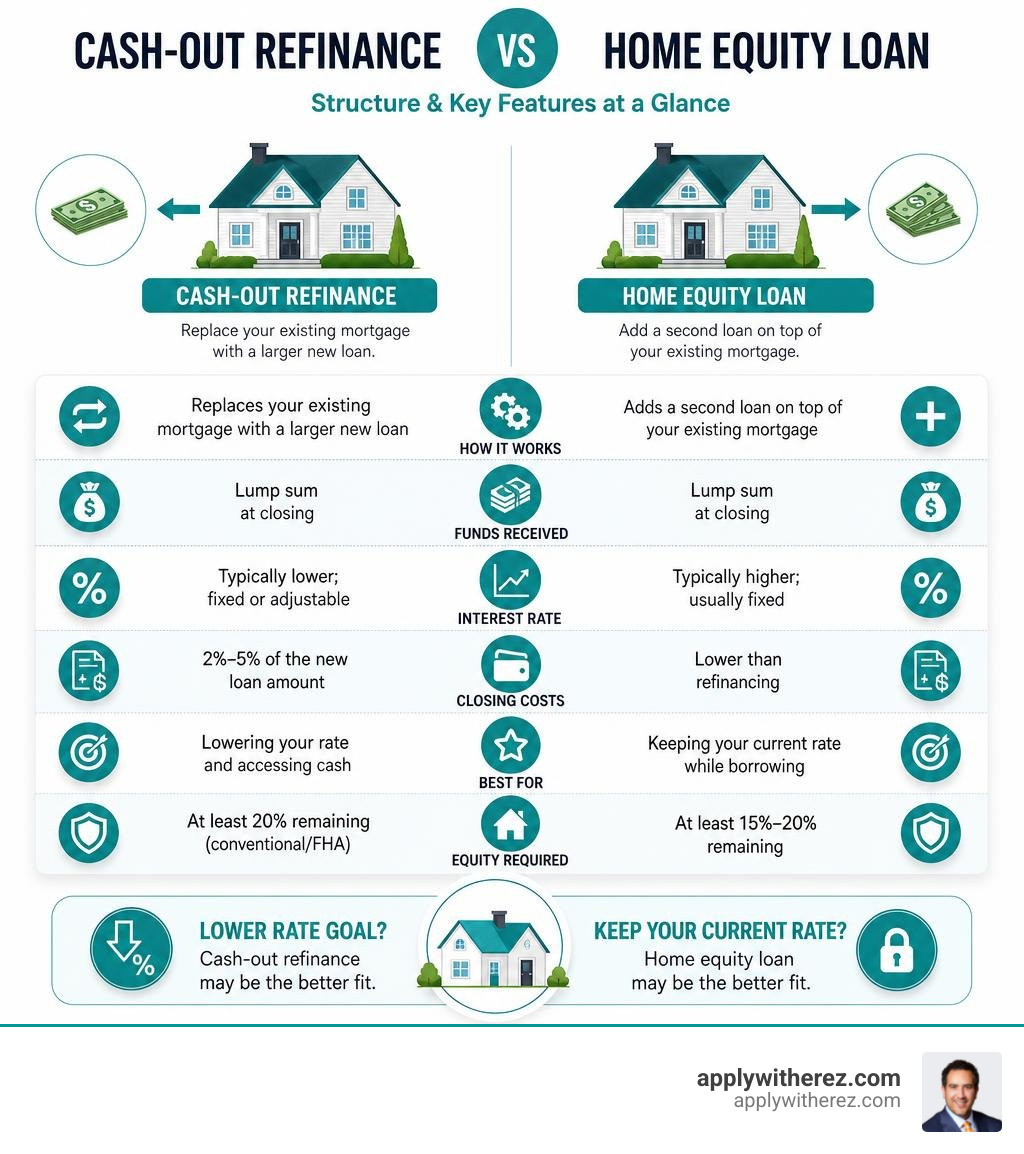
Feature Cash-Out Refinance Home Equity Loan How it works Replaces your existing mortgage with a larger new loan Adds a second loan on top of your existing mortgage Funds received Lump sum at closing Lump sum at closing Interest rate Typically lower; fixed or adjustable Typically higher; usually fixed Closing costs 2%–5% of the new loan amount Lower than refinancing Best for Lowering your rate and accessing cash Keeping your current rate while borrowing Equity required At least 20% remaining (conventional/FHA) At least 15%–20% remaining
When it comes to cash-out refinance vs home equity loan, most homeowners face the same problem: both options sound similar on the surface, but choosing the wrong one can cost you tens of thousands of dollars over the life of your loan.
Here's the core difference in plain English:
A cash-out refinance tears up your old mortgage and replaces it with a bigger one. You get the difference in cash.
A home equity loan sits on top of your existing mortgage as a second loan. Your original mortgage stays untouched.
Which one is better? It depends heavily on your current mortgage rate, how much you need to borrow, and what you plan to do with the money. This guide walks you through both options so you can make a confident decision.
I'm Erez Shimoni, a mortgage broker with 26 years of experience helping homeowners navigate decisions exactly like the cash-out refinance vs home equity loan comparison — and the right answer is rarely one-size-fits-all. Let's break it down so you can see clearly which path fits your situation.
Understanding Your Home Equity Options
Before we dive into the mechanics of each loan type, we need to understand what we are actually borrowing against. Your home equity is not just a vague financial concept; it is a real, tangible asset that represents the portion of your property you truly own free and clear.
Calculating your equity is straightforward. You take the current market value of your home and subtract the remaining balance on your mortgage. For example, if your home is worth $450,000 and you still owe $250,000 on your first mortgage, you have $200,000 in home equity.

To access this wealth without selling your home, you must borrow against it. This is where the battle of cash-out refinance vs home equity loan begins. Both products allow you to tap into this pool of funds, but they do so through entirely different structural pathways.
What is a Cash-Out Refinance and How Does It Work?
A cash-out refinance is a replacement loan. Instead of keeping your current first mortgage, you apply for an entirely new first mortgage that is larger than what you currently owe. The new mortgage pays off your old mortgage balance, and the remaining difference is paid to you as a lump-sum cash payment.
Let's look at how this works in practice. Suppose you have a $200,000 remaining balance on your mortgage, but your home is now worth $400,000. If you need $50,000 to renovate your kitchen or consolidate debt, you can refinance your first mortgage into a new loan of $250,000.
At closing, your original $200,000 mortgage is paid off and retired. The remaining $50,000 is paid directly to you. This is known as getting Cash Back at Closing Refinance. You are left with a single, larger monthly payment on a brand-new loan with its own set of terms, interest rate, and amortization schedule.
What is a Home Equity Loan and How Does It Work?
A home equity loan works differently because it does not alter your original mortgage. Instead, it is a second mortgage that sits behind your primary loan. You are taking out an entirely separate, closed-end loan using your home's equity as collateral.
When you take out a home equity loan, you receive your funds in a single lump-sum disbursement at closing. You then begin making fixed monthly payments on this second loan, completely independent of your first mortgage. This means you will have two separate mortgage payments to make each month: one for your original first mortgage, and one for your new home equity loan.
Because these loans sit in a secondary lien position, lenders take on slightly more risk. If you default on your payments and your home goes into foreclosure, the first mortgage holder is paid off first, and the second mortgage holder gets whatever is left. To learn more about how these structures operate under different borrowing conditions, explore our detailed breakdown of Cash-Out Refinance vs. Home Equity Loan.
The Core Battle: Cash-Out Refinance vs Home Equity Loan
Choosing between these two routes is not a matter of which loan is objectively "better" in a vacuum. It is about matching the structural design of the loan to your specific financial puzzle.
Here is a side-by-side comparison of how these two options stack up across key financial metrics:
Metric Cash-Out Refinance Home Equity Loan Lien Position First lien Second lien Number of Monthly Payments One Two Interest Rate Type Fixed or adjustable (usually fixed) Almost always fixed Maximum Loan-to-Value (LTV) Typically up to 80% Typically up to 80% to 85% Typical Closing Costs High (2% to 5% of the entire loan) Low to moderate Funding Speed Slow (30 to 45 days) Moderate (15 to 30 days)
Comparing Interest Rates: Cash-Out Refinance vs Home Equity Loan
Interest rates are where the "rate math" gets incredibly interesting—and where making the wrong choice can cost you a fortune.
As a general rule of thumb, cash-out refinances offer lower interest rates than home equity loans. This is because a cash-out refinance is a first mortgage, which represents less risk to the lender than a second mortgage.
However, looking only at the nominal interest rate of the new loan is a major trap. In the current rate environment of June 2026, many homeowners are holding onto historically low first-mortgage rates (sub-4%) locked in years ago.
If you have a $300,000 first mortgage at 3% and you need $50,000 in cash, doing a cash-out refinance means you must replace your entire $300,000 balance with a new, larger loan at today’s current market rates (which might be 6.5% or higher).
Replacing a 3% rate on a $300,000 balance with a 6.5% rate will cause your monthly payment to skyrocket and cost you over $100,000 in extra interest over the life of the loan. In this scenario, it is far cheaper to keep your 3% first mortgage untouched and take out a $50,000 home equity loan at 8%. Even though 8% is a higher rate, it only applies to the $50,000 you are borrowing, not your entire mortgage balance.
To run the exact numbers for your specific situation, you can use the Cash-Out Refinance Calculator to compare your current monthly payment against a new, consolidated loan.
Closing Costs, Fees, and Equity Limits
Another massive differentiator is the closing costs. A cash-out refinance behaves just like your original home purchase mortgage. You have to pay for a new appraisal, title search, title insurance, lender origination fees, and underwriting fees. These average refinance closing costs typically range from 2% to 5% of the entire refinance loan amount.
If you are refinancing a $300,000 mortgage to get $50,000 in cash, your closing costs will be calculated based on the full $350,000 loan amount. This can easily translate to $7,000 to $17,500 in upfront fees. You can read more about these expenses in our guide on the Average Closing Costs for Cash-Out Refinance.
In contrast, home equity loans generally have much lower closing costs. Because the loan amounts are smaller and the underwriting process is often streamlined, many lenders offer minimal fees, and some may even waive closing costs entirely in exchange for a slightly higher interest rate.
Equity limits also play a major role. For conventional and Federal Housing Administration (FHA) loans, you must leave at least 20% equity in your home after a cash-out refinance (meaning a maximum 80% Loan-to-Value ratio). Home equity loans sometimes allow you to borrow slightly deeper into your equity, occasionally capping out at 85% LTV depending on your credit score and debt-to-income ratio.
How to Choose Your Best Equity Option in 2026
Navigating the borrowing landscape in June 2026 requires a strategic approach. We have transitioned into an era where protecting your existing low-interest debt is a primary wealth-preservation strategy.

Deciding Between a Cash-Out Refinance vs Home Equity Loan
A cash-out refinance makes the most sense when your current first-mortgage interest rate is already close to, or higher than, today's current market rates.
For example, if you bought your home or refinanced during a high-rate period and your current mortgage rate is 7.25%, refinancing into a new cash-out loan at 6.25% is a double victory. You get to lower the interest rate on your primary mortgage while simultaneously walking away with a lump sum of cash for your needs.
This option is also ideal for major debt consolidation projects where you are combining multiple high-interest debts (like 24% APR credit cards) into a single, low-interest payment. To see how these paths align with your long-term financial goals, check out our resource on Refinancing vs Home Equity Loan.
When a Second Mortgage Makes More Sense
A home equity loan is almost always the superior choice when you are desperate to preserve an existing, below-market interest rate on your primary mortgage.
If your current first mortgage is sitting at 3% or 4%, do not touch it! Leaving that low-rate contract intact is incredibly valuable. By choosing a home equity loan instead, you isolate your higher interest rate to the new, smaller chunk of money you are borrowing.
Additionally, home equity loans are perfect for smaller, defined loan amounts (such as $25,000 to $75,000) where paying thousands of dollars in refinancing closing costs simply does not make financial sense. To compare these dynamics against revolving lines of credit, take a look at our analysis of HELOC vs Cash-Out Refinance.
Tax Implications and Risk Factors to Consider
Before signing on the dotted line, you must consider the risks and tax rules associated with both options.
Under current IRS guidelines, the interest paid on both cash-out refinances and home equity loans is only tax-deductible if the borrowed funds are used to "buy, build, or substantially improve" the home that secures the loan. If you use the cash to pay off credit cards, buy a car, or fund a wedding, that interest is not tax-deductible.
The primary risk of both products is foreclosure. Because both loans use your home as collateral, failing to make your payments means the lender can seize your property.
Furthermore, you must watch out for payment shock. Adding a second monthly payment via a home equity loan can strain your household budget if not carefully planned. To learn more about structuring your borrowing safely, read our guide on Choosing Your Best Equity Option.
Alternatives to Accessing Your Home Equity
If neither a cash-out refinance nor a traditional home equity loan feels like the right fit, don't worry. There are other financial paths available that can help you secure the funding you need without putting your primary mortgage at risk.
You can explore these options further by visiting our Blog Category Refinance to see how various alternative loan products compare.
Home Equity Lines of Credit (HELOCs)
A Home Equity Line of Credit (HELOC) is the most popular alternative. While a home equity loan gives you a lump sum of cash with a fixed interest rate, a HELOC works like a revolving credit card secured by your home.
HELOCs have two distinct phases:
The Draw Period: Usually lasting 10 years, during which you can borrow, repay, and borrow again up to your credit limit. Payments during this time are often interest-only.
The Repayment Period: Usually lasting 15 to 20 years, during which you can no longer draw funds and must pay back both principal and interest.
HELOCs typically have variable interest rates, meaning your monthly payment can fluctuate over time. The transition from the draw period to the repayment period can also cause severe repayment shock if you are not prepared for your monthly payment to jump significantly once principal amortization kicks in.
Frequently Asked Questions about Home Equity
Can I get a cash-out refinance if I already have a home equity loan?
Yes, you can. When you do a cash-out refinance, the new first mortgage is large enough to pay off both your original first mortgage and your existing home equity loan. They are consolidated into a single new loan, leaving you with one monthly payment.
How much equity must I leave in my home?
For conventional and FHA loans, you must leave at least 20% equity in your home (an 80% LTV limit). VA loans are a notable exception, as some lenders allow qualified veterans to cash out up to 90% or even 100% of their home's value, subject to credit and underwriting guidelines.
Is the interest on a home equity loan tax-deductible in 2026?
Yes, but only if the money is used directly to improve the home securing the loan (e.g., adding a deck, replacing the roof, or remodeling a kitchen) and you itemize your deductions on your tax return. We always recommend consulting with a certified tax professional to verify your eligibility.
Conclusion
Deciding between a cash-out refinance vs home equity loan doesn't have to be a guessing game. By looking closely at your current mortgage rate, calculating your closing costs, and understanding your long-term goals, the right choice usually becomes clear.
At applywitherez.com, we specialize in helping homeowners navigate these exact decisions with clear, personalized advice and no hidden surprises. If you're ready to stop guessing and start planning, Explore your refinancing options today and let us help you find the perfect match for your home equity.