
Cash Out and Clear Out Debt with a 15-Year VA Refi
How a 15-Year VA Cash-Out Refinance Can Help You Pay Off Debt Faster
A 15-year VA cash-out refinance gives eligible Veterans a way to tap their home equity and get a lump sum of cash — while paying off their mortgage in half the time of a standard 30-year loan.
Here's a quick summary of what this loan does:
Feature Details Who it's for Veterans, active-duty service members, and surviving spouses What it does Replaces your current mortgage with a new 15-year VA loan and gives you cash from your equity Max equity access Up to 100% LTV (most lenders cap at 90%–95%) Average cash out ~$81,000 (based on FY2025 VA data) Typical rate Low-to-mid 5% range for 15-year terms (June 2026) VA funding fee 2.15% (first use) or 3.30% (subsequent use) — waived for qualifying disabled Veterans Closing costs Typically 3%–5% of the loan amount Time to close 45–60 days on average
In June 2026, more Veterans are using this strategy than ever. According to VA data, 85,049 Veterans used a VA cash-out refinance in FY2025 — a 26.5% jump from the year before. Many are using the cash to wipe out high-interest credit card debt, auto loans, and other balances that drain their monthly income.
The 15-year version is a particularly powerful option for Veterans who want to:
Pay less interest over the life of the loan
Build equity faster
Clear debt and pay off their home sooner
But it comes with higher monthly payments than a 30-year loan. That trade-off is the core decision you need to understand before you apply.
I'm Erez Shimoni, a mortgage broker with 26 years of experience helping borrowers navigate complex decisions like the 15-year VA cash-out refinance — and I'll walk you through everything you need to know to make the right call. Let's start with the numbers and rules that matter most.
What Is a 15 year va cash out refinance and How Does It Work?
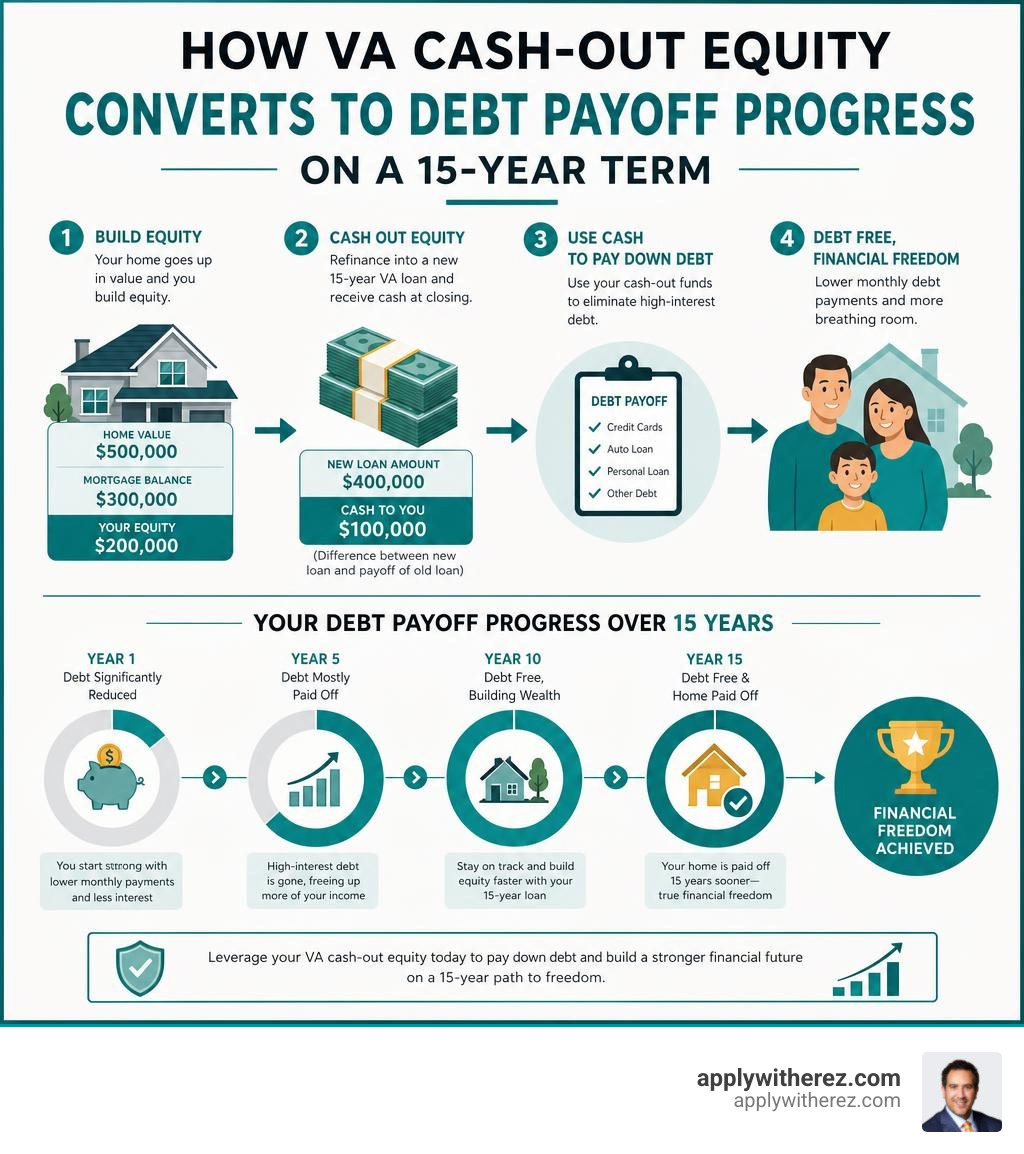
A 15-year VA cash-out refinance is a specialized mortgage option backed by the Department of Veterans Affairs. Unlike a standard refinance that only alters your interest rate or loan term, a cash-out refinance replaces your existing mortgage with an entirely new, larger loan. The difference between your old mortgage balance and the new loan amount is paid to you as a lump-sum cash payout at closing.
This program is highly versatile. You do not currently need to have a VA loan to use it. You can refinance an FHA, conventional, or USDA loan into a VA-backed mortgage.
The VA categorizes these refinances into two distinct types:
Type I Cash-Out: A refinance where the new loan amount (including the financed VA funding fee) does not exceed the payoff balance of your existing mortgage. This is often used to convert a conventional or FHA loan with high interest or costly private mortgage insurance (PMI) into a VA loan without extracting extra cash.
Type II Cash-Out: A refinance where the new loan amount exceeds your existing mortgage payoff balance, allowing you to walk away from the closing table with cash in hand.
Because the VA guarantees a portion of these loans, you do not have to pay monthly PMI, even if you borrow up to 100% of your home's appraised value. For more details on how these programs work, you can review the official VA cash-out loan overview or read More info about VA Home Loan options.
15 year va cash out refinance vs. 30-Year VA Cash-Out Refinance
The structural difference between a 15-year and a 30-year term comes down to amortization—how the loan is paid off over time.
With a 30-year term, your payments are spread out over 360 months. This keeps your monthly payment low, but because the principal is paid down so slowly, you pay a massive amount of interest over the life of the loan.
With a 15-year term, you compress that timeline into 180 months. The advantages are clear: you build equity at a rapid pace, slice your total interest costs by more than half, and achieve complete debt freedom in a fraction of the time. This timeline aligns perfectly with long-term retirement planning, allowing you to enter retirement without a monthly mortgage payment hanging over your head.
The trade-off is your monthly budget. Because you are compressing 30 years of principal payments into 15, your monthly mortgage payment will be significantly higher.
How Cash-Out Funds Can Help Clear High-Interest Debt
Carrying high-interest debt like credit cards, personal loans, or high-rate auto loans can severely limit your monthly cash flow. A 15-year VA cash-out refinance allows you to leverage your home equity to consolidate these debts.
By using your lump-sum payout to pay off credit cards carrying 18% to 24% interest, you swap that high-rate unsecured debt for a mortgage rate in the low-to-mid 5s. This "interest rate spread" can save you hundreds, if not thousands, of dollars every single month.
However, we must emphasize financial discipline. Consolidating unsecured debt (like credit cards) into a secured debt (your home) means you are putting your property on the line. If you fail to make your new, higher mortgage payment, you risk foreclosure. This strategy only works if you commit to keeping your credit cards clear of new balances and use your recovered monthly cash flow to build strong emergency reserves.
2026 Rates, Payments, and Total Interest: 15-Year vs. 30-Year
Interest rates are a moving target, but the relationship between 15-year and 30-year rates remains consistent. Shorter-term loans represent less risk to lenders, which means 15-year terms almost always carry lower interest rates than their 30-year counterparts.
When analyzing refinance offers, pay close attention to the Annual Percentage Rate (APR). While the nominal interest rate is the base cost of borrowing, the APR reflects the total cost of the loan, including lender fees, discount points, and the VA funding fee. For current rate trends, you can explore More info about 15 Year VA Mortgage Rates.
Current 15 year va cash out refinance Rates in June 2026
As of June 2026, standard 30-year VA cash-out rates generally hover in the 6.25% to 6.9% range, depending on market conditions and the borrower's credit profile. By contrast, 15-year VA cash-out refinance rates are sitting comfortably in the low-to-mid 5% range (typically 5.125% to 5.75%).
While market volatility affects everyday pricing, locking in a 15-year term is a reliable way to secure a lower interest rate. To get the best rate, you'll need a strong credit score and a manageable debt-to-income (DTI) ratio. Lenders also look closely at your loan-to-value (LTV) ratio, with lower LTVs often qualifying for slightly better pricing.
Monthly Payment and Lifetime Interest Example
To see the real-world impact of choosing a 15-year term over a 30-year term, let's look at a concrete example.
Imagine you need a new loan amount of $350,000 (which includes paying off your old mortgage, taking out cash, and covering closing costs).
Loan Term Interest Rate Monthly Principal & Interest (P&I) Total Interest Paid Over Loan Life 30-Year Fixed 6.25% $2,155 $425,800 15-Year Fixed 5.125% $2,791 $152,380 The Difference -1.125% +$636 / month -$273,420
By choosing the 15-year option, your monthly payment increases by $636. However, you save a staggering $273,420 in interest costs over the life of the loan. Furthermore, your principal builds up immediately. By year five, you will have paid down a massive chunk of your mortgage balance, whereas a 30-year borrower will have barely made a dent in theirs.
When the Higher 15-Year Payment Is Worth It
The higher monthly payment of a 15-year term is highly beneficial under the right financial conditions. It is worth it if:
You have stable, predictable income: You need to be highly confident that you can comfortably afford the larger payment even if you experience temporary financial setbacks.
Your primary goal is long-term wealth building: If you want to eliminate the interest drag on your net worth, paying off the loan in 15 years is the fastest way to do so.
You are planning for retirement: Removing your mortgage payment before you exit the workforce dramatically reduces your required retirement income, making your nest egg last much longer.
Eligibility, VA Rules, and Lender Requirements
To qualify for a 15-year VA cash-out refinance, you must satisfy two sets of rules: those established by the Department of Veterans Affairs and those enforced by your individual mortgage lender (known as lender overlays). For a deep dive into these regulations, you can read the VA cash-out refinance policy clarification.
VA Eligibility Requirements
The baseline eligibility requirements for a VA cash-out loan are identical to those of a VA purchase loan:
Service Requirements: You must be an eligible Veteran, active-duty service member, National Guard member, Reserve member, or qualifying surviving spouse.
Certificate of Eligibility (COE): You must obtain your COE to prove your entitlement status to your lender.
Occupancy: The property being refinanced must be your primary residence. You cannot use a VA cash-out refinance on an investment property or a second home that you do not actively occupy.
Lender-Specific Requirements
While the VA itself does not set a minimum credit score or maximum debt-to-income ratio, private mortgage lenders do.
Credit Score: Most VA lenders look for a minimum credit score of 620, though some specialized lenders may accept scores down to 580 with strong compensating factors.
DTI Ratio: Lenders prefer a DTI ratio below 41%, but they will go higher if you have significant "residual income"—the cash left over each month after paying all major expenses, adjusted for your family size and geographic region.
Appraisal: A full VA home appraisal is mandatory. The home must meet the VA's Minimum Property Requirements (MPRs) regarding safety, soundness, and structural integrity.
Seasoning, Net Tangible Benefit, and Recoupment Rules
To protect Veterans from predatory refinancing practices, the VA enforces strict seasoning and benefit rules:
The 210-Day Seasoning Rule: Your current mortgage must be seasoned for at least 210 days from the date of your first monthly payment, and you must have made at least six consecutive on-time payments before you can close on a refinance.
Net Tangible Benefit (NTB) Test: The lender must demonstrate that the refinance provides a clear financial benefit to you. This could include lowering your interest rate, converting an adjustable-rate mortgage (ARM) to a fixed-rate loan, or helping you eliminate high-interest debt.
Recoupment Period: For Type I refinances, any fees and closing costs associated with the transaction must be recouped through your monthly savings within 36 months.
Costs, Cash Access, LTV, and Entitlement Impact
Before proceeding, you must evaluate the fees associated with a cash-out refinance and how the transaction affects your home equity. For a broader look at your options, you can read More info about refinance options.

Typical Closing Costs and VA Funding Fee
Refinancing is not free. Closing costs typically range from 3% to 5% of the total loan amount. These costs include third-party fees such as the VA appraisal ($500–$800), title insurance, escrow setup, and lender origination fees.
Additionally, unless you are exempt, you must pay the VA funding fee:
First-Time Use: 2.15% of the loan amount.
Subsequent Use: 3.30% of the loan amount.
Exemption Note: If you receive VA disability compensation for a service-connected condition (even a 10% rating), or if you are an active-duty Purple Heart recipient, the VA funding fee is waived entirely. This can save you thousands of dollars upfront.
Most lenders allow you to roll these closing costs and the funding fee into your new loan balance, meaning you don't have to pay them out of pocket at closing. However, doing so reduces the net cash you receive from your equity.
How Much Equity You Can Access
While the VA theoretically allows cash-out loans up to 100% of your home's appraised value, most private lenders impose their own overlays, capping the maximum loan-to-value (LTV) ratio at 90% or 95% to manage risk.
For example, if your home appraises for $400,000, a lender capping LTV at 90% will limit your maximum loan size to $360,000. If your existing mortgage payoff is $250,000 and your closing costs are $10,000, the maximum cash available to you at closing would be $100,000 ($360,000 new loan - $250,000 payoff - $10,000 costs). To run your own numbers, check out More info about using a mortgage calculator.
How a VA Cash-Out Refinance Affects Entitlement and Long-Term Goals
Your VA loan entitlement is the dollar amount the VA guarantees to your lender. When you close a VA cash-out refinance, your entitlement is tied up in your new home loan.
If you plan to buy another home in the future using a VA loan, your remaining entitlement may be limited unless you pay off this mortgage or sell the home to restore your entitlement. It is crucial to view your 15-year VA cash-out refinance as a long-term strategy that aligns with your broader financial plans, including your retirement horizon and liquidity needs.
How to Use a 15-Year VA Cash-Out Refi to Clear Debt Step by Step
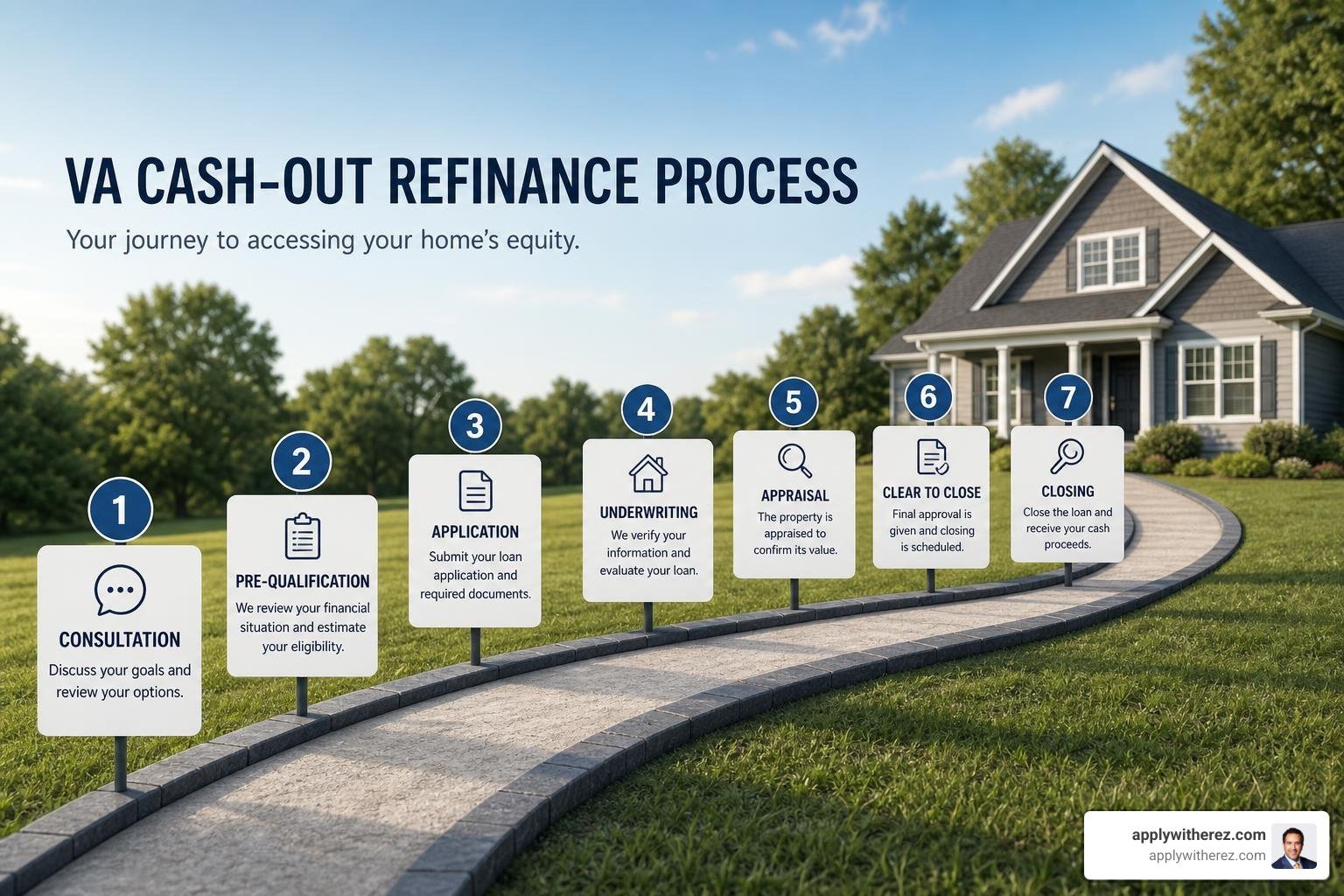
Using your home equity to eliminate high-interest debt requires a systematic approach. Follow this step-by-step process to execute a successful debt-consolidation strategy.
Step 1: Run the Debt-Payoff Math Before You Apply
Do not guess your numbers. Sit down and list every high-interest debt you want to pay off. Write down the current balance, the interest rate, and your minimum monthly payment for each.
Add up those balances to determine your total cash need. Then, compare your current total monthly debt payments (including your current mortgage) against what your new 15-year mortgage payment will be. If the new 15-year payment is lower than the sum of your old payments, you will instantly improve your monthly cash flow while accelerating your path to a mortgage-free life.
Step 2: Compare Loan Estimates and Confirm the Net Benefit
Once you know how much equity you need to extract, shop around. We highly recommend gathering at least three different loan estimates. Look closely at the interest rates, lender fees, and APR.
Verify that the lender has correctly calculated your recoupment period and applied your funding fee waiver if you are eligible. Choose the offer that provides the cleanest path to debt consolidation with the lowest overall transaction costs.
Step 3: Apply, Appraise, Underwrite, and Close
After selecting your lender, submit your formal application. You will need to provide:
Your Certificate of Eligibility (COE)
Recent pay stubs and W-2s (or tax returns if self-employed)
Recent bank statements
Your current mortgage statement and statements for the debts you intend to pay off
The lender will order a VA appraisal to confirm your home's value and safety. Once the underwriting team approves your file, you will attend closing. For primary residences, there is a mandatory three-day right of rescission. This means the lender cannot disburse your cash until three business days after you sign the final closing documents, giving you a brief window to cancel the transaction if you change your mind.
Best Uses for Cash from a 15-Year VA Cash-Out Refi
To maximize the long-term wealth benefits of this loan, your extracted cash should be directed toward high-yield or debt-reducing purposes:
Consolidating High-Rate Credit Cards: Instantly stop paying 20%+ interest rates.
Paying Off Auto and Personal Loans: Eliminate intermediate-term monthly payment drains.
Financing Home Improvements: Invest in renovations that increase your home's market value.
Converting Non-VA Mortgages: Eliminate expensive FHA mortgage insurance premiums (MIP).
Building an Emergency Fund: Keep a portion of your cash in a liquid, high-yield savings account to avoid future credit card reliance.
Pros, Cons, and Alternatives to a 15-Year VA Cash-Out Refinance
While a 15-year cash-out refinance is a phenomenal tool, it is not the perfect fit for every Veteran. You must weigh the benefits against the drawbacks and compare alternative pathways.
When a 15 year va cash out refinance Beats the 30-Year Option
The 15-year term is vastly superior when your primary financial objective is saving money over the long term. If you have stable, robust income and want to pay the absolute lowest interest rate possible, the 15-year term is your best choice. It forces a disciplined savings plan by quickly building home equity and guarantees that you will own your home free and clear in 15 years, giving you unmatched financial security.
When a 15 year va cash out refinance May Be the Wrong Move
This strategy may backfire if your monthly budget is already tight. If the higher monthly payment leaves you "house poor" with little cash left over for monthly living expenses, you are taking on too much risk.
Additionally, if you currently hold an incredibly low interest rate from a few years ago (such as 2.5% or 3%), refinancing your entire mortgage balance into a 5% rate just to access a small amount of cash is mathematically unwise. In that scenario, the increased interest cost on your primary balance will likely outweigh the savings from consolidating your other debts.
Alternatives Veterans Should Compare First
If a 15-year cash-out refinance doesn't align with your situation, consider these alternatives:
VA IRRRL (Streamline Refinance): If you already have a VA loan and want a lower interest rate without extracting cash, an IRRRL is much faster, cheaper, and does not require an appraisal. For rate comparisons, see More info about 30 Year VA Streamline Refinance Rates and More info about VA streamline lenders.
Conventional Cash-Out Refinance: If you have substantial equity (LTV below 80%) and are exempt from the VA funding fee, a conventional loan might occasionally offer a simpler process, though VA rates are generally lower.
Home Equity Line of Credit (HELOC): If you want to keep your current low mortgage rate intact, a HELOC allows you to borrow against your equity as a second mortgage, though interest rates on HELOCs are typically higher and adjustable.
Reverse Mortgage: For Veterans aged 62 or older who want to eliminate monthly payments entirely while accessing equity, a reverse mortgage is a highly specialized alternative. Read More info about Reverse Mortgage options.
Frequently Asked Questions About 15-Year VA Cash-Out Refinancing
Can You Get 100% LTV on a VA Cash-Out Refinance?
Yes, the VA guidelines allow borrowers to refinance up to 100% of their home's appraised value. However, keep in mind that many individual lenders enforce overlays that limit the maximum LTV to 90% or 95%. When you borrow up to the maximum limit, any financed VA funding fee will be added to your loan balance, which can push your total loan-to-value ratio slightly over 100%.
Do You Need an Appraisal for a VA Cash-Out Refinance?
Yes. Unlike the VA IRRRL (Streamline), a cash-out refinance always requires a full VA appraisal. There are no appraisal waivers. The appraiser must verify the current fair market value of your property to determine how much equity is available for you to borrow, and they must confirm that the home meets the VA's Minimum Property Requirements.
Do You Have to Take Cash Out with a VA Cash-Out Refinance?
No, you do not have to walk away with actual cash. A Type I VA cash-out refinance can be used simply to convert a non-VA loan (like a conventional loan with expensive private mortgage insurance) into a VA loan. This allows you to eliminate monthly mortgage insurance and secure a lower rate without extracting any physical cash from your equity.
Conclusion
A 15-year VA cash-out refinance is one of the most effective financial tools available to Veterans who want to take control of their financial future in June 2026. By swapping high-interest credit card debt for a low-rate, 15-year mortgage, you can save hundreds of thousands of dollars in lifetime interest and clear your path to total debt freedom.
However, the key to success is careful planning. You must ensure that the higher monthly payment fits comfortably within your household budget and that you commit to avoiding new debt once your credit cards are cleared.
If you are ready to explore your options, run the numbers, and compare lender rates, we are here to help you navigate every step of the process. Start your refinance review with us today and take your first step toward a mortgage-free future.