
Why Cash Out? Key Benefits of Refinancing Your Mortgage
Why the Benefits of Cash Out Refinance Matter for Homeowners
The benefits of cash out refinance can be significant — but only if you understand exactly what you're getting into. Here's a quick summary:
Top benefits of a cash-out refinance:
Access a large lump sum — borrow against your home equity at mortgage rates, not credit card rates
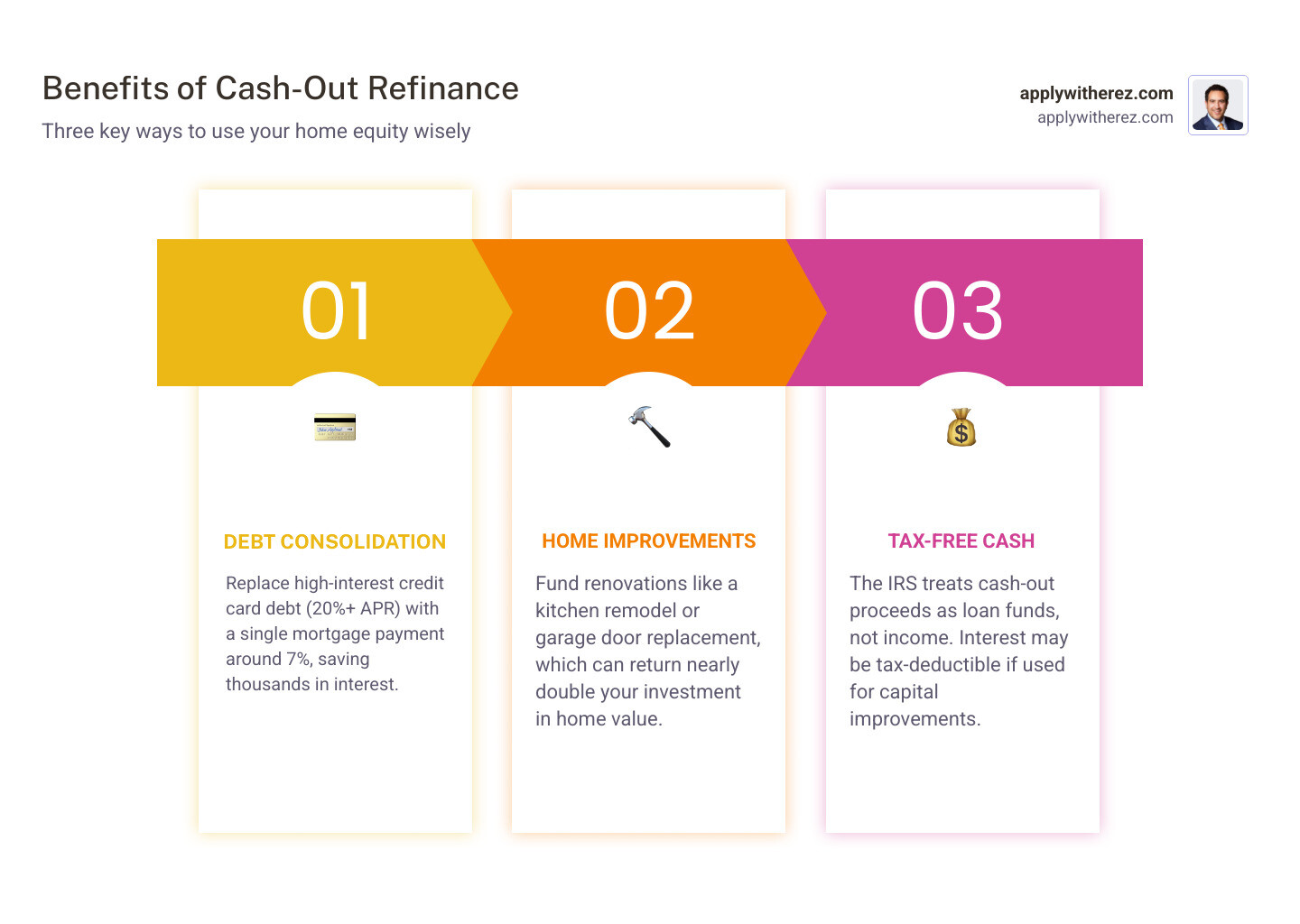
Consolidate high-interest debt — replace 20%+ APR credit card debt with a single mortgage payment around 7%
Fund home improvements — upgrades like a garage door replacement can return nearly twice what you spend
Potential tax deductions — interest may be deductible if funds are used for home improvements
Predictable fixed payments — unlike a variable-rate line of credit, your payment stays the same
Tax-free cash — the IRS treats cash-out proceeds as loan funds, not income
Of course, the strategy isn't right for everyone. Your current mortgage rate, how you plan to use the funds, and your long-term plans for the home all affect whether a cash-out refinance makes sense.
This guide breaks down the real pros, the real risks, and how to decide if it's the right move for you.
I'm Erez Shimoni, a licensed mortgage broker with 26 years of experience helping homeowners evaluate the benefits of cash out refinance and find the right loan structure for their goals. I've guided hundreds of borrowers through this exact decision — and I'll walk you through what most lenders won't tell you upfront.
What Is a Cash-Out Refinance and How Does It Work?
To truly appreciate the benefits of cash out refinance, we first have to understand the basic mechanics. Many homeowners confuse a cash-out refinance with a second mortgage, but they are structurally quite different.
A cash-out refinance is a brand-new first mortgage. Instead of keeping your current home loan and taking out a separate line of credit on the side, you replace your existing mortgage entirely with a new, larger loan. At closing, your new loan pays off your old mortgage balance, covers your closing costs, and hands you the remaining difference as a lump sum of cold, hard cash.
Let’s look at a simple hypothetical scenario to see how this works in action. Imagine your home is currently valued at $400,000, and you still owe $200,000 on your existing mortgage. This means you have built up $200,000 in home equity.
Lenders generally limit you to a maximum loan-to-value (LTV) ratio of 80% for conventional cash-out refinances. This safety margin ensures you maintain a 20% equity cushion in your home.
Using the 80% LTV rule, we can calculate your maximum borrowable amount:
Current Home Value: $400,000
Maximum Loan Amount (80% LTV): $320,000
Minus Your Existing Mortgage Balance: -$200,000
Maximum Cash Available (Before Closing Costs): $120,000
Before you can jump into this process, you must meet the lender's loan seasoning requirement. Most conventional lenders require you to have held your original mortgage for at least six months (and sometimes up to a full year) before they will allow you to tap into your equity. If you meet this requirement, you are ready to take the next step. For a complete breakdown of this journey, check out our Step-by-step cash-out refinance guide.
The Financial Benefits of Cash Out Refinance
Why do so many homeowners choose this path? The primary reason is that cash-out refinances are first mortgages. Because first mortgages hold the primary lien position on your home, lenders view them as much lower risk than second mortgages (like HELOCs or home equity loans) or unsecured personal loans.
This lower risk translates directly into lower interest rates for you. While cash-out borrowers typically pay an average rate premium of 0.25% to 0.50% higher than comparable rate-and-term refinances, these rates are still significantly lower than almost any other borrowing method on the market.
To explore current rate trends and how they impact your borrowing power, take a look at this comprehensive Guide to cash-out refinance rates and benefits.

Beyond securing a lower rate than credit cards or personal loans, a cash-out refinance provides long-term predictability. If you refinance into a fixed-rate mortgage, your monthly principal and interest payments will remain exactly the same for the entire life of the loan. This is a massive advantage over variable-rate options, which can leave you vulnerable to sudden payment shocks if market rates climb.
Let’s dive deeper into the two most popular ways homeowners maximize these benefits.
Debt Consolidation: The Primary Benefits of Cash Out Refinance
In 2025, a staggering 64% of all cash-out refinance volume was used for either debt consolidation or home improvements. It is easy to see why. As we navigate 2026, the average credit card interest rate continues to hover above 22% APR, making revolving debt incredibly expensive to carry.
By converting high-interest credit card debt or personal loans into secured mortgage debt, you can save a fortune. For example, a cash-out refinance can save you $6,000 per year in interest on $40,000 in credit card debt at 22% APR by converting it to mortgage debt at 7%.
In addition to the massive interest savings, consolidating your debt can give your credit score a major boost. When you pay off multiple credit cards, you dramatically lower your credit utilization rate, which is one of the most heavily weighted factors in your credit score. If you want to see how these funds are distributed at the closing table, read our guide on How to get cash back at closing.
However, we always like to share a word of caution with our clients. Consolidating debt only works if you address the underlying spending habits that caused the debt in the first place. Industry data shows that 29% of borrowers who consolidate debt through a refinance end up with the same or higher credit card balances within 3 years. We want to help you build wealth, not fall back into the cycle of high-interest borrowing!
Home Improvements: Maximizing the Benefits of Cash Out Refinance
Using your home equity to reinvest in your property is one of the smartest financial moves you can make. Not only does it make your living space more comfortable, but it can also substantially increase your home’s market value.
But not all home renovations are created equal. If you want to maximize your return on investment (ROI), you should target high-impact upgrades. For instance, home improvement data reveals that a minor kitchen remodel has a 96% ROI, while a garage door replacement has a spectacular 194% ROI.
Furthermore, using your cash-out funds for capital improvements can unlock valuable tax advantages. Under current IRS rules, the interest you pay on your refinanced mortgage is only tax-deductible if the funds are used specifically to buy, build, or substantially improve the home that secures the loan. If you use the cash to pay off credit cards or buy a car, you lose that deduction.
Cash-Out Refinance vs. HELOC vs. Home Equity Loan
If you want to tap into your home's equity, a cash-out refinance is not your only path. You can also look into second mortgages, such as a Home Equity Line of Credit (HELOC) or a Home Equity Loan.
The right choice depends on your current mortgage rate, how much money you need, and how you plan to spend it. To help you compare your options, we've put together a quick breakdown:
Feature Cash-Out Refinance Home Equity Loan HELOC Lien Position First Mortgage (Replaces old loan) Second Mortgage (Kept separate) Second Mortgage (Kept separate) Interest Rate Fixed (Typically lowest rate) Fixed (Slightly higher than first) Variable (Fluctuates with prime rate) Payout Structure One-time lump sum One-time lump sum Revolving line of credit Closing Costs 2% to 5% of new loan amount 2% to 5% of equity loan amount Low or no upfront costs Best For... Large lump sums & rate preservation Preserving a very low first mortgage rate Ongoing, multi-year expenses
If you currently hold an incredibly low interest rate on your primary mortgage (for example, a sub-4% rate from a few years ago), replacing it with a brand-new cash-out refinance at today's rates might not make financial sense. In that scenario, keeping your low first mortgage intact and adding a second mortgage is usually the better move. For a detailed comparison of these strategies, explore our Cash-out refinance vs home equity loan comparison.
Requirements, Costs, and Risks to Consider
While the benefits of cash out refinance are highly appealing, we believe in complete financial transparency. Tapping into your home equity comes with real costs and risks that you must carefully evaluate.
First, let’s talk qualifications. To secure a conventional cash-out refinance, you will generally need:
Credit Score: A minimum credit score of 620 (though scores of 740+ will unlock the best rates).
Debt-to-Income (DTI) Ratio: A maximum DTI of 43% (your total monthly debt payments, including your new mortgage, divided by your gross monthly income).
Equity Cushion: You must leave at least 20% equity in your home post-refinance.
Second, you must prepare for closing costs. Just like your original mortgage, a cash-out refinance requires underwriting, title searches, and home appraisals. Closing costs for a cash-out refinance typically range from 2% to 5% of the total loan amount. On a $300,000 loan, that means you could pay between $6,000 and $15,000 in upfront fees. You can learn more about how these fees are calculated in our guide on Average closing costs for cash-out refinance.

Finally, keep the "amortization reset" and foreclosure risks in mind. When you refinance into a new 30-year mortgage, you reset the clock. Even if you've been paying off your home for 10 years, you will start back at Year 1, where your monthly payments go almost entirely toward interest rather than principal.
Most importantly, a cash-out refinance converts unsecured debt (like credit cards) into secured debt. If you default on a credit card, the bank cannot take your home. If you default on your refinanced mortgage, you risk foreclosure.
Frequently Asked Questions About Cash-Out Refinancing
To help you make an informed decision, we have answered some of the most common questions we hear from homeowners.
How much cash can I get from a cash-out refinance?
The exact amount of cash you can walk away with depends on your home’s current market value, your outstanding mortgage balance, and the specific loan program you choose.
Most conventional and FHA loans cap your maximum loan-to-value (LTV) ratio at 80%. VA loans are highly flexible and may allow eligible veterans to borrow up to 90% or even 100% of their home's value, depending on the lender. To run the numbers for your unique situation, you can use our Calculate your cash-out potential tool.
How long does a cash-out refinance take to close?
A cash-out refinance typically takes 30 to 45 days to close. This timeline depends on how quickly your lender can verify your income, complete the underwriting process, and schedule a home appraisal to confirm your property's value.
Once you sign the final paperwork at the closing table, federal law mandates a three-business-day right of rescission. This cooling-off period gives you the right to cancel the loan if you change your mind. Your funds will be safely disbursed on the fourth business day.
Are there tax benefits to a cash-out refinance?
The cash you receive from a cash-out refinance is not considered taxable income because the IRS views it as a loan, not earnings.
However, the deductibility of the mortgage interest depends entirely on how you spend the cash. If you use the funds to buy, build, or substantially improve the home securing the loan, the interest is generally tax-deductible (up to IRS limits). If you use it to consolidate debt, pay for college, or go on vacation, that portion of the interest is not deductible. For a deeper look at these rules, read about the Tax implications of cash-out refinancing.
Conclusion
A cash-out refinance is a powerful financial tool that can help you achieve your long-term goals, whether that means wiping out high-interest credit card debt, building your dream kitchen, or reinvesting in your family's future.
However, because your home serves as collateral, this strategy requires careful planning, a clear budget, and professional guidance. At applywitherez.com, we are committed to helping you evaluate your home equity options honestly and transparently, ensuring you make the absolute best move for your financial health.
Ready to see what your home equity can do for you? Explore your refinancing options with Erez today, or visit us at our office at 26 Wills Way. We look forward to helping you make your home equity work for you!