
Demystifying the Cash-Out Refinance Process
What Is Cashing Out in Finance — and Should You Do It?
Cashing out in finance means converting the equity you've built in your home into spendable cash — by replacing your current mortgage with a new, larger one and receiving the difference at closing.
Here's the quick version of how it works:
Step What Happens 1. You own a home with equity Your home is worth more than you owe 2. You apply for a cash-out refinance A lender replaces your old mortgage with a bigger one 3. You receive the difference in cash That money lands in your account at closing 4. You repay the new, larger loan Over a new loan term, typically 15 or 30 years
The cash you receive is not taxable income — it's a loan against your home's equity. Most lenders let you borrow up to 80% of your home's value, minus what you still owe.
Example: If your home is worth $300,000 and you owe $100,000, your maximum new loan could be $240,000 — putting up to $140,000 cash in your pocket.
People use that cash for:
Home renovations
Paying off high-interest debt
College tuition
Emergency funds or investments
But it's not a decision to take lightly. You're borrowing more, your monthly payment may rise, and your home is on the line if you can't repay.
I'm Erez Shimoni, a mortgage broker with 26 years of experience helping homeowners navigate cashing out in finance — from calculating equity to closing day. In this guide, I'll walk you through everything you need to make a confident, informed decision.
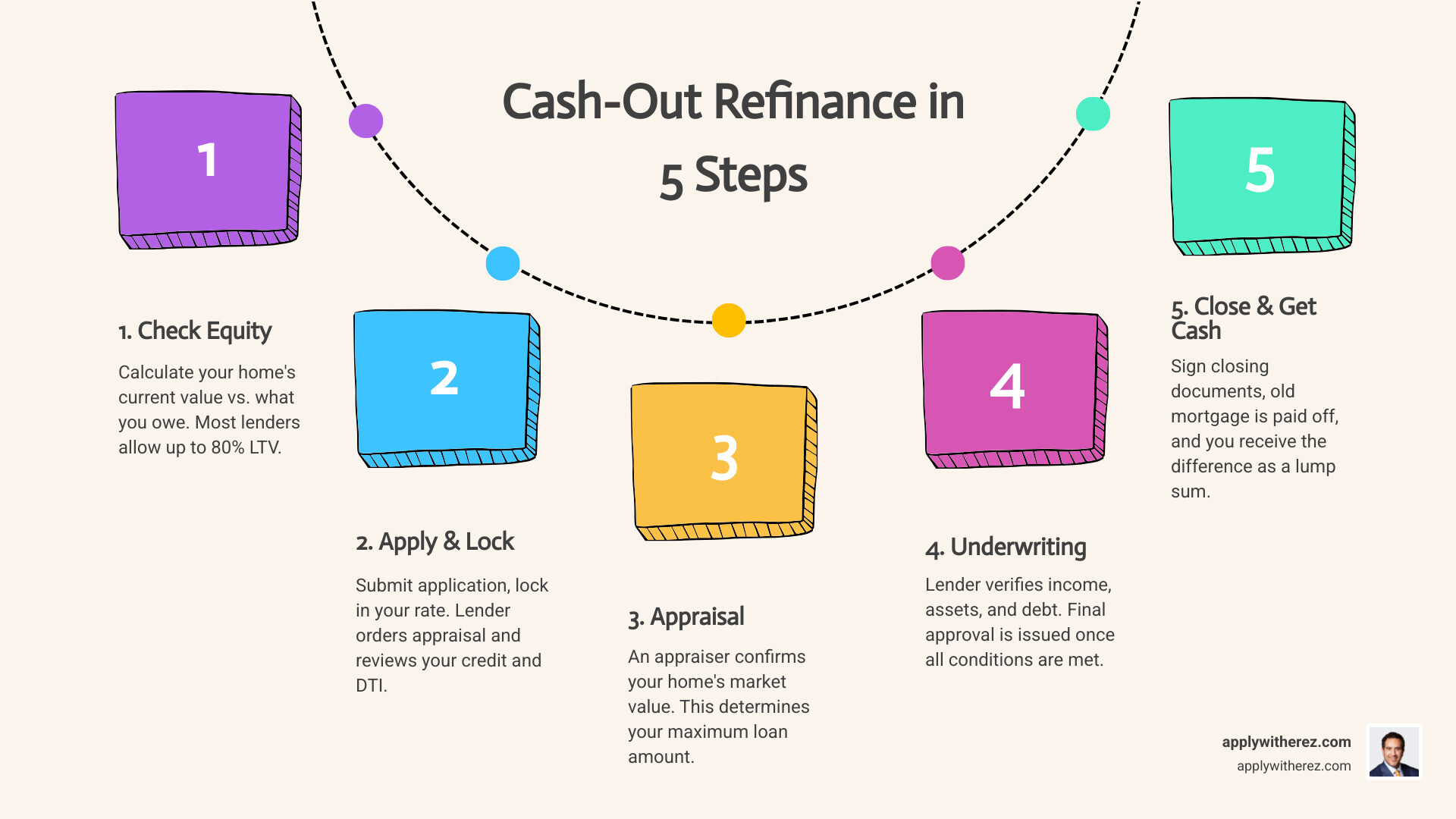
Understanding Cashing Out Finance: What It Means for Homeowners
When we look up the literal definition of this phrase, the CASH OUT STH | English meaning - Cambridge Dictionary points to converting non-liquid assets or stakes into liquid money. In the broader financial world, cashing out can apply to various assets. For instance, an investor might sell their stocks to realize profits, or a crypto enthusiast might look into How to Cash Out Crypto Earnings in 2026: Full Guide | FT Games Blog or research How to Cash Out Crypto Without Losing Money to turn digital tokens into real-world currency before a market shift.
But in real estate and personal finance, cashing out has a very specific, powerful meaning. As explored in Cashing Out: What Does It Really Mean In Finance?, it is the process of tapping into the illiquid wealth accumulated in your property.
When you purchase a home, every mortgage payment you make and every bit of market appreciation increases your home equity. However, you cannot buy groceries or pay for college with "home equity" directly. To unlock this wealth, you must convert it into liquid cash.
A cash-out refinance is the most common mechanism for doing this. Unlike a second mortgage, which sits on top of your existing loan, a cash-out refinance completely replaces your primary mortgage. We write you an entirely new first mortgage with a higher principal balance, pay off your old loan, and hand you the remaining balance as a lump-sum payment at closing. For a deep dive into the mechanics of this strategy, you can read our comprehensive Cash-Out Refinance Guide 2026.
How Cashing Out Finance Impacts Your Monthly Payments
Replacing your mortgage means resetting your loan terms, interest rates, and amortization schedule. Because you are borrowing a larger sum of money, your monthly payment will naturally be affected.
Several moving parts determine your new monthly payment:
The New Loan Balance: Since you are adding the cashed-out funds (and potentially rolling in closing costs) to your existing debt, you are paying interest on a larger principal.
The Interest Rate: If interest rates in July 2026 are higher than when you secured your original mortgage, refinancing your entire balance could significantly increase your monthly interest expense. Conversely, if rates have dropped, you might be able to cash out equity while keeping your monthly payments manageable.
The Amortization Schedule: If you are ten years into a 30-year mortgage and refinance into a new 30-year loan, you are extending your debt repayment by another decade. This lowers the immediate monthly payment but increases the total interest you will pay over the life of the loan.
To minimize the impact of a higher balance, some homeowners look for a Cash Back at Closing Refinance that matches their budget, or they choose a shorter amortization term, such as a 15-year mortgage, to pay off the debt faster.
Is Cashing Out Finance Right for Your Goals?
Before cashing out your home equity, we always recommend asking yourself: What is the return on this investment?
According to Cashing Out – The Basics Guide, cashing out is a strategic decision that should serve a clear purpose, such as profit realization, risk management, or funding life-changing events. Using your home's equity to buy a depreciating asset like a luxury vacation or a sports car is generally a risky financial move.
On the other hand, high-value financial goals make excellent candidates for a cash-out refinance:
Debt Consolidation: If you have $40,000 in credit card debt at a 22% interest rate, consolidating that debt into a mortgage at a much lower interest rate can save you thousands of dollars a month and improve your credit score by lowering your credit utilization.
Home Improvements: Using your equity to remodel your kitchen, repair a roof, or add an extra bathroom can increase your property value, effectively reinvesting the cash back into your home.
Education or Investing: Funding a child's college tuition or using the cash as a down payment on an investment property can generate long-term wealth.
Cash-Out Refinance vs. HELOC: Key Differences
When you want to borrow against your home equity, a cash-out refinance is not your only option. You can also look into a Home Equity Line of Credit (HELOC). While both allow you to tap into your equity, they do so in completely different ways.
Here is a quick breakdown of how these two options compare:
Feature Cash-Out Refinance Home Equity Line of Credit (HELOC) Mortgage Position Replaces your first mortgage Usually a second mortgage (sits behind your first) How You Get Paid One-time lump sum at closing Revolving line of credit (borrow as needed) Interest Rate Type Typically fixed rate Typically variable rate Draw Period N/A (all funds distributed upfront) Typically 10 years Repayment Period Starts immediately (15 to 30 years) Typically 20 years after the draw period ends Closing Costs Higher (2% to 6% of the entire loan) Lower (often minimal or waived by lenders)
For a detailed head-to-head analysis of these structures, check out our Cash-Out Refinance vs Home Equity Loan Guide.
Loan Terms and Fund Distribution
The fundamental difference lies in how you receive and repay the funds.
With a cash-out refinance, you receive a single, large check. This is ideal if you have a massive, immediate expense like a contractor bill or a debt consolidation plan. Because it is a standard first mortgage, it usually comes with a predictable, fixed interest rate, protecting you from future market rate hikes.
A HELOC, however, works more like a credit card secured by your home. You are granted a maximum credit limit and can withdraw funds as needed during the "draw period" (usually 10 years). During this time, you often only have to make interest payments on the amount you actually borrow. Once the draw period ends, you enter the repayment period (typically 20 years), during which you must pay back both principal and interest.
Because HELOCs usually carry variable interest rates tied to indexes like the U.S. Prime Rate, your monthly payments can fluctuate. If you want to compare how these rates impact your overall costs, read our guide on Cash-Out Refinance vs Home Equity Loan.
Closing Costs and Fees
Closing costs are a major factor when deciding between these two options.
Because a cash-out refinance replaces your entire mortgage, you must pay closing costs on the entire new loan amount, not just the extra cash you are taking out. These costs typically range from 2% to 6% of the total loan value and include appraisal fees, origination fees, title insurance, and credit report fees. You can get a realistic estimate of these expenses by reading about the Average Closing Costs for Cash-Out Refinance.
A HELOC, because it is a second mortgage, generally has much lower upfront fees. Some lenders even waive closing costs entirely on HELOCs, though they may charge an annual fee or require you to keep the line of credit open for a minimum period to avoid an early closure fee.
How to Calculate Your Equity and Maximum Loan Amount
Before applying for a refinance, you need to know exactly how much equity you have and how much cash you can realistically walk away with.

To find your home equity, subtract your current mortgage balance from your home's current market value:
$$\text{Home Equity} = \text{Current Market Value} - \text{Remaining Mortgage Balance}$$
To get an accurate estimate of your numbers, you can use our Calculator or check out our Cash-Out Refinance Calculator tool.
The 80% LTV Rule Explained
Lenders do not allow you to strip all the equity out of your home. To protect themselves from market downturns, conventional lenders enforce a strict 80% Loan-to-Value (LTV) limit. This means your new mortgage cannot exceed 80% of your home's appraised value, leaving at least 20% equity untouched.
Let's look at a step-by-step example of how to calculate your maximum cash-out amount:
Determine your home's value: Let's say a professional appraisal values your home at $400,000.
Calculate the 80% maximum loan limit: Multiply the value by 0.80. $$\$400,000 \times 0.80 = \$320,000$$ This is the maximum amount your new mortgage can be.
Subtract your current mortgage balance: If you still owe $180,000 on your home, subtract this from the maximum loan limit. $$\$320,000 - \$180,000 = \$140,000$$
Account for closing costs: If your closing costs are 3% of the new loan (\$9,600) and you choose to roll them into the loan, your actual cash-in-hand will be: $$\$140,000 - \$9,600 = \$130,400$$
Requirements and Qualifications for Approval
Qualifying for a cash-out refinance is generally more rigorous than a standard rate-and-term refinance because the lender is taking on more risk by giving you cash.
To qualify, you will typically need to meet the following criteria:
Credit Score: A minimum credit score of 620 is required for conventional cash-out refinances. Higher credit scores will unlock significantly better interest rates.
Debt-to-Income (DTI) Ratio: Your DTI ratio—the percentage of your gross monthly income that goes toward paying debts—should ideally be 43% or lower, though some lenders allow up to 50% with strong compensating factors.
Seasoning Requirement: For conventional loans, you must have owned the home and held your current mortgage for at least six months before you can refinance. Some government programs or specific portfolio loans may require 12 months.
Appraisal: The lender will require a new professional appraisal of your property to verify its current market value.
If you are a veteran or active-duty service member, you may qualify for more flexible guidelines and higher LTV limits (up to 100% in some cases) through a 15-Year VA Cash-Out Refinance.
Pros, Cons, and Strategic Alternatives
Every financial product has trade-offs. To decide if this path is right for you, you must weigh the benefits against the risks.
The Benefits of Accessing Home Equity
Lower Interest Rates: Compared to personal loans, credit cards, or auto loans, mortgage rates are significantly lower because the loan is secured by your home.
Debt Consolidation and Credit Boost: By paying off high-interest credit card debt, you can drastically reduce your monthly debt payments and lower your credit utilization ratio, which can give your credit score a major boost.
Tax Deductions: Under current IRS rules, the interest paid on a cash-out refinance may be tax-deductible if the funds are used exclusively to buy, build, or substantially improve the home that secures the loan. We always recommend consulting a tax professional to verify your eligibility.
To explore more advantages, read our guide on the Best Way to Get Cash Out of Home Equity.
The Risks of Resetting Your Mortgage Clock
Prolonged Repayment: Resetting a 30-year mortgage clock means you will be paying interest for a longer period. Even if you secure a lower interest rate, adding years to your repayment timeline can result in paying more total interest over the life of the loan.
Foreclosure Risk: Because your home is the collateral, failing to make your payments means the lender can foreclose on your property. This is different from credit card debt, which is unsecured.
The "Debt Reloading" Trap: Consolidating credit card debt only works if you change your spending habits. If you clear your credit cards using your home equity and then run up balances on those cards again, you will end up with twice as much debt.
Alternatives to Refinancing Your Mortgage
If the risks of a cash-out refinance seem too high, or if you currently have an incredibly low primary mortgage rate that you do not want to give up, consider these alternatives:
Home Equity Loan: A second mortgage that gives you a lump sum of cash with a fixed interest rate and its own repayment term, leaving your original mortgage untouched.
HELOC: A flexible, variable-rate line of credit that lets you borrow only what you need, when you need it.
Rate-and-Term Refinance: If your goal is simply to lower your monthly payment or shorten your loan term without taking cash out, this option has lower closing costs and easier qualification guidelines.
Personal Loan: An unsecured loan that doesn't put your home at risk, though it will carry a higher interest rate and a shorter repayment period.
Note on other "cash out" concepts: If you are looking to cash out other assets, such as sports betting slips, sportsbooks build a massive margin into early payouts. As explained in Cash Out Betting Explained: When Is It Actually Worth It? | OddsShopper, cashing out a bet early is often a negative-value decision unless you are actively managing bankroll risk on a massive parlay. Stick to math, not emotion—whether in sports or your home's equity!
Frequently Asked Questions about Cashing Out
Do you pay taxes on a cash-out refinance?
No. The cash you receive from a cash-out refinance is not considered taxable income by the IRS. Because the funds represent a loan that you are obligated to repay, it is not "earned" income or a capital gain.
However, the tax deductibility of the interest is subject to strict rules. The interest is only deductible if the cash-out proceeds are used to make capital improvements that add value, prolong the life, or adapt your home to new uses. If you use the money to pay off credit cards or buy a car, that portion of the interest is not tax-deductible.
How long does the cash-out refinance process take?
The entire process typically takes between 30 and 45 days from the day you submit your application to the day you receive your cash. The timeline depends heavily on how quickly the lender can verify your financial documents, complete the underwriting process, and schedule a professional appraisal to verify your home's value.
Can you do a cash-out refinance on a VA or FHA loan?
Yes, both the Federal Housing Administration (FHA) and the Department of Veterans Affairs (VA) offer cash-out refinance programs.
FHA Cash-Out Refinance: Allows you to borrow up to 80% of your home's value. It is an excellent option for homeowners with lower credit scores or higher DTI ratios who might not qualify for a conventional loan.
VA Cash-Out Refinance: VA loans are incredibly powerful. They often allow qualified military families and veterans to borrow up to 100% of their home's value, typically feature lower interest rates, and do not require monthly private mortgage insurance (PMI).
Conclusion
Cashing out your home equity is a powerful way to fund major life goals, consolidate high-interest debt, or reinvest in your property. However, because it replaces your primary mortgage and resets your repayment clock, it requires careful planning, accurate calculations, and a clear understanding of the long-term costs.
At applywitherez.com, we specialize in helping homeowners navigate the complexities of home financing. We are located at 26 Wills Way, and our team of experienced lending specialists is here to help you compare your options, calculate your maximum borrowing power, and find the perfect mortgage solution for your unique financial situation.
Ready to see how much equity you can unlock? Explore Refinance Options with us today, or reach out to schedule a personalized consultation. Let's make your home equity work for you!