
An Essential Guide to Cash Out Refinance
What a Cash Out Refinance Actually Is (and Whether It's Right for You)
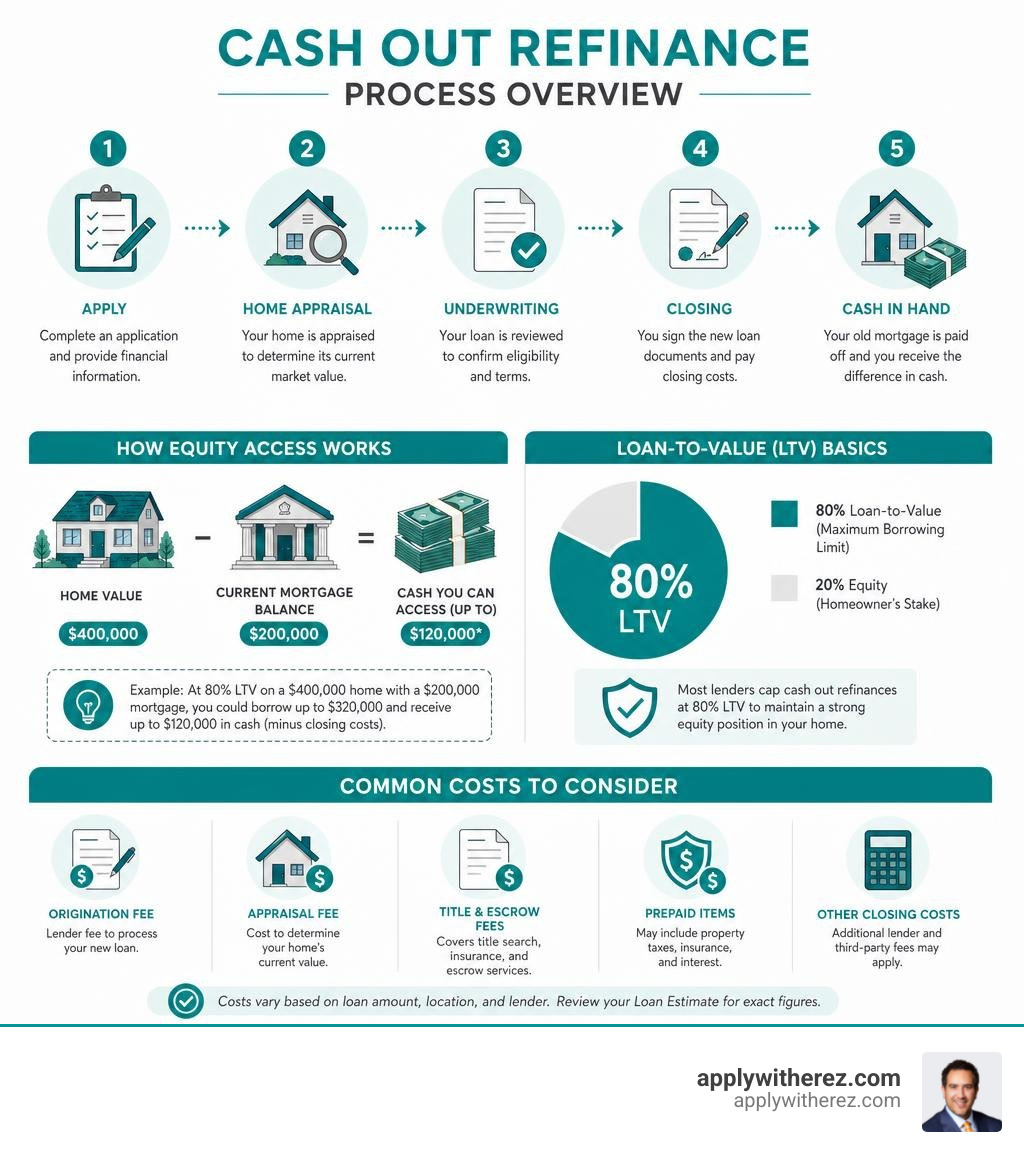
A cash out refinance replaces your existing mortgage with a new, larger loan — and you receive the difference between the two as a lump sum of cash at closing.
Here's the quick version:
You refinance your home for more than you currently owe
The new loan pays off your old mortgage
You pocket the remaining funds (minus closing costs)
You now have one monthly payment on the new, larger loan
Example: Your home is worth $400,000. You owe $200,000. At 80% LTV, you could borrow up to $320,000 — giving you up to $120,000 in cash.
It sounds simple. But the true cost, the eligibility rules, and the long-term trade-offs are where most borrowers get surprised. A cash out refinance can be a powerful financial tool — or an expensive mistake — depending on how and when you use it.
This guide covers everything: how it works, what it costs, who qualifies, and when it makes sense versus when you should look at other options.
I'm Erez Shimoni, a mortgage broker with 26 years of hands-on experience helping homeowners navigate cash out refinance decisions across New Jersey, New York, Pennsylvania, and Florida. My goal here is to give you the same clear, honest breakdown I walk my own clients through — so you can make a confident, informed choice.
What Is a Cash Out Refinance and How Does It Work?
To understand a cash out refinance, it helps to look at your home not just as a place to live, but as a forced savings account. Every monthly mortgage payment you make, combined with any rise in local property values, builds your home equity.
A cash-out refinance is simply a way to break open that savings account. However, unlike withdrawing cash from a bank, you are converting your built-up equity back into debt. We are replacing your original mortgage with a brand-new, larger mortgage, paying off the old balance, and handing you the remaining cash.

The Mechanics of a Cash Out Refinance
When we close a cash-out refinance, a few distinct things happen simultaneously:
Your existing mortgage is paid off entirely: The new loan takes over as the primary first lien on your property.
You receive a lump sum: The extra money you borrowed is paid out directly to you. This is known in the industry as getting Cash Back at Closing Refinance funds.
Your amortization schedule resets: Because you have a brand-new loan, your repayment timeline starts over. If you refinance into a new 30-year fixed loan, you are starting back at year one. This means your early payments will once again be heavily weighted toward interest rather than principal.
Calculating Your Maximum Cash-Out Amount
How much cash can you actually walk away with? Lenders do not let you strip all the equity out of your home. They require you to maintain an equity cushion to protect against falling property values.
For most conventional and FHA loans, the maximum Loan-to-Value (LTV) ratio is capped at 80%. This means you must leave at least 20% equity untouched in your home.
To estimate your maximum cash-out amount, you can use this basic formula:
$$\text{Maximum Loan Amount} = \text{Current Home Value} \times 80\%$$ $$\text{Net Cash to You} = \text{Maximum Loan Amount} - \text{Current Mortgage Balance} - \text{Closing Costs}$$
Let’s look at a quick real-world example:
Your home’s appraised value: $500,000
Your current mortgage balance: $250,000
Maximum borrowing limit (80% LTV): $400,000
Total potential cash available: $150,000 (before subtracting closing costs)
To run your own numbers and see how different interest rates and loan balances impact your monthly payment, you can use a Cash Out Refinance Calculator Bankrate to map out your potential scenarios.
Eligibility Requirements and Seasoning Rules
Because a cash out refinance increases your overall debt and the lender's risk exposure, underwriting standards are notably stricter than they are for a standard rate-and-term refinance. Lenders want to make sure you have the financial stability to handle the larger monthly payment.
Credit Score and Debt-to-Income (DTI) Standards
Your credit score and your debt-to-income (DTI) ratio are the two most critical factors lenders evaluate during underwriting:
Credit Score: While FHA guidelines theoretically allow cash-out transactions with a credit score as low as 580, conventional loans typically require a minimum credit score of 620. To secure the most competitive interest rates and avoid heavy pricing penalties, you will generally need an "indicator score" (the middle score of your three credit bureau reports) of 740 or higher.
Debt-to-Income (DTI) Ratio: Your DTI represents the percentage of your gross monthly income that goes toward paying debts. For conventional cash-out loans, lenders prefer a DTI of 36% or lower, though automated underwriting systems may approve ratios up to 43% to 45% if you have strong compensating factors (such as significant cash reserves).
Loan-to-Value (LTV) Limits and Seasoning Guidelines
Beyond your personal financial profile, the property itself must meet strict guidelines set by agency standards.
According to official Cash-Out Refinance Transactions | Fannie Mae guidelines, there are strict "seasoning" requirements that govern how long you must own the property before you can cash out:
The 6-Month Title Rule: At least one borrower must have been on the property's title for at least six months prior to the disbursement date of the new loan.
The 12-Month Note Age Rule: If you are refinancing an existing first mortgage, that mortgage must be at least 12 months old (measured from note date to note date) at the time of the refinance.
Exceptions to the Rule: There are a few rare exceptions to the seasoning rules. For example, if you inherited the property or if you qualify for the "delayed financing exception" (which allows buyers who purchased their home with 100% cash to refinance and extract equity within the first six months, provided they can document the source of the original cash).
The Costs, Rates, and Terms of Refinancing
Tapping into your home equity is not free. When you execute a cash-out refinance, you will face both ongoing interest expenses and upfront transactional costs.

Interest Rate Premiums and Loan Terms
Lenders charge a "rate premium" on cash-out transactions. Because taking cash out increases the loan balance relative to the home's value, these loans carry higher default risks.
To offset this risk, lenders apply Loan-Level Price Adjustments (LLPAs). This means cash out refinance interest rates are typically 0.25% to 0.50% higher than comparable rate-and-term refinance rates.
While a fraction of a percent might not sound like much, it adds up dramatically over time. For example, the difference between a 6.50% and a 7.00% interest rate on a $320,000 loan is $38,640 in additional interest over the course of a 30-year term.
When choosing your loan terms, you can opt for a traditional 30-year fixed mortgage to keep your monthly payments as low as possible, or a 15-year fixed mortgage to pay off the debt faster and save on lifetime interest.
Understanding Closing Costs and Fees
Just like when you bought your home, refinancing requires paying third-party fees. You can expect the Average Closing Costs for Cash Out Refinance transactions to range between 2% and 5% of the new loan amount. On a $300,000 loan, that translates to $6,000 to $15,000.
These closing costs typically include:
Lender origination and underwriting fees
Appraisal fees (usually $500 to $800 to verify your home's current market value)
Title search and title insurance fees
State recording fees and transfer taxes
Many homeowners ask us about "no-closing-cost" options. It is important to understand that these are not truly free. If you work with the Best Mortgage Refinance Companies with No Closing Costs, the lender will either roll those upfront fees directly into your principal loan balance or raise your interest rate slightly to cover the costs. While this keeps money in your pocket today, it increases your total interest paid over the life of the loan.
Cash-Out Refinance vs. Other Home Equity Options
A cash-out refinance is not the only way to access your home's equity. Depending on your current mortgage rate, other borrowing options may make significantly more financial sense.
Feature Cash-Out Refinance Home Equity Line of Credit (HELOC) Home Equity Loan Lien Position First Mortgage (replaces old loan) Second Mortgage (sits behind old loan) Second Mortgage (sits behind old loan) Interest Rate Fixed (usually) or Adjustable Variable (tied to Prime Rate) Fixed Disbursement Lump sum at closing As-needed during "Draw Period" Lump sum at closing Closing Costs High (2% to 5% of loan amount) Low or None Low to Moderate Best For Large, one-time expenses when market rates are low Ongoing expenses, emergency funds, or flexible borrowing Large, one-time expenses when you want to keep your low first mortgage rate
Comparing a Cash Out Refinance to HELOCs and Home Equity Loans
The biggest advantage of HELOCs and Home Equity Loans is that they are second mortgages. They sit behind your primary mortgage.
If you bought or refinanced your home a few years ago and locked in a historic first mortgage rate of 3.00% or 4.00%, the absolute last thing you want to do is replace that entire loan with a new, larger loan at current market rates.
In that scenario, comparing a Cash Out Refinance vs Home Equity Loan reveals that keeping your low-rate first mortgage intact and taking out a separate second mortgage is almost always the Best Way to Get Cash Out of Home Equity. You only pay the higher current interest rate on the specific amount you borrow, rather than resetting your entire home debt to a higher rate.
Pros, Cons, and Strategic Financial Uses
Before signing on the dotted line, you must weigh the benefits against the very real risks of tapping into your home's equity.
Benefits and Risks of Tapping Home Equity
The Pros:
Lower Interest Rates: Compared to credit cards or personal loans, borrowing against your home offers significantly lower interest rates.
Single Payment Simplicity: You consolidate debt into one manageable monthly payment.
High Borrowing Limits: Your home allows you to access tens of thousands of dollars that would be impossible to secure via unsecured personal loans.
The Cons:
Foreclosure Risk: Your home is the collateral. If you run into financial hardship and cannot make your payments, the lender can foreclose on your property.
Resetting the Amortization Clock: If you are 10 years into a 30-year mortgage and refinance into a new 30-year loan, you just added 10 more years of interest payments to your life.
Reduced Home Equity: You leave yourself with less of an equity cushion if property values decline in your local market.
Smart Uses vs. Financial Pitfalls
Not all uses of cash-out funds are created equal. In 2025, 64% of cash-out refinance volume was used for debt consolidation or home improvements.
Smart Uses (Value-Building): Using the cash for high-ROI home renovations (like kitchen remodels or structural repairs) can increase your home's value. Consolidating high-interest credit card debt (often at 20%+ APR) into a lower-rate mortgage can also save you thousands of dollars a year.
Financial Pitfalls (Wealth-Destroying): Using your home equity to fund lifestyle expenses, buy luxury cars, or go on vacations is highly risky. Furthermore, 29% of borrowers who consolidate debt through a refinance end up with the same or higher credit card balances within 3 years. If you do not address the underlying spending habits, you risk double-dipping your debt.
Tax Implications of Refinancing
The cash you receive from a refinance is considered loan proceeds, not income, meaning you do not pay income taxes on the cash-out lump sum.
However, the deductibility of the mortgage interest has strict IRS rules. Under current tax law, mortgage interest is only tax-deductible if the cash-out proceeds are used to buy, build, or substantially improve the home that secures the loan. If you use the money to pay off credit cards or buy a car, that portion of your mortgage interest is not tax-deductible.
For real estate investors looking to transition properties, it is also worth exploring how a cash-out refinance interacts with other tax strategies, such as a Cash-Out Refinance & 1031 Exchange: How to Access ... to access equity without triggering immediate capital gains taxes.
Frequently Asked Questions About Cash-Out Refinancing
How long does a cash-out refinance take to close?
The typical timeline to close a cash-out refinance is 30 to 45 days. This period includes submitting your financial documentation, having a professional appraiser value your home, completing the lender's underwriting process, and navigating the mandatory 3-day right of rescission (a federal cooling-off period during which you can cancel the loan if you change your mind).
Can I do a cash-out refinance on an investment property?
Yes, but the guidelines are much stricter. Because default rates on investment properties run approximately 2x higher than owner-occupied homes, lenders limit their risk by capping the maximum LTV at 75% (requiring you to leave 25% equity in the property). You will also face a higher interest rate premium and more rigorous cash reserve requirements.
Does a cash-out refinance hurt your credit score?
Initially, yes. When you apply, the lender will perform a hard credit inquiry, which typically dips your score by 5 to 10 points temporarily. However, if you use the cash-out funds to pay off high-interest credit card debt, your credit score can actually see a significant increase in the following months due to a dramatic drop in your credit utilization ratio.
Conclusion
A cash out refinance is one of the most powerful financial tools available to homeowners, but it is not a decision to be made lightly. It requires a clear strategy, a realistic look at the total long-term costs, and a disciplined plan for the funds.
Whether you want to renovate your home, consolidate high-interest debt, or build a long-term investment portfolio, we are here to help you design a customized equity strategy that fits your life.
If you are ready to explore your refinancing options and want to see what rates you qualify for, visit our mortgage team at applywitherez.com and check out our Refinance options today. Let's work together to make your home equity work for you!