
Average Cash Out Refinance Rates and How to Outsmart Them
Average Cash Out Refinance Rates: What You're Actually Paying Right Now
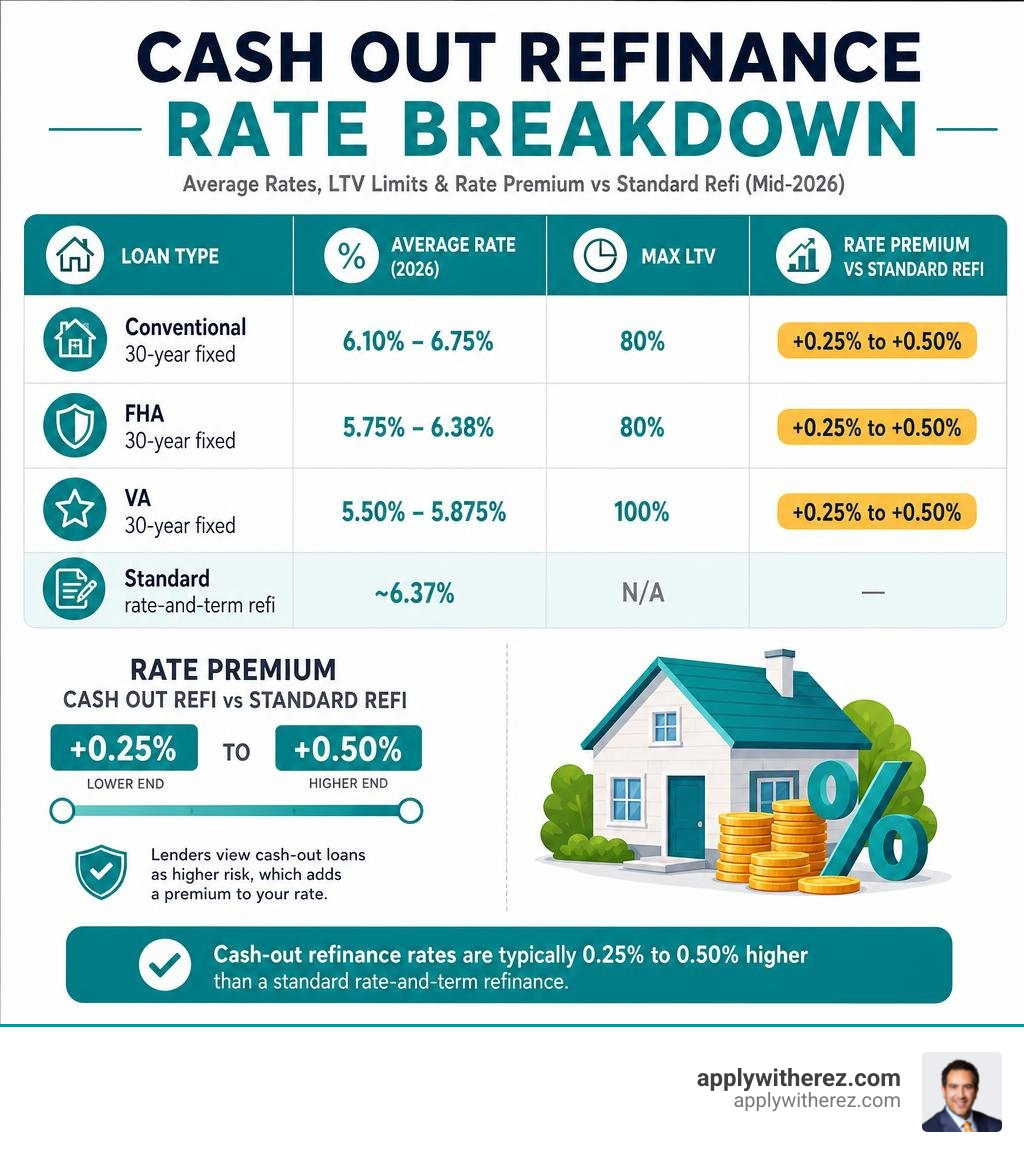
Average cash out refinance rates are running around 6.74% APR as of mid-2026 — here's a quick snapshot before we dig in:
Loan Type Average Rate (2026) Max LTV Conventional 30-year fixed 6.10% – 6.75% 80% FHA 30-year fixed 5.75% – 6.38% 80% VA 30-year fixed 5.50% – 5.875% 100% Standard rate-and-term refi ~6.37% N/A
The key takeaway: Cash-out refinance rates are typically 0.25% to 0.50% higher than a standard rate-and-term refinance. That premium exists because lenders treat cash-out loans as higher risk.
And that gap adds up fast. Research from 2025 found that 78.7% of refinancers paid more than the most competitive rate available for their credit profile — at an average cost of $2,462 per year. That's not a rounding error. That's real money left on the table simply by not shopping around.
If you're sitting on home equity and wondering whether to pull some out — and at what cost — you're in the right place. This guide breaks down exactly what drives your rate, what it costs to borrow, and how to avoid the traps most borrowers walk straight into.
I'm Erez Shimoni, a licensed mortgage broker (NMLS #460222) with 26 years of experience helping homeowners in New Jersey, New York, Pennsylvania, and Florida navigate decisions exactly like this one — including understanding what average cash out refinance rates actually mean for their specific loan profile. I'll walk you through everything you need to make a confident, informed choice.
Understanding Average Cash Out Refinance Rates Today
When you look at advertised mortgage rates online, you are almost always seeing teaser rates for a standard rate-and-term refinance or a primary home purchase. If you step up to pull cash out of your home, the pricing rules change immediately.
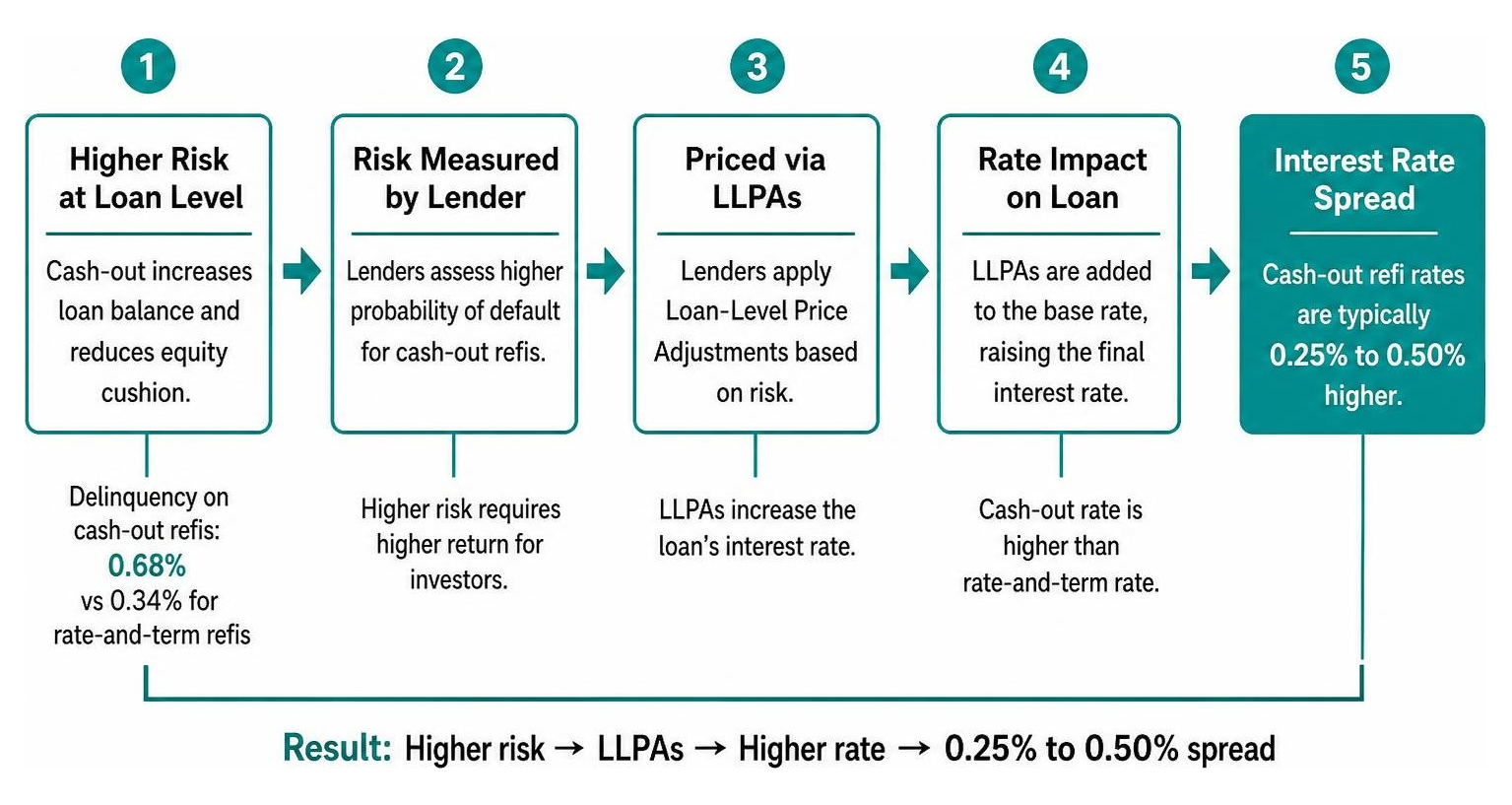
Lenders evaluate cash-out refinances through a stricter risk lens. When you extract equity, you increase your overall loan balance and lower the safety cushion of equity remaining in your home. Historical data shows that serious delinquency rates on cash-out refinances sit around 0.68%—exactly double the 0.34% rate seen on rate-and-term refinances. Because mortgage investors know borrowers are statistically slightly more likely to default when taking cash out, they mandate higher returns.
This extra cost manifests as a rate spread. In mid-2026, the spread between standard rate-and-term refinancing and cash-out refinancing averages between 25 and 50 basis points (0.25% to 0.50%). For conventional loans backed by Fannie Mae or Freddie Mac, this risk is priced directly into the loan through Loan-Level Price Adjustments (LLPAs). Government-backed options like FHA and VA cash-out loans handle risk differently, which is why government loan interest rates often appear lower on paper—even if upfront mortgage insurance or funding fees offset part of those savings.
Historical Spreads vs Standard Refinancing
Historically, the premium for tapping home equity fluctuated between 0.125% and 0.25%. However, shifting market conditions, mortgage-backed security (MBS) yields, and heightened lender conservatism have widened that gap to historical highs. In early 2026, data tracked across national mortgage indices recorded a spread as wide as 47 basis points between rate-and-term refinances (averaging 6.37%) and cash-out refinances (averaging 6.84%).
This baseline risk pricing is heavily driven by lender profit margins and deposit funding costs. When secondary market investors demand higher yields for cash-heavy paper, primary mortgage lenders pass those surcharges directly along to you.
Refinance Type Purpose Typical Rate Range (2026) Lender Risk Level Rate-and-Term Refinance Lower rate or adjust loan term 6.125% – 6.375% Low Conventional Cash-Out Refinance Replace loan + extract equity 6.500% – 6.840% Moderate to High FHA Cash-Out Refinance Replace loan with lower credit threshold 5.750% – 6.380% Moderate VA Cash-Out Refinance Veterans replacing loan up to 100% LTV 5.500% – 5.875% Backed by VA
Current Benchmark Average Cash Out Refinance Rates by Loan Type
To evaluate what you might pay today, you must look at specific loan structures rather than generic national headlines. Rates vary significantly depending on whether you choose a conventional or government-backed program, as well as your term length:
30-Year Fixed Conventional Cash-Out: Benchmarks hover between 6.10% and 6.84% APR for qualified borrowers. Published cash-out refinance rate tables highlight ranges from competitive wholesale quotes near 5.875% APR up to 6.740% APR depending on discount points.
15-Year Fixed Conventional Cash-Out: Shorter terms carry significantly lower risk for lenders. 15-year cash-out rates currently average between 5.625% and 6.37% APR, saving you substantial lifetime interest if your monthly budget can support the higher principal payment.
FHA Cash-Out Refinance: FHA baseline interest rates appear attractive, ranging from 5.75% to 6.38%. However, FHA requires both an upfront mortgage insurance premium (UFMIP) of 1.75% and an annual mortgage insurance payment, which increases your overall annual percentage rate (APR).
VA Cash-Out Refinance: Eligible veterans and active-duty military servicemembers access the most competitive pricing in the market. According to recent lender data compiled by mortgage data indices, VA cash-out rates frequently start between 5.500% (15-year fixed) and 5.875% (30-year fixed).
Regional variations also impact your bottom line. Homeowners refinancing in New York average around 6.84% for a 30-year conventional cash-out, while average rates in New Jersey and Pennsylvania hover closer to 7.03% due to local escrow, tax calculations, and state-level title fee structures documented across regional rate surveys.
Key Factors Influencing Your Refinance Rate and Costs
Your final interest rate isn't chosen at random. Lenders rely on automated underwriting engines that evaluate five distinct risk variables to build your custom rate quote:
Credit Score (FICO): The primary driver of your baseline rate tier.
Loan-to-Value Ratio (LTV): The percentage of your home's total appraised value that you borrow.
Debt-to-Income Ratio (DTI): Your total monthly debt obligations divided by your gross monthly income.
Loan Amount: Larger loans amortize risk differently, while smaller cash draws (under $15,000) often get eaten alive by fixed closing costs.
Property Type and Occupancy: Single-family primary residences receive the best pricing; multi-unit properties and investment homes face steep rate add-ons.
How Credit Scores and LTV Trigger Rate Penalties
Fannie Mae and Freddie Mac utilize Loan-Level Price Adjustments (LLPAs) to adjust rates based on credit score and LTV brackets. These adjustments act as upfront fee surcharges that lenders convert directly into higher interest rates.
Consider how steep these penalties become when you cross key risk thresholds:
The 80% LTV Barrier: For conventional loans, 80% LTV is the strict upper ceiling for cash-out refinances. Borrowing 80% of your home equity triggers a much higher LLPA fee than capping your borrow at 70% or 75% LTV.
The Credit Score Ladder: A borrower with a 760 FICO score looking for an 80% LTV cash-out loan incurs a 1.25% upfront LLPA fee (translating to roughly a 0.375% higher interest rate). Drop that credit score to 680, and the LLPA fee jumps to 3.25%—adding roughly 0.875% to your ongoing interest rate!
According to analysis from a top lender report, the rate penalty between a 760+ credit score (averaging 6.52%) and a sub-700 score (averaging 8.12%) spans 160 basis points. On a $350,000 loan balance, that credit difference costs an extra $1,470 every single year in interest payments alone.
Cash-Out Refinance vs HELOCs and Home Equity Loans
When you need equity, a full cash-out refinance isn't your only option. You can also leave your existing first mortgage completely untouched and secure a second lien through a Home Equity Line of Credit (HELOC) or a closed-end Home Equity Loan.
To understand which pathway makes financial sense, you must compare how each loan product structures its interest rates and repayment terms:
Cash-Out Refinance: Replaces your existing primary mortgage entirely with a single, brand-new 15- or 30-year loan for a higher balance, giving you the extra cash at closing.
Home Equity Line of Credit (HELOC): Functions like a credit card secured by your home. It sits in second position, offers a variable interest rate tied to the Prime Rate, and allows you to draw and pay back funds as needed during an initial draw period (typically 10 years).
Home Equity Loan: A second mortgage that provides a one-time lump sum with a fixed interest rate and fixed monthly payments over 5 to 20 years.
Feature Cash-Out Refinance HELOC Home Equity Loan Lien Position Primary (1st Mortgage) Secondary (2nd Mortgage) Secondary (2nd Mortgage) Existing Mortgage Paid off and replaced Unchanged Unchanged Interest Rate Structure Fixed (usually) Variable Fixed Average Rate (2026) 6.10% – 6.84% 7.00% – 9.10% 7.50% – 8.80% Closing Costs High (2% to 5% of full loan) Low ($0 to $1,500) Moderate ($500 to $2,000) Best For High cash needs + high existing rate Ongoing flex cash or low existing primary rate One-time cash needs + low existing primary rate
For a complete breakdown of second-lien dynamics, explore our Cash Out Refinance vs Home Equity Loan Guide to evaluate which structure fits your long-term wealth strategy.
Evaluating the Total Cost of Re-Pricing Existing Debt
The most dangerous financial mistake homeowners make today is ignoring the rate reset penalty.
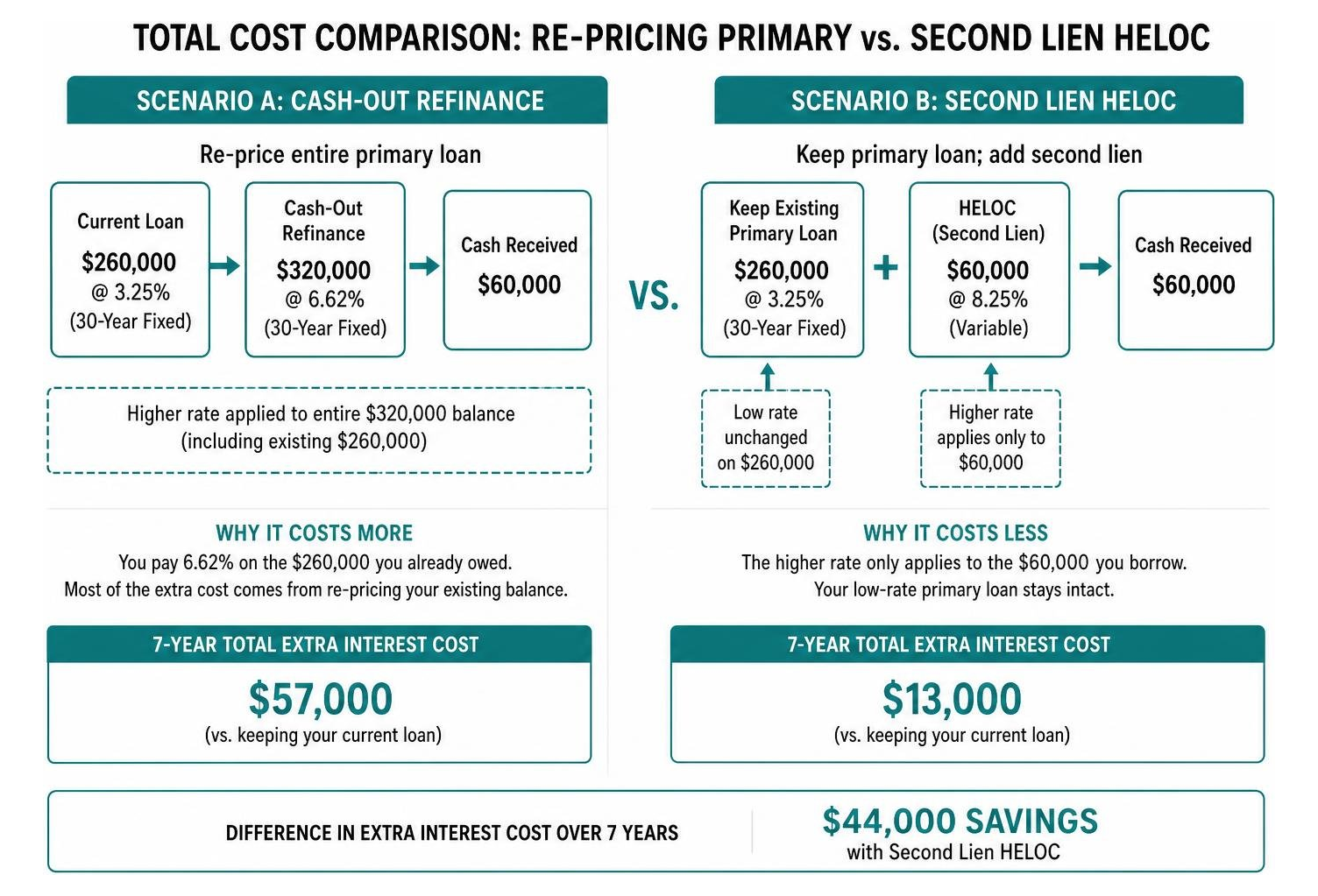
During the record-low rate era of 2020–2022, tens of millions of homeowners locked in 30-year fixed primary mortgages between 2.75% and 4.00%. If you currently hold a 3.25% interest rate on a $260,000 mortgage balance and need $60,000 in cash, doing a cash-out refinance at 6.62% forces you to re-price your entire $260,000 existing mortgage balance up to 6.62%!
Let's look at how the math plays out in the real world:
Scenario A (Cash-Out Refinance Trap): You replace your $260,000 balance at 3.25% with a new $320,000 cash-out loan at 6.62%. Most of your payment increase doesn't come from the $60,000 in cash you took out—it comes from paying an extra 3.37% in interest on the $260,000 you already owed! Over 7 years, this decision adds roughly $57,000 in extra interest costs.
Scenario B (Smart Second Lien): You keep your original $260,000 primary mortgage untouched at 3.25%. You take out a separate $60,000 HELOC or Home Equity Loan at a higher stand-alone rate of 8.25%. Because that higher interest rate only applies to the $60,000, your combined monthly interest payments remain thousands of dollars lower over time.
As detailed in research published in a cash-out refinance guide, if your existing first mortgage rate sits below 5.00%, doing a full cash-out refinance is rarely the right financial move. A second mortgage or HELOC almost always wins on total dollar cost.
Risks, Hidden Fees, and Closing Expenses
Refinancing a primary mortgage requires significant administrative, legal, and underwriting labor. Those services come with closing costs ranging between 2% and 5% of the total new loan balance.
It is crucial to understand that cash-out closing costs are calculated against the entire new loan balance, not just the cash amount you extract. If you owe $300,000 and take out $50,000 in cash, your 2% to 5% closing fee is calculated against the full $350,000 loan ($7,000 to $17,500 in fees!).
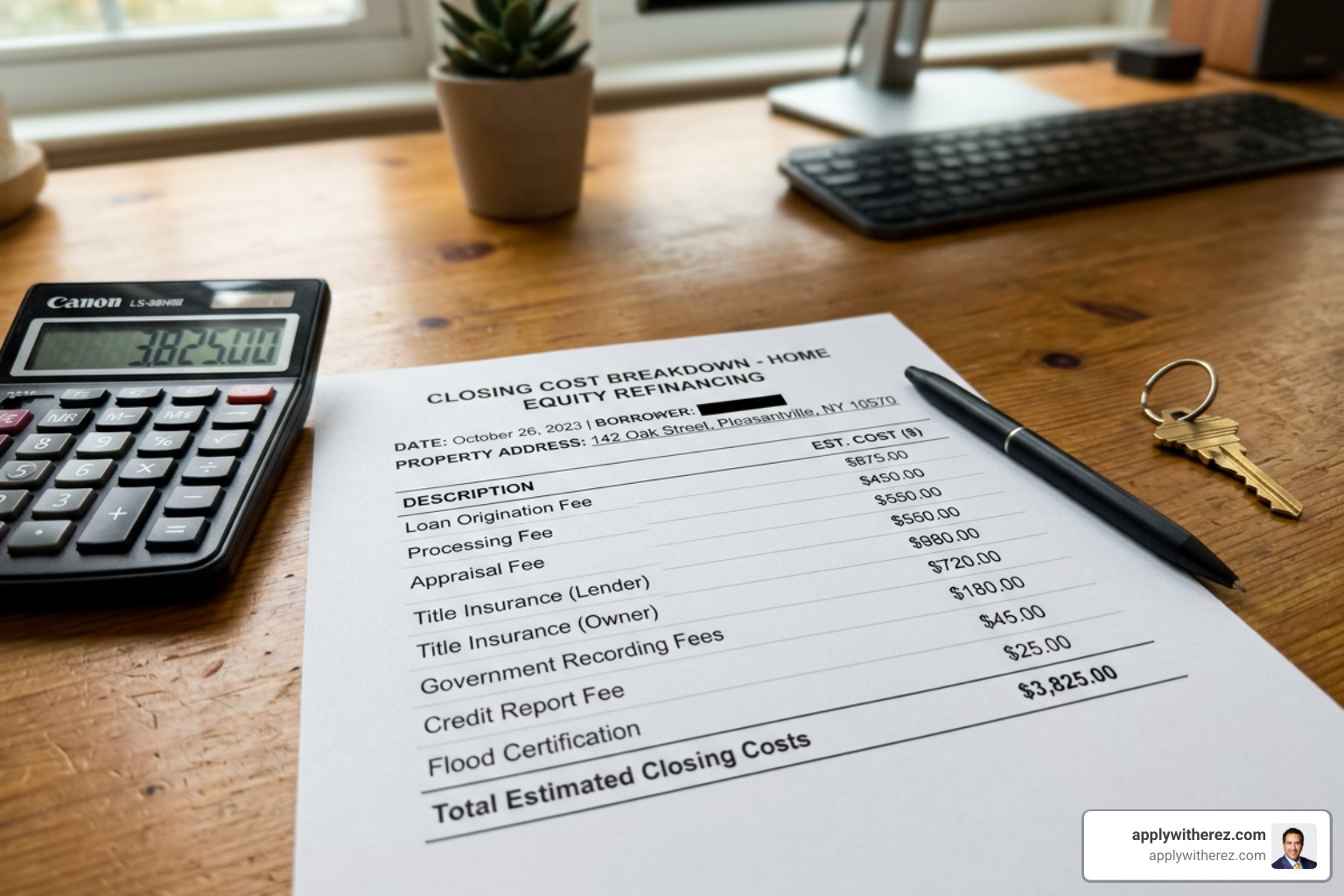
Here is where those closing cost dollars actually go:
Loan Origination Fees (1% to 1.5%): Charged by the lender to process and underwrite the loan ($3,500 to $5,250 on a $350,000 loan).
Property Appraisal Fee ($500 to $1,000+): Required to establish your home's current market value and confirm maximum LTV limits.
Title Search & Title Insurance ($1,000 to $2,500): Protects the lender's priority lien position against old ownership claims or legal defects.
Government Recording Fees & Transfer Taxes ($600 to $1,800): State and county fees charged to record the new mortgage document.
Escrow Prepad Funding: Initial deposits to set up your new property tax and homeowners insurance escrow account.
To see exact fee averages across New York, New Jersey, and Pennsylvania, review our comprehensive analysis on Average Closing Costs for Cash Out Refinance.
Before committing, always calculate your break-even point. Divide your total upfront closing costs by your net monthly benefit (such as monthly credit card interest savings). If closing costs equal $8,000 and your net monthly savings equal $200, it will take you 40 months (3.3 years) just to recoup the cost of refinancing.
Smart Strategies to Secure the Best Average Cash Out Refinance Rates
If a cash-out refinance fits your financial profile, you shouldn't accept the first rate quote you receive. You can actively position your application to land in the lowest pricing tier.
Here are four actionable tactics we recommend to every client before applying:
Optimize Your Credit Score 90 Days Early: Pay down revolving credit card balances below 10% of their limits. Clearing small credit balances can boost your FICO score by 20 to 40 points, crossing crucial LLPA thresholds.
Cap Your Borrowing Below 75% LTV: While conventional rules permit up to 80% LTV, capping your new loan balance at 70% or 75% LTV eliminates steep Fannie Mae risk surcharges.
Buy Down the Rate with Discount Points: One discount point costs 1% of your total loan amount ($3,500 on a $350,000 loan) and typically lowers your interest rate by 0.25%. Paying points upfront can yield substantial savings if you plan to stay in the home for more than 5 to 7 years.
Consolidate High-Interest Debt Wisely: If you are using cash-out proceeds to wipe out 22% credit card balances, calculate your blended cost of capital. Replacing unsecured 22% debt with 6.50% tax-advantaged mortgage debt delivers massive immediate cash flow relief.
For a step-by-step walkthrough on structuring your application, consult our complete Cash Out Refinance Guide 2026.
Outsmarting the Overpayment Penalty Through Rate Shopping
The single most effective way to secure a below-average rate is simple: shop multiple lenders.
According to study data compiled in industry market reports, nearly four out of five borrowers (78.7%) overpaid on their refinances in 2025 because they simply accepted an initial quote from their current loan servicer or a big national bank. VA borrowers suffered even higher rates of overpayment, with 81% paying well above market averages.
To protect yourself from this overpayment trap:
Request Official Loan Estimates (LE): Never rely on verbal quotes or pre-qualification estimates. Demand an official 3-page Loan Estimate form to compare Line A (Origination Charges) and Section J (Total Closing Costs).
Compare Wholesale Mortgage Brokers Against Direct Banks: Wholesale brokers have access to institutional pricing tiers across dozens of competing lenders, allowing them to shop wholesale channels on your behalf.
Lock Your Rate Promptly: Mortgage rates fluctuate daily based on bond market volatility. Once you receive a competitive Loan Estimate, execute a written rate lock within 3 business days.
Frequently Asked Questions About Cash-Out Refinancing
How much equity can I withdraw in a cash-out refinance?
The maximum cash you can extract depends on your loan program's Loan-To-Value (LTV) limit and your current remaining mortgage balance. You can calculate your maximum allowable loan balance using this formula:
Conventional Loans: Capped at an 80% maximum LTV on primary single-family residences. If your home appraises for $500,000, your maximum combined loan balance is $400,000 ($500,000 × 0.80). If you currently owe $250,000, you can extract up to $150,000 (minus closing costs).
FHA Cash-Out Loans: Capped at an 80% maximum LTV.
VA Cash-Out Loans: Qualified military veterans can borrow up to 100% of their home's appraised value, subject to debt-to-income and underwriter approval.
What are the typical closing costs for a cash-out refinance?
Closing costs typically range between 2% and 5% of the new primary mortgage amount. On a $350,000 loan balance, expect total closing costs between $7,000 and $17,500. Standard fees include lender origination fees (1%), property appraisal ($500–$1,000), title search and insurance ($1,000–$2,500), underwriting fees, and local government recording taxes. Most lenders allow you to roll these closing costs into your new loan balance, provided your total LTV stays within allowable program limits.
Is a cash-out refinance wise if my current mortgage rate is below 5%?
In almost all cases, no. Refinancing an existing primary mortgage that carries a 3% or 4% interest rate up to a mid-2026 cash-out rate of 6.50%+ forces you to pay dramatically higher interest across your entire original debt balance. If you need equity for home improvements or debt consolidation, you will almost certainly save thousands of dollars by leaving your existing primary mortgage in place and securing a second mortgage, such as a Home Equity Line of Credit (HELOC) or fixed-rate Home Equity Loan.
Conclusion
Navigating average cash out refinance rates doesn't have to feel like a guessing game. While market average rates hover between 6.10% and 6.84% APR depending on loan type, the rate you pay comes down to credit preparation, equity positioning, and refusing to accept the first quote you see.
Before you make any move, take these three simple steps:
Check your primary mortgage interest rate. If it's under 5%, prioritize a second-lien HELOC or home equity loan over a full cash-out refinance.
Calculate your true Loan-To-Value ratio. Aim to keep your total borrowing at or below 75% LTV to avoid steep pricing penalties.
Shop your loan with a licensed mortgage broker. Comparing wholesale pricing across multiple lenders is the single fastest way to avoid the overpayment trap.
At applywitherez.com, we specialize in helping homeowners across New York, New Jersey, and Pennsylvania evaluate their home equity options objectively. Whether you need a standard cash-out refinance, a VA equity loan, or a secondary home equity line, we shop top wholesale lenders to find the lowest possible borrowing cost for your profile.
Ready to see what you actually qualify for? Get customized refinance rate options today and take control of your home equity strategy.