
Don't Get Sticker Shock from Your Cash Out Refi Closing Costs
What Are the Average Closing Costs for a Cash-Out Refinance in 2026?
The average closing costs for a cash-out refinance typically fall between 2% and 6% of your new loan amount in 2026. Here's a quick breakdown so you know what to expect before reading further:
New Loan Amount 2% (Low) 3% (Typical Low) 5% (Typical High) 6% (High) $100,000 $2,000 $3,000 $5,000 $6,000 $200,000 $4,000 $6,000 $10,000 $12,000 $300,000 $6,000 $9,000 $15,000 $18,000 $400,000 $8,000 $12,000 $20,000 $24,000 $500,000 $10,000 $15,000 $25,000 $30,000
Most homeowners land in the 3%–5% range. The exact number depends on your loan size, location, credit score, and the lender you choose.
Many homeowners are surprised when they first see the closing cost estimate on a cash-out refinance. You apply expecting to walk away with a lump sum of cash — and then you discover thousands of dollars in fees standing between you and that money. That gap between what you expected and what you actually receive is exactly the kind of sticker shock this guide is designed to prevent.
A cash-out refinance isn't just a tweak to your existing mortgage. It's a brand-new loan — and like any mortgage, it comes with a full set of closing costs. On a $400,000 loan, that could mean anywhere from $8,000 to $24,000 in fees. Some of those costs come out of your pocket at closing. Others get rolled into the loan. And some get subtracted directly from the cash you receive.
Understanding these costs before you apply puts you in a much stronger position to negotiate, compare lenders, and decide whether a cash-out refinance is the right move for your situation.
I'm Erez Shimoni, a mortgage professional with 26 years of experience helping homeowners navigate exactly these kinds of decisions — including understanding the average closing costs for a cash-out refinance and how to minimize them. Let's walk through everything you need to know.
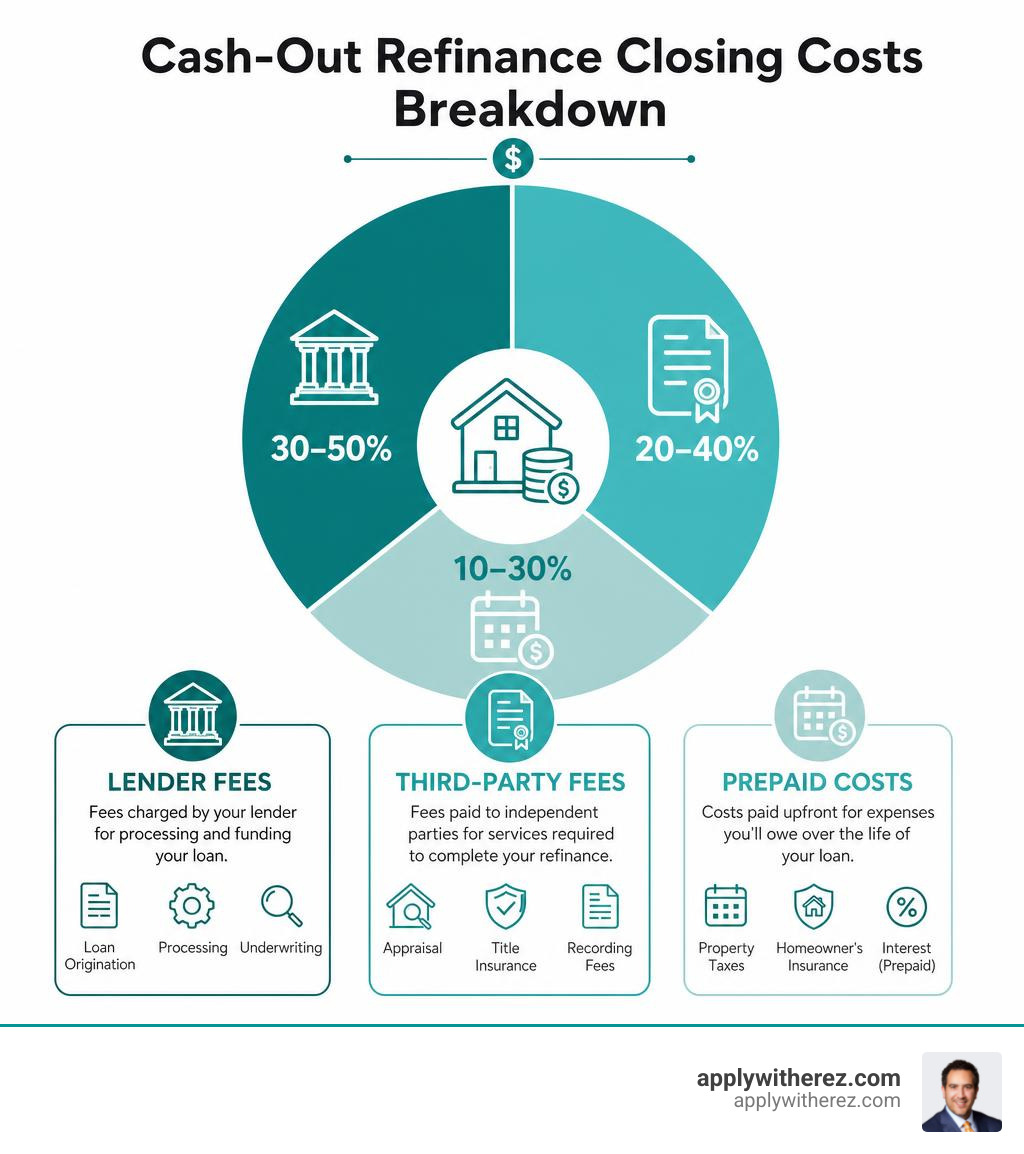
Average closing costs for cash out refinance in 2026: What homeowners should expect
When you begin planning a cash-out refinance, it is vital to establish a realistic refinance budget. In 2026, the industry standard remains consistent: most homeowners pay between 2% and 6% of the newly established mortgage principal in total closing costs. However, because a cash-out refinance involves borrowing more than your current mortgage balance, these percentages are calculated on a larger base than your original loan.
Many people fall victim to the "no-closing-cost" myth. Lenders may advertise loans with "zero upfront fees," but make no mistake—closing costs are never truly free. They are either rolled directly into your new loan balance (which increases your principal and the total interest you will pay over time) or exchanged for a higher interest rate via lender credits.
To see how these numbers shake out for your specific property value and equity goals, we highly recommend trying our Cash Out Refinance Calculator. It will help you visualize your potential loan balance, monthly payments, and estimated cash to close.
Average closing costs for cash out refinance by loan amount
Because closing costs are highly dependent on the size of your mortgage, looking at specific loan amounts can help you estimate your final bill.
Let's look at how the 2% to 6% range scales across different mortgage sizes:
$100,000 Loan: A smaller mortgage or a modest equity draw might incur closing costs between $2,000 and $6,000.
$150,000 Loan: Homeowners can expect to pay between $3,000 and $9,000.
$200,000 Loan: At this level, typical costs range from $4,000 to $12,000.
$300,000 Loan: Expect a range of $6,000 to $18,000.
$400,000 Loan: A mid-to-high balance refinance will see costs between $8,000 and $24,000.
$500,000 Loan: For larger properties, fees can scale from $10,000 to $30,000.

Why cash-out refinance costs are usually based on the new mortgage
It is a common point of confusion: why are your fees calculated on the new, larger loan amount rather than just the amount of cash you are taking out?
When you do a cash-out refinance, you are not simply taking out a second loan for the equity portion. Instead, you are replacing your existing mortgage with an entirely new principal balance. This new balance is the sum of:
Your existing mortgage payoff amount.
The cash-out amount you wish to receive.
Any financed closing costs you choose to roll into the loan.
Because the lender must underwrite, secure, and title-insure the entire new loan amount, fees like origination charges, title insurance policies, and state taxes are calculated based on this total figure.
That lenders enforce a strict maximum loan-to-value (LTV) ratio—typically capping your total borrowing at 80% of your home's appraised value. This means your maximum cash available is heavily influenced by how much of your equity is consumed by the new principal and its associated closing costs.
How cash-out refinance closing costs compare to rate-and-term refinance costs
If you compare a cash-out refinance to a simple rate-and-term refinance (where you only change your rate or loan term without taking cash out), you will find that cash-out options are generally more expensive.
Lenders view cash-out transactions as higher risk. When homeowners increase their debt load and reduce their equity stake, statistically, the likelihood of default rises. To offset this, lenders apply a "cash-out risk premium" in the form of Loan-Level Price Adjustments (LLPAs).
These adjustments typically result in:
Higher Interest Rates: Cash-out refinance rates are often 0.125% to 0.375% higher than rate-and-term options for borrowers with identical profiles.
Higher Upfront Fees: Some lenders charge higher origination or underwriting fees on cash-out transactions.
Increased LTV Sensitivity: If your post-refinance LTV is close to the 80% limit, your pricing and fees will be significantly higher than if you maintained a 60% or 70% LTV.
For a deeper dive into how these risk structures affect your overall terms, you can review this detailed refinance cost breakdown.
What’s included in cash-out refinance closing costs?
Your final closing costs are not a single, flat fee. They are a collection of individual charges from your lender, local government, and various third-party companies. When you receive your Loan Estimate, these fees will be organized into distinct categories.
Here is a quick summary of what is typically included in your closing costs:
Lender Fees: Charges for processing, underwriting, and originating your loan.
Third-Party Fees: Services required by the lender but performed by outside professionals (e.g., appraisals, title searches).
Prepaid Expenses: Upfront payments for interest, property taxes, and homeowners insurance.
Escrow Deposits: Funds used to establish your new escrow account.
Government Charges: Recording fees and transfer taxes.
Lender fees you’ll usually see
Lender fees are the administrative costs associated with setting up your new mortgage. Many of these fees are negotiable, so it pays to review them closely on your Loan Estimate:
Origination Fee: This is the lender’s charge for making the loan. It typically ranges from 0.5% to 1.5% of the total loan amount.
Underwriting and Processing Fees: These cover the cost of evaluating your creditworthiness, verifying your financial documents, and preparing your loan for closing. They usually range from $500 to $1,500.
Application Fee: An upfront fee (typically $0 to $500) to cover the initial administrative costs of your file. Some lenders will waive this upon request.
Rate-Lock Fee: A fee to guarantee your interest rate for a set period (usually 30 to 60 days) while your loan is processed.
Discount Points: Optional fees you pay upfront to "buy down" your interest rate. One point costs 1% of the loan amount and generally lowers your interest rate by 0.25%.
To understand how these lender-specific charges are disclosed and compared, check out this comprehensive guide on refinance fees.
Third-party and property-related fees
Lenders require several external services to verify the value, legal status, and physical condition of your property. While you cannot negotiate these fees directly, you can shop around for certain providers (such as title companies) to find the best rates:
Appraisal Fee: Lenders require a professional appraisal to verify your home’s current market value and ensure your new loan does not exceed LTV limits. This typically costs between $500 and $1,000+.
Title Search and Title Insurance: A title company must search public records to ensure there are no outstanding liens or ownership disputes on your property. You will also need to purchase a new lender’s title insurance policy, which typically costs 0.5% to 1% of the property value.
Settlement/Closing Fee: Paid to the escrow agent or settlement attorney who conducts the final closing meeting and distributes the funds. This ranges from $500 to $1,000.
Recording Fee: Charged by your county or city government to record the new mortgage deed in public records. This is usually a flat fee of $25 to $250.
Credit Report Fee: A nominal fee ($25 to $100) to pull your credit reports from the major bureaus.
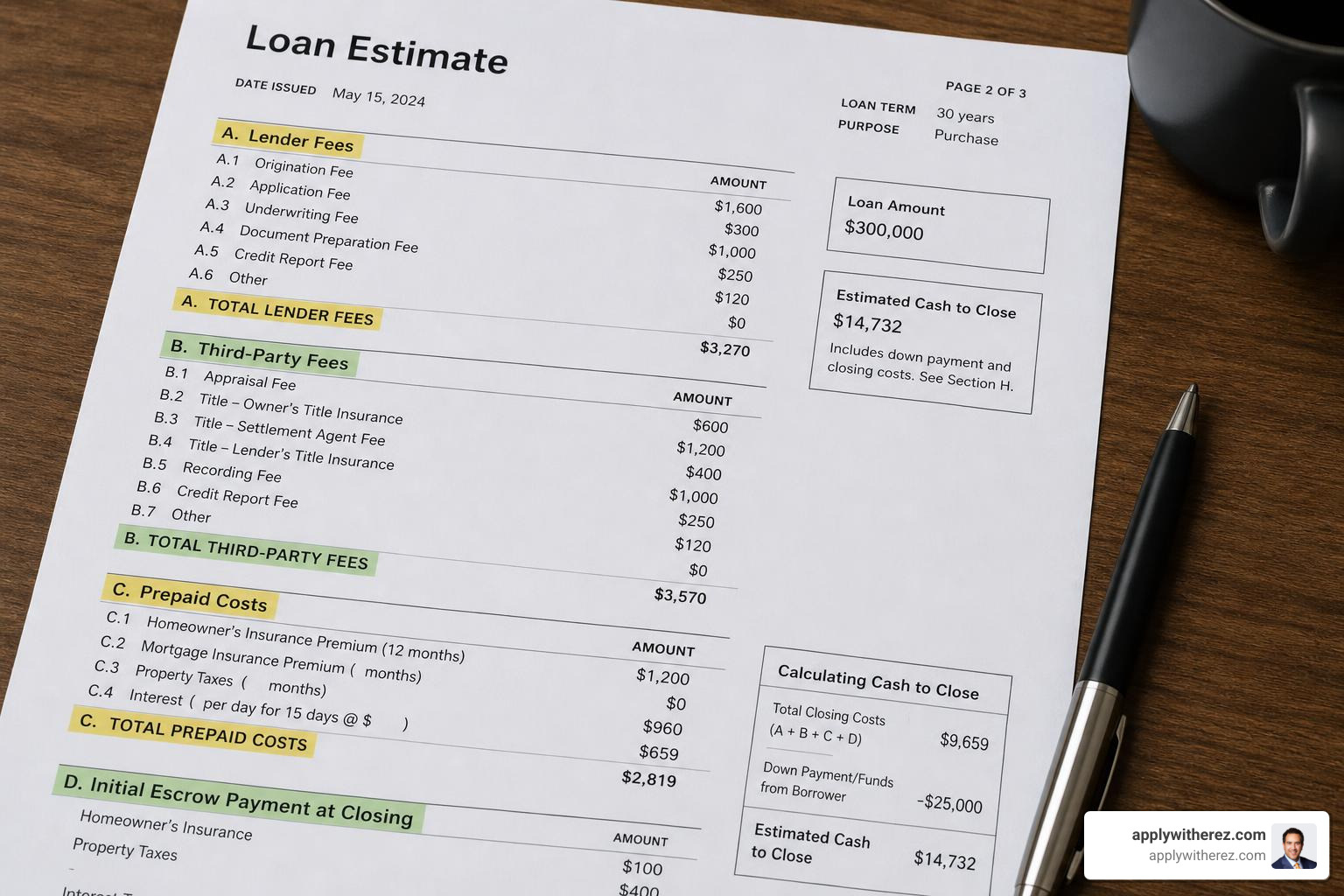
Prepaid costs, escrow deposits, and “hidden” cash-out costs
Prepaid items and escrow deposits are not technically "fees" because the money goes toward your own home-related expenses. However, they still require upfront cash at closing:
Prepaid Interest: This covers the daily interest that accrues on your new loan from the day you close until the end of that calendar month.
Escrow Account Funding: You must pre-fund a new escrow account to cover upcoming property taxes and homeowners insurance. This can require several months of payments upfront.
Mortgage Insurance Premiums: If you are refinancing an FHA loan, you will face an Upfront Mortgage Insurance Premium (UFMIP) of 1.75%. VA loans require a VA funding fee, which varies based on your service history and whether you have used the benefit before.
Payoff Interest: Your current lender will charge daily interest up to the exact day your old loan is paid off, which can add a few hundred dollars to your final payoff amount.
Why your final cost varies by state, loan, and borrower profile
No two cash-out refinances cost the same. Your final closing costs are shaped by a complex mix of local laws, your personal financial profile, and the specific characteristics of your property.
Average closing costs for cash out refinance by state and location
Geographic location is one of the most powerful drivers of closing cost variation. State and local governments have widely different tax structures, recording requirements, and legal standards.
For example, states like New York have high local transfer taxes and mortgage recording taxes, pushing average closing costs up to 2.1% of the loan amount. Conversely, states like California have relatively low state-level mortgage taxes, resulting in average closing costs closer to 0.33% of the loan amount.
Additionally, some states require a licensed attorney to oversee the closing process, which adds an extra $500 to $1,500 in legal fees compared to states where title companies handle the entire transaction.
Borrower factors that influence the total cost
Your financial profile directly impacts how much lenders will charge you for a cash-out refinance. Key factors include:
Credit Score: Borrowers with higher credit scores qualify for the lowest interest rates and the fewest risk-based pricing adjustments. A lower credit score can significantly increase your origination fees or rate.
Loan-to-Value (LTV) Ratio: The more equity you leave in your home, the lower your risk profile. If you borrow right up to the 80% limit, your costs will be higher than if you limit your borrowing to 60% or 70% LTV.
Debt-to-Income (DTI) Ratio: A lower DTI ratio demonstrates strong repayment capacity, which can help you secure better terms and lower lender fees.
Property and market factors that change your estimate
Finally, physical and economic factors can shift your closing cost estimates:
Property Type: Refinancing a condominium or a multi-unit property requires additional underwriting reviews and document fees compared to a single-family home.
Appraisal Complexity: If your home is unique, located in a rural area, or has historical value, the appraisal process will be more complex and expensive.
Market Environment: When interest rates are volatile, rate-lock fees and discount points become more expensive as lenders manage their own financial risks.
How to pay, roll in, or reduce cash-out refinance closing costs
Once you understand what your closing costs will be, you have to decide how to handle them. Fortunately, you have several options for structuring these payments depending on your current cash flow and long-term financial goals.
If you are ready to explore your options, you can start looking at current rates on our Refinance page.
Can closing costs be rolled into the new loan on a cash-out refinance?
Yes, rolling closing costs into the loan balance (also known as financing your closing costs) is the most popular choice for cash-out refinance borrowers.
This approach allows you to avoid paying thousands of dollars out of pocket on closing day. However, it comes with a long-term cost. By adding your closing costs to your principal balance, you will pay interest on those fees for the entire life of the loan. Over 30 years, a $10,000 closing cost balance can easily cost you double that amount in total interest.
Additionally, financing your closing costs reduces the amount of "clean" cash you can take out, as the total loan balance must still remain within your lender's LTV limits.
Can closing costs be deducted from cash-out proceeds?
Yes, this is another highly convenient option. Instead of paying out of pocket or increasing your loan balance, you can choose to have your closing costs deducted directly from your cash-out check.
For example, if you are approved for $50,000 in cash-out proceeds and your total closing costs are $8,000, the lender will simply deduct the fees and hand you a net check for $42,000. This keeps your loan balance from growing further while preserving your personal savings.
How to reduce or negotiate cash-out refinance closing costs
If you want to keep your closing costs as low as possible, use these proven strategies:
Shop Multiple Lenders: Get complete Loan Estimates from at least three different lenders. Use those offers as leverage to negotiate lower origination and processing fees.
Request Fee Waivers: Ask your lender to waive administrative charges like application fees, document preparation fees, or credit check fees.
Ask for a Title Reissue Rate: If you refinance with your current title insurance company, ask for a "reissue rate" discount, which can save you up to 30% to 40% on your owner's and lender's policies.
Time Your Closing Strategically: Schedule your closing for the end of the month. This minimizes the amount of prepaid daily interest you have to pay upfront.
For more strategic tips on minimizing your upfront costs, check out this guide on lowering cash-out refinance fees.
Break-even math: When the closing costs are worth it
Before finalizing any refinance, you must calculate your break-even point to ensure the transaction makes financial sense.
The basic formula is simple:
$$\text{Break-Even Point (Months)} = \frac{\text{Total Closing Costs}}{\text{Monthly Savings}}$$
For example, if your cash-out refinance costs $6,000 in fees and saves you $200 a month (either through a lower interest rate or by consolidating high-interest credit card debt), your break-even point is 30 months:
$$\frac{\$6,000}{\$200} = 30 \text{ months}$$
If you plan to stay in your home for longer than 30 months, the refinance is highly beneficial. If you plan to sell sooner, you will lose money on the transaction. You can run your own numbers using our interactive Calculator.
How closing costs affect your cash-out refinance strategy
Closing costs shouldn't just be viewed as an expense—they should actively shape your borrowing strategy. Balancing your immediate cash needs with the long-term cost of debt is the key to a successful refinance.
Choosing the right cash-out amount
It is tempting to borrow as much as your lender will allow, but over-borrowing is a costly mistake. Because your closing costs and interest payments are tied to your total loan principal, taking out "extra" cash just to have it sitting in a low-yield savings account is financially counterproductive.
Only borrow the exact amount you need for your immediate goals—whether that is home improvements, debt consolidation, or emergency reserves—and leave the rest of your equity untouched.
Choosing points, lender credits, or a standard rate
When structuring your interest rate, you face a classic trade-off:
Discount Points: You pay more upfront at closing to secure a permanently lower interest rate. This is an excellent strategy if you plan to keep the loan for many years.
Lender Credits: The lender pays some or all of your closing costs in exchange for a slightly higher interest rate. This reduces your upfront costs but increases your monthly payments and long-term interest.
Standard Rate: A balanced option with typical closing costs and market-rate interest.
Your expected time in the home should guide this decision. If you plan to move in a few years, lender credits are often the smartest choice. If this is your "forever home," buying discount points will save you the most money over time.
Deciding between a shorter or longer loan term
Many homeowners automatically opt for a standard 30-year term, but switching to a 15-year or 20-year term can yield massive savings. Shorter-term loans carry significantly lower interest rates and allow you to build equity much faster.
While your monthly payments will be higher, the total interest you save over the life of the loan will dwarf the upfront closing costs.
Tax and deductibility considerations for cash-out proceeds
The tax rules surrounding cash-out refinancing can be complex, but understanding them can save you significant money when tax season arrives.
Are cash-out refinance proceeds taxable?
No. Because the cash you receive from a refinance is a loan that you are obligated to repay, the IRS does not consider it taxable income.
Whether you take out $20,000 or $200,000, you do not have to report those proceeds on your annual tax returns, and you will not owe any federal or state income taxes on that money.
When mortgage interest may be deductible
Under current tax laws, the interest you pay on your mortgage is only deductible if the funds are used to buy, build, or substantially improve the home that secures the loan.
Deductible Use: If you use your cash-out proceeds to build a home addition, remodel your kitchen, or replace your roof, the interest on that portion of the loan is generally tax-deductible.
Non-Deductible Use: If you use the cash to pay off credit card debt, buy a car, or fund a vacation, the interest on that portion of the loan is not deductible.
Be sure to keep detailed records and receipts of all home improvement projects to substantiate your deductions, and consult a qualified tax professional to review your specific situation.
How points and prepaid interest may be treated
When you purchase a home, you can typically deduct discount points in the year you buy them. However, for a refinance, the rules are different.
The IRS requires you to amortize (spread out) the deduction for discount points over the entire life of the loan. For example, if you pay $3,000 for points on a 30-year mortgage, you can deduct $100 of those points each year for 30 years.
Frequently Asked Questions about cash-out refinance closing costs
Do you pay closing costs on a cash-out refinance?
Yes. Because a cash-out refinance replaces your existing mortgage with a brand-new loan, it requires a full closing process. You must pay all standard mortgage fees, including origination charges, title insurance, and appraisal fees. These can be paid out of pocket, financed into the loan, or deducted from your cash-out proceeds.
Is an appraisal required for a cash-out refinance?
In almost all cases, yes. Because lenders are taking on additional risk by allowing you to withdraw equity, they must verify the current market value of your home through a professional appraisal. This ensures your new loan balance does not exceed the standard 80% LTV limit.
Do no-closing-cost cash-out refinances really exist?
No. There is no such thing as a free refinance. In a "no-closing-cost" loan, the lender simply rolls the fees into your principal balance or charges you a higher interest rate. While this eliminates your out-of-pocket costs on closing day, it increases the total amount you pay over the life of the mortgage.
How soon will I know my actual closing costs?
Within three business days of submitting your formal application, your lender is legally required to provide you with a Loan Estimate. This document outlines all estimated interest rates, monthly payments, and closing costs. At least three business days before your scheduled closing, you will receive a Closing Disclosure, which details your final, exact costs.
Can closing costs change before closing?
Yes, but federal law strictly limits how much they can change. Fees charged directly by your lender (such as origination and underwriting fees) cannot change at all. Third-party fees (such as title services) can only increase by a maximum of 10% unless there is a "change in circumstance," such as a lower-than-expected appraisal or a change in your credit profile.
Conclusion: Estimate your cash-out refi costs before you apply
A cash-out refinance is an incredibly powerful financial tool when used correctly. It can help you consolidate high-interest debt, fund vital home renovations, or secure a more stable financial future. However, navigating the associated closing costs requires careful planning and expert guidance.
At ApplyWithErez, we believe in complete transparency. We want to help you understand every single fee on your estimate so you can make decisions with absolute confidence.
If you are ready to explore your options and find the perfect mortgage structure for your goals, we are here to help. Start your refinance consultation with us today, and let's make your home equity work for you.