
Do the math before you tap your equity
Do the Math Before You Tap Your Equity: What Every Homeowner Needs to Know
Using a cash-out refinance vs home equity loan calculator is the fastest way to see which option actually costs less — before you commit to anything.
Here's a quick comparison to help you decide:
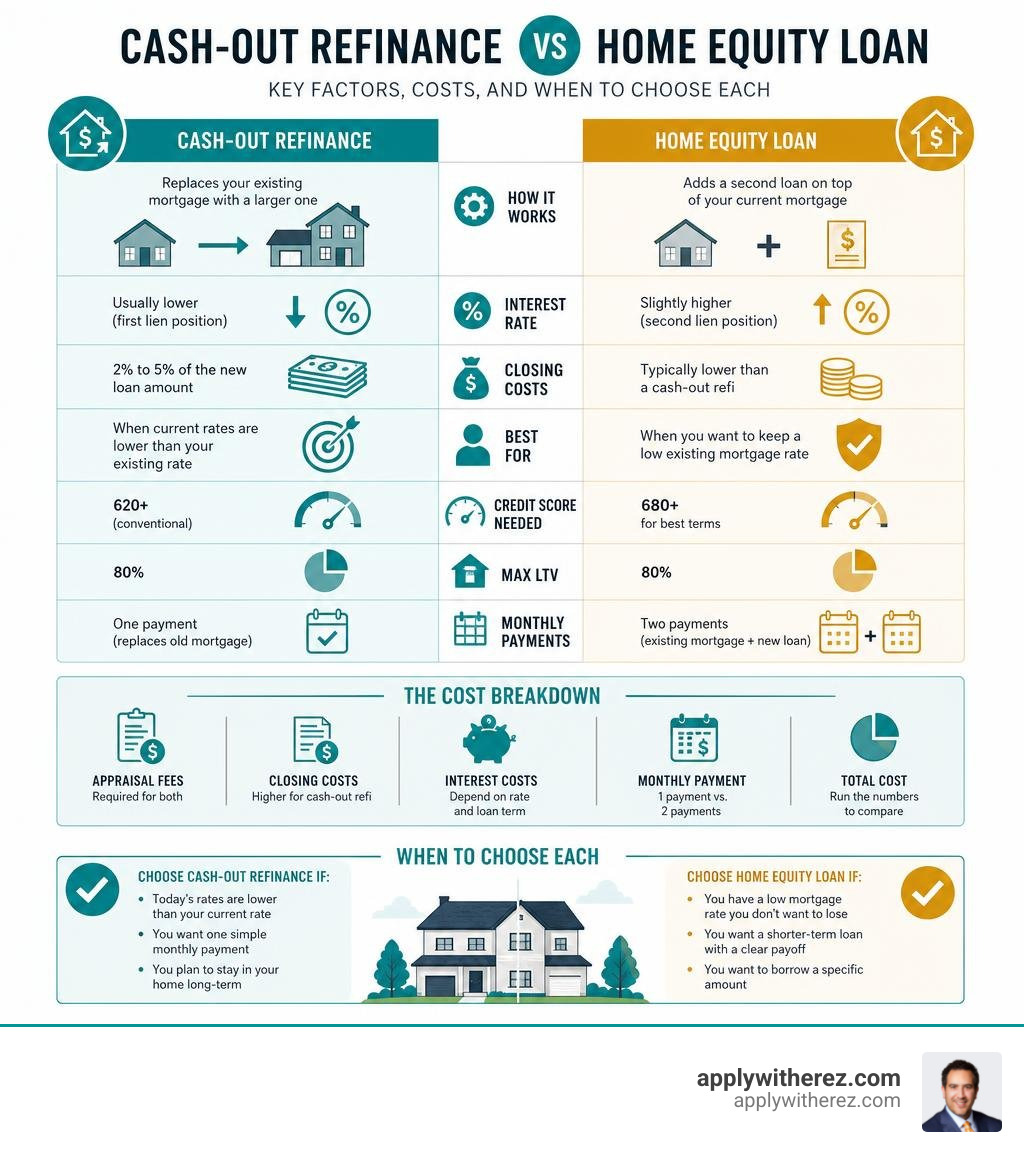
Factor Cash-Out Refinance Home Equity Loan How it works Replaces your existing mortgage with a larger one Adds a second loan on top of your current mortgage Interest rate Usually lower (first lien position) Slightly higher (second lien position) Closing costs 2% to 5% of the new loan amount Typically lower than a cash-out refi Best for When current rates are lower than your existing rate When you want to keep a low existing mortgage rate Credit score needed 620+ (conventional) 680+ for best terms Max LTV 80% 80% Monthly payments One payment (replaces old mortgage) Two payments (existing mortgage + new loan)
The bottom line: If today's rates are lower than your current mortgage rate, a cash-out refinance often wins. If you already have a low rate you don't want to lose, a home equity loan usually makes more sense.
Both options let you tap the equity you've built in your home. But they work very differently — and the wrong choice can cost you tens of thousands of dollars over the life of the loan. A homeowner consolidating $50,000 in debt, for example, could pay $24,400 in total interest with a 10-year home equity loan at 8.5% — or $63,800 with a 30-year cash-out refinance at 6.5%. A lower rate doesn't always mean a lower total cost.
That's exactly why running the numbers matters so much.
I'm Erez Shimoni, a mortgage broker with 26 years of experience helping homeowners navigate decisions like this — including choosing between a cash-out refinance and a home equity loan using the right calculator tools. In this guide, I'll walk you through everything you need to compare both options clearly and confidently.
Cash-Out Refinance vs Home Equity Loan Calculator: Key Differences
When you want to pull cash out of your home, you have two primary vehicles to choose from. While both tap into your hard-earned equity, they restructure your debt in fundamentally different ways.

A cash-out refinance is a complete replacement of your current mortgage. You take out a brand-new first mortgage for a larger amount than what you currently owe. The new loan pays off your old one, and the leftover balance is handed to you as a lump sum of cash at closing. Because this new loan is in the first lien position, lenders face less risk, which typically means you get the lowest possible long-term interest rate.
A home equity loan, on the other hand, is a second mortgage. It sits right on top of your existing mortgage without disturbing it. You leave your primary mortgage exactly as it is—retaining its interest rate and payoff timeline—and take out a separate, secondary loan for a lump sum. Because the lender of a second mortgage is in a riskier position (they only get paid after the first mortgage holder is satisfied in a foreclosure), the interest rate on a home equity loan is usually slightly higher than a refinance rate.
To see how these structural differences play out with your specific numbers, you can run your details through a Home Equity vs. Refinance Calculator. This tool helps you see the long-term cost of keeping your current loan versus replacing it entirely.
How to Use a Cash-Out Refinance vs Home Equity Loan Calculator
Using an online calculator doesn't have to be intimidating. To get the most accurate results, you will need to gather a few key pieces of information first:
Your Estimated Home Value: What is your property worth in today's market? (You can use recent local sales or online valuation tools as a starting point).
Your Outstanding Balance: Exactly how much do you still owe on your current mortgage?
Your Current Interest Rate: What is the rate on your existing loan?
The Cash Amount Needed: How much money do you actually need to borrow for your project or consolidation?
Once you have these figures, you can plug them into our Calculator to see a side-by-side comparison. The calculator will estimate your new monthly payments, the total interest you will pay over the life of both options, and the upfront closing costs you can expect to encounter.
Key Calculator Inputs: LTV Limits and Credit Scores
Two of the most critical factors that dictate your options are your Loan-to-Value (LTV) ratio and your credit score.
The LTV ratio represents how much you owe compared to what the home is worth. For both conventional cash-out refinances and home equity loans, lenders generally enforce a maximum LTV limit of 80%. This means you must leave at least 20% equity untouched in your home.
For example, if your home is worth $500,000, your total debt (existing mortgage plus any new cash pulled out) cannot exceed $400,000.
Your credit score also plays a major role in your eligibility and the rates you'll receive. While you can sometimes qualify for a cash-out refinance with a credit score as low as 620, home equity loans often require higher credit scores—typically 680 or above—to lock in the best terms. Lenders also evaluate your Debt-to-Income (DTI) ratio, generally looking for a DTI of 43% or lower to ensure you can comfortably manage the payments.
To model how different credit scores and equity levels affect your borrowing power, you can test different scenarios with a Cash-Out Refinance Calculator.
Comparing Costs: Rates, Payments, and Closing Fees
To truly understand which route is cheaper, we have to look past the initial interest rate and examine the total cost of borrowing. A cash-out refinance might offer a lower interest rate than a home equity loan, but because that rate is applied to your entire mortgage balance, it can end up costing you far more if you are giving up a historically low rate on your primary loan.
Let's look at how the numbers compare. You can get a clearer picture of these expenses by reviewing the Average Closing Costs for Cash Out Refinance to see how upfront fees impact your bottom line.
Closing Costs and Fees Explained
Closing costs can represent a significant portion of your upfront expenses. For a cash-out refinance, closing costs typically range from 2% to 5% of the new, total loan amount. Because you are refinancing the entire balance of your home, these fees can quickly add up to thousands of dollars.
With a home equity loan, closing costs are generally much lower because the loan size itself is smaller. Some lenders even waive upfront closing fees entirely on second mortgages, though they may charge an early-closure fee if you pay off and close the loan within the first few years.
If you are looking to minimize out-of-pocket expenses during a refinance, you might consider a Cash Back at Closing Refinance where closing costs are rolled directly into the new loan balance.
Tax Implications of Tapping Your Equity
The tax rules for borrowing against your home equity changed significantly under the Tax Cuts and Jobs Act (TCJA) of 2017, and these rules remain in effect through 2026.
Today, interest paid on both cash-out refinances and home equity loans is only tax-deductible if the funds are used specifically to "buy, build, or substantially improve" the qualified home that secures the loan. If you use the cash to pay off credit card debt, buy a car, or take a vacation, that interest is absolutely not tax-deductible.
Always keep detailed receipts of your home improvement projects and consult with a qualified tax professional to ensure you meet all IRS guidelines before claiming any deductions.
When to Choose a Cash-Out Refinance vs. a Home Equity Loan
Choosing the right path depends entirely on your current financial situation, your existing mortgage rate, and how much money you need to borrow.

Before making your choice, it helps to read up on the Best Way to Get Cash Out of Home Equity to align your strategy with your long-term wealth-building goals.
When a Cash-Out Refinance Wins
A cash-out refinance is usually the best choice when:
Current market rates are lower than your existing rate: If you can lower your overall interest rate while pulling out cash, it's a double win.
You want a single monthly payment: Managing one mortgage is simpler than keeping track of two separate loans with different lenders.
You need a very large sum of money: Because refinance rates are lower than second mortgage rates, borrowing a large amount over 15 or 30 years is often more affordable through a primary refinance.
To calculate exactly how long it will take to break even on your closing costs, you can use the Cash-Out Refinance Calculator — Net Cash + Breakeven.
When a Home Equity Loan Wins
A home equity loan is typically the superior option when:
You have an incredibly low rate on your first mortgage: If you locked in a 3% or 4% mortgage rate years ago, you do not want to refinance that entire balance into today's higher rates just to get some cash.
You need a smaller loan amount: If you only need $25,000 or $50,000, paying refinance closing costs on a $300,000 mortgage makes no financial sense.
You want a shorter repayment term: Home equity loans frequently offer shorter terms (such as 10 or 15 years), helping you pay off the debt much faster.
To compare the specific payment schedules and interest costs of these two paths, try using the Home Equity Loan Comparison Tool.
Where Do HELOCs Fit Into the Equation?
We cannot talk about home equity loans and refinances without mentioning the Home Equity Line of Credit (HELOC).
A HELOC is a revolving line of credit that works similarly to a credit card, secured by the equity in your home. Instead of receiving a lump sum all at once, you can draw funds as you need them during a set "draw period" (usually the first 10 years). During this time, you typically only have to pay interest on the amount you actually borrow. Once the draw period ends, you enter the "repayment period" (often 15 to 20 years), during which you must pay back both principal and interest.
Comparing HELOCs with a Cash-Out Refinance vs Home Equity Loan Calculator
The main difference between a HELOC and a traditional home equity loan is that HELOCs usually feature variable interest rates. This means your monthly payments can fluctuate over time based on market conditions.
If you want to compare how a variable-rate line of credit stacks up against a fixed-rate cash-out refinance over your planned timeline, you can model both options using a HELOC vs Cash-Out Refinance Calculator.
Frequently Asked Questions
What is the maximum LTV for a cash-out refinance and a home equity loan?
For both a conventional cash-out refinance and a standard home equity loan, the maximum Loan-to-Value (LTV) limit is typically capped at 80%. This means you must retain at least 20% equity in your home after taking out the new loan. The only major exceptions are VA refinance loans, which can sometimes allow up to 100% LTV for qualified military veterans.
How has second mortgage debt changed in recent years?
Second mortgage debt has experienced dramatic shifts over the last two decades. It peaked at an all-time high of $1.138 trillion in October 2007 just before the housing market crash, eventually bottoming out at $436.7 billion at the end of 2021 when interest rates were at historic lows.
However, since the Federal Reserve began raising interest rates in earnest to combat inflation, second mortgage debt has grown by approximately 2% per quarter (or roughly 8% annually). Homeowners are choosing to keep their low-rate first mortgages intact and are opting for second mortgages to tap into their equity instead.
Is the interest on home equity loans tax-deductible in 2026?
Yes, but only under strict conditions. According to IRS guidelines established by the TCJA of 2017, interest on home equity debt is only deductible if the loan is used to buy, build, or substantially improve the primary or secondary home that secures the loan. If you use the funds for debt consolidation, college tuition, or personal expenses, the interest is not tax-deductible.
Conclusion
Tapping into your home equity is one of the greatest financial advantages of owning a home, but making the wrong choice can be incredibly expensive. Always take the time to run your numbers, compare the total interest costs over the life of the loans, and factor in closing fees before signing on the dotted line.
When you're ready to explore your options and find the perfect path forward for your home, we are here to help. Refinance your mortgage with Apply with Erez and let us help you maximize your home's equity.