
Cash-Out Refinance Calculator 101
How a Cash-Out Refinance Calculator Can Save You Thousands
Using a cash-out refinance calculator from a trusted mortgage professional gives you an instant snapshot of your potential savings before you ever talk to a lender. According to the Consumer Financial Protection Bureau, a cash-out refinance allows you to take out a new mortgage for more than you owe on your current home. Here's the quick answer most homeowners are looking for:
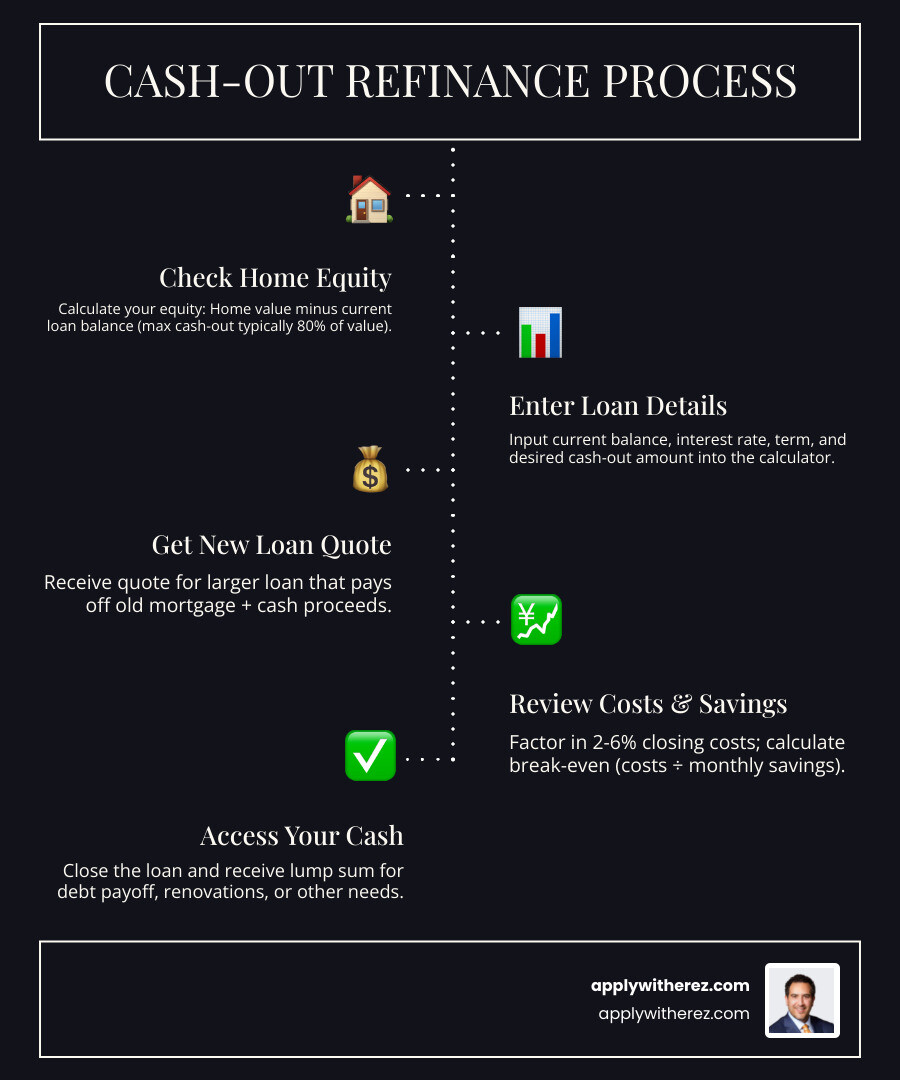
How to calculate your cash-out refinance savings:
Enter your current loan balance (from your mortgage statement)
Input your current interest rate and your new target rate
Add your desired cash-out amount (max is typically 80% of home value minus your balance)
Enter closing costs (typically 2%-6% of the new loan amount)
Check your break-even point - divide total closing costs by monthly savings (e.g., $4,800 ÷ $200/month = 24 months)
Key rule of thumb: A new rate should be meaningfully lower than your current rate, or the cash-out funds should clearly support a strong financial goal, for refinancing to make sense.
As of May 2026, the average 30-year fixed mortgage rate sits around 6.46%. Cash-out refinance rates run roughly 0.25%-0.5% higher than standard refinance rates. That means the timing of your decision - and the numbers you plug into a calculator - really matter.
I'm Erez Shimoni, a mortgage professional with 26 years of industry experience, and I've helped hundreds of homeowners use our cash-out refinance calculator to run the numbers confidently before committing. In this guide, I'll walk you through exactly how to use one - and how to read what the results are actually telling you.
Understanding Cash-Out Refinance vs. Standard Refinance
Before we dive into the math, let’s clarify what we are actually doing here. A standard refinance (often called a "rate-and-term" refinance) is like a "restart" button for your mortgage. You replace your old loan with a new one to get a lower interest rate or a different term (like switching from a 30-year to a 15-year loan).
A cash-out refinance is a different beast entirely. It’s a tool for equity access. Instead of just swapping the rate, you take out a new loan that is larger than what you currently owe. The lender pays off your old mortgage and gives you the difference in a cold, hard lump sum of cash.
Think of your home equity as a giant piggy bank. Every time you make a mortgage payment or your home value goes up, that piggy bank gets heavier. A cash-out refinance lets you crack open that piggy bank without selling your house.
We often see homeowners use this for:
Home improvements: Renovating a kitchen or adding a deck to increase property value.
Debt consolidation: Paying off high-interest credit cards (which might be at 20% APR) with a mortgage rate that is significantly lower.
Major life expenses: Funding education or starting a business.
While a standard refinance focuses on lowering your monthly payment, a cash-out refinance focuses on liquidity. Because you are taking on a larger primary mortgage, your monthly payment might go up even if your interest rate goes down. This is why using a comprehensive cash-out refinance calculator is so critical—it helps you see the trade-off between your new monthly payment and the cash in your pocket.
How to Use a Cash-Out Refinance Calculator
To get the most accurate results, don't guess the numbers. Go grab your most recent mortgage statement. We want to be precise - down to the penny and the third decimal point on your interest rate.

Here is exactly how to navigate a cash-out refinance calculator:
Current Loan Balance: Enter the remaining principal balance from your statement.
Current Monthly Payment: Include only the principal and interest. Don't include your escrow (taxes and insurance) yet, as those usually stay the same regardless of the loan.
New Loan Term: Are you looking at another 30-year fixed? Or perhaps a 15-year to pay it off faster?
New Interest Rate: Look at current market trends for May 2026. Cash-out rates are usually 0.25% to 0.5% higher than standard rates.
Cash-Out Amount: How much do you need? Be careful here. Most lenders require you to leave at least 20% equity in the home.
Fees and Points: Refinancing isn't free. Closing costs typically range from 2% to 6% of the new loan amount. If you are "buying down the rate" with mortgage points, one point costs 1% of the loan amount and usually drops your rate by about 0.25%.
By plugging these into a calculator, you can run "what-if" scenarios. What if the rate drops another 0.25%? What if you take $50,000 instead of $70,000? The tool does the heavy lifting so you don't have to be a math whiz.
Interpreting Your Refinance Results
Once you hit "calculate," you'll be greeted with a lot of numbers. Here is what we should focus on:
Monthly Savings (or Increase): This is the difference between your old P&I (Principal and Interest) payment and the new one. If you are taking out a lot of cash, don't be surprised if this number is negative - meaning your payment went up.
Interest Savings: This shows how much total interest you will pay over the life of the new loan compared to the old one. This is a huge factor in long-term wealth building.
The Break-Even Point: This is the "Golden Ratio" of refinancing. A mortgage refinance break-even analysis tells you how many months it will take for your monthly savings to cover your closing costs. For example, if your closing costs are $6,000 and you save $200 a month, your break-even is 30 months. If you plan to move in two years, that refinance just cost you money.
Amortization Schedule: This shows how your balance will drop over time. With a cash-out refinance, you are essentially resetting the clock, so pay attention to how much principal reduction you are achieving in the early years.
Comparing Rates and Market Trends
As we stand in May 2026, the mortgage market has seen some interesting shifts. Back in January 2025, we saw 30-year fixed rates as high as 7.19%. By January 2026, they had cooled to 6.18%. Currently, the average sits at 6.46%.
When using a cash-out refinance calculator, you must account for the "risk premium." Lenders view cash-out loans as riskier than standard ones. Because of this, you'll typically pay a 0.25% to 0.5% premium over the standard refinance rate. If a regular refi is 6.0%, your cash-out refi may be around 6.25% to 6.5%.
Your credit score also plays a massive role here. While the market average is 6.46%, someone with a 780 credit score might see a lower offer than someone at 640. Market fluctuations are out of our control, but your credit impact is something we can often manage before we apply.
For broader mortgage guidance and consumer protections, it's also worth reviewing resources from Consumer Financial Protection Bureau.
Eligibility Requirements and Closing Costs in 2026
You can’t just walk into a bank and ask for your equity; you have to prove you’re a good bet. In 2026, the requirements have remained fairly steady but strict.
Minimum Requirements for a Cash-Out Refinance:
Credit Score: Usually a minimum of 620. Higher scores get significantly better rates.
Debt-to-Income (DTI) Ratio: Lenders generally want to see your total monthly debts (including the new mortgage) stay under 43% of your gross monthly income.
Loan-to-Value (LTV) Ratio: For conventional and FHA loans, you are typically capped at an 80% LTV. This means if your home is worth $500,000, your new total loan cannot exceed $400,000. VA loans are a rare exception, sometimes allowing up to 100% LTV.
Seasoning: Most lenders require you to have owned the home for at least six months.

Then, there are the costs. Closing costs are the "entry fee" for your new loan.
Fee Type Estimated Cost Origination Fee 0.5% – 1.5% of loan amount Appraisal $400 – $800 Title Insurance $500 – $1,500 Credit Report/Admin $100 – $300 Total Closing Costs 2% – 6% of loan amount
On a $300,000 loan, you could be looking at $6,000 to $18,000 in fees. You can often roll these into the loan balance so you don't pay them out of pocket, but remember: you'll be paying interest on those fees for the next 30 years!
Strategic Uses and Alternatives for Home Equity
Just because you can take cash out doesn't mean you should. We always recommend using home equity for things that build wealth or save money in the long run.
Home Renovations: Using $50,000 to fix a dated kitchen can sometimes add meaningful value to your home. That's often a productive use of equity.
Consolidating High-Interest Debt: If you have $30,000 in credit card debt at 22%, moving that into a 6.5% mortgage can create substantial monthly relief, though it also converts unsecured debt into debt tied to your home.
Education: Funding a degree or training program that increases your earning potential can be a thoughtful long-term move.
However, there is a foreclosure risk. When you do a cash-out refinance, you are increasing the debt secured by your home. If you can't make the payments, you could lose the roof over your head. Never use cash-out funds for depreciating assets like a luxury vacation or a new car unless your financial house is in perfect order.
What if a Cash-Out Refi isn't right? If your current mortgage has a very low interest rate, you may not want to replace it. In that case, consider these refinance options and alternatives:
HELOC (Home Equity Line of Credit): This works like a revolving credit line tied to your home. You only pay for what you use, and it sits as a second lien, leaving your primary mortgage untouched.
Home Equity Loan: This is a separate fixed-rate loan with a lump sum. Again, it does not replace your original mortgage.
For a general overview of home equity borrowing, the Federal Trade Commission provides a helpful consumer guide.
Frequently Asked Questions about Cash-Out Refinancing
How long does a cash-out refinance typically take to close?
Generally, you should expect the process to take 30 to 60 days. This includes the time for an appraisal, underwriting, and the "rescission period." Federal law gives you a three-day "cooling off" period after you sign the papers before the lender can actually give you the cash.
What are the tax implications of taking cash out of my home?
The cash you receive is generally not considered income, so you don't pay income tax on it. However, the interest deduction rules changed a few years ago. You can usually only deduct the interest on the portion of the loan used to "buy, build, or substantially improve" the home that secures the loan. If you use the cash to pay off credit cards, that portion of the interest might not be tax-deductible. Always consult a tax pro, and you can review current guidance from the Internal Revenue Service.
How much equity must I keep in my home after refinancing?
For most conventional loans, you must maintain at least 20% equity. This means your Loan-to-Value (LTV) ratio cannot exceed 80%. This protects the lender if home prices drop and helps protect you from owing more than the home is worth.
Conclusion
A cash-out refinance calculator is the best first step toward achieving your financial goals. Whether you are looking for long-term savings through debt consolidation or building wealth through home improvements, the numbers will tell the story.
At applywitherez.com, we believe in making these complex decisions simple and transparent. We’ve seen how the right refinance can change a family's financial trajectory, especially in a market like 2026.
If you’re ready to see what your home equity can do for you, or if you need more info about refinance services, we are here to help you run the numbers. Let’s make sure your home is working just as hard for you as you worked for it.