
Zero-Cost Refinance Options Demystified
How a Free Refinance Mortgage Actually Works
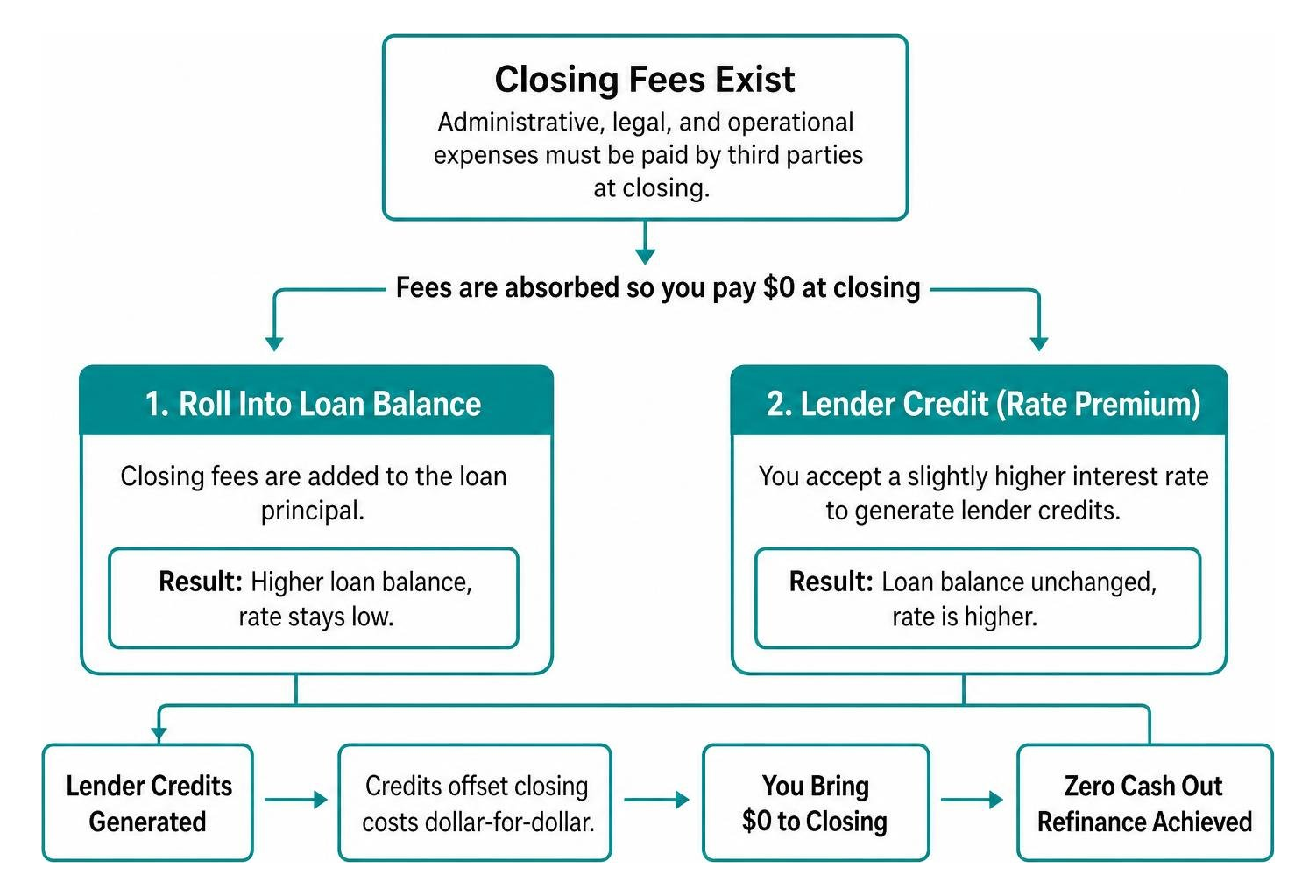
When lenders promote a "free" or "zero-cost" loan, they do not magically make the administrative, legal, and operational expenses of origination disappear. In the mortgage industry, third parties like title attorneys, state recording offices, and appraisal management companies must be paid. A free refinance mortgage functions by shifting who pays those expenses at the closing table and how they are recovered over time.
There are three main structures used across the lending market to achieve a zero-cash-out-of-pocket transaction: paying upfront, rolling costs into the principal, or utilizing lender credits.
Refinance Structure | Upfront Cash Required | Loan Balance Impact | Interest Rate Impact | Best Suited For |
|---|---|---|---|---|
Traditional Refinance | High (2%–5% of loan) | None (stays at principal) | Lowest available market rate | Long-term homeowners (5+ years) |
Financed (Rolled-In) Refinance | None ($0 out of pocket) | Increases by total closing costs | Low market rate maintained | Homeowners with strong equity keeping loan 3–7 years |
Lender-Credit (Zero-Cost) Refinance | None ($0 out of pocket) | None (original principal only) | Higher by 0.125%–0.250% | Short-term horizon (under 3–4 years) or frequent refinancers |
The Lender Credit Mechanism
The most authentic version of a no-closing-cost refinance uses lender credits generated via premium pricing. When you accept an interest rate slightly higher than the lowest par rate—typically an increase of 0.125% to 0.25%—the secondary market pays a premium for that mortgage note (historically referred to as a yield spread premium).
The lender uses this surplus yield to offset your settlement fees dollar-for-dollar. For example, on a $400,000 mortgage, a 0.25% bump in your interest rate might generate a $4,000 to $6,000 lender credit. That credit appears on your closing ledger to pay off origination charges, title fees, and transfer stamps. You bring $0 to closing, and your loan balance remains exactly $400,000. However, your monthly interest payment is permanently higher for as long as you retain that specific note.
Financing Costs vs. Rate Premiums
The second method involves financing the closing costs directly into the loan balance. Instead of taking a higher rate, you accept the lower market rate, but your loan balance increases from $400,000 to $408,000 to cover settlement fees.
While this preserves your liquid cash, it immediately reduces your home equity and raises your loan-to-value (LTV) ratio. For borrowers navigating equity restructuring, our Cash Out Refinance Guide 2026 explains how capital extraction interacts with overall loan balance adjustments.
Financing costs means you will pay interest on those fees across the entire life of your loan. A $400,000 refinance with $16,000 in closing costs rolled into a 30-year term results in $37,360 more in total lifetime interest compared to paying those costs upfront out of pocket.
What Fees Are Truly Covered (and What You Still Pay)
Understanding the fine print requires separating lender-specific charges from non-negotiable third-party and governmental fees.
When an offer promises zero lender fees, it generally waives internal administrative items while leaving operational pass-through costs intact:
Typically Waived in "No-Lender-Fee" Programs:
Loan origination fee (often 0.5% to 1.0% of the loan amount)
Underwriting fees
Processing charges
Document preparation and administrative application fees
Typically NOT Waived (Borrower Responsibility or Covered via Rate Credits):
Independent home appraisal fees ($500–$800)
Title search, settlement, and lender’s title insurance policies
State and county mortgage recording fees
Transfer taxes (especially significant in states like New York and Pennsylvania)
Prepaid property taxes, per-diem interest, and homeowners insurance escrow reserves
Uncovered Third-Party and Prepaid Expenses
In states like New York, New Jersey, and Pennsylvania, regional fees can substantially elevate total closing costs. For example, New York’s Mortgage Recording Tax can add thousands to a closing ledger unless mitigated through legal assignment instruments like a Consolidation, Extension, and Modification Agreement (CEMA).
When evaluating these non-lender expenses, review the Average Closing Costs for Cash Out Refinance to understand how regional title, settlement, and recording liabilities establish your baseline closing budget.
Scrutinizing the Loan Estimate and Closing Disclosure
Federal TRID regulations require every lender to deliver a standardized Loan Estimate (LE) within three business days of application, followed by a Closing Disclosure (CD) at least three days prior to closing.
To verify whether your refinance is truly zero-cost, review these specific sections:
Section A (Origination Charges): Should reflect $0 or show matching lender credits offsetting internal charges.
Sections B & C (Services You Cannot / Can Shop For): Lists third-party costs (appraisal, credit report, title).
Section J (Total Closing Costs): Look for the line item labeled Lender Credits. In a true no-cost transaction, the negative number in Section J should equal the sum of your closing costs.
Calculating Real Net Costs: You can audit your Loan Estimate by comparing your stated interest rate against your Annual Percentage Rate (APR). In a loan where closing costs are truly absorbed via lender credits, the APR will be very close or identical to the nominal note rate.
Financial Analysis: Is a No-Closing-Cost Refinance Worth It?
Data from recent lending cycles indicates that approximately 78.7% of refinance borrowers pay above the most competitive available market rate, overpaying by an average of $2,462 annually due to miscalculated cost structures.
Choosing whether to pay fees out of pocket or trade them for a higher rate depends on your anticipated time horizon in the property.
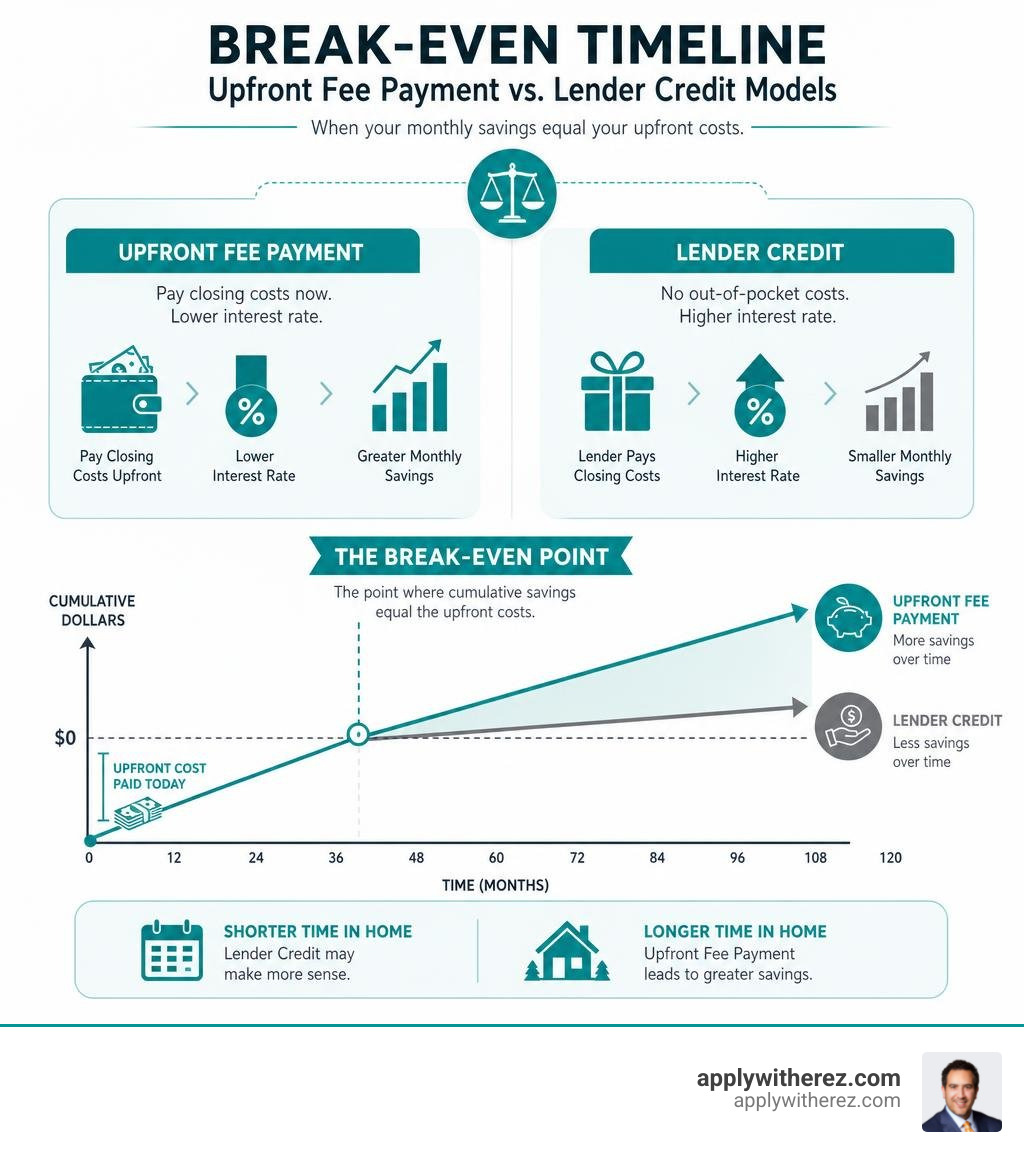
If standard closing costs run between 2% and 5% of your loan amount (averaging $3,000 to $7,000 in most markets), absorbing those fees through a 0.25% rate increase makes sense if you plan to sell or refinance again within 3 to 4 years. Conversely, if you plan to keep the mortgage for 10, 15, or 30 years, accepting a permanently higher rate means you will pay back those fees several times over in cumulative interest. You can calculate lifetime refinance savings to compare these multi-year trajectories.
Calculating Your Free Refinance Mortgage Break-Even Point
The break-even point is the exact month where the cumulative monthly payment savings from your lower interest rate surpass the transaction costs incurred.
$$\text{Break-Even Point (Months)} = \frac{\text{Total Closing Costs}}{\text{Monthly Payment Savings}}$$
For example, if a standard refinance costs $4,800 out of pocket and lowers your payment by $160 per month, your break-even point is 30 months:
$$\frac{\$4,800}{\$160} = 30 \text{ months}$$
In a lender-credit zero-cost refinance, your upfront cost is $0. Thus, your break-even point is technically Month 1. However, your monthly payment savings will be smaller because of the higher rate premium.
To evaluate whether rolling costs or trading rate credits delivers a better net tangible benefit, use the Mortgage Refinance Break-Even Analyzer alongside our dedicated Refinance analysis frameworks.
Comparing 15-Year vs. 30-Year Refinance Trajectories
Amortization resets play a massive role in whether a zero-cost refinance saves money over the long term. If you are 7 years into a 30-year mortgage and refinance into a new 30-year loan with a zero-cost rate premium, you reset your amortization clock back to 360 months, heavily weighting your initial payments toward interest rather than principal reduction.
Switching to a shorter amortization schedule can eliminate this drawback. For eligible service members and veterans, our 15 Year VA Refinance Rates Guide 2026 outlines how compressed terms drastically cut total interest exposure while maximizing equity accumulation.
Eligibility and Loan Options Across Different Programs
Securing favorable terms on a no-closing-cost refinance requires meeting standard underwriting and risk-layering benchmarks:
Credit Score Requirements: While conventional loans allow approvals starting at a 620 credit score, borrowers with scores of 740+ access the best pricing tiers. Higher credit scores generate larger lender credits for smaller rate adjustments.
Seasoning Rules: Most conventional and government loan programs require a minimum seasoning period of 6 months (or 180 to 210 days) from the first payment date of your existing mortgage before you are eligible to refinance.
Net Tangible Benefit: State regulations across New York, New Jersey, and Pennsylvania require lenders to prove a measurable financial benefit to the consumer (such as a minimum payment reduction or rate drop) before executing a refinance.
Government Loan Programs vs. Free Refinance Mortgage Offers
Government-backed mortgage programs offer specialized "streamline" structures designed to lower closing expenses and documentation hurdles:
For FHA homeowners, reviewing the Best FHA Streamline Refinance Guide 2026 details how upfront mortgage insurance premiums interact with monthly payment reductions. Military borrowers can explore the Best VA Streamline Refinance Lenders to learn how the Interest Rate Reduction Refinance Loan (IRRRL) waives appraisal requirements and limits out-of-pocket settlement charges.
Equity and Loan-to-Value Constraints
Your equity position directly determines your pricing tier and whether you can eliminate costly ancillary expenses:
The 20% Equity Threshold: Maintaining at least 20% equity (an 80% LTV or lower) allows conventional borrowers to eliminate Private Mortgage Insurance (PMI), delivering immediate monthly savings independent of interest rate movements.
Financing Limitations: If your LTV exceeds 80% and you roll closing costs into the loan balance, you risk pushing your loan into PMI territory or increasing your existing insurance premium tier.
Cash Management: For transactions involving minor equity distributions, reviewing our insights on Cash Back at Closing Refinance ensures your loan structure complies with strict secondary market limits regarding incidental cash distributions.
Frequently Asked Questions About Zero-Cost Refinances
Can you refinance multiple times under a no-fee program?
Yes. There is no statutory limit on how many times you can refinance a property over your lifetime. However, you must satisfy standard seasoning requirements (typically 6 months between closings) and pass the state-mandated net tangible benefit test for every individual transaction. Frequent refinancing is most effective when utilizing lender credits, as rolling costs into your principal balance repeatedly will systematically erode your accumulated home equity.
Does a no-cost refinance hurt your credit score?
Applying for a refinance triggers a hard credit inquiry, which may temporarily reduce your score by a few points. However, credit scoring models (including FICO and VantageScore) apply a deduplication shopping window of 14 to 45 days. All mortgage credit checks conducted within that window count as a single inquiry, allowing you to shop multiple lenders without compounding credit penalties.
How do you negotiate lender fees if a refi isn't 100% free?
Lender-controlled fees (Section A of your Loan Estimate, such as origination, processing, and application charges) are entirely negotiable. You can negotiate by:
Securing competing Loan Estimates from at least three different lenders on the same business day.
Requesting an appraisal waiver (Property Inspection Waiver) through automated underwriting systems if your equity level qualifies.
Shopping for your own title insurance and settlement agent (Section C of your Loan Estimate) rather than defaulting to the lender's preferred providers.
Conclusion
A zero-cost refinance is a powerful financial tool when paired with a clear understanding of your long-term ownership plans. By matching your time horizon to the right cost structure—whether paying upfront for the lowest lifetime interest, rolling costs in to preserve liquidity, or using lender credits for short-term flexibility—you can optimize your monthly cash flow without compromising your financial future.
Explore our comprehensive analysis of the Best Mortgage Refinance Companies with No Closing Costs to evaluate current market options and find the structure tailored to your homeownership goals.