
Streamline Your Savings with the Best FHA Refinance Lenders
Why Finding the Best FHA Streamline Refinance Lender Can Save You Thousands
If you're looking for the best FHA streamline refinance lenders, you should compare them based on their minimum credit scores, closing speed, and standout features. Some lenders offer access for scores as low as 580, while others prioritize closing in under 30 days or offering no-appraisal options for existing customers.
You have an existing FHA loan. Rates have shifted. And you're wondering if now is the right time to refinance -- and who to refinance with.
That's a smart question to ask.
The national average 30-year FHA refinance rate is 6.64% (APR: 6.68%) as of March 2026. Even a modest rate drop can mean hundreds of dollars saved each month -- without the hassle of a full loan application.
The FHA Streamline Refinance program is built for exactly this situation. No appraisal. Less paperwork. Faster closing. But not all lenders offer the same rates, fees, or service quality -- and the differences matter.
This guide compares the top lender qualities side by side so you can find the best fit for your credit score, timeline, and budget.
I'm Erez Shimoni, a mortgage professional with 26 years of industry experience (NMLS #460222), and helping borrowers navigate options like the best fha streamline refinance lenders is exactly the kind of work I do every day. Whether you're comparing rates or trying to understand the fine print, I'll walk you through everything you need to make a confident decision.
What Is an FHA Streamline Refinance and Who Should Use It?
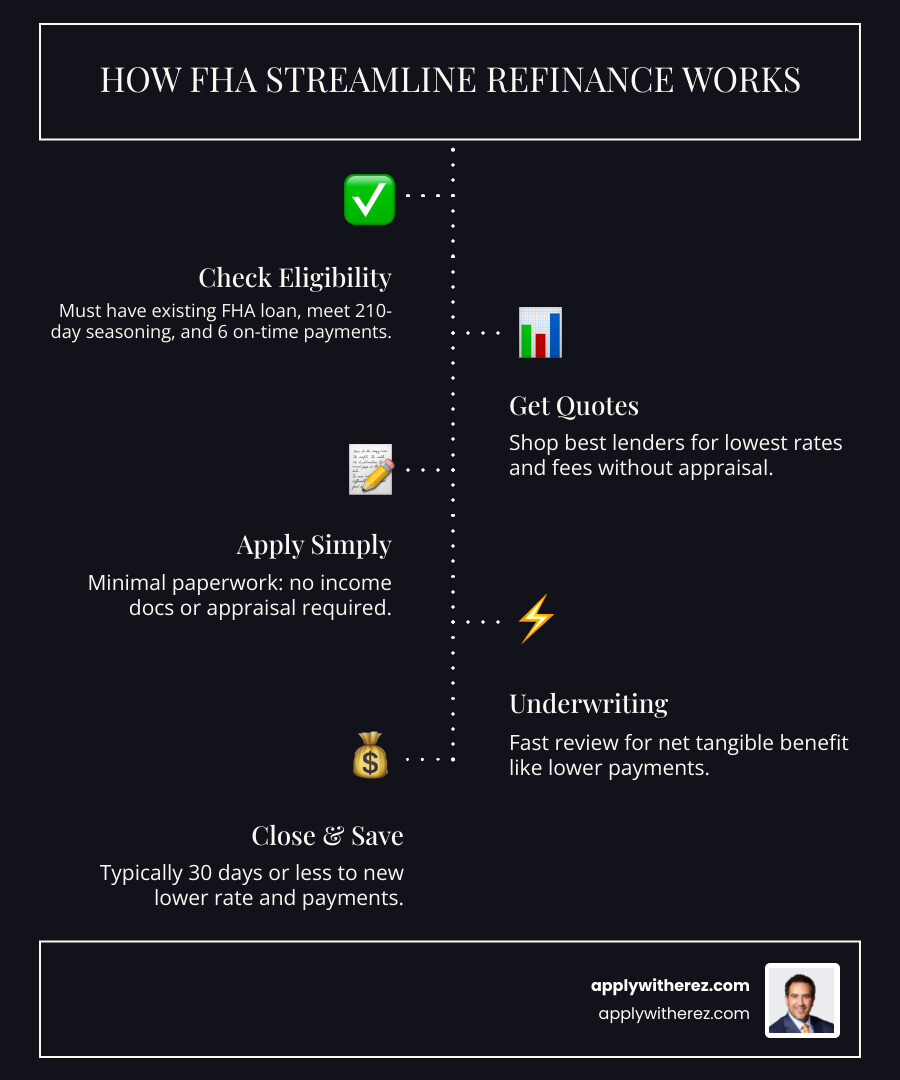
An FHA Streamline Refinance is a specialized program designed for homeowners who already have an FHA-backed mortgage. Think of it as a "shortcut" to a lower interest rate. Because the Federal Housing Administration (FHA) already insures your current loan, they don't require the mountain of paperwork that usually comes with a traditional refinance.
The primary goal of this program is to provide a "net tangible benefit." In plain English, this means the refinance must actually help you—usually by lowering your monthly principal and interest payment by a specific percentage or by moving you from a risky adjustable-rate mortgage (ARM) into a stable fixed-rate loan.
How an FHA Streamline Refinance Works
Unlike a standard rate-term refinance, the "Streamline" version lives up to its name by bypassing several hurdles. It is strictly a rate-and-term adjustment. This means you cannot use it to take cash out of your home equity.
One of the most unique features is the mortgage insurance. You will still pay a Mortgage Insurance Premium (MIP), but if you are refinancing from one FHA loan to another, you may be eligible for a partial refund or credit of your previous upfront MIP if you close within a certain timeframe. The process is significantly faster because the lender often relies on the information from your original FHA application.
Who Qualifies for an FHA Streamline Refinance?
To step into this program, you need to meet the "seasoning" requirements. We look for a loan that is at least 210 days old from the closing date of your last mortgage. Additionally, you must have made at least six monthly payments on your current loan.
Your payment history is the star of the show here. The FHA requires that you have made your last six monthly payments on time. Over the past 12 months, you are allowed no more than one late payment (30 days past due). While the program is often used for primary residences, it can also be used for investment properties and second homes, provided they were originally financed with an FHA loan.
Key Benefits and Tradeoffs to Know
The "Big Three" benefits are reduced documentation, no required appraisal, and the ability to refinance even if you are "underwater" (meaning you owe more than the home is currently worth). Since no appraisal is required, the LTV (loan-to-value) ratio is essentially unlimited.
However, there are tradeoffs. While you save on the appraisal fee, you still have closing costs to consider. Also, because this is an FHA loan, the MIP stays with you for the life of the loan in most cases. You’ll want to calculate if the monthly savings outweigh these ongoing costs.
Best FHA Streamline Refinance Lenders: What to Compare Before You Apply
When you start shopping, don't just look at the interest rate. You need to look at the "big picture." This includes the APR (which accounts for fees), the lender's credit score requirements (known as "overlays"), and how fast they can actually get you to the closing table.
Best FHA Streamline Refinance Lenders for Low Credit Scores
Technically, the FHA doesn't set a minimum credit score for a Streamline Refinance. However, individual lenders do.
Some lenders are known for their accessibility, allowing existing customers to refinance with a score as low as 580.
Other national providers typically look for a 620.
If your score is on the lower end, you'll want to find a lender that performs a "manual review" rather than just relying on an automated "no" from a computer.
Best FHA Streamline Refinance Lenders for Fast Closings
If you're in a hurry to catch a low rate, speed is everything.
Certain high-speed lenders are standouts here, aiming for an underwriting decision in just hours and processing within 7 to 10 days.
Many top-tier mortgage companies target a sub-30-day closing window.
Some lenders even put their money where their mouth is with a close-on-time guarantee, which provides great peace of mind.
Best FHA Streamline Refinance Lenders for Low-Cost Options
Closing costs can be a hurdle, but the best fha streamline refinance lenders offer creative ways to handle them.
Some providers are frequently cited for "low or no-cost" options. In a "no-cost" refinance, the lender gives you a credit to cover your closing costs in exchange for a slightly higher interest rate.
Some lenders also allow you to roll the closing costs into the loan balance, but there’s a catch: this usually requires an appraisal to prove you have the equity to cover the new, higher loan amount.
FHA Streamline Refinance Rates in 2026 and How Much You Could Save
As of May 2026, we are seeing national average 30-year FHA refinance rates hovering around 6.64%. While this is higher than the historic lows of a few years ago, it is competitive for the current market. You can also compare broader market benchmarks using today's FHA refinance rates.
How to Compare FHA Streamline Rates Across Lenders
When comparing quotes, always ask for the Loan Estimate. This standardized document lets you compare "Apples to Apples." Look closely at:
The APR: This is the true cost of the loan.
Discount Points: Are they charging you extra upfront to "buy down" the rate?
Lender Credits: Are they paying your costs in exchange for a higher rate?
To run your own numbers and see what your new payment might look like, use our Calculator.
Sample Savings Scenarios for FHA Borrowers
Imagine you have a $300,000 FHA loan at 7.5%. By refinancing to 6.64%, you could potentially save over $170 per month on your principal and interest. Over five years, that's $10,200 back in your pocket. The "break-even point" is the moment your monthly savings have covered the cost of the refinance. If your closing costs are $3,000 and you save $170 a month, your break-even point is about 18 months.
FHA Streamline vs Other Refinance Options
Why choose an FHA Streamline over a conventional refinance?
Appraisal: Conventional loans almost always require an appraisal; Streamline doesn't.
Credit Score: FHA is much more forgiving of lower scores.
Equity: You can be "underwater" on an FHA Streamline, whereas conventional loans usually require at least 3% to 5% equity.
Requirements, Documents, Closing Costs, and Timeline
Even though it’s "streamlined," you can't just snap your fingers and get a new loan. There is still a process to follow.
Documents You May Need Even With a “Streamline” Process
While you won't need to provide stacks of paystubs or tax returns in many cases, you should have the following ready:
Valid Government ID.
Your most recent mortgage statement.
A payoff statement from your current lender.
An occupancy certification (confirming if you live in the home).
Proof of homeowners insurance.
Can Closing Costs Be Rolled Into the Loan?
This is a common point of confusion. Under FHA rules, you generally cannot roll closing costs into the new loan amount on a Streamline Refinance unless you get an appraisal. If you skip the appraisal, you must either pay the costs out of pocket at closing or opt for a "no-cost" refinance where the lender covers the fees in exchange for a higher interest rate.
How Long the FHA Streamline Process Typically Takes
On average, expect the process to take about 30 days. Some high-speed lenders can do it in 15 to 20 days, while others might take longer if they have a high volume of applications. The steps usually include:
Application: 1 day.
Disclosures: 3 days.
Underwriting: 1–7 days.
Closing/Funding: 3–5 days.
How to Choose the Right Lender for Your Situation
Choosing among the best fha streamline refinance lenders comes down to your personal priorities. Are you chasing the absolute lowest monthly payment, or do you need a lender who will overlook a recent credit hiccup?
Best Fit for Lower Scores, Limited Equity, or Minimal Docs
If your home value has dropped or your credit score is in the 500s, look for lenders who specialize in FHA products. They are more likely to work with "overlays" that favor your situation. The FHA Streamline is one of the few ways to refinance a home that is worth less than the loan balance.
Best Fit for Speed, Transparency, and Support
If you value a digital experience, lenders with robust online portals are your best bet. Look for lenders that offer clear communication and direct access to a loan officer.
When you're ready to see what's possible for your specific home and financial goals, you can start the process here: Refinance.

Frequently Asked Questions About the Best FHA Streamline Refinance Lenders
Can FHA Streamline Refinance be used for investment properties or second homes?
Yes! While many FHA programs are for primary residences only, the Streamline program allows you to refinance an investment property or a second home, provided the loan you are refinancing is already an FHA loan. Some lenders may have stricter requirements or slightly higher rates for non-owner-occupied properties.
What credit score is required for FHA Streamline Refinance?
While the FHA itself doesn't require a minimum score for a Streamline, most lenders do. You'll find that many of the best fha streamline refinance lenders look for a score of at least 580 to 620. If your score is lower, don't give up—some lenders are willing to do a manual underwriting process if your payment history is perfect.
Is mortgage insurance required on an FHA Streamline Refinance?
Yes. FHA loans require both an Upfront Mortgage Insurance Premium (UFMIP) and an annual MIP paid monthly. If you are refinancing an existing FHA loan into a new one, you may get a pro-rated credit toward the new UFMIP if you refinance within three years of your original loan's closing date.
Conclusion
Finding the best fha streamline refinance lenders is about more than just finding the lowest headline rate. It’s about finding a partner who understands the FHA’s unique rules and can guide you to a "net tangible benefit" that makes financial sense for your family.
Whether you're looking to drop your monthly payment, switch to a fixed rate, or simply take advantage of your excellent payment history, the FHA Streamline Refinance is a powerful tool. By comparing the lender qualities we've discussed and doing your homework on fees and timelines, you can secure a more affordable future for your home.
Ready to take the next step? We’re here to help you navigate the paperwork and find the savings you deserve. Refinance with us today.