
Refinancing into a 15-Year VA Loan: A Smart Move for Veterans
Are 15-Year VA Refinance Rates Worth It in May 2026?
15-year VA refinance rates are currently as low as 5.000% (5.686% APR) as of May 30, 2026 — well below the national average for conventional refinance loans.
Here's a quick snapshot to answer your most pressing questions:
Loan Type Interest Rate APR Monthly Payment ($300K) 15-Year VA Refinance 5.000% 5.686% $2,372 30-Year VA Refinance 5.375% 5.813% ~$1,679 15-Year Conventional 5.375% 5.588% — 30-Year Conventional 6.000% 6.142% — National Avg 15-Year Fixed 6.08% — —
Rates as of May 2026. Monthly payment estimates exclude taxes and insurance.
If you're a veteran weighing your refinance options, the math can be compelling. A 15-year VA loan typically offers a lower interest rate than a 30-year VA loan, and dramatically lower rates than conventional refinance products. The tradeoff? A higher monthly payment — but far less interest paid over the life of the loan.
This guide breaks down exactly how these rates work, what affects your personal quote, and how to decide whether a 15-year VA refinance is the right move for your financial goals.
I'm Erez Shimoni (NMLS #460222), a mortgage broker with 26 years of industry experience helping veterans and service members navigate 15-year VA refinance rates and find loan structures that fit their long-term plans. I'll walk you through everything you need to make a confident, informed decision.
Current 15 year va refinance rates and how they compare in May 2026
As of May 2026, advertised 15-year VA refinance pricing can be very competitive, with examples as low as 5.000% with 0.500 discount points and a 5.686% APR. For context, national 15-year fixed refinance averages are around 6.08%, while 30-year refinance averages are generally higher.
That gap matters. A lower rate can reduce total interest, but the 15-year term is the real savings engine. You are compressing the payoff schedule, so more of each payment goes toward principal sooner.
You can review broader market benchmarks through current VA refinance rate benchmarks, but remember: posted rates are starting points, not promises. Your quote depends on your credit, equity, loan type, closing-cost structure, and whether you are doing a VA streamline refinance or cash-out refinance.
Refinance Option Example Rate Example APR Key Takeaway 15-Year VA Refinance 5.000% 5.686% Lowest example rate, faster payoff 30-Year VA Refinance 5.375% 5.813% Lower payment, more total interest 15-Year Conventional 5.375% 5.588% Competitive, but may require stronger equity and credit 30-Year Conventional 6.000% 6.142% Longer term and typically higher interest cost
APR is especially important when comparing loans. The interest rate tells you the cost of borrowing the principal. APR includes the interest rate plus certain finance charges, such as points and some closing costs. If one loan has a lower rate but much higher fees, the APR helps reveal that tradeoff.
Discount points also matter. In the example above, the 15-year VA refinance rate includes 0.500 points, meaning the borrower pays one-half of 1% of the loan amount upfront to reduce the rate. On a $300,000 loan, that is about $1,500 before considering any other costs. Points can make sense if you plan to keep the loan long enough to recover the upfront cost through monthly savings.
What current 15 year va refinance rates mean for a $300,000 loan
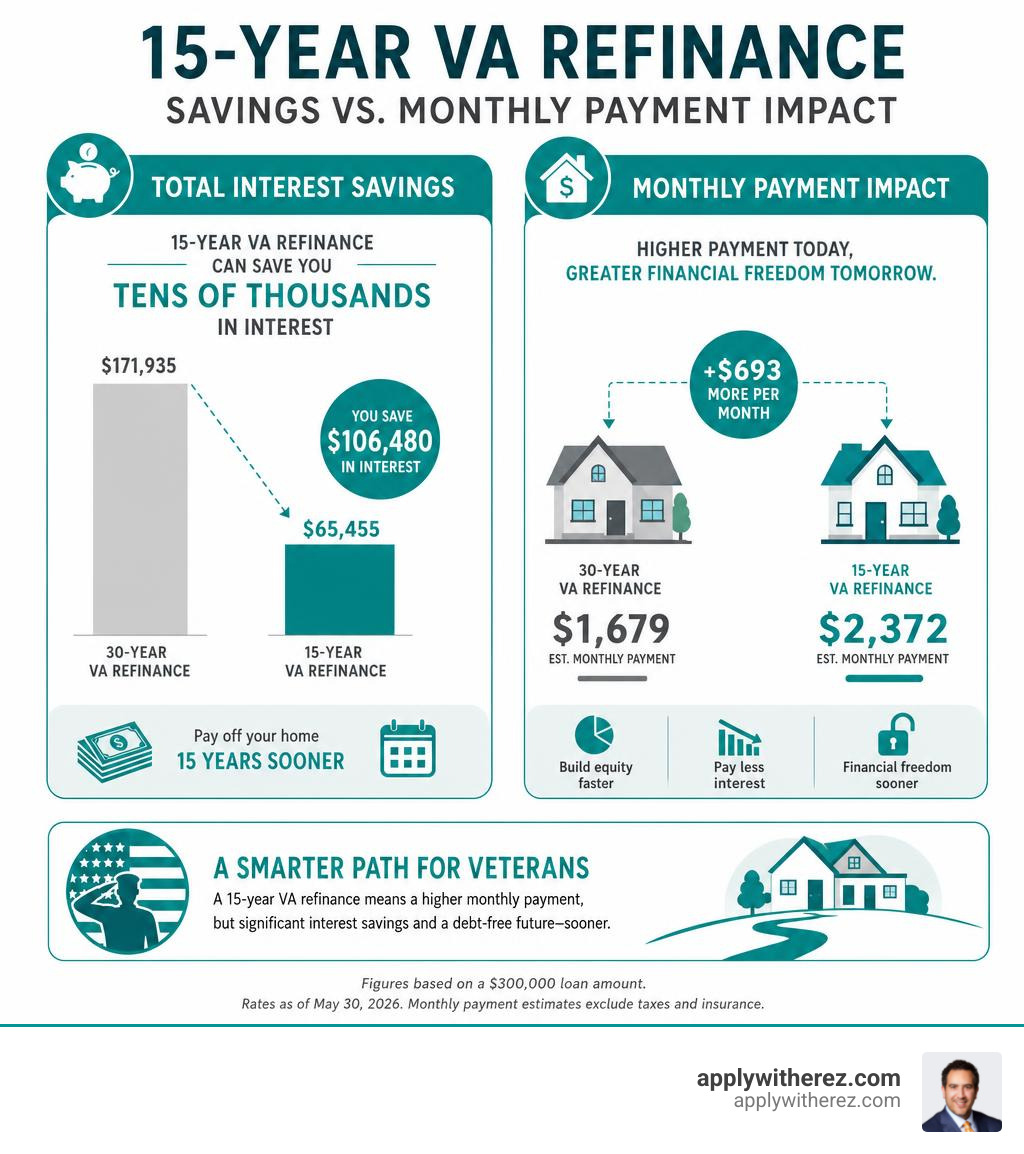
For a $300,000 15-year VA refinance at 5.000%, the estimated principal and interest payment is about $2,372 per month. That does not include property taxes, homeowners insurance, HOA dues, or escrow adjustments.

Here is the basic payment picture:
Loan Scenario Loan Amount Rate Term Estimated Principal and Interest 15-Year VA Refinance $300,000 5.000% 15 years $2,372 30-Year VA Refinance $300,000 5.375% 30 years ~$1,679
The 15-year payment is roughly $693 higher per month in this example. That is not pocket change. That is “maybe we do not need every streaming subscription known to humanity” money.
But the lifetime interest difference can be substantial. With a $300,000 loan:
Loan Scenario Approx. Monthly P&I Approx. Total Interest 15-Year at 5.000% $2,372 ~$127,000 30-Year at 5.375% $1,679 ~$305,000
That is an estimated interest savings of roughly $178,000 before accounting for fees, funding fee treatment, or any future refinance or sale.
Before deciding, run your own numbers with our mortgage payment calculator. We recommend testing the payment with taxes, insurance, and any financed closing costs included, because the real monthly budget is what matters.
Why VA refinance rates are often lower than conventional rates
VA loans are backed by the U.S. Department of Veterans Affairs. That guaranty reduces lender risk, which is one reason VA rates are often competitive compared with conventional loans.
VA refinance loans also have advantages that can improve the total cost picture:
No monthly private mortgage insurance requirement
Flexible credit standards compared with many conventional programs
Possible refinancing up to high loan-to-value levels, depending on the VA refinance type
Streamlined options for existing VA borrowers
A relatively low VA funding fee for IRRRLs
That said, the VA does not set mortgage rates. Private lenders set rates based on market conditions, loan risk, investor pricing, and borrower qualifications. You can compare general VA refinance market commentary through this VA refinance rate overview, but the best rate is always the one tied to your real loan estimate.
15-year VA refinance vs 30-year VA refinance: payment, interest, and equity
A 15-year VA refinance and a 30-year VA refinance can both be smart. They simply solve different problems.
A 15-year loan is built for speed. You pay the mortgage off faster, build equity faster, and usually pay far less interest. A 30-year loan is built for cash flow. You get a lower required monthly payment, which can leave more room for savings, emergency funds, family expenses, or other goals.
Think of it this way:
Goal Better Fit Lowest required monthly payment 30-year VA refinance Fastest payoff 15-year VA refinance Lowest lifetime interest 15-year VA refinance More monthly budget flexibility 30-year VA refinance Building equity quickly 15-year VA refinance Preparing for retirement with no mortgage Often 15-year VA refinance
The right answer depends less on the rate and more on whether the payment supports your life.
How 15 year va refinance rates compare to 30-year VA refinance rates
In the May 2026 example, the 15-year VA refinance rate is 5.000%, while the 30-year VA refinance rate is 5.375% with a 5.813% APR.
That is a 0.375 percentage point rate difference. The 15-year option has the lower rate, but because the repayment period is half as long, the monthly payment is higher.
For borrowers who want a lower payment and a longer runway, a 30-year VA streamline may be worth comparing. We explain that option in more detail in our 30-year VA streamline refinance guide.
The key is not “15-year good, 30-year bad.” The key is matching the mortgage to the mission.
Benefits of choosing a 15-year VA refinance
A 15-year VA refinance may be attractive if your income is stable and your goal is long-term savings.
Key benefits include:
Faster mortgage payoff
You can own the home free and clear in 15 years instead of 30.Less total interest
Because the term is shorter, interest has less time to accumulate.Faster equity growth
More of each payment goes toward principal earlier in the loan.Lower rate potential
Shorter-term mortgages often price below longer-term mortgages.No monthly mortgage insurance
VA loans do not require PMI, even at higher loan-to-value ratios.Retirement planning advantage
If you want the mortgage gone before retirement, a 15-year term can be powerful.Debt-free motivation
Some borrowers simply sleep better knowing the payoff clock is moving faster.
Drawbacks of choosing a 15-year VA refinance
The biggest drawback is simple: the payment is higher.
Potential downsides include:
Higher monthly obligation
The payment can strain your budget if income changes or expenses rise.Tighter debt-to-income ratio
A higher payment may make it harder to qualify.Less cash-flow flexibility
More money goes to the mortgage each month, leaving less for savings or investing.Emergency fund pressure
If the 15-year payment prevents you from maintaining reserves, it may be too aggressive.Opportunity cost
Money used to accelerate mortgage payoff cannot be used elsewhere.Moving soon may reduce the benefit
If you sell before reaching the break-even point on closing costs, the refinance may not pay off.
We like 15-year VA loans when they create strength, not stress. If the payment makes your budget feel like it is doing pushups in full gear, we should compare other options.
What influences 15 year va refinance rates and your personalized quote
Advertised rates are useful, but your personal rate is based on your full file.
Major factors include:
Credit score
Debt-to-income ratio
Residual income
Loan-to-value ratio
Loan amount
Loan term
Property type
Occupancy
Refinance type
Cash-out amount
Discount points
Market conditions
Rate lock period
Lender pricing
Mortgage rates are also influenced by broader economic forces, including inflation, bond yields, mortgage-backed securities pricing, and expectations around Federal Reserve policy. The Fed does not directly set VA mortgage rates, but its policies can influence the markets that lenders use to price loans.
Credit score, DTI, and income documentation
The VA itself does not set a single minimum credit score for all VA loans. However, lenders can apply their own requirements, often called overlays. Many lenders use 620 as a common benchmark, while stronger credit can improve pricing.
Borrowers with higher credit scores, lower debt, and stable income are generally viewed as lower risk. In some mortgage pricing models, scores in the upper ranges can help with better terms, especially when combined with strong equity and reserves.
Your debt-to-income ratio, or DTI, compares monthly debt payments to gross monthly income. A 15-year refinance has a higher payment than a 30-year loan, so DTI becomes especially important.
VA loans also consider residual income. This is the money left over after major obligations. It is one of the VA program’s strengths because it looks beyond a simple ratio and asks a practical question: after the mortgage and debts are paid, is there enough money left to live?
Income documentation may include:
Pay stubs
W-2s
Tax returns, especially for self-employed borrowers
Military income documentation
Retirement or disability income documents
Bank statements
Employment verification
Loan-to-value ratio, equity, and cash-out amount
Loan-to-value ratio, or LTV, compares the loan amount to the home’s value. If your home is worth $400,000 and your new loan is $300,000, your LTV is 75%.
LTV affects risk. Lower LTV generally means more equity and less lender exposure. Higher LTV can still be possible with VA financing, but the loan type matters.
VA cash-out refinancing can allow eligible borrowers to refinance an existing non-VA loan into a VA loan, or access home equity, subject to full underwriting, appraisal, entitlement, and lender requirements. VA cash-out loans may allow higher LTVs than many conventional cash-out programs, but pricing can be higher than an IRRRL because cash-out adds risk.
The no-PMI feature is a major VA advantage. A conventional loan above 80% LTV often involves mortgage insurance, while VA loans do not require monthly PMI.
Discount points, APR, and closing-cost tradeoffs
Discount points are upfront fees paid to reduce the interest rate. One point equals 1% of the loan amount. A half point on a $300,000 loan is $1,500.
Points are not automatically good or bad. They are a tradeoff.
Paying points may make sense if:
You plan to keep the home for a long time
The monthly savings are meaningful
You have enough cash reserves after closing
The break-even period fits your plan
Paying points may not make sense if:
You may sell soon
You may refinance again soon
You need to preserve cash
The rate reduction is small compared with the upfront cost
APR helps compare this tradeoff because it includes certain loan costs. A loan with a lower interest rate but high points may have an APR that is closer to, or even higher than, another quote.
Some borrowers also consider lender credits or “no-cost” refinance structures. These usually mean accepting a higher rate in exchange for reduced upfront costs. That can work well for short-term plans, but it can cost more over time.
How VA streamline and cash-out refinancing work for 15-year loans
There are two main VA refinance paths to understand:
VA Interest Rate Reduction Refinance Loan, commonly called an IRRRL or VA streamline refinance
VA cash-out refinance
A 15-year term may be available under either structure, depending on your file and the lender’s program options.
You can learn more about VA loan fundamentals on our VA Home Loan page.
VA streamline refinance requirements for a 15-year loan
A VA streamline refinance is for borrowers who already have a VA loan. It is designed to make refinancing simpler when the borrower receives a benefit, such as a lower rate, a more stable loan, or a shorter term.
Common IRRRL features include:
Existing loan must be a VA loan
VA funding fee is typically 0.5%
No cash-out proceeds allowed, except limited permitted amounts
Appraisal is often not required by the VA
Credit underwriting may be reduced, though lenders can still require review
Occupancy certification is required, but you generally certify prior occupancy
Seasoning rules apply
The refinance must usually provide a net tangible benefit
Timing matters. For many VA-to-VA refinances, you generally need to wait at least 210 days and have made the required number of payments, commonly six monthly payments, before refinancing.
One important detail: refinancing into a 15-year loan may raise the monthly payment because the term is shorter. That does not automatically disqualify the loan, but the file must still meet VA and lender requirements.
VA cash-out refinance requirements for a 15-year loan
A VA cash-out refinance is a full-underwriting refinance. Despite the name, it can be used to take cash out, but it can also be used to refinance a non-VA loan into a VA loan.
Common requirements include:
VA eligibility
Certificate of Eligibility
Full credit review
Income verification
Appraisal
Property must meet VA standards
Sufficient entitlement
Occupancy as a primary residence
Funding fee unless exempt
Lender approval
Cash-out refinance pricing can differ from streamline pricing because the risk profile is different. If you are taking equity out of the home, the lender evaluates the new loan amount, LTV, credit, DTI, and purpose of the refinance.
Who qualifies for a 15-year VA refinance
A 15-year VA refinance may be available to eligible:
Veterans
Active-duty service members
Certain National Guard members
Certain Reserve members
Eligible surviving spouses
Typical eligibility and approval documents may include:
Certificate of Eligibility
Government-issued photo ID
Current mortgage statement
Homeowners insurance declaration page
Recent pay stubs
W-2s or tax returns
Bank statements
Disability award letter, if applicable
Divorce decree or support documentation, if applicable
HOA statement, if applicable
Eligibility for the VA benefit is only one part of approval. The lender must also verify that the loan meets underwriting requirements and that the property qualifies.
Fees, payments, and total cost examples for a 15-year VA refinance
A VA refinance can involve several costs. Some may be paid at closing, some may be financed into the loan, and some may be offset through lender credits depending on the structure.
Common costs include:
VA funding fee
Origination or lender fees
Discount points
Appraisal fee, if required
Credit report fee
Title search and title insurance
Recording fees
Prepaid interest
Property tax escrow deposits
Homeowners insurance escrow deposits
Settlement or closing fee
The VA funding fee depends on the refinance type and exemption status. For an IRRRL, the funding fee is typically 0.5%. Cash-out refinance funding fees can be higher and may vary based on first use or subsequent use of the VA benefit. Borrowers with qualifying service-connected disability benefits and some surviving spouses may be exempt.
Typical monthly payment and lifetime interest examples
Let’s compare a $300,000 balance using the May 2026 examples.
Scenario Rate Term Monthly P&I Approx. Total Interest 15-Year VA Refinance 5.000% 15 years $2,372 ~$127,000 30-Year VA Refinance 5.375% 30 years $1,679 ~$305,000
The 15-year refinance costs more each month but saves significantly over the life of the loan. It also reduces the principal much faster.
However, if you finance closing costs or the VA funding fee, your new loan balance may be higher than your current payoff. That is why we always look at:
New loan amount
Cash to close
Monthly savings or payment increase
Total interest
Break-even point
How long you expect to keep the home
Whether the payment is comfortable
How to compare lender quotes without focusing only on the rate
The lowest advertised rate is not always the best loan. Compare the full Loan Estimate.
Pay attention to:
Interest rate
APR
Discount points
Lender fees
Third-party fees
VA funding fee
Cash to close
Monthly payment
Escrow setup
Rate lock period
Total loan costs
Whether costs are paid upfront or financed
Ask for quotes on the same day if possible. Mortgage rates can change quickly, and comparing one quote from Monday with another from Friday can be misleading.
Also, VA loans do not have prepayment penalties, which gives you flexibility if you want to make extra principal payments later.
If you want help comparing options, we can walk through your numbers on our refinance options page.
When a 15-year VA refinance makes sense—and when it does not
A 15-year VA refinance may make sense when:
You can comfortably afford the higher payment
You want to pay off the mortgage faster
You plan to stay in the home long enough to benefit
You are preparing for retirement
Your current rate is meaningfully higher
You want to build equity faster
You have stable income and emergency savings
It may not make sense when:
The payment would strain your budget
You have high-interest debt that needs attention first
You may move soon
Closing costs outweigh the benefit
Your emergency fund is thin
A 30-year loan with extra principal payments gives you better flexibility
One strategy worth considering is refinancing into a 30-year VA loan and voluntarily paying extra principal. That does not produce the same forced savings as a 15-year loan, and the rate may be higher, but it gives you a lower required payment if life happens.
Frequently Asked Questions about 15-year VA refinance rates
Are 15-year VA refinance rates always lower than 30-year VA rates?
Usually, 15-year VA refinance rates are lower than 30-year VA rates because the lender is taking risk over a shorter period. However, “always” is too strong.
Rates depend on market conditions, borrower profile, loan type, points, lock period, and whether the loan is streamline or cash-out. APR can also tell a different story than the note rate if one loan has higher upfront costs.
How soon can I refinance into a 15-year VA loan?
For many VA-to-VA refinances, seasoning rules require at least 210 days and the required payment history, often six monthly payments. Lenders may also have their own overlays.
An IRRRL can sometimes close faster than a full refinance because documentation may be reduced. A streamlined refinance might take a few weeks, while a full cash-out refinance often takes longer, commonly closer to 30 to 45 days depending on appraisal, documentation, and underwriting.
Can I refinance from a conventional loan into a 15-year VA loan?
Yes, if you are VA-eligible and qualify for the new loan. Refinancing from a conventional loan into a VA loan is generally done through a VA cash-out refinance structure, even if you are not taking cash at closing.
This can be useful if you want to remove PMI, access VA loan benefits, refinance to a shorter term, or use available equity. You will need a Certificate of Eligibility, appraisal, income review, credit review, and lender approval.
Conclusion
A 15-year VA refinance can be a smart move for veterans and service members who want a lower rate, faster payoff, and major long-term interest savings. But it is not just about chasing the lowest rate. The right refinance should fit your payment comfort, retirement goals, cash reserves, and how long you plan to keep the home.
Our advice: compare APR, review closing costs, verify VA eligibility, and run both 15-year and 30-year scenarios before deciding.
If you are ready to see whether today’s 15 year va refinance rates work for your situation, we can help you review the numbers clearly and confidently. Start your refinance review.