
Stop Paying Fees with These No Closing Cost Refinance Lenders
Why So Many Homeowners Are Searching for No Closing Cost Refinance Options Right Now
The best mortgage refinance companies with no closing costs let you lower your rate — or tap your equity — without writing a big check at the closing table. These lenders typically provide options to either waive specific lender fees or provide credits to cover third-party costs, ensuring you don't need to bring cash to the table.
Quick answer: No single lender is right for everyone. The best choice depends on your loan type, how long you plan to stay in the home, and whether you want lender fees waived outright or rolled into your rate.
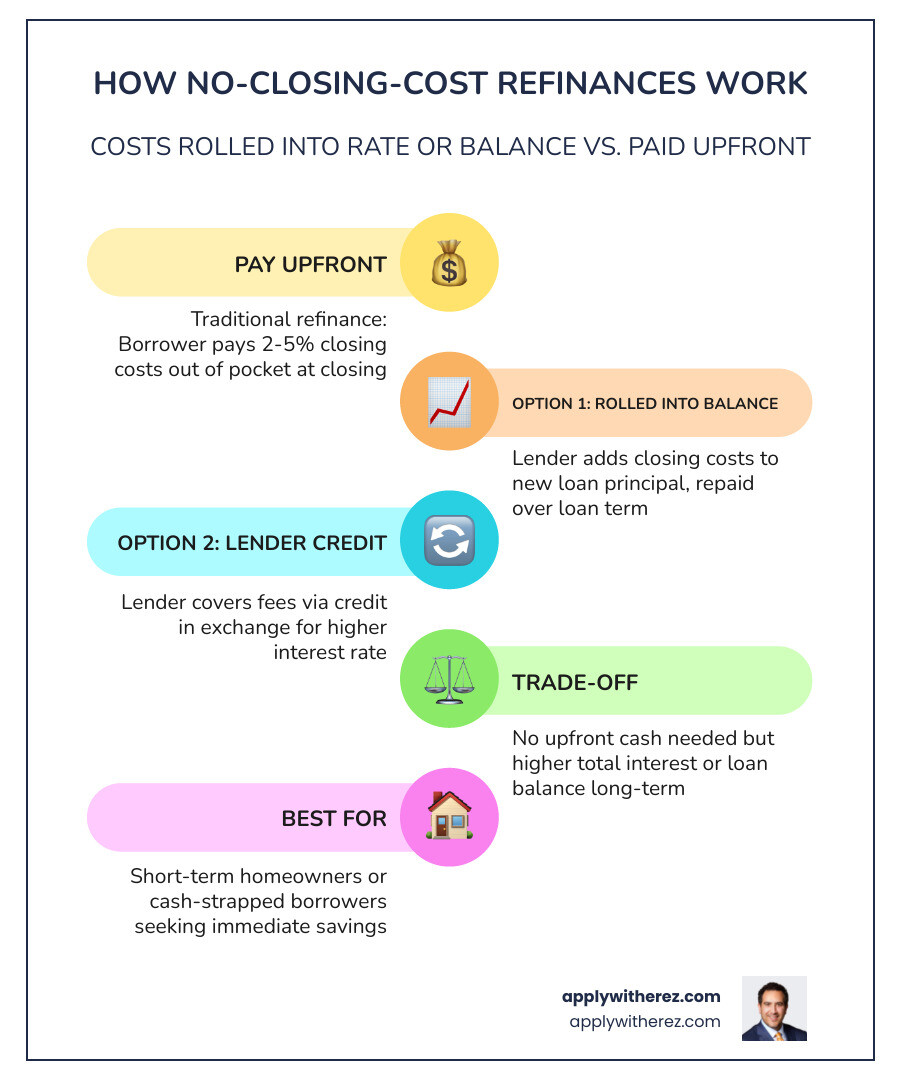
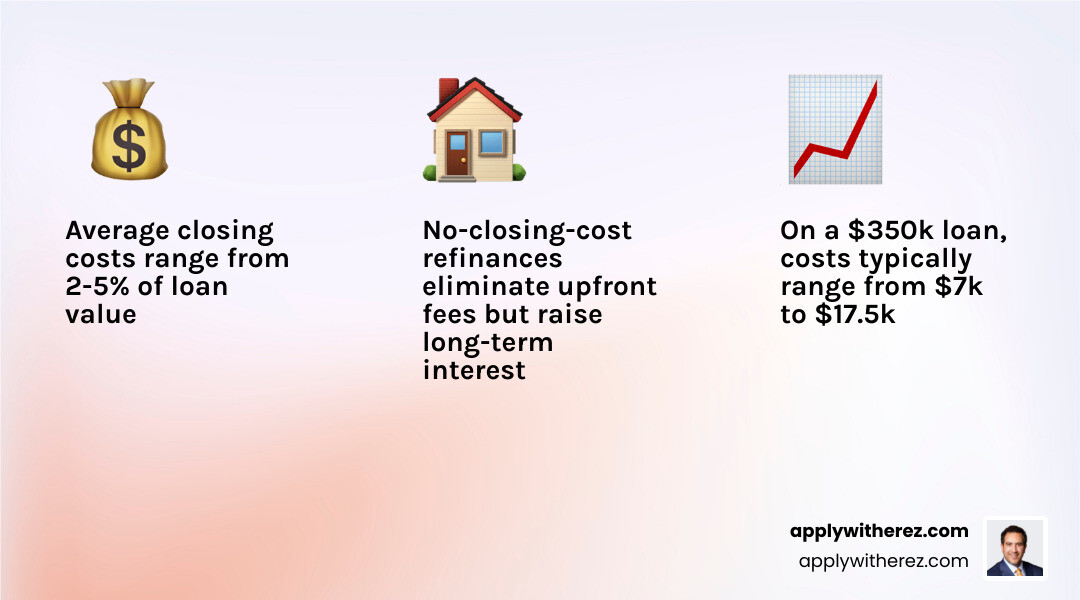
Here's the problem most homeowners face: refinancing costs money before it saves money. According to Fannie Mae, closing costs typically run between 2% and 5% of the loan amount. On a $350,000 mortgage, that's anywhere from $7,000 to $17,500 out of pocket — before you see a single dollar in monthly savings.
That's a real barrier. Especially if you're cash-tight, planning to sell in a few years, or just want to move fast on a rate drop.
No-closing-cost refinances solve for that upfront liquidity problem. But — and this matters — they don't make the costs disappear. The fees are either rolled into your new loan balance or offset by a slightly higher interest rate. You pay either way, just on a different timeline.
That trade-off is exactly what this guide breaks down.
I'm Erez Shimoni, a mortgage broker with 26 years of industry experience (NMLS #460222), and I've helped countless borrowers navigate the exact decision you're facing right now — weighing upfront fees against long-term rate costs to find the best mortgage refinance companies with no closing costs for their specific situation. As a broker, I have access to a wide range of loan products across conventional, FHA, VA, and jumbo programs, which means I can help you compare options that a single bank simply can't offer.
Understanding the Best Mortgage Refinance Companies with No Closing Costs
When we talk about the best mortgage refinance companies with no closing costs, it is important to clarify what "no closing costs" actually means in the mortgage world of May 2026. If you are looking for a completely free lunch, you might be disappointed—but if you are looking for a way to preserve your cash, you are in luck.
Lenders generally use two primary methods to eliminate your upfront out-of-pocket expenses:
Lender Credits (Premium Pricing): The lender offers you a slightly higher interest rate than the absolute lowest market rate. In exchange, they provide a "credit" that covers your closing costs. For example, if the market rate is 6.25%, you might accept a 6.50% rate to have $5,000 in fees paid for you.
Financing Costs into the Principal: The lender adds the closing costs to your total loan balance. If you owe $300,000 and the fees are $6,000, your new mortgage starts at $306,000. You don't pay anything today, but you will pay interest on that extra $6,000 for the next 30 years.
As noted in this guide on no-closing-cost refinancing, these options are fantastic for homeowners who want to keep their liquidity. In a market where home values have reached significant highs, many of our clients prefer to keep their cash in the bank for investments or emergency funds rather than sinking it into loan fees.

Pros and Cons of Refinancing Without Upfront Fees
Choosing between a traditional refinance and a no-cost option is a balancing act. We often tell our clients that the "best" choice depends entirely on your "exit strategy" for the home.
The Pros: Why It Makes Sense
Cash Preservation: You keep your savings for home improvements, debt consolidation, or high-yield investments.
Immediate Savings: You start benefiting from a lower monthly payment (if the rate is lower than your current one) without having to wait years to "earn back" the money you spent on fees.
Ideal for Short-Term Ownership: If you plan to sell your home in 3 to 5 years, paying $10,000 in closing costs rarely makes sense. You likely won't reach the break-even point before you move.
The Cons: The Hidden Costs
Higher Monthly Payments: If you take a higher interest rate to cover the fees, your monthly payment won't be as low as it could have been.
Long-Term Interest: Over 30 years, a 0.25% higher interest rate can cost significantly more than the original closing costs would have been.
Reduced Equity: If you roll the costs into the loan balance, you immediately owe more on your home, which could be a factor if home prices dip.
Comparison Table: Traditional vs. No-Closing-Cost Refinance
Feature Traditional Refinance No-Closing-Cost (Higher Rate) No-Closing-Cost (Rolled In) Upfront Cash Required 2% – 5% of loan $0 $0 Interest Rate Lowest available Slightly higher Market rate Loan Balance Stays the same Stays the same Increases Total Interest Paid Lowest Highest Higher
For more personalized insights, you can explore our refinance services to see how these numbers play out for your specific property.
How to Identify the Best Mortgage Refinance Companies with No Closing Costs
In May 2026, the market is competitive. To find the best mortgage refinance companies with no closing costs, you need to look beyond the flashy headlines. Some lenders claim "no fees" but then hide those costs in uncompetitive interest rates.
Transparency is the name of the game. A quality lender will provide you with a Loan Estimate that clearly shows the "Lender Credits" being applied to offset the "Total Loan Costs." According to a 2026 market analysis, the top-tier companies are those that offer a blend of speed, digital ease, and fee flexibility.

Criteria for the Best Mortgage Refinance Companies with No Closing Costs
When we evaluate lenders for our clients, we look for several specific green flags:
Origination Fee Waivers: Some lenders specifically waive their internal "lender fees" (processing and underwriting), though you may still have third-party costs like title insurance.
Appraisal Credits: A true no-cost lender might offer a credit to cover the $500–$700 cost of a home appraisal.
Competitive APRs: Since the APR (Annual Percentage Rate) includes fees, comparing APRs is the fastest way to see which "no-cost" loan is actually the cheapest over time.
Rate-Match Guarantees: Some digital lenders offer a cash guarantee (e.g., $100) if they can't match a competitor's lower rate.
Loan Types Offered by the Best Mortgage Refinance Companies with No Closing Costs
Not every loan program is eligible for a no-cost structure. Here is what is typically available:
Conventional Loans: Most common for no-cost refinances, provided you have at least 20% equity to avoid Private Mortgage Insurance (PMI).
FHA Streamline: A great option for current FHA borrowers. It requires minimal documentation and no new appraisal, though you still have to deal with FHA mortgage insurance premiums.
VA IRRRL (Interest Rate Reduction Refinance Loan): For veterans, this is the gold standard. It allows you to roll all costs into the loan, and the "funding fee" is much lower than for purchase loans.
Jumbo Refinances: Harder to find in a "no-cost" format, but some specialized lenders offer credits for high-net-worth borrowers.
If you are unsure which category you fall into, you can start a refinance application to see the specific programs available in your area.
Calculating Your Break-Even Point and Long-Term Savings
The most important math problem in refinancing is finding the break-even point. This is the moment when the monthly savings from your new mortgage finally exceed the costs of getting that mortgage.
If you are paying $6,000 in closing costs to save $200 a month, your break-even point is 30 months ($6,000 / $200 = 30). If you plan to sell the house in 24 months, you are losing money.
However, in a no-closing-cost refinance, the math changes. Since your upfront cost is $0, your "break-even" is technically immediate! You start saving money from month one. The catch is that your long-term savings might be lower because of the higher rate or higher balance.
The 5-Year Rule
A good rule of thumb we use: if you plan to stay in the home for more than 5 years, it is usually better to pay the closing costs upfront to secure the lowest possible interest rate. If you plan to move in less than 5 years, a no-closing-cost refinance is almost always the smarter financial move.
Frequently Asked Questions about No-Fee Refinancing
Is a no-closing-cost refinance actually free?
No. As the saying goes, there is no such thing as a free lunch. The lender has to pay the appraiser, the title company, and their own staff. In a no-closing-cost loan, the lender covers these "third-party" and "origination" fees by either:
Charging you a higher interest rate (Lender Credit).
Adding the costs to your loan balance (Financing the fees).
Who qualifies for a no-closing-cost refinance?
The requirements are generally the same as a standard refinance:
Credit Score: Most lenders look for a 620 minimum, though 740+ gets you the best credits.
Equity: You typically need at least 20% equity for conventional loans to avoid PMI, though FHA and VA programs are more flexible.
DTI Ratio: Your debt-to-income ratio should generally be below 43%, though some programs allow up to 50%.
Employment: You will need stable income and employment verification.
When should I choose a higher interest rate over upfront fees?
This is a great strategy if:
You are cash-poor but equity-rich: You have plenty of value in your home but don't want to drain your savings account.
You want to invest the cash: If you can invest $10,000 at a 10% return, it's better to keep that cash and take a 0.25% higher mortgage rate.
You are selling soon: You avoid the "sunk cost" of fees you'll never recoup.
Conclusion
Refinancing shouldn't feel like a financial penalty. The best mortgage refinance companies with no closing costs provide a vital service by removing the high entry fee to better mortgage terms. Whether you choose to take a slightly higher rate or roll the costs into your balance, the goal is the same: improving your financial flexibility.
In the May 2026 market, rates can be volatile. Having the ability to refinance without a massive upfront investment allows you to be nimble—taking advantage of rate drops as they happen rather than waiting years to save up for closing costs again.
At applywitherez.com, we specialize in helping you weigh these trade-offs. We look at your credit, your home's value, and your future plans to determine if a no-cost option is truly the best path forward for you.
Ready to see what your savings look like without the upfront fees? Start your refinance journey today and let us find the perfect match for your homeowning goals.