
Stop Searching and Start Saving with These Best VA Streamline Refinance Lenders
VA IRRRL Refinance Is Booming in 2026 — Here's How to Pick the Right Lender
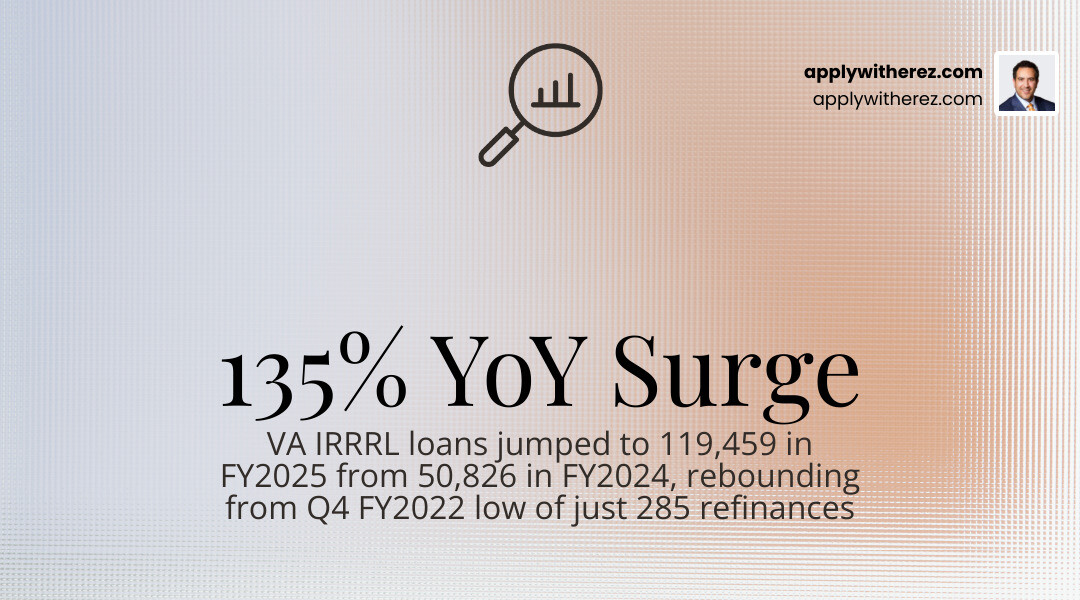
Finding the best VA streamline refinance lenders in 2026 matters more than ever — with IRRRL loan volume surging 135% year-over-year in FY2025, veterans are moving fast to lock in lower rates before the window shifts again.
What to look for in the best VA streamline refinance lenders this year:
Aggressive Pricing: Some lenders are advertising rates as low as 5.250% (APR 5.661%) for well-qualified borrowers.
Service Standards: Look for providers with 24/7 customer support and dedicated VA loan specialists.
Fee Transparency: Top-tier options often include $0 lender fee structures or credits to cover the VA funding fee.
Credit Flexibility: Many providers now accept FICO scores as low as 580 for streamline products.
Digital Speed: The most efficient lenders utilize fully digital workflows to close in under 30 days.
Rates look low on paper. But the right lender isn't always the one with the smallest number in the headline. Fees, speed, credit score requirements, and closing cost policies all change the real cost of your refinance — sometimes dramatically.
The national average 30-year VA refinance rate sits at 6.50% as of early 2026. But top lenders are advertising rates well below that. The gap between a good deal and a great one often comes down to who you choose to work with.
This guide cuts through the noise. You'll get a clear, honest look at the criteria that define a top lender — and the red flags to watch for.
I'm Erez Shimoni (NMLS #460222), a mortgage broker with 26 years of industry experience helping veterans and homeowners find the right loan fit — including navigating the best VA streamline refinance lenders for clients across New Jersey, New York, Pennsylvania, and Florida. I'll walk you through everything you need to compare lenders confidently and lock in real savings.
What a VA IRRRL Is and Who Qualifies
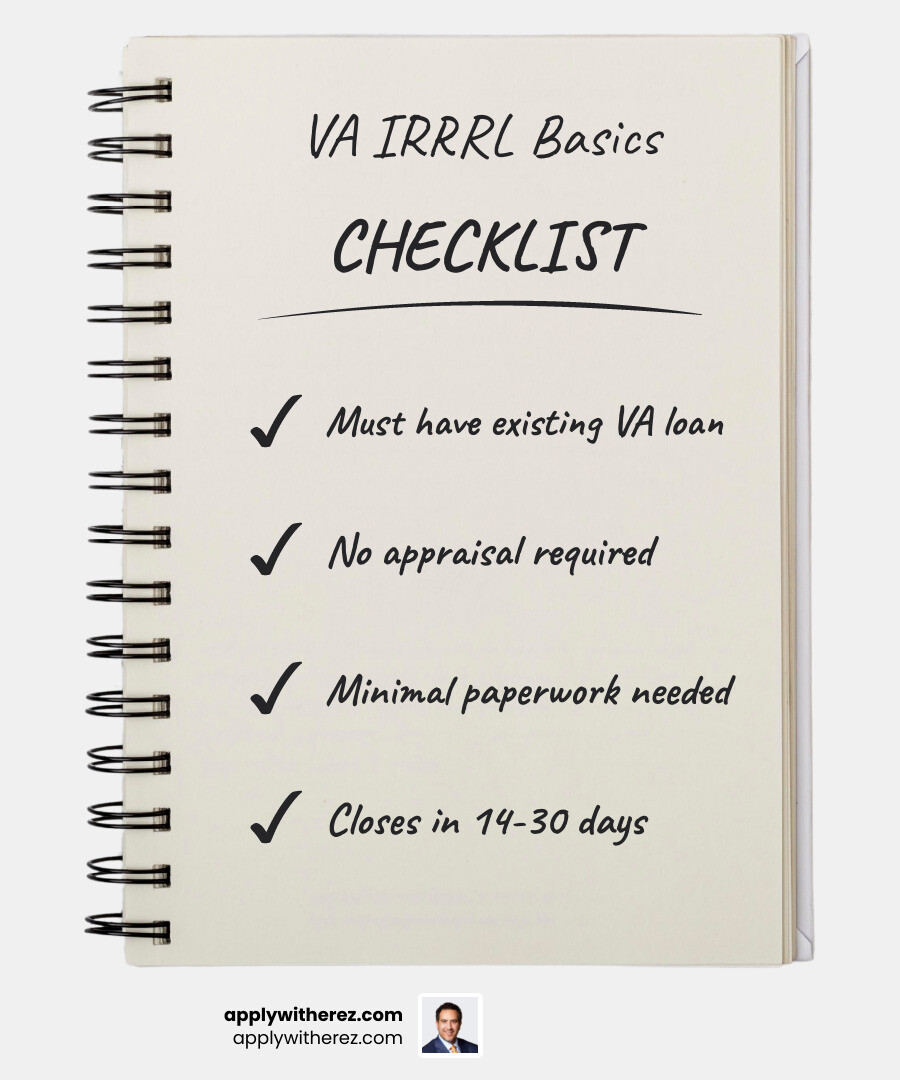
A VA IRRRL, short for Interest Rate Reduction Refinance Loan, is the VA's streamlined refinance option for homeowners who already have a VA loan. Think of it as the refinance with fewer hoops, less paperwork, and usually less hassle.
Its main job is simple:
lower your interest rate
reduce your monthly payment in many cases
switch an adjustable-rate mortgage to a fixed-rate loan
simplify refinancing compared with a standard refinance
A VA IRRRL is not a cash-out loan. If you want to pull equity from your home, this is the wrong tool. You would need a VA cash-out refinance instead.
To qualify, you generally need to meet these basics:
You already have an existing VA-backed mortgage.
Your current loan has met the seasoning rule.
You can show a net tangible benefit from refinancing.
You certify prior occupancy of the home.
Your recent mortgage history is acceptable.
The seasoning rule usually means both of these must be true:
at least 210 days have passed from the first payment due date on your current loan
you have made at least 6 monthly payments
The net tangible benefit rule means the new loan must clearly help you in a meaningful way. That usually means:
a lower rate
a lower payment
moving from an ARM to a fixed-rate mortgage for more stability
For a broader overview of VA financing, visit our VA Home Loan page.
How a VA IRRRL works from application to closing
The reason borrowers hunt for the best VA streamline refinance lenders is that the process can be much easier than a typical refinance.
In many cases:
no new appraisal is required
no income verification is required by the VA
less documentation is needed
closing costs can be rolled into the new loan
The basic process looks like this:
We review your current VA loan and goals.
We compare available IRRRL rates, APRs, and fees.
We confirm you meet seasoning and benefit requirements.
We gather a light document package.
The lender underwrites and prepares closing.
You sign final documents and the old VA loan is paid off.
Many VA streamline refinances close in about 14 to 30 days, though timeline depends on lender speed, title work, and how quickly documents are returned.
Eligibility rules veterans should check before applying
Before you apply, check these items carefully:
Your current mortgage is a VA loan.
You are current or close to current on payments.
You have made the last several payments on time.
Your loan is seasoned at least 210 days and 6 payments.
The refinance creates a net tangible benefit.
You understand whether you qualify for a funding fee exemption.
Some lenders may also ask for a Certificate of Eligibility or use prior VA loan data to confirm entitlement and exemption status. If you're exempt from the VA funding fee due to disability status or certain surviving spouse status, that can reduce your cost.
Best VA Streamline Refinance Lenders: What Actually Makes a Lender “Best”
A lender earns a spot among the best VA streamline refinance lenders by doing more than advertising a shiny low rate.
We look at the full picture:
interest rate
APR
lender fees
discount points
closing speed
credit score flexibility
digital experience
customer support
ability to roll in costs
membership restrictions, if any
For example, one lender may advertise an ultra-low rate but charge points that make the deal expensive. Another may offer a slightly higher rate but lower total costs and faster closing. The second lender may actually be the better refinance.
A few 2026 examples from the market:
One major credit union advertised a 30-year VA IRRRL as low as 5.250% with 5.661% APR.
Another large VA-focused lender showed 5.750% with 6.001% APR.
Some lenders accept FICO scores as low as 580.
Some lenders offer no lender fees or lender-paid cost structures.
That is why the "best" lender depends on your situation, not just a headline number.
How to compare the best VA streamline refinance lenders side by side
When comparing lenders, we recommend lining up each quote on the same day and looking at these categories:
Compare This Why It Matters Interest rate Affects monthly payment APR Shows a truer total borrowing cost Points Can make a low rate expensive Lender fees Impacts cash needed or loan balance Closing timeline Important if rates are moving Credit overlays Some lenders are stricter than VA minimums No-closing-cost option Can help if cash is tight Servicing Matters if you care who collects payments
Here is the key rule: compare rate and APR together. A lower rate with a much higher APR usually means more fees, more points, or both.
You should also calculate your break-even point:
total refinance cost divided by monthly savings = months to recoup costs
If it takes 40 months to break even and you may move in 24 months, that refinance might not be worth it. Mortgage math can be rude, but at least it is honest.
Red flags that can turn a low advertised rate into a costly refinance
A low advertised rate can be real, but it can also come with baggage. Watch for these red flags:
discount points not obvious in the headline
APR much higher than the rate
high prepaids and escrow collection
lender fees pushing total costs up
longer loan term that restarts the clock
"no-cost" offers that simply raise the interest rate
add-on products you do not need
VA rules cap origination charges, but total closing costs can still add up. A refinance that lowers your payment by a little but extends your term significantly can increase lifetime interest.
2026 VA IRRRL Rates, Fees, and Closing Costs to Expect
As of early 2026, the national average 30-year VA refinance rate is around 6.50%. But advertised IRRRL rates from top lenders can be notably lower, with examples as low as 5.250% and others around 5.750%.
That spread matters.
A quick reality check:
Your actual rate depends on credit, loan size, occupancy details, and pricing on the day you lock.
Advertised rates often assume strong borrower profiles.
APR gives a more complete picture than rate alone.
The standard VA IRRRL funding fee is 0.5% of the loan amount. Compared with purchase VA funding fees that can run much higher, this is relatively low. In many cases, the funding fee can be financed into the new loan.
Typical total closing costs for an IRRRL often range from about 2% to 5% of the loan amount, depending on lender charges, title fees, recording costs, prepaid items, and whether points are paid.
Current VA IRRRL rate trends and why refinance demand surged in 2025
VA streamline refinance activity came roaring back in FY2025.
According to the research, VA IRRRL usage jumped 135% year over year, rising to 119,459 loans in FY2025 from 50,826 in FY2024. That is a major rebound from the market low point, when IRRRL volume fell to only 285 refinances in Q4 FY2022.
Why the comeback?
Rates created a refinance opportunity for existing VA borrowers.
IRRRLs are simpler than many other refinance options.
Veterans responded quickly when payment savings appeared.
More borrowers wanted to switch from ARM structures to fixed rates.
When demand rises, lender capacity and speed matter more. In a busy refinance market, the lender with the fastest, cleanest process can help you lock savings before pricing changes.

Which costs can be rolled into the new loan
One of the biggest advantages of a VA IRRRL is that many costs can be included in the new loan balance rather than paid out of pocket.
Often eligible to roll in:
the 0.5% VA funding fee
lender origination charges
title-related charges
recording fees
some allowable closing costs
Items like prepaid interest, escrow setup, and homeowners insurance escrows may still require attention depending on how the lender structures the transaction.
That is why "no money out of pocket" does not always mean "free." It may simply mean the costs are financed or offset by a lender credit in exchange for a higher rate.
For more background on cost structure and guidelines, see VA IRRRL Rates & Guidelines 2026 | VA Streamline Refinance.
Pros, Drawbacks, and Documentation Requirements
VA IRRRLs are popular because they are efficient, but they are not automatically the right choice for everyone.
Biggest benefits of a VA streamline refinance
The biggest upsides include:
faster underwriting than many standard refinances
no PMI
no appraisal in many cases
no income verification in many cases
lower funding fee than many other VA loan uses
ability to lower payment or improve loan stability
simpler paperwork than a cash-out refinance
A good VA IRRRL can help in two common situations:
You want a lower rate and lower monthly payment.
You want to get out of an ARM and into a fixed-rate mortgage.
Drawbacks to weigh before refinancing
Even streamlined refinances have trade-offs:
closing costs still exist
the funding fee may apply
you cannot take cash out
extending the term can raise total lifetime interest
monthly savings may be small if costs are high
your break-even period may be longer than expected
This is why we always suggest looking beyond the payment. Saving $120 a month sounds great until you realize it cost $6,000 to get there and restarted a 30-year term.
Documents you may need even for a “streamlined” refinance
"Streamlined" does not mean "show up with a smile and nothing else." You may still need:
government-issued ID
current mortgage statement
payoff information
homeowners insurance declaration page
bank information for payoff or autopay setup
note and deed or prior loan details in some cases
Certificate of Eligibility in some files
proof of disability exemption or surviving spouse exemption if applicable
Some lenders ask for very little. Others still apply their own overlays and may request credit or employment information even when the VA itself does not require it.
For a lender overview of benefits and requirements, see VA IRRRL Streamline Refinances | Benefits and Requirements.
How to Choose the Right Lender for Your Situation
The right lender depends on what matters most to you.
If you are shopping for the best VA streamline refinance lenders, match the lender's strengths to your needs:
lowest total cost
lowest credit score requirement
fastest closing
digital convenience
strongest service
fee waivers or lender credits
flexible rate lock policy
A lender that is great for a borrower with 760 credit and lots of equity may not be best for someone with a 590 score who needs flexible underwriting.
Best fit by borrower type
Here is a practical way to narrow the field:
Low-credit borrower: look for lenders that may go down to 580.
Fee-sensitive borrower: focus on lenders offering low-fee or lender-paid-cost structures.
Speed-focused borrower: prioritize lenders known for fast turn times, sometimes as quick as 14 days.
Online-first borrower: choose a lender with a strong digital application and mobile workflow.
Credit union shopper: compare membership rules against rate and fee benefits.
Repeat refinancer: ask whether future refinance incentives exist.
Surviving spouse or exempt borrower: confirm funding fee exemption handling upfront.
The biggest mistake is choosing based on one feature alone. A fast lender with a costly APR may not beat a slightly slower lender with much lower fees.
Smart shopping tips before you lock your rate
Before locking, we recommend this checklist:
Get at least three quotes on the same day.
Compare APR, not just rate.
Ask whether discount points are included.
Ask for all lender fees in writing.
Review whether costs are rolled in or offset by lender credits.
Calculate your break-even point.
Ask how long the rate lock lasts.
Ask whether a float-down option exists if rates improve.
Confirm the estimated closing timeline.
Make sure the refinance meets VA net tangible benefit rules.
If you want to explore your refinance options in more detail, visit our Refinance page.
Frequently Asked Questions About Best VA Streamline Refinance Lenders
Can you take cash out with a VA IRRRL?
No. A VA IRRRL is for refinancing an existing VA loan to improve the rate or terms. It does not allow cash back to you, except for very minor adjustments in limited circumstances. If you want to tap home equity, you need a VA cash-out refinance.
How long does a VA streamline refinance usually take?
Many VA IRRRLs close in roughly 14 to 30 days. Faster closings are possible when title work is smooth, documents come in quickly, and the lender is efficient. Slower closings can happen during busy refinance periods or when lender overlays require extra review.
Is the VA funding fee always required?
Not always. The standard IRRRL funding fee is 0.5% of the loan amount, but some borrowers are exempt, including many veterans receiving qualifying disability compensation and some eligible surviving spouses. Always verify exemption status early so the quote reflects the real cost.
Conclusion: Compare Carefully, Then Lock In Savings
The best VA streamline refinance lenders are not just the ones with the lowest advertised rate. The real winners are the lenders that combine strong pricing, reasonable fees, clear disclosures, and a process that fits your timeline and credit profile.
In 2026, that means focusing on:
APR over headline rate
total loan cost over marketing claims
break-even timeline over monthly payment alone
lender flexibility over flashy ads
A VA IRRRL can be an excellent tool when it delivers a real net tangible benefit. But the smartest move is to compare carefully before you lock.
If you're ready to review your options and find the right refinance strategy, learn more on our Refinance page.