
Your Wallet's Guide to Average Mortgage Refinance Costs in 2026
What Is the Average Cost to Refinance a Mortgage in 2026?
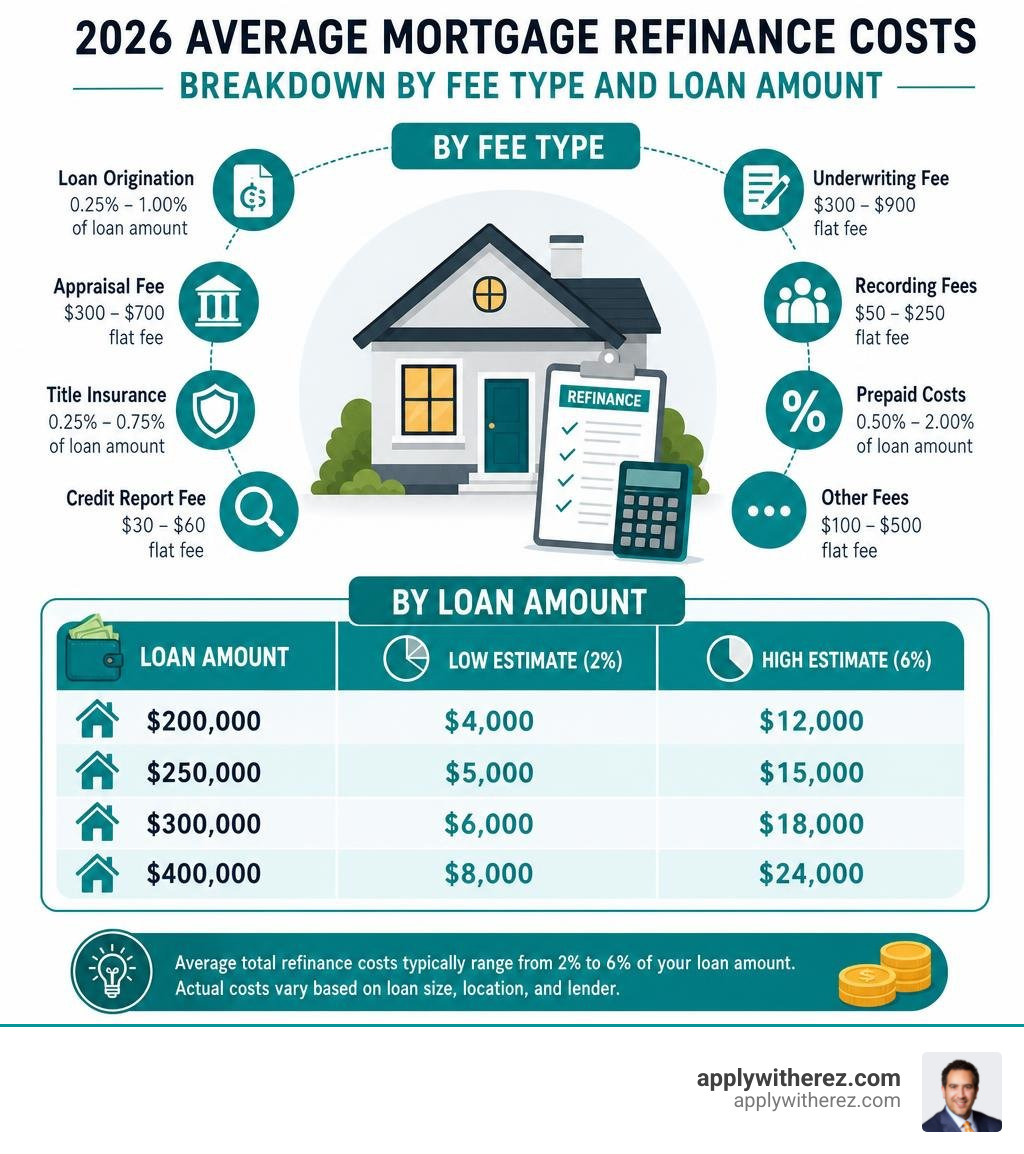
The average cost to refinance a mortgage falls between 2% and 6% of your loan amount — here's what that looks like in real dollars:
Loan Amount | Low Estimate (2%) | High Estimate (6%) |
|---|---|---|
$200,000 | $4,000 | $12,000 |
$250,000 | $5,000 | $15,000 |
$300,000 | $6,000 | $18,000 |
$400,000 | $8,000 | $24,000 |
The national average total closing cost for a refinance was $2,207 in 2025 — but that number is misleading on its own. It excludes state taxes and recording fees that can push costs far higher depending on where you live.
Refinancing sounds simple: swap your old mortgage for a new one with a better rate. But the upfront costs can catch homeowners off guard.
And the stakes are real. According to industry research, 78.7% of refinance borrowers overpaid in 2025 — most simply because they didn't compare enough lenders. Homeowners who locked in rates above 7% between 2022 and 2025 are losing $200 to $400 every single month by not refinancing.
That's not a small number. Over three years, that's up to $14,400 left on the table.
This guide breaks down exactly what you'll pay, why costs vary so much, and how to make sure refinancing actually works in your favor.
I'm Erez Shimoni, a mortgage broker with 26 years of experience helping homeowners navigate the average cost to refinance a mortgage and find loan options that genuinely save them money. Throughout this guide, I'll walk you through every fee, every trade-off, and every strategy I use with my own clients.
Understanding the Average Cost to Refinance Mortgage
When we talk about the average cost to refinance a mortgage, we are looking at a collection of administrative, legal, and transactional fees required to close your new loan. These fees are commonly grouped together as "closing costs."
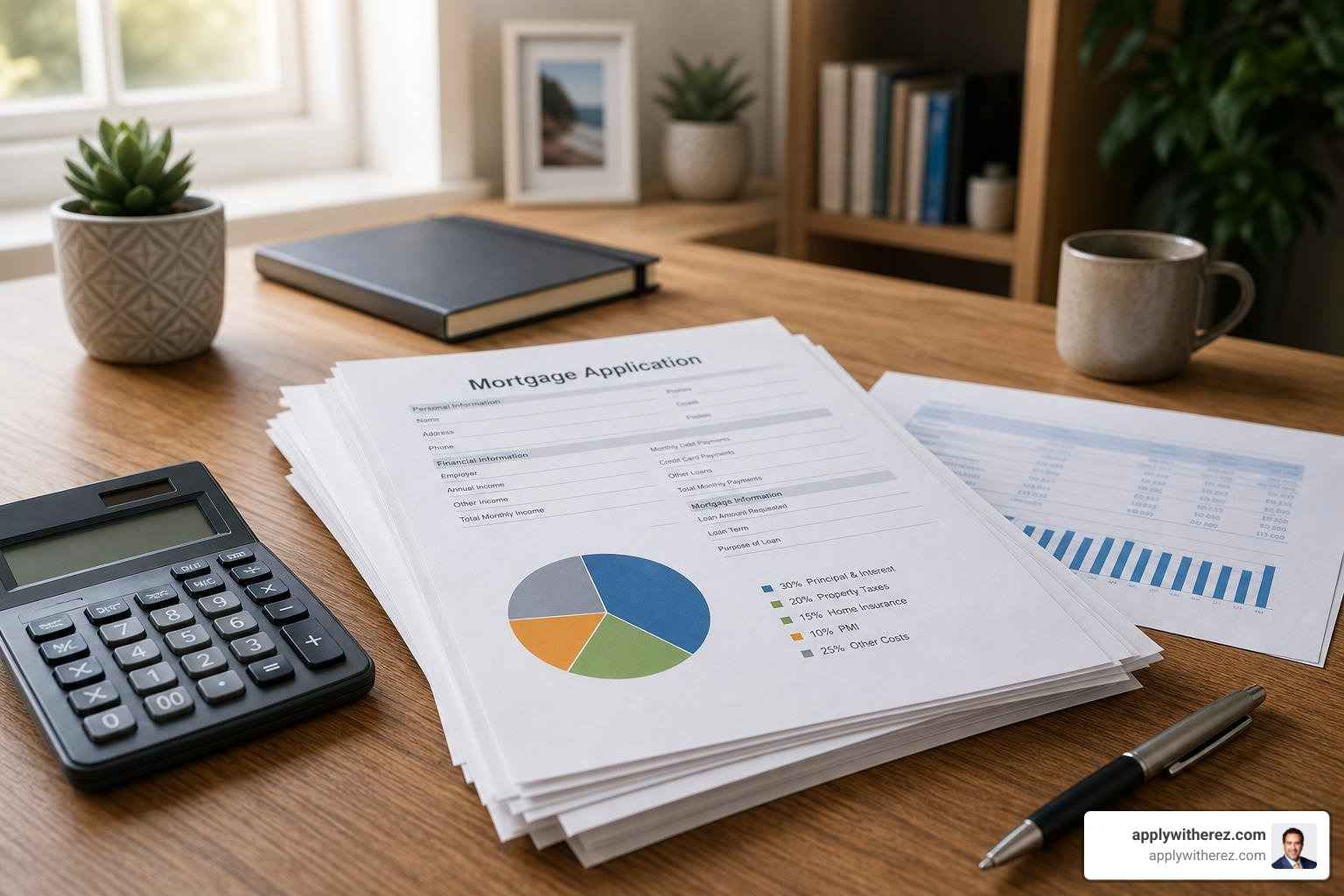
While the national average for basic lender and settlement fees sits around $2,207, your real-world out-of-pocket costs will depend heavily on your loan principal. Lenders and third-party service providers charge fees that scale with the size of your mortgage.
Failing to refinance when market conditions are in your favor acts as a "Hidden Homeownership Tax." If you locked in a rate above 7% during the recent rate spikes, staying put is likely costing you hundreds of dollars a month. Yet, many homeowners hesitate because they are afraid of overpaying on closing costs. By understanding the fee structure, you can avoid becoming part of the 78.7% of borrowers who overpaid due to a lack of shopping around.
The Typical Percentage-Based Fee Structure
Most of the expenses associated with refinancing are directly tied to your loan amount. Instead of flat fees, major components like origination fees, title insurance, and prepaid interest are calculated as a percentage of the total loan.
On a standard $300,000 loan, a 2% to 6% closing cost structure translates to a range of $6,000 to $18,000. While some of these fees are fixed (such as the credit check or tax service fees), the percentage-based fees mean that the larger your mortgage balance, the more cash you will need to close.
National Averages and State-by-State Cost Variations
Your geographic location is one of the most powerful factors determining your final bill. According to the LodeStar 2025 Refinance Mortgage Closing Cost Data Report, refinance closing costs vary wildly across the United States.
For instance, New York has some of the highest refinance costs in the nation, averaging $10,553 (roughly 2.06% of the average loan amount) due to heavy state mortgage recording taxes. On the other end of the spectrum, states like California and Arizona have average closing costs representing just 0.32% to 0.37% of the loan amount because they do not impose these steep transfer and mortgage taxes.
Breaking Down the 12 Refinance Closing Costs
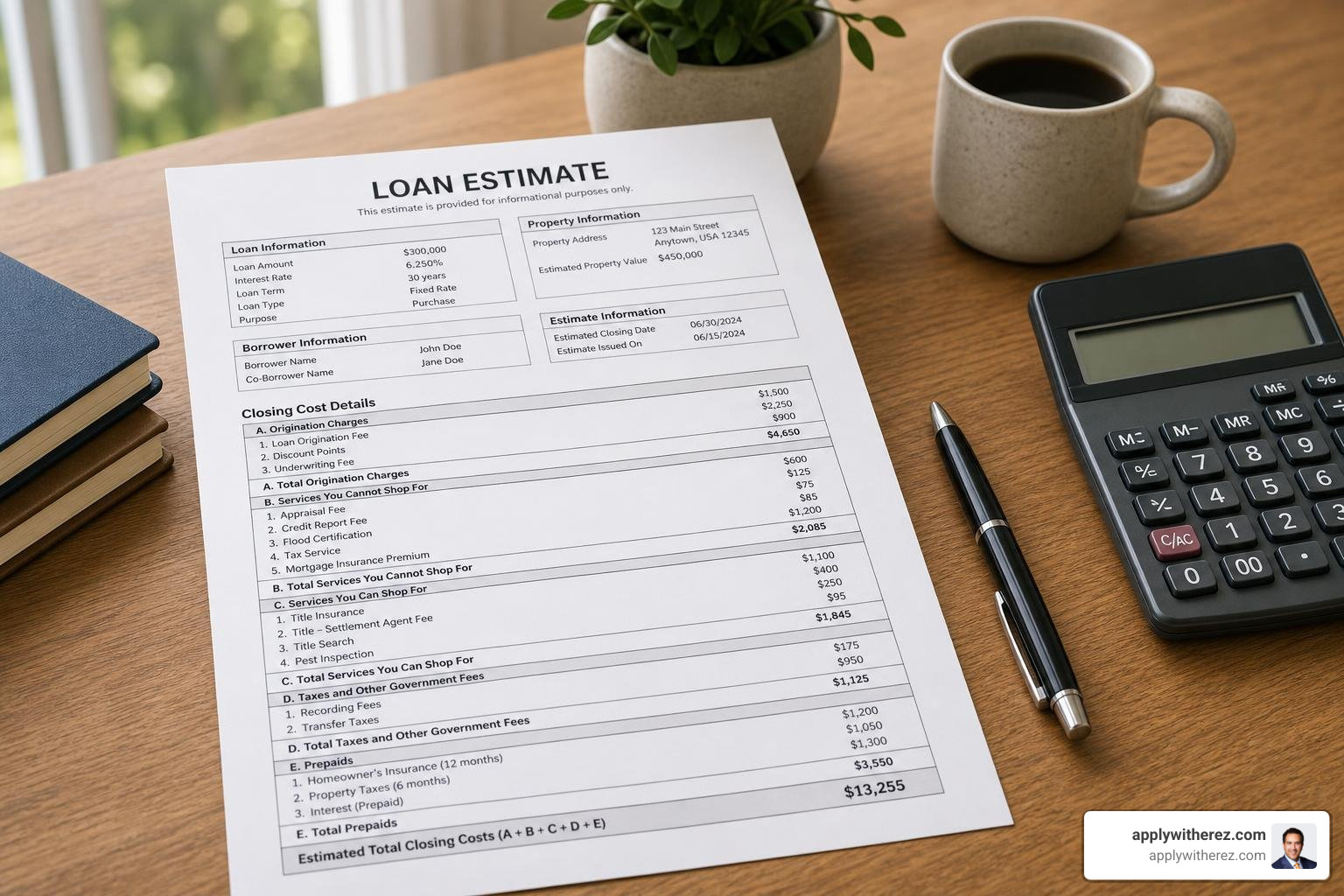
To demystify where your money actually goes, let’s look at a typical mortgage loan estimate. Refinance costs are split into three main categories: lender fees, third-party fees, and prepaid items (including escrow accounts).
How Your Credit Score Affects the Average Cost to Refinance Mortgage
Your credit score does more than just dictate your interest rate; it directly impacts your closing costs. Lenders use risk-based pricing adjustments (often called Loan-Level Price Adjustments).
If your credit score is below the premier 780 threshold, lenders may charge higher upfront fees to offset their risk, or build those fees into a higher interest rate. Additionally, if your loan-to-value (LTV) ratio is high (meaning you have less than 20% equity in your home) and your debt-to-income (DTI) ratio is tight, you may face higher private mortgage insurance (PMI) premiums, raising your overall transaction costs.
Lender Fees vs. Third-Party Expenses
Here is a breakdown of the typical fees you will see on your Loan Estimate:
Loan Origination Fee ($1,545 to $2,258 average): This is what the lender charges to evaluate and prepare your mortgage. It typically ranges from 0.5% to 1% of the loan amount.
Underwriting Fee (Up to $900): Paid to the lender for verifying your financial documentation and approving the loan.
Application Fee ($75 to $500): Covers the initial cost of processing your request. Some lenders will waive this if you ask.
Home Appraisal Fee ($558 average): Paid to an independent appraiser to confirm your home's current market value.
Title Search and Lender’s Title Insurance ($1,626 average): Ensures the property is free of liens and protects the lender against future ownership disputes.
Attorney or Settlement Fee ($500 to $1,000): Paid to the closing attorney or title company that conducts the actual closing.
Credit Report Fee ($25 to $100): The cost of pulling your credit history from the major bureaus.
Survey Fee ($150 to $400): Required in some states to verify property boundaries.
Recording Fee ($20 to $250): Charged by your local county government to update public land records with your new mortgage details.
Flood Certification Fee ($8 to $50): Paid to determine whether your property sits in a federally designated flood zone.
Prepaid Interest (Variable): Covers the interest that accrues on your new loan from the day of closing to the end of that calendar month.
Escrow Account Funding (Variable): Pre-billing to establish your new escrow account for property taxes and homeowners insurance.
Government-Backed Loan Fees and Streamline Programs
If you have an FHA, VA, or USDA loan, you can take advantage of specialized streamline refinance programs. These programs are designed to lower the average cost to refinance a mortgage by waiving expensive requirements like home appraisals and extensive underwriting.
FHA Streamline: Requires an upfront Mortgage Insurance Premium (MIP) of 1.75% of the loan amount, which can usually be rolled into the loan balance.
VA IRRRL (Interest Rate Reduction Refinance Loan): Waives the appraisal and credit check in most cases. It requires a low VA funding fee of just 0.5% of the loan amount. For a detailed breakdown of how to qualify and save, check out our VA Refinance Complete Guide 2026.
USDA Streamline: Offers a simplified process with a 1% upfront guarantee fee and a 0.35% annual fee.
How to Calculate Your Break-Even Point
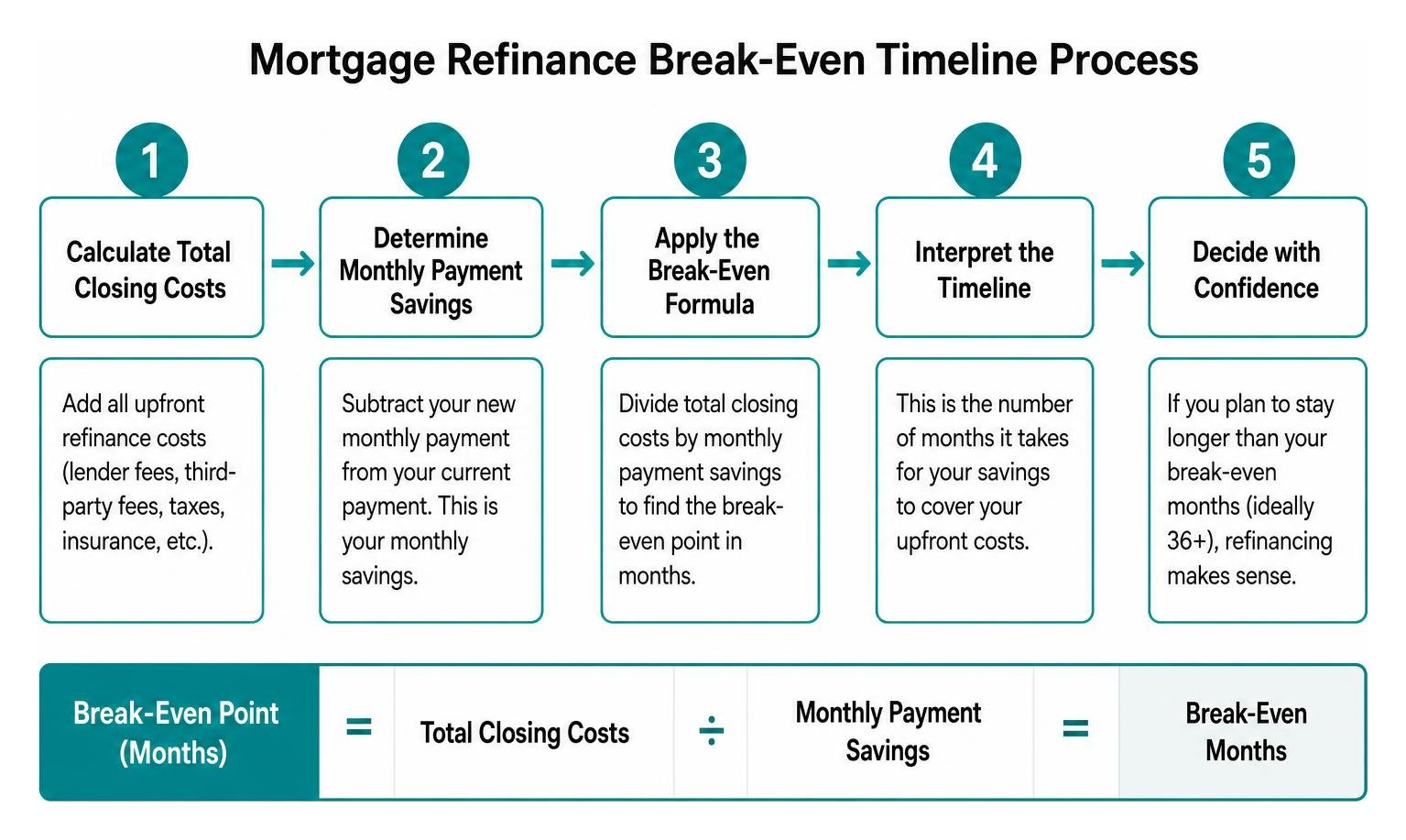
Before committing to a refinance, you must determine if the upfront costs are worth the long-term savings. This is done through a break-even analysis.
The Mathematical Formula for Your Break-Even Timeline
The break-even point is the exact month where your accumulated monthly savings surpass the upfront costs of securing the new loan.
The formula is straightforward:
$$\text{Break-Even Point (Months)} = \frac{\text{Total Closing Costs}}{\text{Monthly Payment Savings}}$$
For example, if your total closing costs are $6,000 and the lower interest rate saves you $200 per month, your math looks like this:
$$\$6,000 \div \$200 = 30 \text{ months}$$
In this scenario, it will take you 2.5 years (30 months) to break even. If you plan to stay in your home for at least 3 to 5 years (the standard "36-month rule"), refinancing is a highly profitable move. If you plan to sell the home sooner, you will lose money.
Rate-and-Term vs. Cash-Out Refinance Cost Differences
The type of refinance you choose will also dictate your costs.
A rate-and-term refinance is designed purely to change your interest rate, your loan term, or both. It is the cheapest and most straightforward way to refinance.
A cash-out refinance allows you to tap into your home's equity by taking out a loan larger than your current mortgage balance and keeping the difference in cash. Because cash-out transactions carry higher risk for lenders, they come with stricter equity requirements, slightly higher interest rates, and higher closing costs.
To compare these options and understand how equity requirements impact your costs, read our guides on the Average Closing Costs for Cash Out Refinance and the Cash Out Refinance Guide 2026. If you are torn between a cash-out refinance and other equity options, you can also explore our comparison on Cash Out Refinance vs Home Equity Loan or learn about getting Cash Back at Closing Refinance.
Smart Strategies to Lower Your Refinance Costs
You do not have to accept the first closing fee estimate you receive. There are several actionable ways to lower your costs.
Smart Ways to Lower Your Average Cost to Refinance Mortgage
Shop and Compare Loan Estimates: Apply with at least three to five different lenders. Under federal law, lenders must provide a standardized Loan Estimate within three business days of your application. Compare these side-by-side to find the lowest origination and underwriting fees.
Negotiate Lender Fees: Application, processing, and document preparation fees are highly negotiable. Ask your lender to match lower competitor estimates or waive these fees entirely.
Request a Title Insurance Reissue Rate: If you refinance with the same title insurance company that handled your original purchase, ask for a "reissue rate." This can save you 20% to 40% on your title policy.
Close at the End of the Month: Scheduling your closing date for the 28th or 29th of the month minimizes the amount of prepaid per-diem interest you must pay upfront.
Ask for an Appraisal Waiver: If your loan is being backed by Fannie Mae or Freddie Mac and you have substantial equity, the lender’s automated underwriting system may waive the physical appraisal, saving you around $600.
Understanding the No-Closing-Cost Refinance Trade-Off
If you want to avoid paying thousands of dollars upfront, you might consider a no-closing-cost refinance.
In a no-closing-cost scenario, the lender pays your upfront fees at closing. However, this is not free money. The lender covers these costs in one of two ways:
Charging a higher interest rate (usually 0.25% to 0.50% higher) in exchange for lender credits.
Rolling the closing costs into your principal loan balance, meaning you will pay interest on those fees over the entire life of the loan.
A no-closing-cost option is highly beneficial if you are short on cash or plan to move within a few years, but paying your closing costs upfront yields the highest overall savings if you plan to stay in the home long-term. To find lenders offering these structures, check out our list of the Best Mortgage Refinance Companies with No Closing Costs.
Frequently Asked Questions
Are refinance closing costs tax deductible?
Generally, standard refinance closing costs (like appraisal fees, title insurance, and recording fees) are not tax-deductible for a primary residence.
However, there are two main exceptions:
Mortgage Points: If you pay discount points upfront to buy down your interest rate, you can typically deduct them, but you must amortize the deduction evenly over the entire life of the loan rather than taking it all in year one.
Home Improvements: If you use a cash-out refinance and use the funds to make substantial, value-adding improvements to your primary residence, the interest on that portion of the loan may be tax-deductible. Always consult a certified tax professional to verify your eligibility under current IRS rules.
When is it worth it to refinance, and when should I wait?
Refinancing is typically worth it if you can lower your interest rate by at least 0.5% to 0.75%, provided you plan to stay in the home long enough to pass your break-even point.
You should wait to refinance if:
You plan to move or sell the home within the next two years.
Your credit score has recently dropped, which would prevent you from qualifying for the best rates.
You are far along in your current mortgage. Refinancing resets your 30-year amortization clock, meaning you will start over paying mostly interest rather than building principal equity.
What happens to my escrow account when I refinance?
Because your refinance replaces your old mortgage with an entirely new one, your old escrow account will be closed.
Your old lender is legally required to send you a check refunding any remaining balance in your escrow account within 30 days of your loan being paid off. However, because your new lender will require you to establish a new escrow account at closing, you will experience a temporary cash gap. You must fund the new escrow account upfront at the closing table before you receive the refund check from your old lender.
Conclusion
Navigating the average cost to refinance a mortgage does not have to be overwhelming. By understanding the fee breakdown, calculating your break-even point, and using smart negotiation strategies, you can secure a loan that aligns perfectly with your financial goals.
At applywitherez.com, we specialize in helping homeowners cut through the noise, eliminate unnecessary junk fees, and maximize their monthly savings.
Ready to see how much you can save? Apply for a Refinance Today and let us build a personalized, low-cost refinance plan tailored just for you.