
VA Refinance 101: Compare Your Options
What Is a VA Refinance — and Which Option Is Right for You?
A VA refinance is one of the most powerful financial tools available to eligible veterans, active-duty service members, and surviving spouses. Here's a quick overview before we dive deeper:
Your two main options:
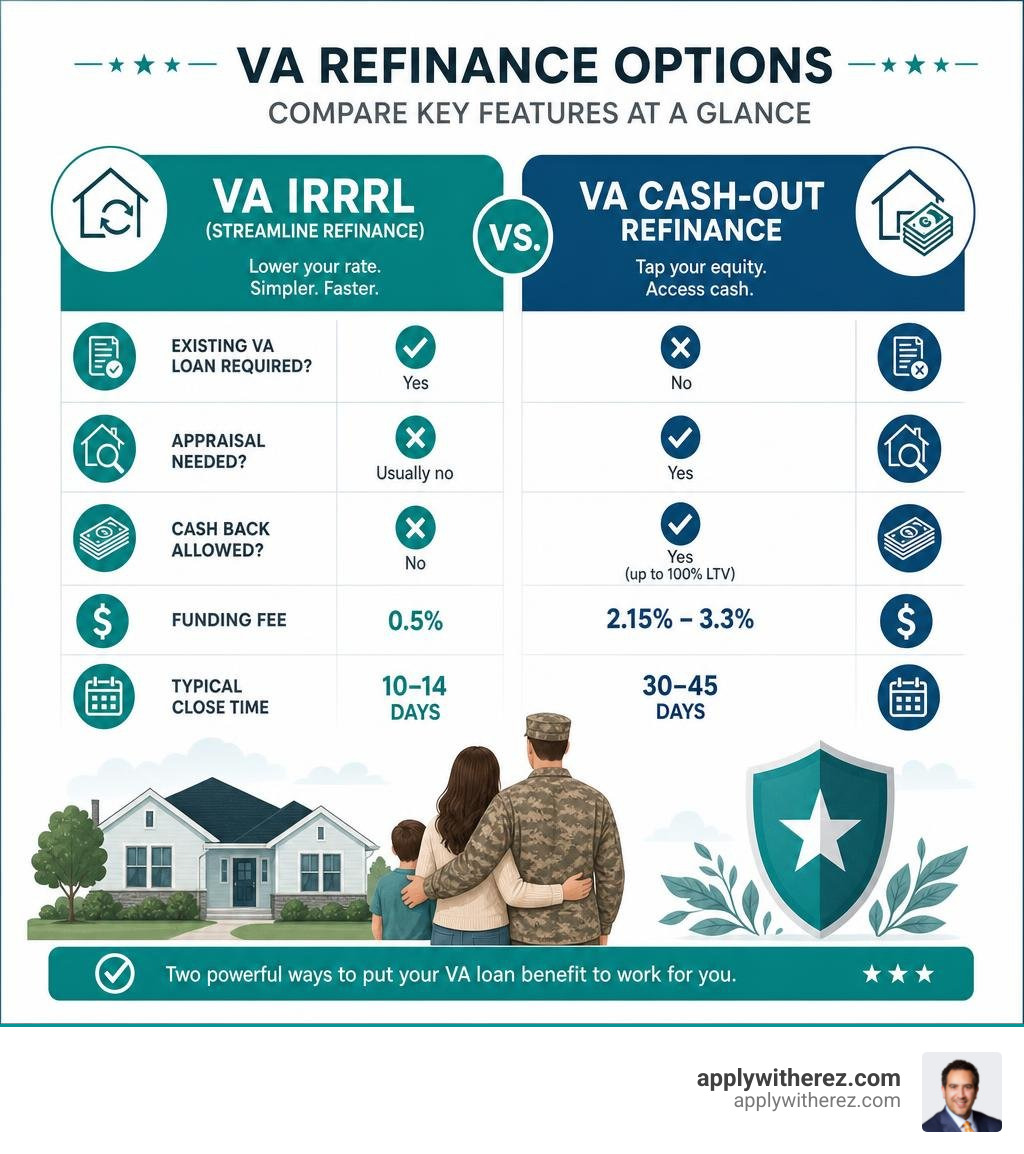
VA IRRRL (Streamline Refinance) — Lowers your rate or stabilizes your payment on an existing VA loan. Minimal paperwork, no appraisal required in most cases, and a low 0.5% funding fee.
VA Cash-Out Refinance — Replaces any existing mortgage (VA or non-VA) with a new VA loan, letting you borrow up to 100% of your home's value and take the difference as cash.
At a glance:
IRRRL Cash-Out Existing VA loan required? Yes No Appraisal needed? Usually no Yes Cash back allowed? No Yes (up to 100% LTV) Funding fee 0.5% 2.15%–3.3% Typical close time 10–14 days 30–45 days
Whether you want to cut your monthly payment, lock in a fixed rate, or tap into equity you've built up — the VA loan program has an option designed for you.
I'm Erez Shimoni, a mortgage professional with 26 years of industry experience, and I've helped many veterans navigate the VA refinance process from first question to closing day. In this guide, I'll walk you through everything you need to know to make a confident, well-informed decision.
Understanding the VA Refinance: IRRRL vs. Cash-Out

When you decide to explore a va refinance, you are essentially looking at two entirely different pathways. While both programs are backed by the Department of Veterans Affairs, they serve completely different financial goals, carry different underwriting standards, and have distinct cost structures.
Choosing between them comes down to a simple question: Do you want to lower your monthly payment, or do you need to access your home's equity?
For those who already have a VA-backed mortgage and simply want to take advantage of dropping market interest rates, the Interest Rate Reduction Refinance Loan (IRRRL) is the go-to option. On the flip side, if you want to tap into your home's value to pay off high-interest debt, fund home improvements, or transition a non-VA loan into the VA system, the Cash-Out Refinance is your vehicle.
To help you visualize how these two products compare across key loan-to-value (LTV) limits, appraisal requirements, and fees, we have put together this comprehensive comparison table:
Feature Interest Rate Reduction Refinance Loan (IRRRL) VA Cash-Out Refinance Primary Purpose Lower interest rate or convert ARM to fixed-rate Extract cash from equity or refinance non-VA loan Current Loan Type Required Must be an existing VA loan Can be VA, Conventional, FHA, or USDA Maximum Loan-to-Value (LTV) No strict LTV limit (underwater mortgages allowed) Up to 100% LTV Appraisal Required? No (with rare lender-specific exceptions) Yes, full VA appraisal required Credit & Income Underwriting None required by the VA (lenders may have overlays) Full credit, debt-to-income (DTI), and asset review VA Funding Fee 0.50% 2.15% (first-time use) or 3.30% (subsequent use) Cash Out to Borrower $0 (only minor adjustments for energy-efficient upgrades) Unlimited up to 100% of appraised value
For official regulatory definitions and guidelines on how these programs operate, you can review the Interest Rate Reduction Refinance Loan Details provided directly by the Department of Veterans Affairs.
What is a VA IRRRL (Streamline)?
The VA Interest Rate Reduction Refinance Loan, commonly referred to as a streamline refinance, is widely considered one of the most borrower-friendly mortgage products in the United States. Its primary objective is simple: to help you move from your current interest rate to a lower one with as little red tape as possible.
Because the VA already guarantees your current loan, they do not require a new appraisal, income verification, or intensive credit underwriting to approve an IRRRL. This makes the process incredibly fast—often closing in just 10 to 14 days. It also means that even if your home has decreased in value and you find yourself "underwater" on your mortgage, you can still successfully refinance.
Historically, IRRRL activity spikes dramatically whenever market rates ease. For example, during rate dips in the FY 2024–2025 period, streamline refinances accounted for the lion's share of all VA refinance activity. In mid-2026, we are seeing competitive pricing return to the market. For instance, benchmark rates for a 15-year VA streamline refinance can sit around 5.250% (5.941% APR) with minor discount points, while 30-year streamline rates hover near 5.625% (6.045% APR) to 5.750% (6.035% APR).
To see how today's environment impacts your specific goals, check out our guides on 30-year VA Streamline Refinance Rates and explore the Best VA Streamline Refinance Lenders to find a partner who understands these streamline rules inside and out.
What is a VA Cash-Out Refinance?
While the IRRRL is strictly a rate-and-term tool that forbids you from taking cash out at closing, the VA Cash-Out Refinance is designed to do the exact opposite. It allows you to replace your current mortgage with a brand-new loan that is larger than what you currently owe, pocketing the difference in cash.
The defining feature of this loan is its unmatched 100% loan-to-value (LTV) limit. While conventional and FHA cash-out refinances strictly cap your borrowing power at 80% of your home's appraised value, the VA program allows eligible military homeowners to access up to 100% of their home equity.
How does this look in the real world? Imagine your home is appraised at $350,000, and your current loan balance is $200,000. Under a conventional cash-out program, you could only borrow up to $280,000 (80% LTV), leaving you with roughly $80,000 before closing costs. With a VA cash-out loan, you can theoretically borrow up to the full $350,000, unlocking significantly more capital. In fact, industry reports show that veterans utilizing a 100% VA cash-out option walk away with an average of $81,000 in cash.
This cash can be used for strategically sound financial moves, such as:
Debt consolidation: Replacing high-interest credit card debt (often carrying 20%+ interest rates) with a mortgage rate hovering around 6.375% (6.697% APR) as of mid-2026.
Home improvements: Funding renovations that directly increase your property's market value.
Major life expenses: Paying for college tuition, medical bills, or purchasing a vehicle outright.
Because this is a brand-new loan with a higher balance, it requires a full VA appraisal, credit underwriting, and income verification. To understand how these rates compare for shorter terms, read our 15-year VA Refinance Rates Guide 2026.
Eligibility, Seasoning, and Net Tangible Benefit Rules
The VA refinance program is highly advantageous, but it is not a financial free-for-all. To protect veterans from predatory lending practices—such as "loan churning," where unscrupulous lenders convince borrowers to refinance repeatedly just to collect loan origination fees—the federal government enforces strict seasoning and benefit rules.
To qualify for any va refinance, you must meet these foundational requirements:
Certificate of Eligibility (COE): You must have a valid COE proving your qualifying military service. If you are doing an IRRRL, you do not need a brand-new COE; your lender can verify your existing entitlement electronically. If you are doing a cash-out, you can request a new one using the official [PDF] VA Form 26-1880 - Veterans Benefits Administration.
Occupancy Requirements: For a cash-out refinance, you must certify that you intend to personally occupy the property as your primary residence. For an IRRRL, the rules are much more flexible: you only need to certify that you previously occupied the home. This is a massive benefit for military families who have received Permanent Change of Station (PCS) orders, moved away, and converted their former home into a rental property.
Credit and Income: While the VA does not establish a official minimum credit score, individual lenders set their own "lender overlays." Most lenders require a credit score of 580 to 620 for cash-out refinances, alongside proof of stable income and a manageable debt-to-income (DTI) ratio.
To learn more about how these rules protect your hard-earned benefits, read the comprehensive VA Refinance Seasoning Rules.
The 210-Day Seasoning and Six-Payment Rules
If you recently closed on a mortgage, you cannot immediately turn around and refinance it. Under federal laws designed to stabilize the mortgage-backed securities market managed by Ginnie Mae, your current loan must be properly "seasoned" before it can be replaced.
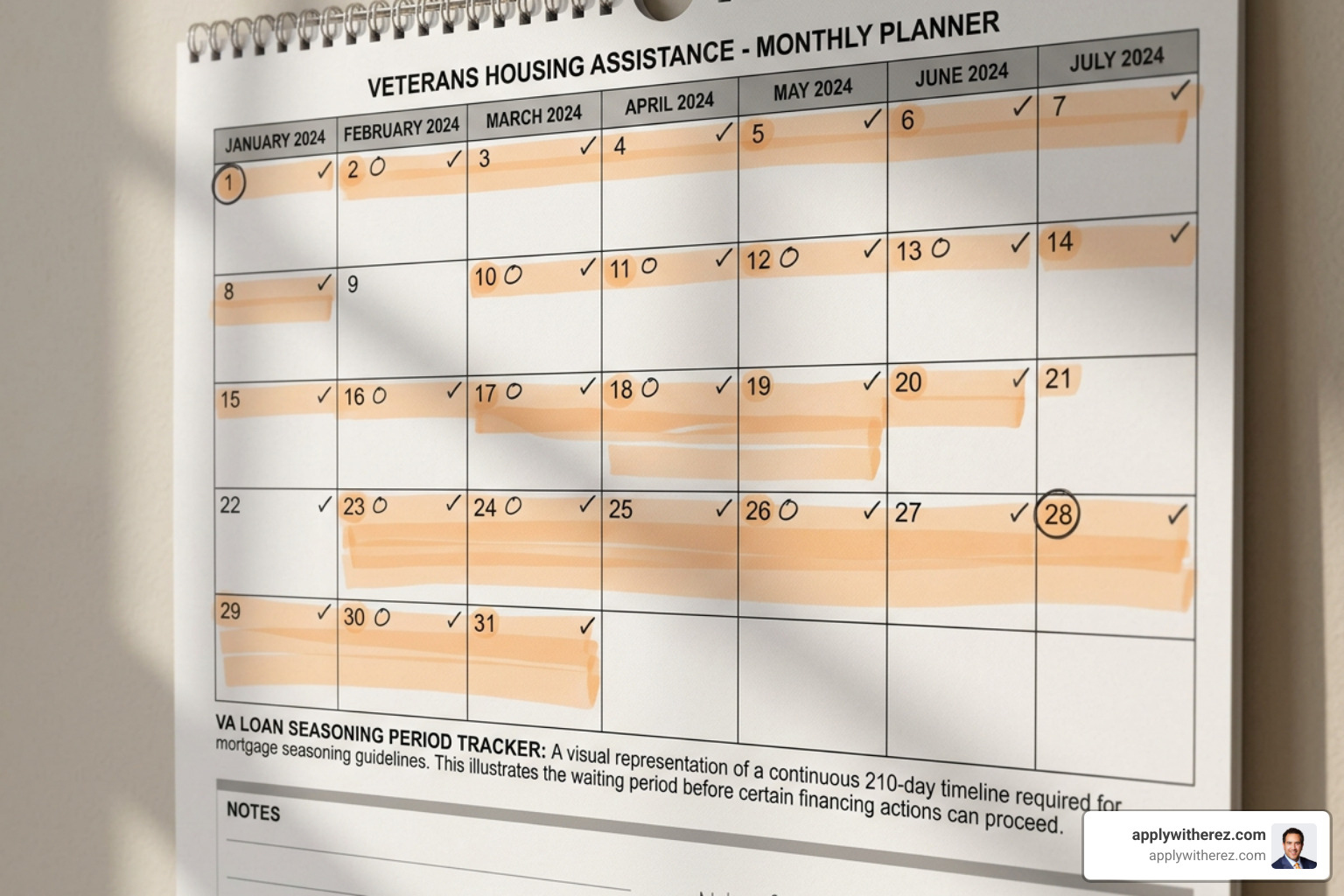
The seasoning requirement is twofold, and whichever date is later controls the timeline:
The Six-Payment Rule: You must have made at least six consecutive, on-time monthly payments on your current mortgage. If you entered into a temporary forbearance program, those paused months do not count toward this six-payment minimum.
The 210-Day Rule: At least 210 days must have passed between the due date of your very first mortgage payment on your current loan and the closing date of your new refinance.
A common mistake borrowers make is counting 210 days from their original closing date. Because your first mortgage payment is usually due on the first day of the second month following your closing, counting from the closing date will make you roughly 60 days too early. Attempting to close a refinance even one day before this seasoning period expires will result in an automatic rejection.
Net Tangible Benefit Requirements
Every va refinance must pass a strict Net Tangible Benefit (NTB) test. Simply put, your lender must document and prove that the new loan places you in a measurably better financial position than your current one.
According to official guidelines detailed in the Refinancing Loans compliance documentation, the NTB requirements vary by loan type:
Fixed-to-Fixed IRRRL: The new interest rate must be at least 0.50% (50 basis points) lower than your current rate.
Fixed-to-ARM IRRRL: The new interest rate must be at least 2.00% (200 basis points) lower than your current rate.
The 36-Month Recoupment Rule: For an IRRRL, all fees, closing costs, and expenses associated with the transaction must be fully recouped through your monthly savings within 36 months of closing.
Cash-Out Refinance: The benefit must fall into one of several recognized categories, such as converting an adjustable-rate mortgage to a stable fixed-rate, shortening the loan term, or utilizing the extracted cash to eliminate high-interest external debt. Additionally, if the cash-out LTV exceeds 90%, strict underwriting standards apply to ensure the loan remains in your best interest.
Refinancing a Conventional Mortgage into a VA Loan
Many veterans purchased their homes using a conventional mortgage or an FHA loan because they were not aware of their VA benefits at the time, or because market conditions made a conventional offer more competitive. If you find yourself in this situation, you are not locked out of your military benefits.
You can absolutely refinance a conventional mortgage into a VA loan. To do this, you will utilize the VA Cash-Out Refinance program. Do not let the name mislead you: you are not required to take any cash out to use this program. You can use it strictly as a "rate-and-term" refinance to transition your conventional loan into a VA-backed loan and eliminate private mortgage insurance (PMI).
For a detailed, step-by-step breakdown of how this transition works, see this guide on How to Refinance a Conventional Mortgage to a VA Loan.
Pros and Cons of Switching to a VA Loan
Refinancing from a conventional mortgage into a VA loan is an excellent financial move for many, but it is important to weigh the advantages against the upfront costs.
The Pros:
Eliminate Private Mortgage Insurance (PMI): Conventional loans require you to pay monthly PMI if you have less than 20% equity. FHA loans require mortgage insurance premiums (MIP) for the entire life of the loan. VA loans never require monthly mortgage insurance, regardless of how much equity you have. This alone can save you $100 to $300 per month.
Higher Loan-to-Value (LTV) Limits: If your home's value has dipped or you haven't built up much equity, conventional lenders will generally not let you refinance if your LTV exceeds 80% to 95%. The VA program will happily guarantee a refinance up to 100% LTV.
Lower Interest Rates: Because they are backed by the federal government, VA loans typically offer interest rates that are 0.25% to 0.50% lower than comparable conventional mortgages.
The Cons:
The VA Funding Fee: Unless you qualify for an exemption due to a service-connected disability, you will have to pay a one-time VA funding fee. For a first-time cash-out refinance, this fee is 2.15% of the loan amount, rising to 3.30% for subsequent uses.
Mandatory Appraisal: You must pay for a new VA appraisal, which can cost between $400 and $600, to verify the home's value and ensure it meets the VA's Minimum Property Requirements (MPRs).
If you are ready to explore your options, you can read more about the core benefits of a VA Home Loan to see if making the switch aligns with your long-term goals.
How to Apply for a VA Refinance
The application process for a va refinance is straightforward, but staying organized will help you close your loan much faster. Here is a checklist of the essential documents you will need to gather for your lender:
Certificate of Eligibility (COE): Proves your service credentials.
Government-Issued ID: A copy of your driver's license, military ID, or passport.
DD Form 214: For retired veterans or those who have separated from service.
Proof of Income: Your two most recent pay stubs and your last two years of W-2 forms.
Tax Returns: Your last two years of federal tax filings (especially important if you are self-employed).
Current Mortgage Statement: Showing your current balance, interest rate, and escrow details.
Homeowners Insurance Policy: Verification of active coverage on the property.
Once you have gathered these documents, the process follows these standard steps:
Prequalification: Consult with us to run your numbers and check your eligibility.
Application Submission: Fill out the official loan application and submit your documentation.
Appraisal & Underwriting: For a cash-out loan, a VA appraiser will visit your home, while our underwriters review your credit and financial files.
Closing: Sign your final loan documents and pay your closing costs (which can often be rolled into your total loan balance so you pay nothing out of pocket).
Frequently Asked Questions About VA Refinancing
Can you refinance a VA loan multiple times?
Yes. The Department of Veterans Affairs does not place a lifetime cap or a maximum limit on how many times you can refinance your mortgage. However, practical boundaries exist. Each refinance must successfully clear the 210-day seasoning clock, satisfy the six-payment minimum, and pass the Net Tangible Benefit test.
Furthermore, Ginnie Mae enforces strict "churning" restrictions on lenders. Because of this, most mortgage companies are highly reluctant to write a second refinance for a borrower within a single 12-month window. You should also remember that every time you refinance into a new 30-year loan, you reset your amortization schedule back to year one, meaning more of your early monthly payments will go toward interest rather than building home equity.
The True Cost of a VA Refinance
Refinancing is never entirely free. Even "no-cost refinances" simply roll the transaction fees into your principal loan balance or exchange them for a slightly higher interest rate.
The primary costs involved in a va refinance include:
The VA Funding Fee: A mandatory federal fee that helps keep the VA loan program self-sustaining for future generations. For an IRRRL, this fee is a flat 0.50%. For a cash-out refinance, it is 2.15% for first-time use and 3.30% for subsequent use. If you have a service-connected disability rating of 10% or higher, are a Purple Heart recipient, or are a surviving spouse of a veteran who died in service, you are completely exempt from this fee.
Lender and Third-Party Fees: Title insurance, escrow fees, recording fees, and loan origination charges, which typically range between $2,000 and $5,000.
To determine if a refinance makes financial sense, you must calculate your break-even point. Divide your total closing costs by your projected monthly savings. For example, if your closing costs are $3,600 and you save $150 per month, your break-even point is 24 months ($3,600 / $150 = 24). If you plan to stay in your home longer than two years, the refinance is highly beneficial.
Do you need an appraisal for a VA refinance?
It depends entirely on the type of refinance you choose. If you are applying for a VA IRRRL (Streamline), the VA does not require an appraisal. Lenders can process your loan using your original home valuation, making it an excellent option if your home has lost value.
If you are applying for a VA Cash-Out Refinance (including transitioning a conventional loan to a VA loan), a brand-new, comprehensive VA appraisal is legally mandatory. The appraiser must verify the current market value of your property to establish your maximum borrowing limit and ensure the home meets the VA's strict safety and structural guidelines.
Conclusion
A va refinance is an incredible benefit designed to reward you for your service by helping you save money, secure your financial future, and leverage the equity in your home. Whether you choose the speed and simplicity of an IRRRL to lower your monthly payments, or the robust financial power of a Cash-Out Refinance to consolidate debt, understanding these rules is the key to maximizing your benefits.
At applywitherez.com, located at 26 Wills Way, we are dedicated to helping military families make smart, strategic mortgage decisions. If you are ready to analyze your numbers, calculate your break-even point, or explore today's competitive rates, let's start a conversation.
Take the first step toward your financial goals and visit our Refinance portal today to see how much you can save.