NJ Teacher Home Buyer Programs: A Practical Guide to Grants and Mortgages
NJ Teacher Home Buyer Programs Can Lower Your Upfront Costs
New Jersey educators may be able to reduce the cash needed to buy a home through teacher-focused grants, down payment assistance, and special mortgage programs. The best first steps are to get pre-approved, confirm which programs are currently funded, and ask whether the assistance can be combined with your mortgage.
Key NJ teacher home buyer programs include:
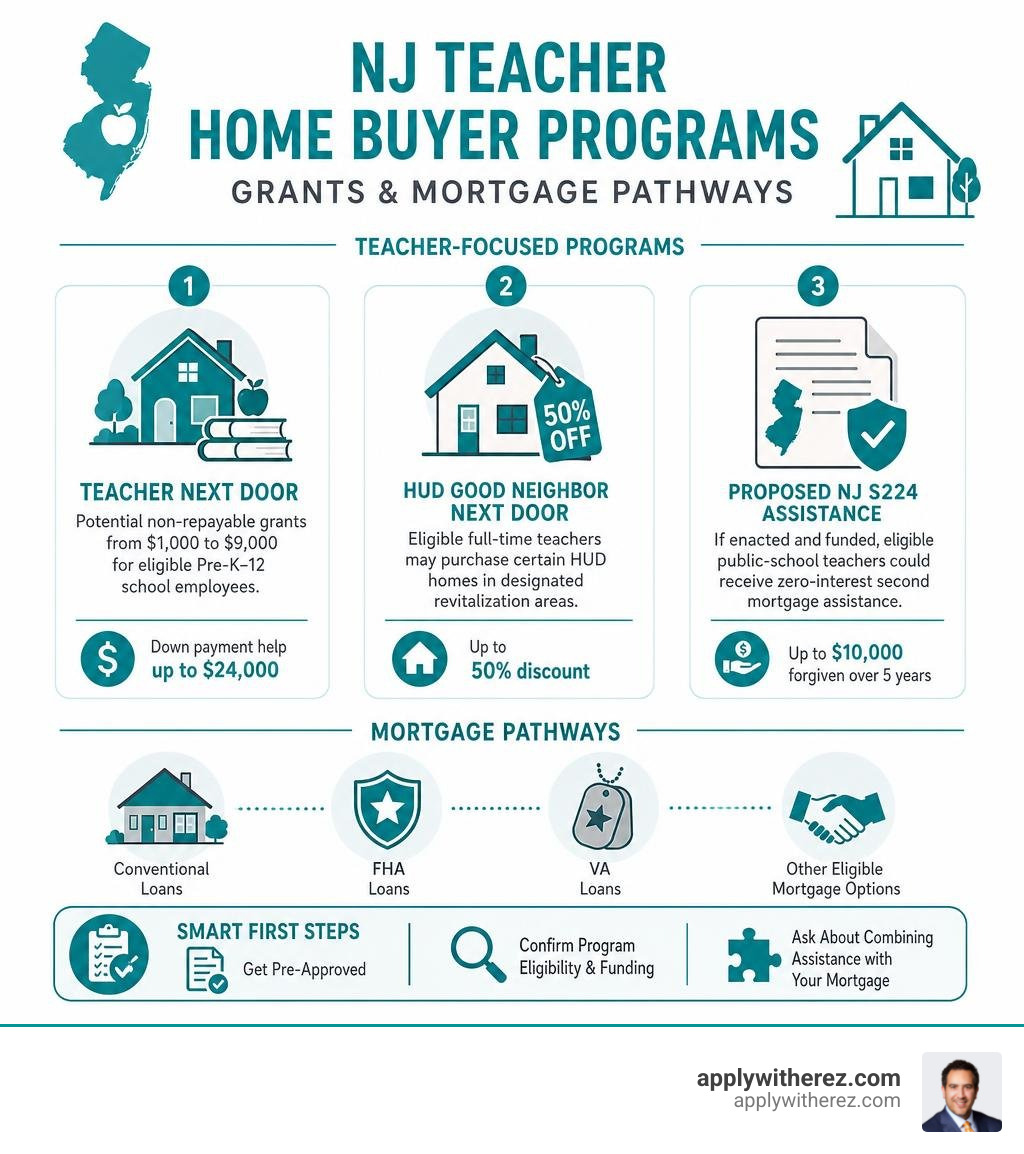
Educator Housing Grants: Potential non-repayable grants and down payment assistance ranging from $1,000 to over $20,000 for eligible Pre-K through 12 school employees through specialized programs.
HUD Good Neighbor Next Door: A limited-inventory federal program that can provide eligible full-time teachers a 50% discount on certain HUD homes in designated revitalization areas.
Proposed NJ S224 assistance: If enacted and funded, this state proposal would offer eligible public-school teachers up to $10,000 in zero-interest second-mortgage assistance, forgiven over five years.
Each option has different rules for employment, income, property location, financing, and occupancy. For example, HUD's 50% discount requires the buyer to use the home as a primary residence for 36 months, while the proposed state program would focus on eligible teachers working in participating SDA districts.
I am Erez Shimoni, a mortgage professional with 26 years of experience helping borrowers understand loan options, closing costs, and the path to homeownership. In this guide to NJ teacher home buyer programs, I will help you see which assistance may fit your situation and how it can work alongside a conventional, FHA, VA, or other mortgage.
Overview of NJ Teacher Home Buyer Programs and Grant Options
Navigating the housing market in the Garden State requires a clear strategy, especially for educators managing structured public salary schedules. Finding the right down payment support can turn a daunting settlement sheet into an accessible, rewarding purchase. As a first-time home buyer, an educator can access specialized grant pools, non-repayable funding, and state-backed opportunities coordinated through agencies like the New Jersey Housing and Mortgage Finance Agency.
These programs aim to keep community pillars—such as classroom teachers, paraprofessionals, and administrators—living within the communities they serve. Because down payment and closing costs often represent the single largest hurdle for educators, understanding how these grants interface with a primary mortgage is the key to maximizing savings.
Housing Grants and Assistance for New Jersey Educators
Dedicated educator housing initiatives offer targeted assistance structured specifically around educational professionals. Through these opportunities, eligible Pre-K through 12th-grade certified teachers, school administrators, and support staff can secure non-repayable grants and down payment support.
Grant Size: Grants generally range between $1,000 and $9,000 depending on funding availability, home location, and applicant qualifications.
Down Payment Support: Highly qualified applicants may access additional down payment assistance of up to $24,000.
Fee Reductions: These initiatives frequently pair grants with discounted settlement fees and appraisal credits, saving educators thousands of dollars on closing day.
HUD Good Neighbor Next Door 50% Home Discount
The U.S. Department of Housing and Urban Development (HUD) sponsors the Good Neighbor Next Door (GNND) program. It offers a 50% discount off the list price of single-family homes located in designated revitalization areas.
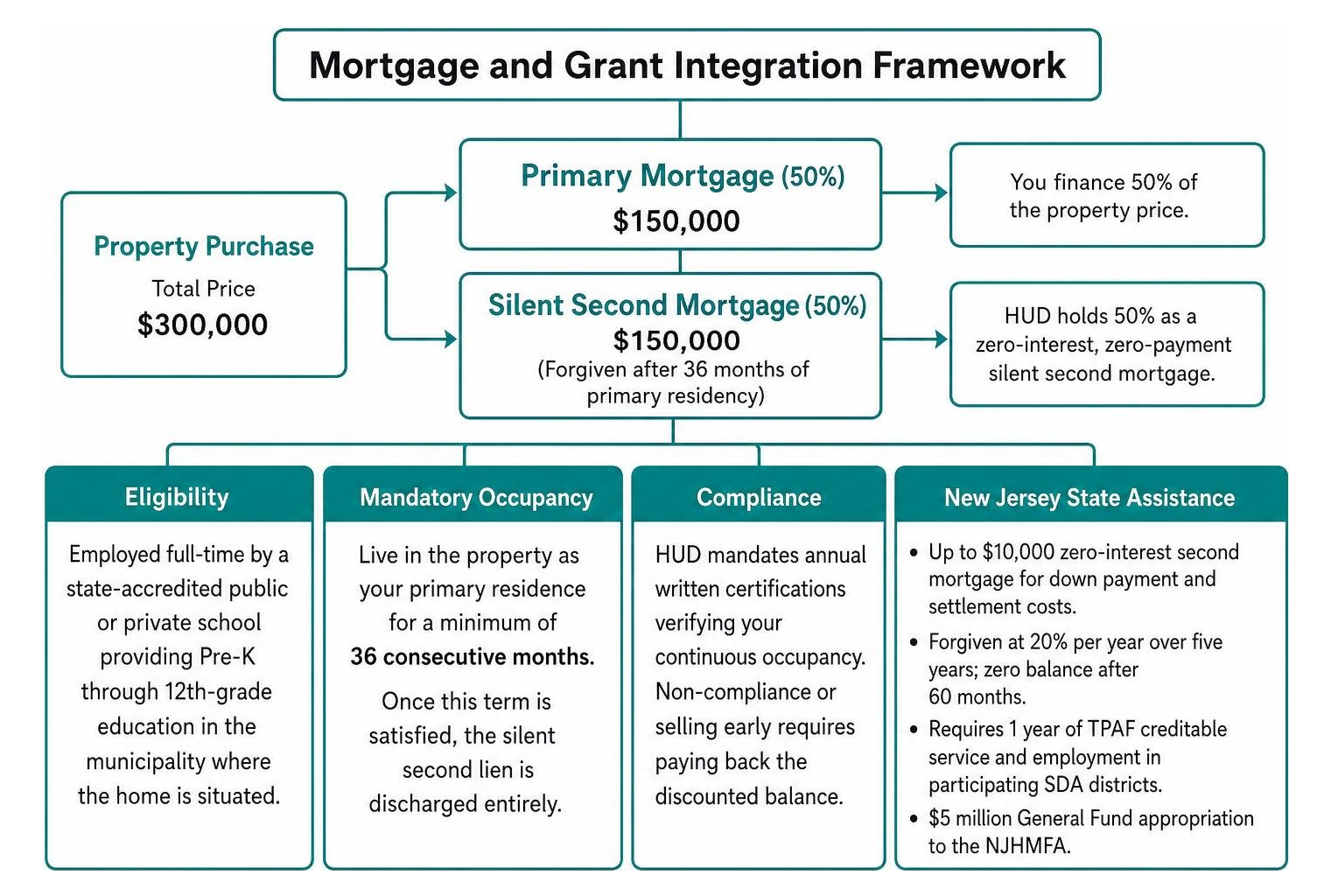
Eligibility: You must be employed full-time by a state-accredited public or private school providing Pre-K through 12th-grade education in the municipality where the home is situated.
The "Silent Second" Mortgage: You finance only 50% of the property's purchase price. HUD holds the remaining 50% as a zero-interest, zero-payment silent second mortgage.
Mandatory Occupancy: You must live in the property as your primary residence for a minimum of 36 consecutive months. Once this term is satisfied, the silent second lien is discharged entirely.
Compliance: HUD mandates annual written certifications verifying your continuous occupancy. Non-compliance or selling early requires paying back the discounted balance.
New Jersey Legislative Bill S224 and State Assistance
The New Jersey Legislature introduced S224, a measure designed to provide dedicated down payment assistance for public servants, including public school teachers.
Loan Amount: Up to $10,000 in zero-interest second mortgage funding to cover down payment and settlement costs.
Forgiveness Structure: The loan is forgiven at a rate of 20% per year over five years, reaching a zero balance after 60 months of continuous primary occupancy.
Service & District Requirements: Applicants must have at least one year of creditable service in the Teachers' Pension and Annuity Fund (TPAF) and work within participating Schools Development Authority (SDA) districts that have adopted local enabling ordinances.
Appropriation: The bill allocates a $5 million General Fund appropriation to the NJHMFA for statewide management.
Financing Options and Mortgage Pathways for Educators
Grants and discounts must pair with a strong primary loan. Comparing options ensures you secure the best first-time buyer mortgages 2026 while finding the best way to buy a house for the first time.
Structuring Conventional and Government-Backed Loans
Educators have diverse credit profiles, tenures, and savings goals. Choosing the right loan framework ensures grant funds integrate smoothly into closing:
Conventional Mortgages: A standard conventional loan pairs well with down payment grants for borrowers with credit scores of 620 or higher. Putting down 20% removes private mortgage insurance (PMI), but conventional programs also allow down payments as low as 3% for qualifying educators.
FHA Mortgages: An fha loan provides flexible debt-to-income (DTI) allowances and requires a minimum 3.5% down payment. It is an effective vehicle when layering state or local housing assistance grants.
VA Mortgages: For educators with prior or active military service, a va home loan offers 100% financing with zero down payment and no monthly mortgage insurance requirements.
Comparing NJ Teacher Home Buyer Programs with Standard Mortgages
Feature | Educator Grant Programs | HUD Good Neighbor Next Door | Proposed NJ Bill (S224) | Standard Residential Mortgage |
|---|---|---|---|---|
Typical Benefit | Grants: $1,000–$9,000; DPA: up to $24,000 | 50% off appraised list price | $10,000 zero-interest loan | Market interest rate pricing |
Repayment Requirement | Non-repayable grants | None, if 36-month residency is met | Forgiven at 20% annually over 5 years | Fully amortized monthly payments |
Location Restrictions | Statewide (any eligible home) | Revitalization areas only | Participating SDA school districts | No geographic limits |
Eligible Roles | Pre-K–12 teachers, staff, administrators | Full-time Pre-K–12 teachers serving the area | Full-time public school teachers in TPAF | Any creditworthy borrower |
Occupancy Requirement | Primary residence | 36 months mandatory | 5 years mandatory | Primary, secondary, or investment |
Eligibility Criteria and Application Process for NJ Educators

Qualifying for educator-specific housing funds requires careful documentation. Lenders and state agencies review employment status, credit standing, and debt obligations before approving down payment grants.
Employment and Service Verification Guidelines
To qualify for teacher-specific housing assistance programs, you must verify your educational career path:
Employment Status: Verification of full-time employment within a public, charter, or accredited private school system.
Pension Verification: For state initiatives like S224, documentation confirming at least one year of creditable service in the Teachers' Pension and Annuity Fund (TPAF).
Service Verification Letter: A formal employer verification letter signed by your district superintendent or human resources department.
Income and Purchase Caps: Compliance with county-level income thresholds and purchase price maximums established by state housing agencies.
Step-by-Step Guide to Applying for NJ Teacher Home Buyer Programs
Get Pre-Approved: Secure a comprehensive home loan pre-approval to determine your true borrowing capacity.
Estimate Monthly Payments: Run payment scenarios with our online mortgage calculator to budget for principal, interest, taxes, and insurance (PITI).
Verify Program Availability: Coordinate with your mortgage broker to check active state grant allocations, SDA municipality participation, and available educator grant programs.
Property Search and Offer: Work with your real estate agent to find a home that meets the structural, geographic, and appraisal requirements of your chosen loan program.
Underwriting and Closing: Submit your employment verification, complete any required homebuyer education courses, and finalize your layered financing package for settlement.
Frequently Asked Questions About Home Buying for NJ Teachers
How much down payment grant money can a New Jersey teacher receive?
Qualified educators can receive between $1,000 and $9,000 in direct grants through specialized educator assistance programs, with certain qualified applicants accessing up to $24,000 in layered down payment assistance. If enacted, state measures like S224 provide an additional $10,000 in forgivable second-mortgage funds.
What is the occupancy requirement for HUD Good Neighbor Next Door in NJ?
HUD requires participants to live in the purchased home as their sole principal residence for at least 36 consecutive months. HUD monitors compliance through mandatory annual occupancy certifications.
Can school staff and administrators qualify for educator home grants?
Yes. Many educator grant initiatives extend grant access to administrators, guidance counselors, paraprofessionals, and school support personnel across Pre-K through 12th-grade institutions.
Conclusion
Securing the right mortgage is one of the most significant financial steps you will take in your career. Leveraging educator-focused grants, state down payment loans, and competitive mortgage programs can save you thousands of dollars at settlement and over the life of your loan.
As an independent mortgage broker, we compare loan options across multiple lenders to build a financing package tailored to your financial goals. Whether you are ready to apply or simply exploring your buying power, we are here to help you move forward with clarity and confidence.
Ready to explore your options? Connect with us today to buy a home and put your educator benefits to work.