
How to Buy Your First Home Like a Total Pro
Why the Best Way to Buy a House for the First Time Starts with a Plan
The best way to buy a house for the first time is to prepare before you start touring homes. Here's the core process:
Check and improve your credit score (aim for 620 minimum, 740+ for best rates)
Save for three buckets: down payment (3–20%), closing costs (2–5%), and cash reserves
Get pre-approved — not just pre-qualified — with at least three lenders
Find a buyer's agent and start your home search with a clear budget and must-have list
Make an offer with contingencies to protect yourself legally and financially
Get a home inspection — always, no exceptions
Review your Closing Disclosure and close with confidence
It sounds straightforward. But in 2026, with mortgage rates hovering around 6.5–6.75% and the national median home price near $415,000, the stakes are real. One wrong move — skipping an inspection, ignoring your credit, or choosing the first lender you talk to — can cost you tens of thousands of dollars.
The good news? 2026 is the most balanced housing market in nearly a decade. Inventory is up. Price growth has stalled. Buyers finally have some leverage again. That means preparation matters more than timing.
This guide walks you through every step — from building your savings to closing day — so you can move fast when the right home shows up.
I'm Erez Shimoni, a mortgage broker with 26 years of experience helping buyers navigate exactly this process, and guiding first-time buyers through the best way to buy a house for the first time is what I do every day across New Jersey, New York, Florida, and Pennsylvania. Let's make sure you go in ready.
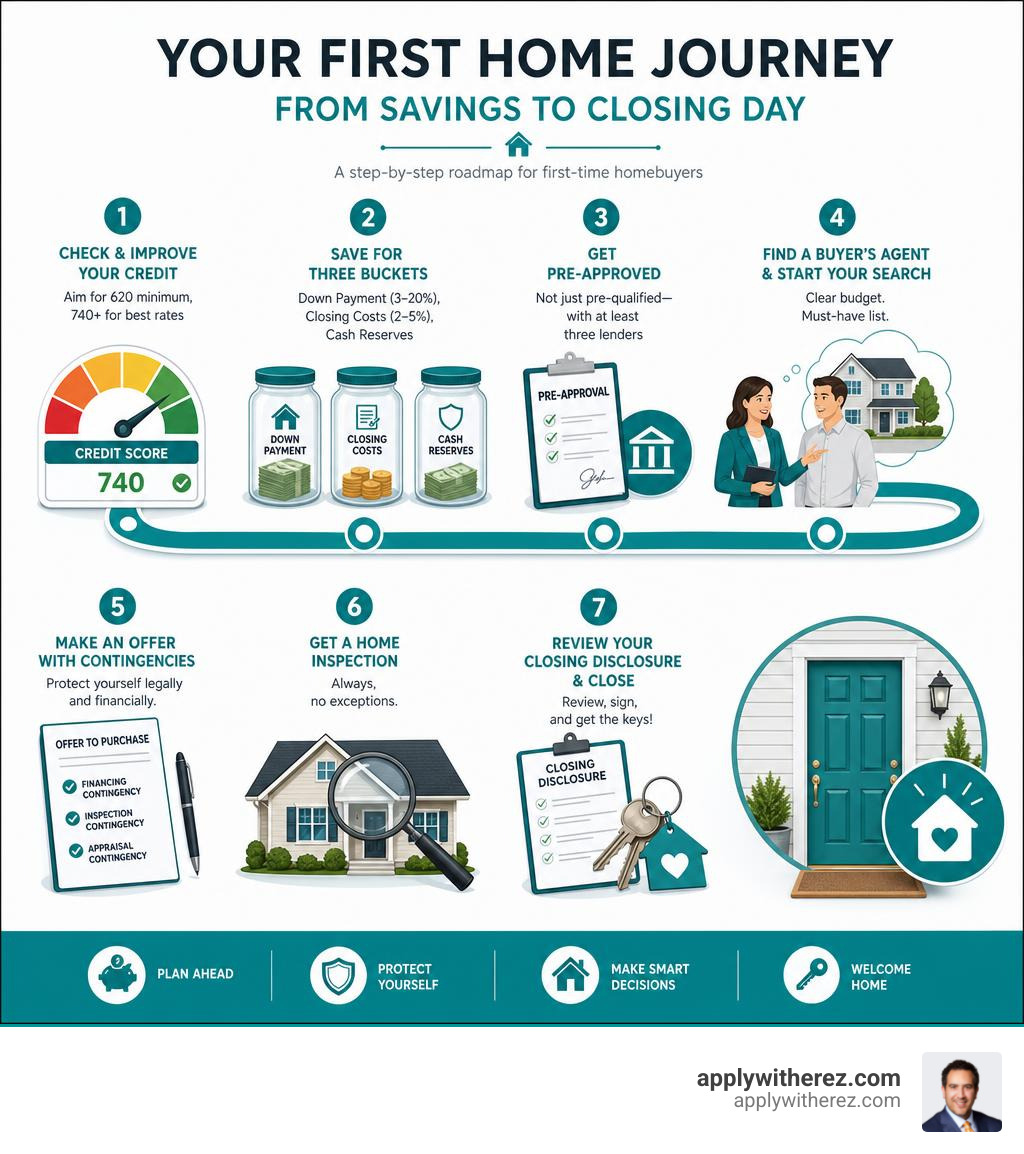
The best way to buy a house for the first time: your 2026 roadmap
The first-time homebuying process is a chain of decisions, each affecting the next.
In 2026, buyers face three main realities:
Mortgage rates require careful shopping to secure the best terms.
Home prices have stabilized nationally, but affordability remains tight.
Inventory is healthier, giving prepared buyers more negotiating room.
While you cannot control rates, you can control your credit, budget, loan strategy, offer terms, and inspection protections. A realistic homebuying process takes 3 to 6 months once you are actively shopping. If you need to improve credit or save more, plan for 6 to 18 months of preparation.
For general consumer guidance, HUD homebuying resources are also worth reviewing as you get started.
Start with your “why,” budget, and must-haves
Before asking how much you can borrow, ask why you want to buy now. Common reasons include building long-term stability, locking in housing costs, starting a family, or gaining control over your property. Your "why" helps you avoid emotional decisions.
Build two lists to keep your search on track:
Must-haves:
Maximum monthly payment
Number of bedrooms and bathrooms
Commute limit and school needs
Safety and neighborhood fit
Parking and accessibility
Nice-to-haves:
Updated kitchen or newer appliances
Finished basement or extra office
Large yard or fireplace
Keep resale in mind. A home with broad appeal, reasonable taxes, and a functional layout is often a smarter first purchase than the quirkiest house on the block.
Know what 2026 buyers are up against-and where they have leverage
First-time buyers in 2026 are putting down an average of about 10%. However, buyers have more leverage than they did during the ultra-competitive years. National home price growth is flat, inventory has improved, and sellers are more open to negotiation.
Areas where buyers have leverage:
Asking for seller credits toward closing costs
Negotiating repairs after inspection
Comparing more homes instead of rushing
Considering townhomes (which now make up 18% of single-family construction)
Asking for rate buydown contributions
Writing offers with reasonable contingencies
Adjustable-rate mortgages (ARMs) are also getting more attention in 2026. ARMs can make sense in specific situations, but you must understand the future adjustment risk before choosing one.
Build a realistic homebuying timeline
Here is a clean timeline most first-time buyers can follow:
Stage Typical timing What happens Credit and savings prep 6 to 18 months before buying Improve credit, reduce debt, save cash Mortgage planning 2 to 4 months before shopping Compare loan types and estimate payments Pre-approval Before touring seriously Submit documents and verify buying power Home search 2 weeks to 6 months Tour homes, compare neighborhoods, study prices Offer and negotiation 1 to 7 days Submit offer, negotiate terms, sign contract Inspection period Usually 7 to 14 days Inspect, review findings, negotiate repairs Appraisal and underwriting 2 to 5 weeks Lender verifies property and borrower file Closing Usually 30 to 45 days after contract Sign documents, transfer funds, get keys
Build in a moving plan too. Budget for utility setup, locksmiths, and immediate repairs during your first 30 days.
Get financially ready before you tour homes
Financial readiness includes credit, debt-to-income ratio, cash to close, reserves, and the ongoing cost of ownership.
If you want a simple starting point, review our guide on Five Simple Steps to Get Your Finances in Order.
How much money first-time buyers realistically need to save

Think in three savings buckets.
Bucket 1: Down payment
VA loan: 0% down for eligible borrowers
USDA loan: 0% down for eligible rural properties
Conventional first-time buyer programs: as low as 3% down
FHA loan: 3.5% down with a 580+ credit score
20% down: avoids private mortgage insurance (PMI)
On a $400,000 home:
Down payment Cash needed 3% $12,000 3.5% $14,000 5% $20,000 10% $40,000 20% $80,000
Bucket 2: Closing costs
Closing costs commonly run 2% to 6% of the purchase price ($8,000 to $24,000 on a $400,000 home). These include lender fees, appraisal, title search, title insurance, recording fees, and prepaid taxes and insurance.
Bucket 3: Reserves and move-in money
Do not spend every dollar to close. Plan for:
Earnest money deposit (1% to 3% of purchase price)
Home inspection and appraisal fees
Moving costs and utility deposits
Immediate repairs and basic tools
Aim to have at least 2 to 3 mortgage payments left after closing, and ideally 3 to 6 months of living expenses.
Credit score and DTI requirements by mortgage type
Your credit score affects your interest rate and mortgage insurance. Your debt-to-income (DTI) ratio compares your monthly debt payments to your gross monthly income.
Loan type Common minimum credit score Down payment DTI guidance Notes Conventional 620+ As low as 3% 36% ideal, up to 45%+ with approval Best pricing at 740+ FHA 580+ 3.5% Often around 43%, sometimes higher Flexible credit, MIP required VA No official minimum 0% Focuses on residual income No monthly mortgage insurance USDA 620-640 commonly used 0% Often around 41% to 44% Property/income limits apply
The classic 28/36 rule suggests keeping housing costs near 28% and total debts near 36% of gross monthly income. Qualifying for a higher payment does not mean you should take it.
How better credit can save you thousands
In 2026, moving from a 640 credit score to a 720 on a $350,000 mortgage can save roughly $166 per month and over $60,000 over the life of the loan. Even a 0.25% rate difference can save more than $15,000 in total interest.
To improve your credit before applying:
Pay every bill on time
Keep credit card balances under 10% to 30% of limits
Dispute credit report errors
Avoid opening new accounts or closing old ones
Pay down revolving debt first
Keep cash after closing-not just enough to close
Draining your savings to maximize your down payment can backfire. Homeownership comes with surprise expenses like HVAC repairs, roof leaks, or plumbing issues. A useful rule is to budget 1% to 2% of the home's value per year for maintenance.
Choose the right mortgage, lender, and pre-approval strategy
Your mortgage is more than just an interest rate. It includes the loan type, term, fees, monthly payment, mortgage insurance, and closing costs.
For a deeper loan breakdown, see our guide to the Best Type of Mortgage for First Time Buyers.
Compare loan types like a pro
Conventional loans Best for buyers with solid credit. Some programs allow 3% down. Private mortgage insurance (PMI) is required for down payments under 20% but can be removed once you reach 20% equity.
FHA loans Great if your credit is still improving. Requires 3.5% down with a 580+ score. FHA mortgage insurance (MIP) usually lasts for the life of the loan if you put down less than 10%.
You can review current FHA-related guidance here: 30 Year FHA Mortgage Rates Today.
VA loans For eligible service members and veterans, VA loans allow 0% down and do not require monthly mortgage insurance. Learn more here: VA Home Loan.
USDA loans Allow 0% down for eligible buyers purchasing in qualifying rural or suburban areas. Income and property location rules apply.
Fixed-rate vs ARM A fixed-rate mortgage offers payment stability. An ARM starts with a lower rate that can adjust later, adding long-term risk.
Why pre-approval is the best way to buy a house for the first time with confidence
Pre-qualification is a rough estimate based on unverified information. Pre-approval is a formal commitment where the lender verifies your pay stubs, W-2s, tax returns, bank statements, and credit history.
A pre-approval helps you know your actual price range, make stronger offers, and show sellers you are serious. Most pre-approvals are valid for 60 to 90 days.
When you are ready to start, our Buy a Home page can help you map the next step.
Shop at least three lenders before you choose
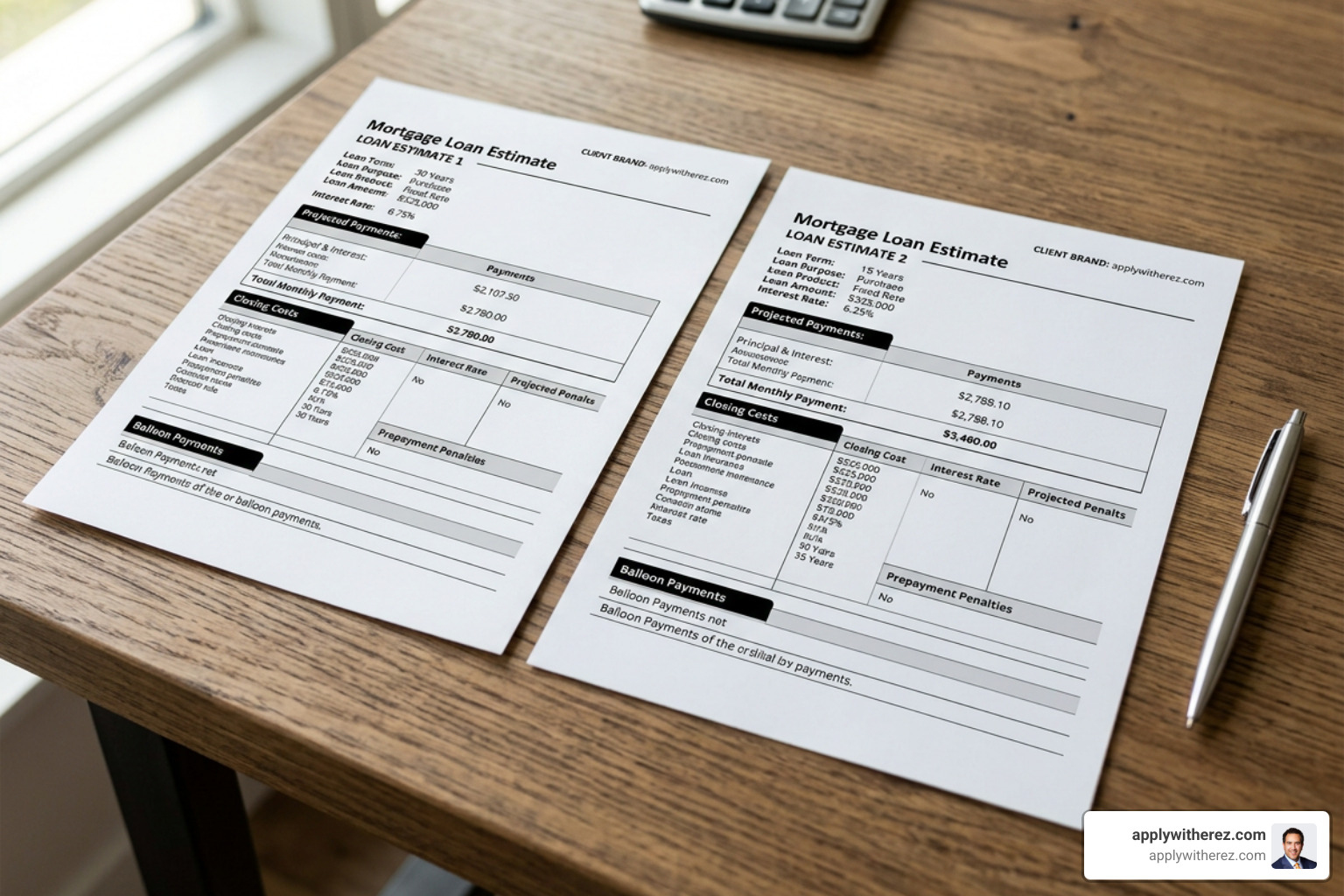
Borrowers who get at least three mortgage quotes save an average of $1,500 in the first year alone. Compare the interest rate, APR, lender fees, discount points, and estimated closing costs on each Loan Estimate.
Ask each lender about first-time buyer options, total cash to close, and how long the rate is locked.
Avoid mortgage mistakes between pre-approval and closing
Once pre-approved, keep your finances stable. Avoid:
Opening new credit cards or taking auto loans
Changing jobs
Making large undocumented deposits
Moving money between accounts without a paper trail
Missing payments or co-signing loans
Before making any financial move, check this list of 9 Mistakes That Can Affect Your Mortgage.
Shop, offer, inspect, and close without rookie mistakes
Touring homes is exciting, but falling in love with a property before checking its condition is risky. Use a buyer's agent, review comparable sales, and stick to your budget.
Evaluate homes and neighborhoods beyond the listing photos
Look beyond the staging and photos. Evaluate:
Commute times at rush hour
Property tax history and homeowners insurance costs
Flood zone status and HOA fees/rules
Age of the roof, HVAC, and windows
Signs of water damage or foundation cracks
Electrical panel condition and drainage
If there is an HOA, review the CC&Rs, budget, reserves, and any pending assessments. Consider resale demand; homes on busy roads or with unusual layouts can be harder to sell later.
Make a smart offer with buyer-protecting contingencies
A strong offer balances price, timing, and terms. Key contingencies for first-time buyers include:
Financing contingency: Protects you if you cannot secure mortgage approval.
Inspection contingency: Allows you to negotiate repairs, request credits, or walk away based on inspection findings.
Appraisal contingency: Protects you if the home appraises for less than the purchase price.
Title contingency: Protects you against ownership disputes or liens.
HOA review contingency: Gives you time to review HOA documents.
Never skip the home inspection
Skipping the inspection is a costly mistake. A general inspection reviews the roof, foundation, plumbing, electrical, HVAC, attic, and appliances. Depending on the property, you may also need specialty inspections for radon, mold, pests, sewer lines, or septic systems.
Use the inspection report to understand what you are buying, estimate future repairs, or negotiate seller credits and price reductions.
Understand appraisal, underwriting, and closing costs
If the appraisal comes in low, you can renegotiate the price, bring extra cash to cover the gap, challenge the appraisal, or cancel the contract if protected by your contingency.
Underwriting is the lender's final review of your financial file and the property details. You will receive a Closing Disclosure at least 3 business days before closing. Review the loan amount, interest rate, monthly payment, and cash to close carefully.
Prevent closing-day disasters and wire fraud
Wire fraud is a real threat. Protect yourself:
Never trust wiring instructions sent only by email.
Call the title company using an independently verified phone number to confirm details before sending funds.
Ask if a cashier's check is accepted instead of a wire.
Before signing, perform a final walkthrough to confirm agreed repairs are complete, appliances remain, and the home is in good condition.
Frequently asked questions about buying your first home
What is the best way to buy a house for the first time if I have a small down payment?
Low down payment options include 3% down conventional programs, 3.5% down FHA loans, and 0% down VA or USDA loans. You can also look into down payment assistance programs, gift funds, or seller credits. Always ensure the monthly payment remains comfortable once taxes, insurance, and mortgage insurance are added.
You can also explore 100 Mortgages for First Time Buyers to understand how many program paths exist.
How much house can I afford in 2026?
Use the 28/36 rule as a starting point: keep your housing payment around 28% of your gross monthly income and total debt payments under 36%. Lenders may allow higher ratios, but you should also budget for utilities, maintenance, savings, and lifestyle expenses. The lender's maximum approval is not always your ideal budget.
What first-time homebuyer assistance programs should I check?
Look for programs at the state, county, and city levels. These include down payment assistance grants, forgivable second mortgages, and mortgage credit certificates. Many programs have income limits, purchase price caps, or education requirements, so research them early in your planning process.
Is 2026 a good year to buy your first home?
Yes, if you are financially ready. The 2026 market offers more balanced inventory, slower price growth, and better negotiating leverage than in recent years. However, personal readiness matters more than market timing. Buy when you can afford the payment, have emergency savings, and plan to stay in the home long enough to offset transaction costs.
Conclusion
Buying your first home like a pro does not mean knowing everything. It means knowing what matters before it costs you money.
The best way to buy a house for the first time is to:
Prepare your credit early
Save for down payment, closing costs, and reserves
Compare loan options
Get fully pre-approved
Shop at least three lenders
Stick to a realistic budget
Make offers with smart contingencies
Never skip the inspection
Review closing documents carefully
Protect yourself from wire fraud
In 2026, buyers have more breathing room than they have had in years, but affordability still requires discipline. The right plan can help you move quickly, negotiate confidently, and avoid the classic first-time buyer traps.
When you are ready, we can help you build your numbers, compare loan options, and start with clarity.