
An Essential Guide to the Home Loan Pre Approval Process
Why Getting a Home Loan Pre Approval Is the Smartest First Step You Can Take
Home loan pre approval is a lender's written confirmation that they are tentatively willing to lend you a specific amount of money — based on a review of your income, assets, debts, and credit history.
Here's what you need to know at a glance:
Question Quick Answer What is it? A conditional commitment from a lender stating how much you can borrow How long does it take? 1–10 business days depending on the type How long is it valid? Typically 30 to 90 days Does it affect your credit? Yes — lenders perform a hard credit inquiry Is it a guarantee? No — final approval depends on the property and your finances at closing Who needs it? Anyone serious about making an offer on a home
Most buyers start house hunting before they know what they can actually afford. That's a costly mistake. A pre-approval gives you a real number, not a guess — and it tells sellers you're a serious, qualified buyer.
In a competitive market, a pre-approval letter can be the difference between winning and losing a home you love.
I'm Erez Shimoni (NMLS #460222), a mortgage broker with 26 years of experience guiding buyers through the home loan pre approval process in New Jersey, New York, Pennsylvania, and Florida. I'll walk you through everything you need to know — clearly, step by step, with no jargon.
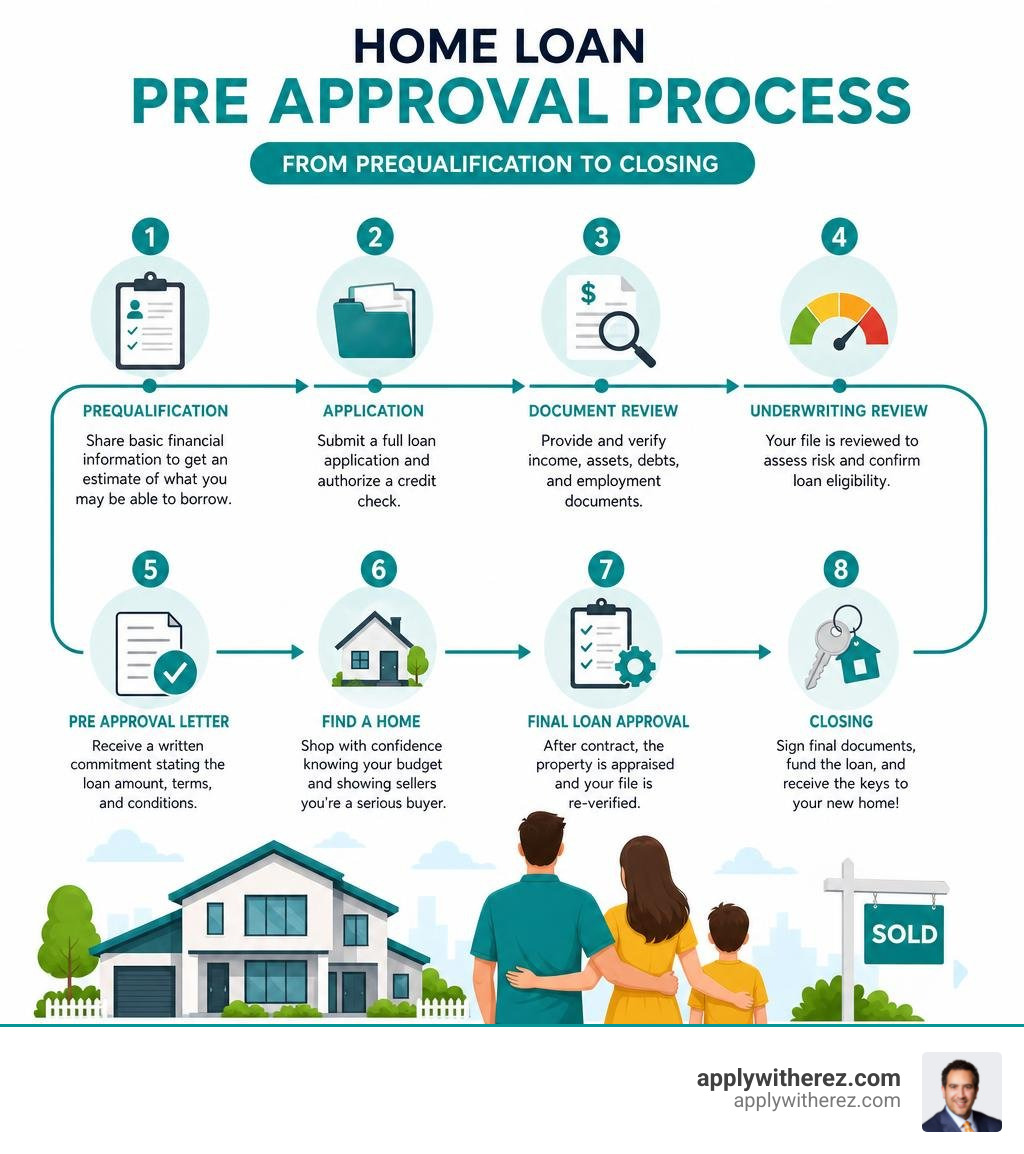
Prequalification vs. Home Loan Pre Approval
When you begin researching home loans, you will quickly run into two terms that sound almost identical but are actually very different: prequalification and preapproval.
Getting prequalified is the casual, low-stakes first step. It is essentially an informal estimate of your borrowing power based entirely on self-reported data. You tell a lender how much you make, what you owe, and what you have saved. They will run a soft credit check—which has zero credit impact—and give you a ballpark figure of what you might qualify for. No paperwork is required, and the whole process can happen online in minutes.
A formal home loan pre approval, on the other hand, is the real deal. It is as close as you can get to securing a mortgage without actually having a property under contract. Instead of taking your word for it, we verify your financial claims. We pull a comprehensive credit report (a hard credit check) and scrutinize your actual pay stubs, tax returns, and bank statements.
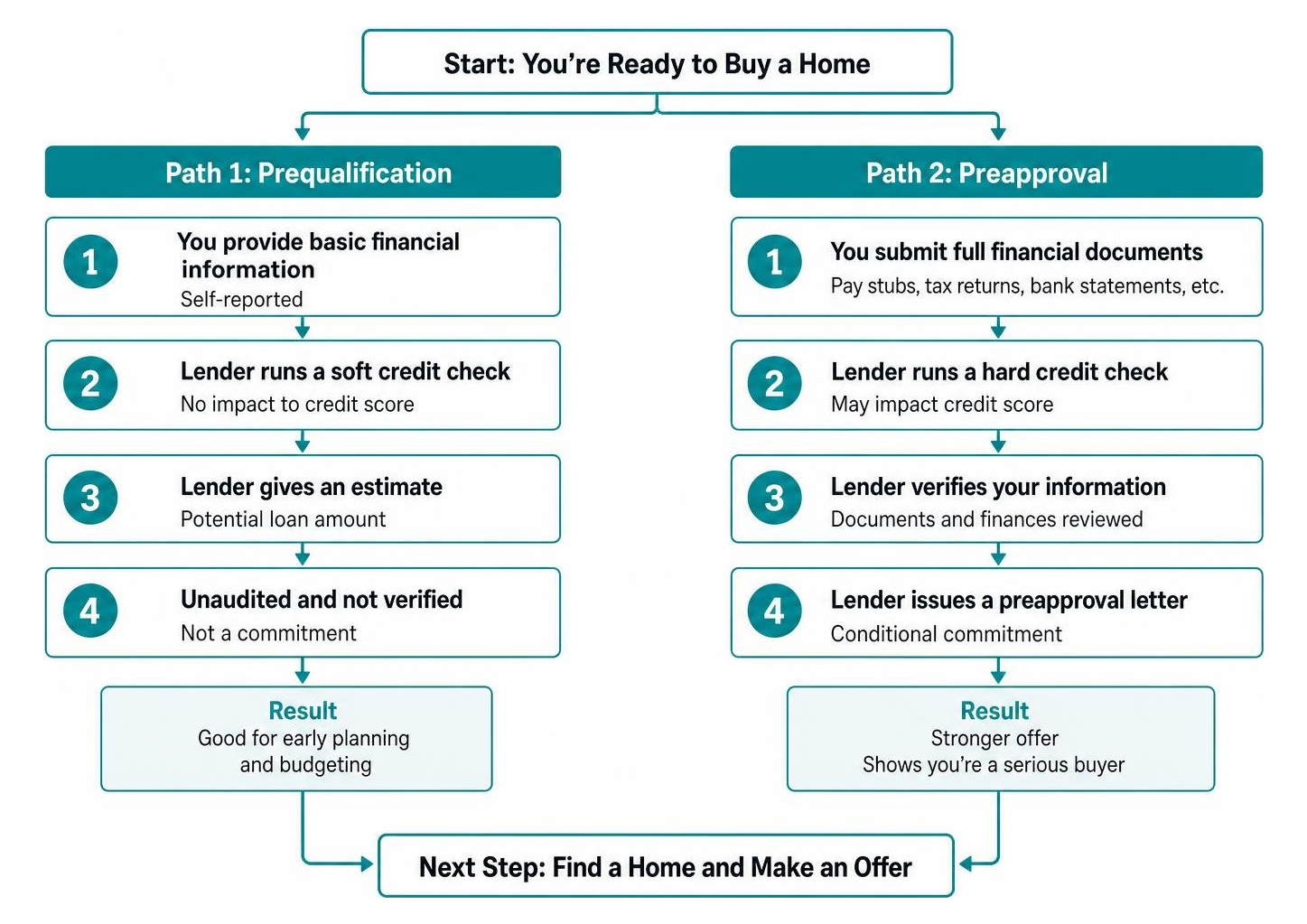
To help you visualize the differences, we have mapped them out below:
Feature Mortgage Prequalification Home Loan Pre Approval Data Source Self-reported, unverified financial details Verified financial documentation Credit Inquiry Type Soft credit pull (no score impact) Hard credit pull (minor temporary impact) Documents Required None W-2s, tax returns, pay stubs, bank statements Processing Time Instant to 1 hour 1 to 10 business days Sellers' Perception Viewed as an estimate; carries little weight Viewed as a serious, verified commitment Expiration None (though accuracy fades as finances change) Typically 30 to 90 days
If you are a first-time home buyer guide, starting with a prequalification is a great way to gauge your entry point into the market. But when you are ready to start visiting open houses and talking to real estate agents, you absolutely need a verified pre-approval.
Why You Need a Pre-Approval Before House Hunting
Imagine finding the perfect home in a beautiful neighborhood in New York, New Jersey, or Pennsylvania. You can already picture where your furniture will go. You submit an offer, only to discover the seller won't even look at it because you don't have a home loan pre approval letter. By the time you contact us to get one, another buyer has already snatched up the property.
This heartbreak happens to unprepared buyers every single day. Here is why having that letter in hand before you step foot in an open house is non-negotiable:
It gives you a competitive edge: Sellers do not want to risk taking their home off the market for a buyer whose financing might fall through. A pre-approval letter proves that a professional financial institution has already vetted your creditworthiness.
It establishes your absolute budget parameters: It prevents you from wasting time looking at $600,000 homes when your comfortable borrowing limit is actually $450,000.
It gives you negotiation leverage: If a seller receives two similar offers, but yours is accompanied by a solid pre-approval letter and the other is not, they will almost always choose yours—even if the other offer is slightly higher.
It fast-tracks your closing timeline: Because we have already collected and verified most of your financial documents, the underwriting process moves significantly faster once you are under contract.

Getting pre-approved also helps you identify potential financial roadblocks early. If there is an outstanding collection account or an error on your credit report, we can address it before it costs you your dream home. To make sure your processing goes smoothly, be sure you are avoiding common mortgage mistakes that can derail your progress.
How to Prepare for the Home Loan Pre Approval Process
Preparing for a mortgage is a lot like training for a marathon; you don't want to show up on day one without any warm-up. Lenders look at your financial life through a microscope. They want to see stability, predictability, and responsibility.
Your preparation should focus on three core pillars:
Your Credit Score: Check your credit reports for any errors or outdated negative marks. Pay down credit card balances to keep your credit utilization ratio below 30% (ideally under 10%).
Your Debt-to-Income (DTI) Ratio: This is the percentage of your gross monthly income that goes toward paying debts (like student loans, car payments, and minimum credit card payments). The lower your DTI, the more a lender will be willing to let you borrow.
Your Financial Consistency: Avoid making major life changes right before or during the process. This means no changing careers, no opening new lines of credit, and no massive cash transfers between accounts.
If you are just starting to plan your purchase, taking a few structured steps will save you weeks of stress later. We highly recommend reading our guide on getting your finances in order to set yourself up for absolute success.
Documents Required for a Home Loan Pre Approval
To turn your pre-approval application around quickly, you should gather your financial paperwork in advance. We will need to verify your identity, your income, your assets, and your employment history.
Here is a standard checklist of what you should prepare:
Proof of Identity: Your driver's license, Social Security card, or passport.
Proof of Income: Your two most recent pay stubs showing year-to-date earnings.
Tax Documents: Your W-2 statements and complete federal tax returns from the last two consecutive years.
Asset Statements: Complete bank statements (all pages, even the blank ones) for the last 60 days for your checking, savings, and investment accounts.
Proof of Employment: Contact information for your current HR department so we can verify your employment. If you are self-employed, you will need to provide business tax returns and a year-to-date profit and loss statement.
Having these documents neatly organized in a digital folder makes the submission process seamless. For more details on what federal regulators expect during this process, you can learn how to Get a preapproval letter from the CFPB.
Credit Score Impact of a Home Loan Pre Approval
A very common concern among buyers is whether applying for a home loan pre approval will damage their credit score.
The short answer is: Yes, but only minimally and temporarily.
When we pull your credit report for a formal pre-approval, it triggers a "hard inquiry." A single hard inquiry typically knocks fewer than five points off your credit score. For most borrowers, this minor dip is completely inconsequential and recovers within a few months of normal financial activity.
Furthermore, credit scoring models are designed to allow you to shop around. If you apply for a mortgage with multiple lenders within a specific window (usually 14 to 45 days depending on the scoring model), all of those hard inquiries are treated as a single event. This means you can shop for the best rate without compounding the damage to your credit score.
If you are looking for the absolute best terms available as a first-time buyer in July 2026, explore the options highlighted in our breakdown of the Best First Time Buyer Mortgages 2026.
Key Features of a Mortgage Pre-Approval
Once you receive your pre-approval letter, it is crucial to understand its features and limitations. A pre-approval is not an open-ended pass to go shopping forever. It comes with a built-in shelf life and specific parameters.

First, pre-approval letters expire. Most lenders place an expiration date of 60 to 90 days on the document. Why? Because interest rates fluctuate constantly, and your personal financial situation can change. If your pre-approval expires before you find a home, don't panic. We will simply need to pull an updated credit report and collect your most recent pay stubs to issue a renewal.
Second, you may have the opportunity to protect yourself from market volatility through rate lock protection. Some lenders offer "Lock and Shop" programs. These programs allow you to lock in a specific interest rate for a set period (often 60 to 90 days) while you are actively looking for a home. If interest rates rise while you are shopping, your rate remains protected. Many of these programs also offer a "float-down" option, meaning if market rates drop before you sign a contract, you can capture the lower rate.
Understanding these features is key to choosing the right financing structure. To learn more about aligning your pre-approval with the right loan product, check out our guide on the best type of mortgage for first-time buyers.
Standard Pre-Approval vs. Verified Pre-Approval Letter
Not all pre-approval letters are created equal. In highly competitive real estate markets like New York City, Northern New Jersey, or Philadelphia, a standard pre-approval might not be strong enough to win a bidding war against cash buyers. That is where a Verified Pre-Approval Letter (VPAL) comes in.
Here is how they differ:
Standard Pre-Approval: A loan officer reviews your credit and runs your financial documents through an Automated Underwriting System (AUS). It is highly reliable, takes 1 to 2 days, and is standard practice for most home purchases.
Verified Pre-Approval: Your financial file is handed over to an actual human underwriter for a comprehensive review before you even find a property. The underwriter issues a conditional commitment to lend. Because your income, assets, and credit have already cleared the toughest hurdles, this letter carries almost the same weight as a cash offer. It typically takes 5 to 10 business days to process.
Opting for a fully verified underwriter review is the ultimate way to stand out in a crowded market.
Frequently Asked Questions About Home Loan Pre Approval
Navigating the mortgage world can raise a lot of questions. We have compiled the most common questions our clients in NY, NJ, and PA ask during their homebuying journey.
What should I do if my pre-approval application is declined?
Receiving a denial letter can be incredibly discouraging, but it is not the end of your homeownership journey. Think of it as a diagnostic tool pointing out exactly what needs to be fixed.
If your application is declined, take the following steps:
Find out why: Lenders are legally required to send you an Adverse Action Notice explaining the exact reasons for the denial (e.g., high debt ratio, low credit score, or insufficient employment history).
Request your credit reports: If the decision was based on your credit score, you are entitled to a free copy of the credit report used. Check it thoroughly for errors and dispute any inaccuracies.
Create a targeted action plan: Focus heavily on credit repair, reducing your credit card balances, and building up your down payment savings.
Seek professional guidance: Consider contacting a HUD-approved housing counseling agency. They can help you build a realistic budget and a step-by-step plan to qualify in the future.
How much can I afford to borrow, and how is that amount determined?
The maximum amount you can borrow is determined by a formula, but the amount you should borrow is a personal decision.
Lenders determine your borrowing capacity using several metrics:
The Front-End DTI Ratio: The percentage of your gross monthly income that will go toward your future housing payment (principal, interest, taxes, and insurance). Lenders generally prefer this to be 28% or lower.
The Back-End DTI Ratio: The percentage of your income going toward all monthly debt obligations combined. Lenders typically look for 36% to 43%, though some loan programs allow higher.
Loan-to-Value (LVR) Ratio: The size of the loan compared to the value of the property.
While a lender might approve you for a monthly payment of $3,500, only you know your lifestyle expenses. If you enjoy traveling, dining out, or have high childcare costs, you should set a personal budget limit that is lower than the lender's maximum approved limit to avoid becoming "house poor."
Is a pre-approval a guarantee that I will get the loan?
No, a home loan pre approval is a conditional commitment, not a final guarantee.
Several things must happen between receiving your pre-approval letter and sitting down at the closing table:
The Property Valuation: The home you choose must pass a professional appraisal. If you are approved for a $500,000 loan but the home appraises for only $450,000, there is a valuation gap that must be resolved.
Title and Inspections: The home must have a clean title, free of liens, and must meet basic safety standards.
Your Financial Stability: We will perform a final credit check and verify your employment again right before closing. If you bought new furniture on credit, changed jobs, or closed a bank account, your final approval could be completely revoked.
Keep your finances entirely frozen during the underwriting process to ensure your transaction closes smoothly.
Conclusion
Obtaining a home loan pre approval is the single most empowering step you can take as a homebuyer. It transforms you from a curious browser into a powerful, confident shopper. It protects your earnest money, establishes a clear financial path, and ensures that when you finally find the perfect home in New York, New Jersey, or Pennsylvania, you are fully prepared to secure it.
At applywitherez.com, we specialize in making the mortgage process transparent, stress-free, and successful. Whether you are buying your very first home or upgrading to your next one, we are here to help you secure the best financing possible.
Ready to take the first step with absolute confidence? Let's get started on your pre-approval today. Buy a Home with Erez.