
The Complete Guide to FHA Loan Basics
The primary force behind government-backed home financing is the Federal Housing Administration (FHA), which operates under the umbrella of the U.S. Department of Housing and Urban Development (HUD). Understanding how this structure works is simple: HUD sets the overarching guidelines and manages the Mutual Mortgage Insurance Fund (MMIF), while approved private mortgage lenders issue the actual funds. You can explore official government resources at FHA and Housing Resources.
When you secure an fha loan, the government provides a safety net for your lender. Because HUD guarantees to compensate the lender if a borrower defaults, private banks, credit unions, and mortgage brokers are willing to offer competitive interest rates, low down payment minimums, and relaxed credit standards.
This program applies specifically to 1-to-4 unit residential properties. That means you can buy a single-family house, a townhouse, an approved condo, or even a multi-unit property (up to four units) as long as you live in one of the units yourself. The core requirement for all FHA financing is the primary residence rule: you must occupy the home as your principal residence within 60 days of closing. FHA loans cannot be used to purchase vacation homes or pure investment properties.
For buyers navigating the housing market for the first time, this government backing unlocks access that conventional financing often denies. You can read more about starting your homeownership journey in our guide for the First Time Home Buyer.
Standard FHA Loan Types and Variations
The FHA insurance model isn't a one-size-fits-all product. Depending on your goals, several distinct loan programs are available:
FHA 203(b) Standard Purchase Loan: This is the flagship home purchase mortgage that most people mean when they refer to an fha loan. It lets you buy a move-in ready 1-to-4 unit primary residence with a down payment as low as 3.5%.
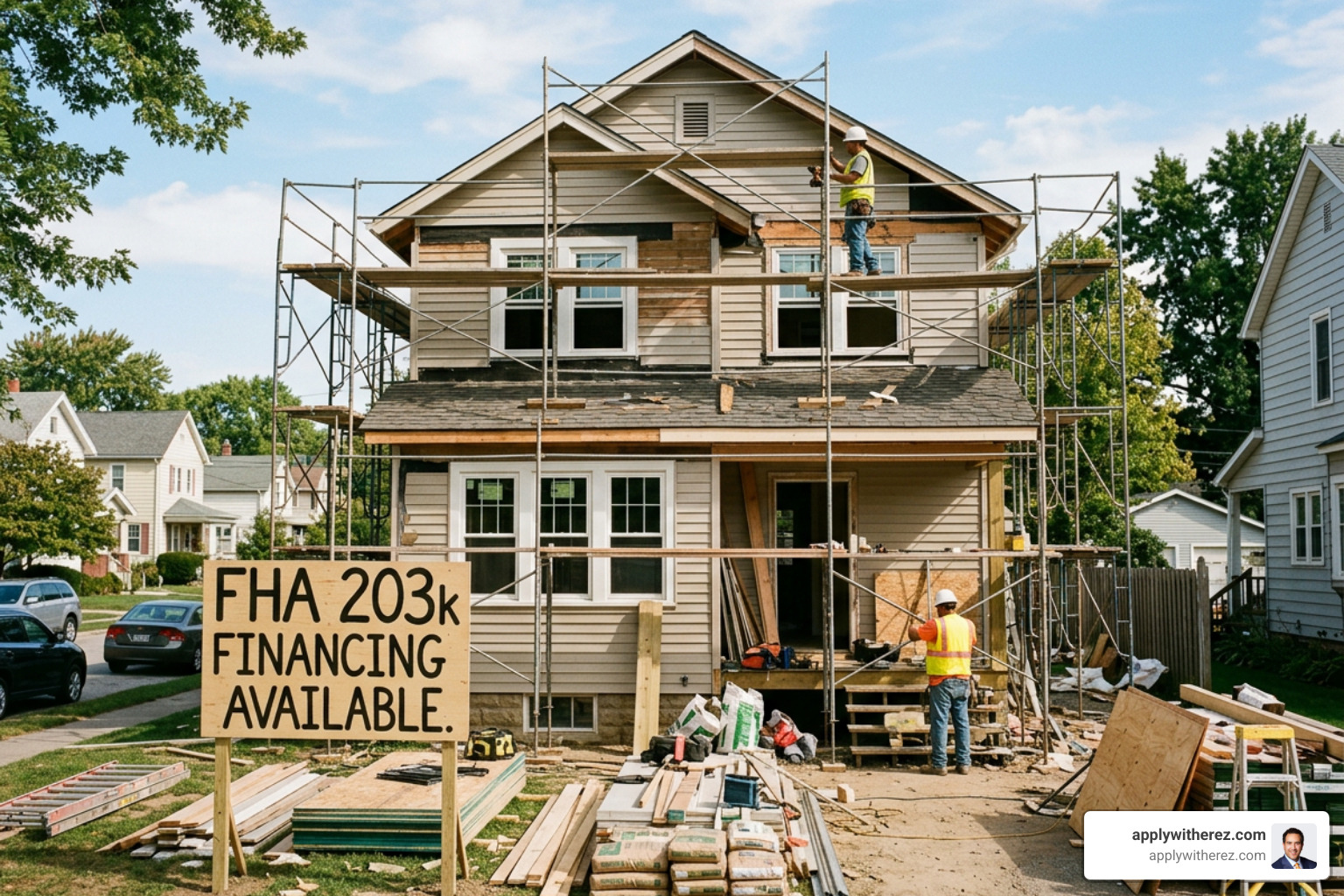
FHA 203(k) Rehabilitation Loan: If you're purchasing a fixer-upper, this loan rolls both the purchase price and the renovation costs into a single home mortgage with one closing and one monthly payment.
FHA Streamline Refinance: Designed specifically for existing FHA homeowners, this option lets you lower your interest rate quickly with reduced paperwork, no income verification, and often no full home appraisal. Learn how to maximize this option in our Best FHA Streamline Refinance Guide 2026.
FHA Rate-and-Term Refinance: Allows current homeowners to swap their current mortgage for an FHA loan with better interest rates or terms, requiring full underwriting and an appraisal.
FHA Cash-Out Refinance: Lets you tap into your accumulated home equity to borrow cash for home repairs or debt consolidation, provided you maintain at least 20% equity in the property after closing. Explore your general home equity options on our Refinance page.
Qualification Requirements for an FHA Loan in 2026

Qualifying for an fha loan in 2026 requires meeting guidelines set by HUD, alongside any specific policy add-ons (known as "lender overlays") implemented by your mortgage provider.
Here are the key financial benchmarks you need to meet:
Credit Score and Down Payment Tiers:
580+ Credit Score: Qualifies you for the maximum financing option, which requires just a 3.5% down payment. In 2026, the median credit score for an FHA borrower sits at 642.
500 to 579 Credit Score: You can still qualify under official HUD rules, but you must make a minimum 10% down payment. (Note: Many individual lenders enforce overlays set at 580 or 620).
Debt-to-Income (DTI) Ratios: Your DTI measures your total recurring monthly debt against your gross monthly income. In 2026, lenders cap the total back-end DTI ratio at 50% for most applicants, though a standard baseline target is 43%.
Verified Cash Reserves: Lenders now require verified cash reserves equal to 2 months of mortgage payments sitting in your bank account for standard applicants, and up to 3 months if your down payment comes from gifted funds.
Employment and Income: You need to document a stable 2-year work history with pay stubs, W-2s, and federal tax returns. Self-employed borrowers must present two full years of tax documentation.
For a detailed breakdown of current market shifts and qualification rules, consult the updated FHA Loan Requirements and Rates 2026 analysis.
2026 Lending Limits and Property Standards
The federal government sets annual limits on the maximum amount you can borrow using an FHA mortgage. These figures vary based on local real estate costs:
Low-Cost Baseline Limit (Floor): In lower-cost areas across New York, New Jersey, and Pennsylvania, the 2026 single-family FHA loan limit is capped at $541,287.
High-Cost Ceiling: In expensive metropolitan regions (such as the New York City metro area), the high-cost lending limit reaches $1,249,125.
Beyond loan amounts, the home itself must meet basic safety criteria. Every property financed through an FHA loan requires an appraisal by an FHA-approved appraiser. To protect both you and the government, the house must satisfy HUD's minimum safety, security, and structural soundness standards.
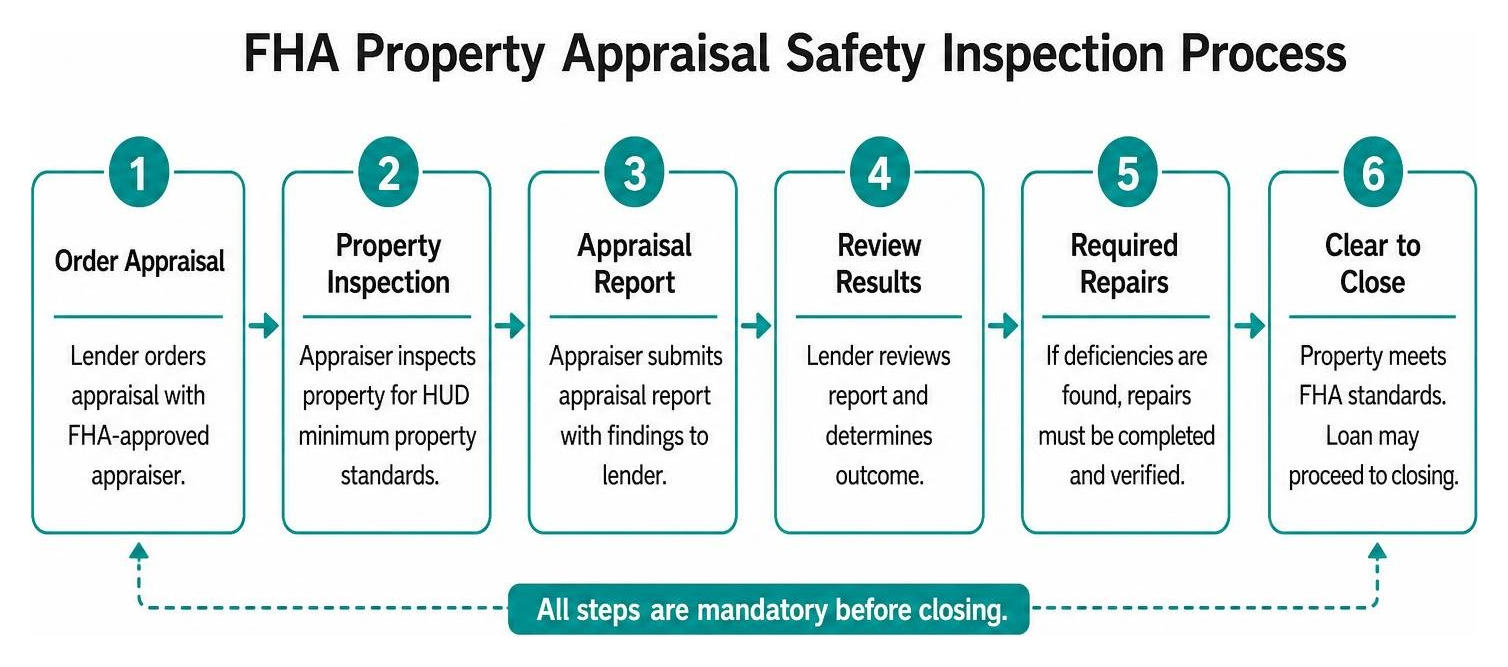
In 2026, appraisers are issuing "conditional appraisals" (requiring repairs prior to closing) on roughly 22% of FHA submissions. Common repair triggers include peeling lead-based paint (in pre-1978 homes), roof defects, faulty electrical panels, missing handrails, or standing water issues. You can read the official government handbook rules via the FHA Property Appraisal Guidelines.
If you are buying a condominium, the condo development must either be on HUD's pre-approved project list or pass a "single-unit approval" process conducted by your lender before the loan can proceed.
Mortgage Insurance Premiums and Overall Costs Explained
Because an fha loan comes with lower credit score thresholds, HUD requires borrowers to pay mortgage insurance premiums (MIP). This insurance protects the government fund, not the homebuyer. FHA mortgage insurance consists of two distinct parts:
Upfront Mortgage Insurance Premium (UFMIP): Set at 1.75% of your total loan amount in 2026. For example, on a $300,000 mortgage, the upfront MIP comes to $5,250. You do not have to pay this out of pocket; almost all borrowers roll this premium directly into their final loan balance.
Annual Mortgage Insurance Premium (Annual MIP): Charged annually but divided into 12 equal monthly installments added to your regular mortgage bill. In 2026, annual MIP rates range from 0.45% to 1.05% of the loan balance, depending on your loan term, amount, and initial down payment. Most 30-year buyers putting 3.5% down pay an annual MIP rate of 0.55%.
Beyond mortgage insurance, expect standard closing costs—such as origination fees, appraisal fees, title insurance, and escrow reserves—to range between 2% and 6% of your total purchase price. For current interest rate trends on standard 30-year terms, review our live updates on 30-Year FHA Mortgage Rates Today.
The MIP Duration Rules
A common point of confusion is how long you have to pay FHA mortgage insurance:
Down Payment under 10%: If you put down less than 10% (such as the standard 3.5%), you must pay annual MIP for the entire life of the loan. It does not drop off automatically when you reach 20% home equity.
Down Payment of 10% or More: If you put down 10% or more at closing, your annual MIP automatically cancels after 11 years.
To permanently eliminate MIP on a low-down-payment FHA loan once you have accumulated 20% equity, most homeowners choose to refinance into a conventional mortgage.
Comparing Government Mortgages to Conventional Options
Choosing the right home loan means weighing your individual credit profile, down payment savings, and overall budget against available mortgage programs.
Feature FHA Loan Conventional Loan VA Loan USDA Loan Min. Credit Score 580 (3.5% down) / 500 (10% down) 620 Typically 580–620 (lender rule) Typically 640 Min. Down Payment 3.5% 3% (First-time buyers) 0% 0% Upfront Insurance 1.75% UFMIP None 1.25%–3.3% Funding Fee 1.00% Guarantee Fee Ongoing Insurance Annual MIP (Life of loan if <10% down) Private Mortgage Insurance (Cancels at 80% LTV) None 0.35% Annual Fee Max DTI Ratio Up to 50% Typically 43%–45% Up to 41%–50% Typically 41% Property Rules Strict HUD Safety Standards Standard Appraisal Strict VA Minimum Property Rules Rural Area Restrictions
While conventional loans offer the advantage of cancellable Private Mortgage Insurance (PMI) once you build 20% equity, an fha loan remains significantly easier to qualify for if your credit score is below 680 or your monthly debts run higher. To see how these choices align with your buying plans, read our breakdown of the Best Type of Mortgage for First Time Buyers.
Pros and Cons of Government-Backed Financing
Before applying, take time to consider both sides of FHA financing:
The Pros
Low Down Payment Requirement: Buy a primary home with as little as 3.5% down.
Flexible Credit Standards: Obtain approval with credit scores down to 580 (or 500 with 10% down).
Higher Allowed Debt Ratios: Secure approval with DTI ratios up to 50%.
Generous Seller Concessions: FHA rules permit sellers to pay up to 6% of the purchase price toward your closing costs.
Assumable Mortgages: Future buyers can potentially take over your existing FHA loan and its interest rate if you sell your home.
The Cons
Mandatory Life-of-Loan MIP: If you put down less than 10%, mortgage insurance stays active until the loan is fully paid off or refinanced.
Upfront Cost Burden: The mandatory 1.75% UFMIP adds directly to your total debt balance.
Strict Appraisal Requirements: Properties in need of major repairs won't clear appraisal without pre-closing fixes.
Primary Residence Limit: You cannot purchase second homes, seasonal properties, or rental-only investments.
How to Apply for an FHA Loan Step by Step

Navigating the application process is straightforward when you take it step by step:
Check Your Credit and Finances: Review your credit report for errors and calculate your monthly debt payments against your gross income. Aim to build cash reserves equal to 2 months of mortgage payments.
Find an Approved FHA Lender: The FHA doesn't write loans directly. Work with an approved mortgage broker or lender who understands current guidelines. You can research program details through HUD Single Family Housing Resources.
Gather Required Documentation:
2 years of recent W-2 forms and federal tax returns
30 days of recent pay stubs
60 days of complete bank account statements
Government-issued photo ID and Social Security card
Get Pre-Approved: Your lender runs your credit and submits your file through HUD's Automated Underwriting System (or evaluates it via manual underwriting). This includes running a CAIVRS check to verify you don't have delinquent federal debts (like unpaid federal student loans or back taxes).
Shop for a Home and Appraise: Find a suitable primary home within local loan limits and make an offer. Once under contract, your lender orders an official FHA appraisal.
Underwriting and Closing: Complete any final conditions requested by the underwriter, sign your closing documents, bring your remaining down payment funds, and receive your keys!
Frequently Asked Questions
What are the main reasons a mortgage application gets denied?
The most common reasons for an fha loan denial include:
An excessive Debt-to-Income (DTI) ratio above 50%
Unverified or inconsistent income and employment history over the last 2 years
A property failing to pass the HUD appraisal due to unaddressed safety hazards
A direct hit on the CAIVRS database showing delinquent federal student loans or unpaid taxes
Recent late payments on existing credit cards or loans within the last 12 months
Can gift funds be used for the minimum down payment?
Yes! HUD allows 100% of your 3.5% down payment and closing costs to come as a gift from an approved source, such as a family member, employer, or charitable organization. The donor must sign an official gift letter stating that the funds are a genuine gift with no repayment expected, and they must provide bank statement documentation showing the transfer of funds. That using gift funds may trigger a lender requirement to verify up to 3 months of cash reserves in your own account.
How long do borrowers pay mortgage insurance premiums?
If you make a down payment of less than 10%, you pay annual MIP for the entire duration of the mortgage term. If your initial down payment is 10% or higher, annual MIP automatically ends after 11 years. Borrowers who want to drop MIP sooner often build up 20% equity in their home and then transition out of the program by refinancing into a conventional mortgage. Explore your refinancing options further in our Blog Category Refinance articles.
Conclusion
An fha loan remains one of the most flexible pathways to homeownership, giving buyers across New York, New Jersey, and Pennsylvania access to low down payment options, manageable credit standards, and competitive interest rates. While changes in 2026 require careful budgeting for upfront mortgage insurance premiums and verified cash reserves, the core benefits of government backing continue to help buyers achieve their goals.
If you're ready to explore your options, determine your maximum purchase price, or discuss a customized mortgage strategy tailored to your finances, our team is here to help every step of the way.
Apply for a Home Loan with ApplyWithErez today to take the first step toward your homebuying journey!