
The Complete Guide to First-Time Home Buyers
What Every First-Time Home Buyer Needs to Know in 2026
Being a first-time home buyer is one of the most exciting — and overwhelming — financial steps you'll ever take.
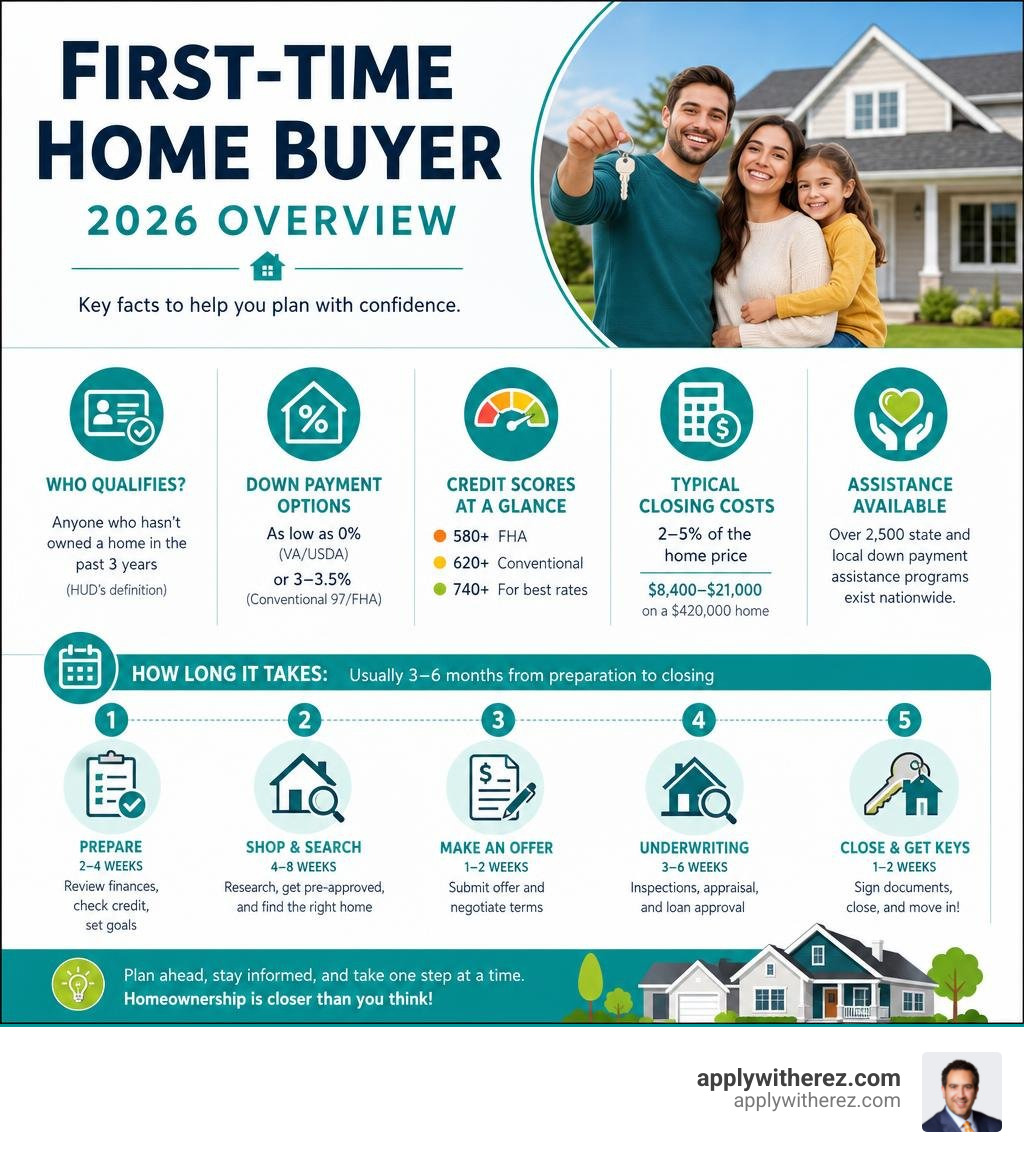
Here's a quick snapshot of what you need to know right now:
Who qualifies: Anyone who hasn't owned a home in the past 3 years (HUD's definition)
Minimum down payment: As low as 0% (VA/USDA) or 3–3.5% (Conventional 97/FHA)
Credit score needed: 580+ for FHA, 620+ for conventional, 740+ for the best rates
Typical closing costs: 2–5% of the home price (roughly $8,400–$21,000 on a $420,000 home)
Assistance available: Over 2,500 state and local down payment assistance programs exist nationwide
How long it takes: Usually 3–6 months from preparation to closing
In 2026, median home prices sit around $420,000 nationally, and mortgage rates have settled in the 6.5–7.0% range. Despite that, first-time buyers made up 32% of all home purchases in 2025 — and most of them put down just 6–8%, not the 20% many people assume is required.
The biggest hurdle? 60% of first-time buyers say saving for a down payment is their #1 barrier. But with the right loan programs and assistance options, that barrier is often smaller than it looks.
This guide walks you through everything — programs, costs, credit requirements, and the step-by-step process — so you can buy with confidence.
I'm Erez Shimoni (NMLS #460222), a mortgage broker with 26 years of experience helping clients — including many first-time home buyers — navigate loan options across New Jersey, New York, Florida, and Pennsylvania. I'll make sure every section of this guide is clear, practical, and free of the jargon that makes this process harder than it needs to be.
What Defines a First Time Home Buyer and Who Qualifies?
You might think "first-time home buyer" means you have never, ever owned a piece of real estate in your life. Fortunately, the Department of Housing and Urban Development (HUD) is much more generous.
To HUD and most state assistance programs, you are considered a first-time buyer if you meet any of the following criteria:
You have not owned a principal residence at any point during the last 3 years.
You are a single parent who has only owned a home with a former spouse.
You are a displaced homemaker who has only owned with a spouse.
You owned a home that was not permanently attached to a foundation (like a mobile home or RV).
This 3-year lookback period is a massive advantage. If you owned a home years ago but have been renting for the last 36 months, your clock has reset, and you are fully eligible for first-time buyer benefits. Choosing the Best Place to Buy First Home often comes down to matching these flexible qualification rules with local housing opportunities.
Major Mortgage Programs for New Buyers

When buying your first home, picking the right mortgage is just as important as choosing the right neighborhood. The primary decision revolves around selecting a 30-year fixed-rate mortgage, which offers consistent monthly payments and protects you from market volatility.
Let's break down the primary loan types available to you in 2026.
FHA Loans for the First Time Home Buyer
FHA loans are backed by the Federal Housing Administration. They are designed for buyers with lower credit scores or smaller down payments.
Minimum Down Payment: 3.5%
Minimum Credit Score: 580 (or 500 with a 10% down payment)
The Catch: You must pay a Mortgage Insurance Premium (MIP) both upfront and annually. Unlike conventional private mortgage insurance, FHA mortgage insurance typically lasts for the entire life of the loan unless you refinance into a conventional mortgage later.
Conventional 97 and Private Mortgages
Conventional 97 is a program backed by Fannie Mae and Freddie Mac. It is designed to compete directly with FHA loans by offering an even lower down payment option for buyers with stronger credit.
Minimum Down Payment: 3%
Minimum Credit Score: Generally 620
Private Mortgage Insurance (PMI): You will pay monthly PMI, but it automatically cancels once your loan balance drops to 80% of your home's original value. This makes it the Best Type of Mortgage for First Time Buyers who have solid credit and want to avoid permanent mortgage insurance fees.
VA and USDA Zero-Down Options
If you qualify, zero-down payment loans are the absolute gold standard of home financing.
VA Loans: Available to active-duty military, veterans, and eligible surviving spouses. They require 0% down, have no monthly mortgage insurance, and offer highly competitive interest rates. Exploring the 14 Advantages of a VA Home Loan will show you why this is one of the most powerful wealth-building tools available. If you are eligible, we highly recommend checking out our dedicated VA Home Loan solutions.
USDA Loans: Backed by the U.S. Department of Agriculture, these loans require 0% down for homes located in designated rural and suburban areas. There are household income limits, but they offer an incredibly affordable path to homeownership outside major metropolitan areas.
Down Payment Assistance (DPA) and Grants
Saving up tens of thousands of dollars while paying rent is incredibly difficult. That is where Down Payment Assistance (DPA) programs come in. These programs provide funds to cover your down payment or closing costs.
DPA generally comes in three forms:
Grants: True "free money" that does not have to be repaid.
Forgivable Second Liens: Loans with 0% interest that are slowly forgiven over a set period (usually 5 to 15 years) as long as you remain in the home.
Deferred-Payment Loans: Second mortgages that do not require monthly payments but must be repaid when you sell, refinance, or move out.
Federal and State-Level Assistance Programs
State housing finance agencies are excellent resources for first-time buyers. For example, the New Jersey Housing and Mortgage Finance Agency - NJ.gov offers competitive mortgage rates and robust down payment grants. Similarly, programs like the Homebuyers Loan Program | CA Housing Finance Agency - CalHFA provide low-interest second loans to help cover upfront purchase costs.
For those facing historical barriers, the First-Generation Homebuyer RI | RIHousing program offers up to $25,000 in assistance for buyers whose parents have never owned a home. To see how these state-level assistance options stack up nationwide, check out the First-Time Home Buyer Guide 2026: Programs & Down Payment Help.
Local Programs: NYC, Texas, San Diego, Ohio, and South Dakota
Many cities and states run localized programs with highly specific eligibility rules:
NYC (HomeFirst): Offers up to $100,000 toward down payments or closing costs for buyers earning up to 120% of the Area Median Income (AMI). The residency requirement is 10 years for loans under $40,000 and 15 years for larger or City-funded loans.
Texas (TSAHC): Provides assistance through programs like the Home Sweet Texas Home Loan Program and specialized grants for teachers, police officers, and firefighters. You can learn more directly from the First Time Home Buyer Grants in Texas page or explore the broader options via tdhca - The Texas Homebuyers Program.
San Diego (SDHC): Offers deferred-payment loans up to 19% of the purchase price for low-income buyers, alongside a $10,000 closing cost grant. No payments are required for 30 years unless the home is sold or refinanced.
Ohio (OHFA): Partners with local lenders to offer 30-year fixed mortgages bundled with down payment assistance, tax credits, and specialized grants for recent college graduates.
South Dakota (SD Housing): Offers "Fixed Rate Plus" loans providing 3% or 5% down payment assistance structured as a 0% interest second mortgage due only upon sale or refinance.
Other Localities: Programs like the Apply for First-Time Homebuyer Program - Miami provide zero-interest deferred loans up to regional price limits, while the [PDF] Homebuyer Assistance Program (HAP) Guidelines (Revised 4/15/26) outline local qualification steps in Texas.
Financial Readiness: Credit, Debt, and Real Costs
Before you start browsing real estate websites, you need to look closely at your personal balance sheet.
A great place to start is our guide on Five Simple Steps to Get Your Finances in Order. We recommend keeping your total monthly housing payment under 28% of your gross monthly income (the 28% rule) to ensure you aren't "house poor."
Credit Score and Debt-to-Income (DTI) Requirements
Your credit score has a massive impact on your monthly payment. For example, securing a credit score above 740 can qualify you for the best market rates. A mere 0.5% difference in your interest rate on a $340,000 loan can save you more than $37,000 over the life of a 30-year mortgage!
Lenders will also look closely at your Debt-to-Income (DTI) ratio, which is the percentage of your gross monthly income that goes toward paying debts (like student loans, credit cards, auto loans, and your future mortgage). While some FHA loans allow DTIs up to 50% with compensating factors, conventional loans typically require keeping your DTI under 43% to 45%.
How Much Cash Does a First Time Home Buyer Actually Need?
Many buyers forget to budget for closing costs, which typically range from 2% to 5% of the home's purchase price. On a $420,000 home, that means you need an additional $8,400 to $21,000 in cash on top of your down payment to cover loan origination fees, appraisals, title insurance, and prepaid taxes.
For a detailed breakdown of these upfront fees, see our Best First Time Buyer Mortgages 2026 guide.
Loan Program Minimum Down Payment Typical Closing Costs Recommended Emergency Reserve Conventional 97 3% 2% – 5% 3 months of PITI FHA Loan 3.5% 2% – 5% 3 months of PITI VA Loan 0% 2% – 5% 3 months of PITI USDA Loan 0% 2% – 5% 3 months of PITI
Step-by-Step Home Buying Process

The journey from renter to homeowner is a multi-step process that takes careful planning.
Phase 1: Financial Prep and Pre-Approval
Do not start looking at houses until you have a pre-approval letter in hand. Getting pre-approved shows sellers you are a serious, qualified buyer.
Pre-qualification vs. Pre-approval: Pre-qualification is a quick estimate of what you might qualify for based on unverified info. Pre-approval is a formal commitment where a lender actually verifies your tax returns, pay stubs, and credit report.
Shopping Around: We always recommend getting quotes from at least three different lenders. Doing so within a 14-day window counts as a single inquiry on your credit report, protecting your score while helping you find the absolute Best Way to Buy a House for the First Time. To compare options, look into the Best First Time Buyer Mortgages 2026.
Phase 2: House Hunting and Making an Offer
Once pre-approved, you can select a real estate agent. Under modern real estate guidelines, you will sign a written buyer agreement outlining your agent's services and compensation before touring homes.
The average first-time buyer views 8 to 10 homes before making an offer. Your agent will help you draft a competitive offer, negotiate seller concessions (such as asking the seller to pay for some of your closing costs), and navigate the contract details. For more details on finding and working with an agent, see the Consumer Guide: Buying Your First Home.
Phase 3: Under Contract and Closing
Once your offer is accepted, you are officially "under contract." This phase usually takes 30 to 45 days:
Home Inspection: Hire an independent inspector to check the home's structure, roof, plumbing, electrical systems, and HVAC.
Home Appraisal: Your lender will order an appraisal to ensure the home is worth the agreed-upon purchase price.
Underwriting: The lender's underwriting team will review your financial documents one last time.
Final Walk-Through: You will walk through the property right before closing to ensure it is in the agreed-upon condition.
Closing Day: You will sign the mortgage paperwork, pay your remaining closing costs, and get the keys to your new home!
Common Mistakes First-Time Buyers Make
Buying a home has a lot of moving parts, and small mistakes can derail your transaction. Keep these guidelines in mind:
Waiving the Inspection Contingency: No matter how competitive the market is, never waive your home inspection. A $400 inspection can save you from buying a home with a $15,000 foundation issue.
Changing Jobs or Careers: Lenders look for stable income. Changing jobs or transitioning to self-employment while under contract can cause your loan to be denied.
Opening New Credit Lines: Do not buy furniture on credit, finance a new car, or open new credit cards until after your mortgage has officially closed.
Forgetting Maintenance Costs: Owning a home means you are now the landlord. Budget at least 1% of your home's value annually to cover routine maintenance like roof repairs, plumbing leaks, and HVAC servicing.
Frequently Asked Questions about Buying a Home
What happens to my down payment assistance if I sell or refinance early?
It depends on the specific program. Many DPA programs require you to occupy the home as your primary residence for a set period (often 5 to 10 years). If you sell or refinance before this period ends, you may have to repay a prorated portion of the assistance. Some programs also feature a "recapture tax" if you sell the home for a significant profit early on.
Is it better to buy a home or rent in 2026?
It depends on how long you plan to stay in the home. Because of upfront transaction costs (closing costs, agent commissions), the financial breakeven point for buying versus renting is typically 4 to 7 years. If you plan to move within 3 years, renting is often the more affordable option. If you plan to stay longer, buying allows you to build home equity and benefit from long-term property appreciation.
How do I find participating lenders and counseling agencies?
Most state and local DPA programs require you to work with a HUD-approved housing counseling agency and a lender from their approved list. You can find these directories directly on your state's Housing Finance Agency website or by searching HUD’s official database of certified housing counselors.
Conclusion
Taking the leap into homeownership is a major milestone, but you do not have to navigate it alone. With the right preparation, a clear understanding of your loan options, and the support of an experienced mortgage team, you can transition smoothly from renting to owning.
Ready to take your first step toward homeownership? We are here to help you explore your options, compare competitive loan programs, and find the perfect path forward.
Buy a Home today, or Book a Call with us to get your questions answered. You can also reach out directly via our Contact page. Let's make your dream of homeownership a reality!