
Detailed Guide to Conventional Loan Basics
The Most Important Mortgage Type You Need to Understand
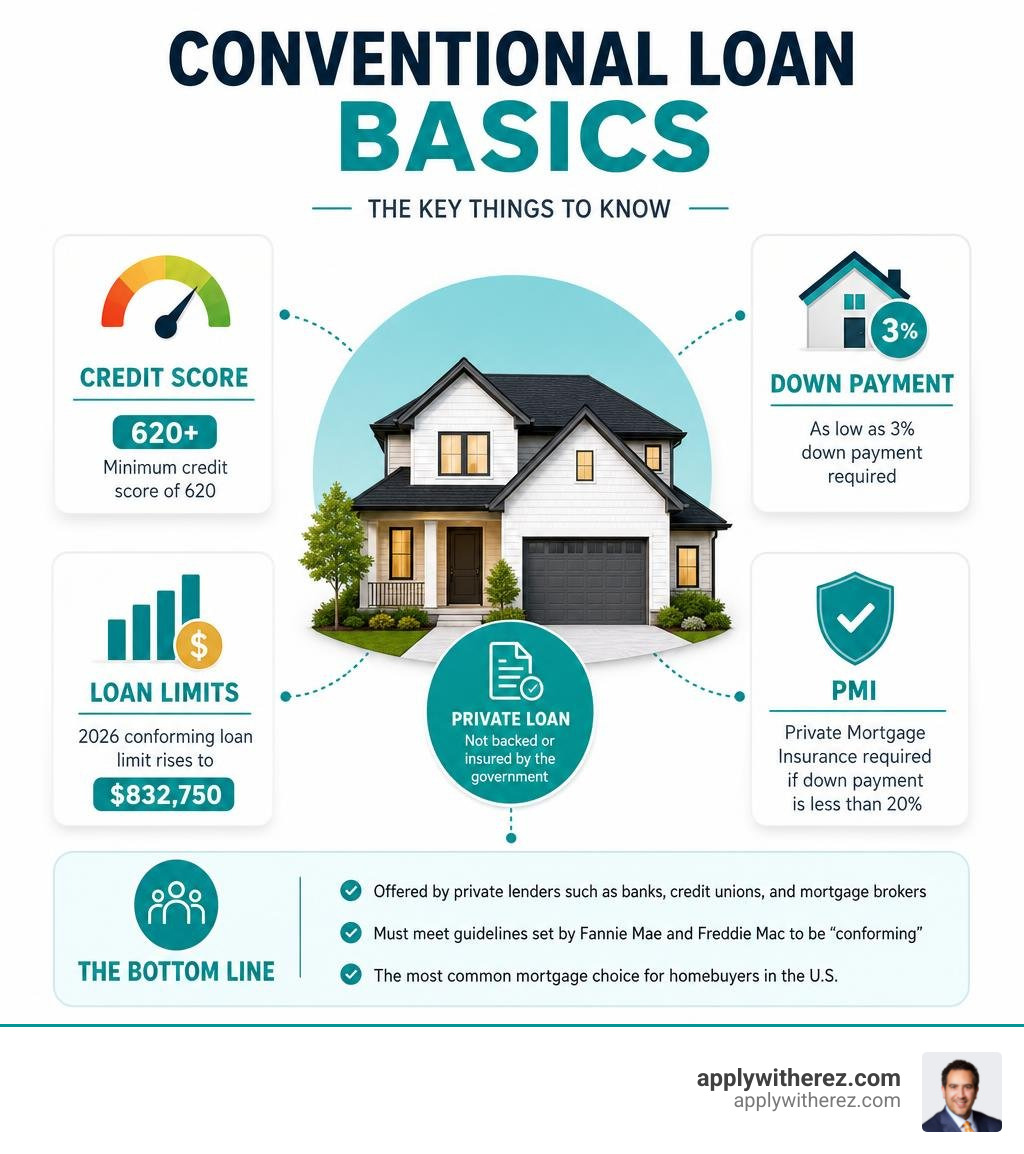
A conventional loan is the most common type of mortgage in the U.S. — and for good reason. Here's the quick answer if that's all you need:
What is a conventional loan?
A mortgage that is not backed or insured by the government
Offered by private lenders such as banks, credit unions, and mortgage brokers
Must meet guidelines set by Fannie Mae and Freddie Mac to be considered "conforming"
Requires a minimum credit score of 620 and a down payment as low as 3%
Private mortgage insurance (PMI) is required if you put down less than 20%
The 2025 conforming loan limit is $806,500 (or up to $1,209,750 in high-cost areas); for 2026, that limit rises to $832,750
In April 2025, more than 75% of all new mortgages originated were conventional loans. According to the 2025 National Association of REALTORS® report, 64% of all homebuyers chose a conventional loan to finance their home purchase. That makes it — by far — the dominant mortgage product on the market today.
Yet despite how common they are, many buyers still feel confused about how they work, what they cost, and whether they're the right fit.
This guide breaks all of that down in plain language.
I'm Erez Shimoni, a licensed mortgage broker with 26 years of experience helping buyers navigate conventional loan options across New Jersey, New York, Pennsylvania, and Florida. I've guided hundreds of clients through the exact questions this article answers, and my goal here is to make the process as clear and stress-free as possible.
What is a Conventional Loan and How Does It Work?
To understand a conventional loan, it helps to understand what it is not. Unlike FHA, VA, or USDA loans, a conventional mortgage has no direct financial backing from the federal government. If a borrower defaults on a government loan, the government steps in to pay the lender back. With a conventional mortgage, the private lender takes on that risk themselves.
Because of this, conventional mortgages are originated, funded, and serviced by private entities. These include commercial banks, local credit unions, and independent mortgage companies.
To offset their risk, lenders package these mortgages together and sell them to investors on the secondary mortgage market. This process is called securitization. To make these loans attractive to investors, they are usually designed to meet the strict guidelines of two government-sponsored enterprises (GSEs): Fannie Mae and Freddie Mac. By purchasing these mortgages from lenders, Fannie Mae and Freddie Mac free up capital, allowing lenders to issue even more loans to prospective homebuyers.
Key Differences Between a Conventional Loan and Government-Backed Mortgages
When we sit down with buyers to discuss the Best Type of Mortgage for First Time Buyers, we always compare conventional options with government-backed programs.
Here is how they stack up:
FHA Loans: Backed by the Federal Housing Administration. These are designed for buyers with lower credit scores (down to 500 with a 10% down payment, or 580 with 3.5% down). However, they require mortgage insurance premiums (MIP) that usually last for the entire life of the loan.
VA Loans: Backed by the Department of Veterans Affairs. These offer incredible benefits — including 0% down and no monthly mortgage insurance — but they are strictly reserved for eligible military service members, veterans, and surviving spouses.
USDA Loans: Backed by the U.S. Department of Agriculture. These also offer 0% down financing but are restricted to buyers purchasing homes in designated rural areas who meet specific income limits.
To make these differences easier to digest, we have put together this comparison:
Feature Conventional Loan FHA Loan VA Loan USDA Loan Government Backing None Yes (FHA) Yes (VA) Yes (USDA) Minimum Credit Score 620 500 to 580 Varies (often 580-620) 640 (typically) Minimum Down Payment 3% 3.5% 0% 0% Mortgage Insurance PMI (removable at 20% equity) MIP (usually for life of loan) None (upfront funding fee) Annual fee (for life of loan) Property Restrictions Few (primary, second, or investment) Primary residence only Primary residence only Primary residence in rural area
Conforming vs. Non-Conforming Mortgages
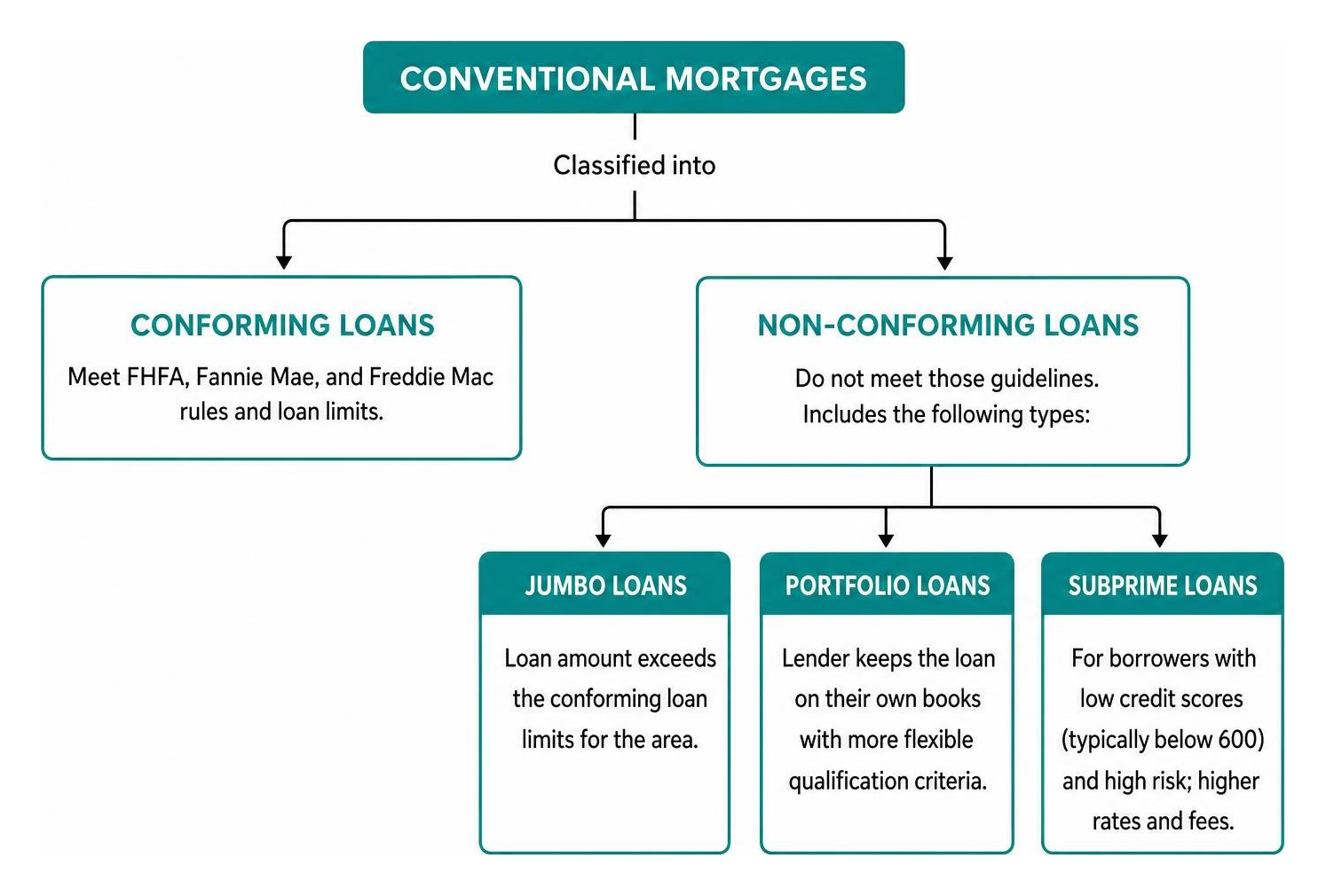
Not all conventional loans are created equal. They are broadly split into two categories: conforming and non-conforming.

A conforming loan is a mortgage that adheres to the rules and maximum loan limits established by the Federal Housing Finance Agency (FHFA) and the underwriting guidelines of Fannie Mae and Freddie Mac. These rules govern everything from your credit history to your debt-to-income ratio.
A non-conforming loan does not meet these guidelines. The most common type of non-conforming mortgage is a jumbo loan, which is used when the purchase price of a home exceeds local conforming limits.
Other types of non-conforming mortgages include:
Portfolio Loans: Loans that a lender chooses to keep on their own books rather than selling them on the secondary market. Because the lender holds the risk, they can establish more flexible qualification criteria for unique borrowers, such as self-employed individuals or newly graduated doctors.
Subprime Loans: Mortgages designed for borrowers with low credit scores (typically below 600) and high risk profiles. These carry significantly higher interest rates and fees.
It is worth noting that many of the high-risk, predatory loans that contributed to the 2008 housing crisis fell into the non-conforming category. Today, underwriting standards are much safer, but non-conforming loans still require careful consideration.
We can visualize this relationship with the following diagram:
Conforming Loan Limits for 2025 and 2026
Because home prices fluctuate, the FHFA adjusts conforming loan limits every year.
For 2025, the baseline conforming loan limit for a single-family home was set at $806,500. In designated high-cost areas, the limit went as high as $1,209,750.
For 2026, the baseline conforming loan limit for a single-family home rises to $832,750.
If you need to borrow more than these baseline limits, you will typically need to apply for a jumbo loan, which often requires a larger down payment (typically 10% to 20%) and a higher credit score (usually 700 or above).
Requirements to Qualify for a Conventional Mortgage
Because conventional loans lack government backing, lenders are highly focused on minimizing risk. If you are a First Time Home Buyer, understanding these criteria ahead of time is key to a smooth approval process.
Lenders evaluate your application using a holistic risk assessment. They will look closely at your credit history, your debt load, your down payment, your employment stability, and your verified assets.
Credit Score and Debt-to-Income (DTI) Standards
Your credit score is the single most important factor in determining your mortgage interest rate. While the absolute minimum credit score to qualify for a conforming conventional loan is 620, aiming higher pays off. Borrowers with credit scores of 740 or above qualify for the lowest rates and the cheapest mortgage insurance premiums.
Your Debt-to-Income (DTI) ratio measures how much of your gross monthly income goes toward paying recurring debts (such as credit cards, student loans, auto loans, and your future housing payment).
Preferred DTI: Lenders prefer a DTI ratio of 36% or lower.
Maximum DTI: The standard maximum DTI is 43%, though Fannie Mae and Freddie Mac guidelines allow DTIs up to 45% to 50% for borrowers with strong compensating factors (like high credit scores or large cash reserves).
Down Payment Options for a Conventional Loan
There is a persistent myth that you must put down 20% to buy a home with a conventional mortgage. That is simply not true!
In reality, qualified buyers can secure a conventional mortgage with as little as 3% down. These low-down-payment programs are highly popular among first-time buyers. However, if you are looking for zero-down options, you might want to explore 100% Mortgages for First Time Buyers to see how they compare.
While a lower down payment makes homeownership accessible sooner, putting more money down has clear advantages:
Lower Interest Rates: Lenders offer better pricing when they have less money at risk.
Smaller Monthly Payments: A larger down payment means a smaller loan balance.
No PMI: Putting down 20% or more allows you to skip private mortgage insurance entirely.
Understanding Private Mortgage Insurance (PMI)
If you put down less than 20% on a conventional loan, your lender will require you to pay Private Mortgage Insurance (PMI).

It is important to remember that PMI does not protect you — it protects the lender in case you stop making your payments. The cost of PMI typically ranges from 0.46% to 1.5% of your original loan amount annually, and it is broken down into monthly payments added to your mortgage bill. Your exact PMI rate is determined by your credit score and your down payment size.
The great news about conventional PMI is that it is not permanent. Unlike FHA loans, where mortgage insurance often lasts for the entire life of the loan, conventional PMI is designed to fall away as you build equity:
Request Removal (80% LTV): Once your unpaid principal balance drops to 80% of the original value of your home, you can write to your lender and request that they cancel your PMI.
Automatic Termination (78% LTV / 22% Equity): By law, your lender must automatically terminate your PMI on the date your loan balance is scheduled to reach 78% of the original home value, provided you are current on your payments.
If you want to see how different down payments and PMI rates will impact your monthly housing budget, use our online Calculator.
Pros and Cons of Choosing a Conventional Mortgage
For about 74% of homebuyers, purchasing a home requires a mortgage. While a conventional 30-year fixed-rate mortgage is the most popular financial product on the market, it is not perfect for everyone.
When helping clients research Best First Time Buyer Mortgages 2026, we always weigh the advantages and drawbacks.
The Pros:
Removable Mortgage Insurance: PMI can be cancelled once you reach 20% equity, saving you hundreds of dollars a month down the road.
Property Flexibility: You can use a conventional mortgage to buy primary residences, second homes, or investment properties. Government loans almost always restrict you to primary residences.
Fewer Property Restrictions: Conventional appraisals are generally less strict about minor cosmetic property repairs compared to FHA or VA appraisals.
Lower Overall Costs for Good Credit: If you have strong credit, conventional loans typically offer lower interest rates and lower fees than FHA loans.
The Cons:
Stricter Qualification Guidelines: With a minimum credit score requirement of 620 and strict DTI limits, conventional mortgages are harder to qualify for than government-backed loans.
No Government Guarantee: Because private lenders hold the risk, interest rates can rise sharply if your credit score is on the lower end of the spectrum.
Non-Assumable: Conventional loans almost always contain a "due-on-sale" clause, meaning a future buyer cannot assume your existing interest rate when you sell the home.
Frequently Asked Questions About Conventional Mortgages
Buying a home is a major financial milestone, and it is completely normal to have questions along the way. Here are some of the most common queries we receive from our clients.
Can I use a conventional loan to buy an investment property?
Yes! This is one of the biggest advantages of conventional financing. While FHA, VA, and USDA loans are strictly limited to primary residences, conventional loans can be used to purchase second homes, vacation properties, or residential investment properties (up to four units).
That lenders view investment properties as higher risk. Because of this, you will need a larger down payment (typically at least 15% to 20% for a single-family rental) and stronger cash reserves.
How do conventional loan interest rates compare to FHA rates?
At first glance, FHA interest rates often look slightly lower than conventional rates. However, looking only at the interest rate can be highly misleading.
FHA loans require both an upfront mortgage insurance premium (usually 1.75% of the loan amount) and an ongoing monthly premium that typically lasts for the life of the loan. When you calculate the lifetime costs of both loans, a conventional loan with removable PMI is often significantly cheaper for buyers with good credit scores.
What are the risks of non-conforming conventional loans?
Non-conforming loans that fall outside of Fannie Mae and Freddie Mac guidelines carry unique risks.
For jumbo loans, the primary risk is the strict underwriting and the potential for higher interest rates if market liquidity dries up.
For "niche" non-conforming loans — such as those requiring minimal income documentation — the risk is much higher. These products often carry adjustable interest rates, prepayment penalties, or balloon payments that can cause your monthly housing costs to skyrocket. Always consult with a licensed professional and compare multiple loan estimates before signing on the dotted line.
Conclusion
Deciding on the right mortgage is a foundational step in your financial planning journey. While a conventional loan offers unmatched flexibility, removable mortgage insurance, and competitive rates for strong-credit borrowers, the right choice always depends on your unique financial profile.
If you are ready to take the next step toward homeownership, we are here to help you explore your options. You can start your journey with us to Buy a Home today, or reach out directly to discuss your goals!