
Detailed Guide to VA Loan Funding Fee
Understanding the VA Funding Fee and Why It Exists
The VA funding fee is a one-time statutory fee, typically ranging from 0.50% to 3.30% of the loan amount, paid directly to the Department of Veterans Affairs to help sustain the mortgage guaranty program. In exchange for this upfront charge, the VA loan eliminates recurring monthly private mortgage insurance (PMI). Established under 38 U.S.C. §3729, this fee enables eligible service members, Veterans, and surviving spouses to purchase or refinance a primary residence with 0% down and flexible guidelines while protecting taxpayers by funding lender losses during defaults.
When you explore the Fourteen Advantages of a VA Home Loan, you quickly realize why this structure works so well. The government provides a guarantee to private lenders—typically covering up to 25% of the loan amount against default. In exchange, non-exempt borrowers contribute this one-time fee to keep the program self-sustaining for future generations of military homebuyers.
For complete administrative regulations, review the official guidance on VA Funding Fee And Loan Closing Costs.
How the VA Guarantee Replaces Private Mortgage Insurance
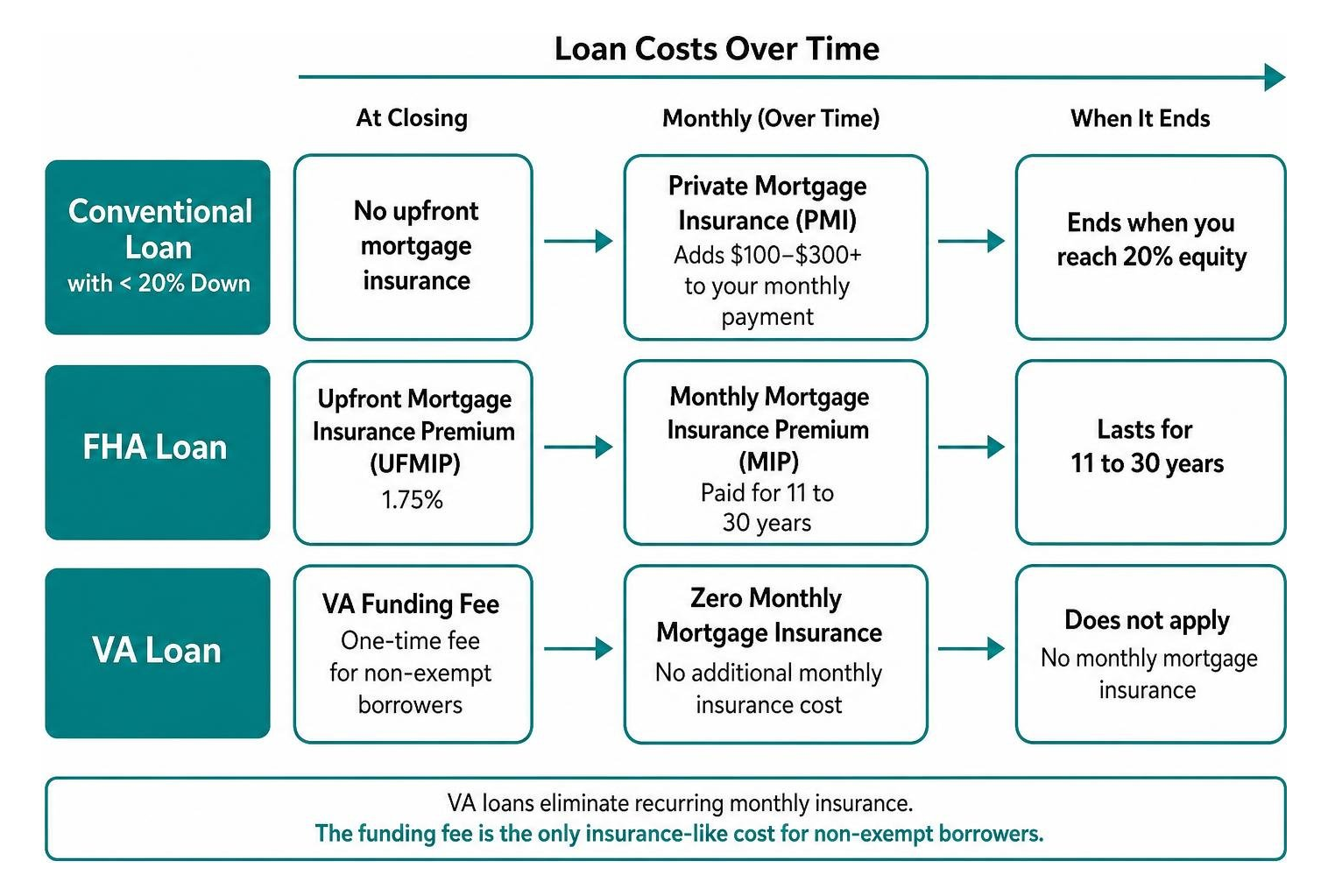
When securing a conventional mortgage with less than 20% down, private lenders require you to pay monthly Private Mortgage Insurance (PMI). On an FHA mortgage, borrowers are hit from both sides: an upfront Mortgage Insurance Premium (UFMIP) of 1.75% plus an ongoing monthly mortgage insurance premium that often lasts for the entire life of the loan.
The VA loan structure operates entirely differently:
Conventional PMI: Adds $100 to $300+ to your monthly mortgage payment until you reach 20% equity.
FHA MIP: Requires an upfront fee plus monthly premiums for 11 to 30 years.
VA Loan: Requires zero monthly mortgage insurance. The one-time funding fee is the only insurance-like cost charged to non-exempt borrowers.
Because the VA loan eliminates recurring monthly insurance, your monthly housing expense is substantially lower. When comparing long-term borrowing costs, securing a VA Home Loan often saves military families tens of thousands of dollars over a standard holding period.
Complete Breakdown of the Funding Fee on VA Loan Rates for 2026
The funding fee is calculated strictly as a percentage of your base loan amount (the purchase price minus any down payment), not the appraised value or the final financed balance.
Two main criteria determine your purchase rate tier:
Prior entitlement usage: Have you used your VA home loan benefit before?
Down payment amount: Are you putting down 0%, 5%, or 10% or more?
Here is the complete rate schedule for VA purchase and construction loans:
Down Payment Tier | First-Time Use Rate | Subsequent Use Rate |
|---|---|---|
Less than 5% down (0% down) | 2.15% | 3.30% |
5.0% to 9.99% down | 1.50% | 1.50% |
10.0% or more down | 1.25% | 1.25% |
Note: Thanks to legislative updates, active-duty personnel, Veterans, National Guard members, and Reservists all pay the exact same statutory rates.
Calculating the Funding Fee on VA Loan Purchases with Down Payments
Putting money down can yield significant savings, especially for repeat borrowers. Let’s evaluate how down payments alter the numbers on a $400,000 home purchase:
Example 1: First-Time Homebuyer ($400,000 Purchase)
0% Down ($400,000 Loan): 2.15% funding fee = $8,600
5% Down ($20,000 Down, $380,000 Loan): 1.50% funding fee = $5,700 (Savings: $2,900)
10% Down ($40,000 Down, $360,000 Loan): 1.25% funding fee = $4,500 (Savings: $4,100)
Example 2: Repeat Homebuyer ($400,000 Purchase)
0% Down ($400,000 Loan): 3.30% funding fee = $13,200
5% Down ($20,000 Down, $380,000 Loan): 1.50% funding fee = $5,700 (Savings: $7,500)
10% Down ($40,000 Down, $360,000 Loan): 1.25% funding fee = $4,500 (Savings: $8,700)
For repeat borrowers, placing 5% down reduces the funding fee rate from 3.30% to 1.50%—instantly saving $7,500 on a $400,000 home.
To see how current market interest rates interact with your monthly principal and interest figures, review our VA Mortgage Rates Guide 2026. Under federal rules outlined in VBA Circular 26-23-06, down payments entered into the VA Funding Fee Payment System (FFPS) cannot be rounded up; a 4.99% down payment still triggers the less-than-5% fee tier.
Refinance and Specialty Loan Funding Fee Guidelines
Refinancing an existing mortgage or purchasing specialty property types follows distinct funding fee schedules. Whether you are seeking a lower interest rate, extracting home equity, or assuming a mortgage, specific statutory rules apply. For a detailed breakdown of refinancing strategies, check out our VA Refinance Complete Guide 2026.
IRRRL Streamline Refinance vs Cash-Out Rates
The VA Interest Rate Reduction Refinance Loan (IRRRL), also known as the VA Streamline Refinance, offers one of the lowest funding fees across any federal lending program:
VA IRRRL (Streamline Refinance): Flat 0.50% of the loan amount, regardless of whether it is your first time or subsequent time using the benefit. If you are refinancing an existing loan balance of $300,000, your funding fee is only $1,500. Check our guide on 30-Year VA Streamline Refinance Rates to model out monthly savings.
VA Cash-Out Refinance (First Use): 2.15% of the total new loan balance.
VA Cash-Out Refinance (Subsequent Use): 3.30% of the total new loan balance.
If you are pulling equity out to consolidate high-interest debt or fund home renovations, explore our analysis on 15-Year VA Cash Out Refinance structures.
Manufactured Homes, NADL, and Loan Assumptions
Specialty properties and unique transaction types have designated fee percentages:
Manufactured Home Loans (not permanently affixed to land): 1.00% flat fee. (Note: Using a VA loan strictly for a non-permanently affixed manufactured home does not count as prior usage when you later buy a traditional single-family home).
Native American Direct Loan (NADL): 1.25% for purchase transactions; 0.50% for refinance transactions.
VA Loan Assumptions: 0.50% flat fee paid by the party assuming the loan.
Vendee Loans (Purchasing VA-owned real estate): 2.25% flat fee.
Exemption Criteria, Pending Claims, and Refund Procedures

A significant percentage of military borrowers never have to pay a single dollar toward the funding fee. According to federal data outlined in VA funding fee: Who pays and who is exempt?, more than half of all Veterans who obtained a VA-guaranteed home loan since 2021 were fully exempt.
Exemptions from Paying the Funding Fee on VA Loan Transactions
You qualify for a complete funding fee waiver if you meet any of the following statutory criteria prior to closing:
Service-Connected Disability: You receive VA disability compensation for a service-connected condition (at 10% or higher, or a compensable 0% rating).
Retirement Pay in Lieu of Disability: You are an eligible Veteran entitled to receive disability pay, but receive military retirement or active-duty pay instead.
Pre-Discharge Proposed Rating: You are an active-duty service member who has been awarded a proposed or memorandum disability rating through the Integrated Disability Evaluation System (IDES) before your closing date.
Purple Heart Recipients: You are an active-duty service member who provides verifiable documentation of having been awarded the Purple Heart on or before the closing date.
Surviving Spouses: You are an eligible surviving spouse receiving Dependency and Indemnity Compensation (DIC), or the spouse of a Veteran who died in service or from a service-connected disability.
Exemptions are verified through your VA Certificate of Eligibility (COE) or VA Form 26-8937 (Verification of VA Benefits).
Handling Pending Disability Claims and Retroactive Refunds
A common dilemma occurs when a Veteran has submitted a disability claim that is actively pending adjudication when their home purchase is scheduled to close.
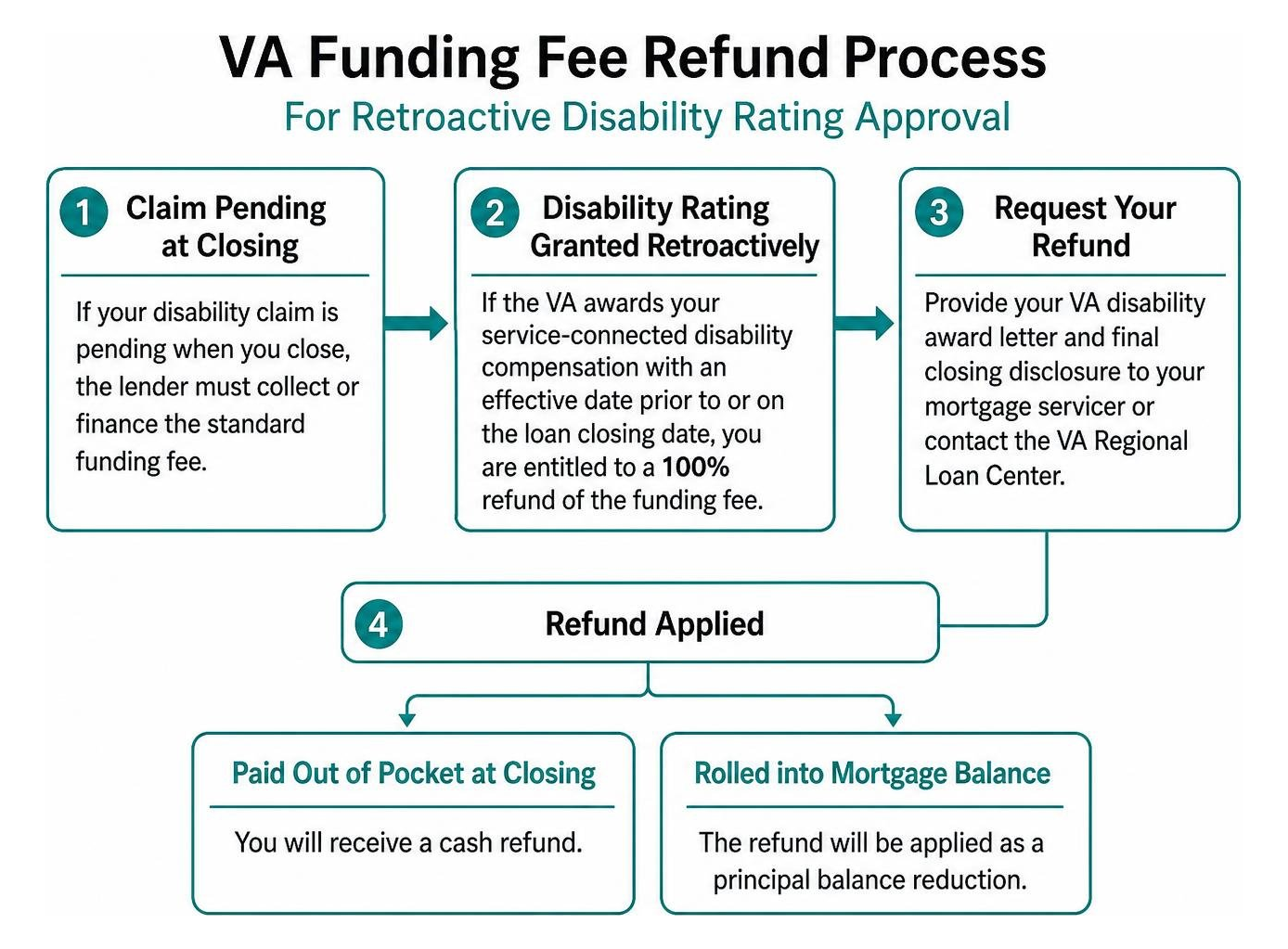
If your claim is pending at closing: The lender must collect or finance the standard funding fee. Lenders cannot waive the fee based on an anticipated approval.
If your disability rating is granted retroactively: If the VA awards your service-connected disability compensation and makes the effective award date prior to or on the date of your loan closing, you are entitled to a 100% refund of the funding fee.
To request your refund, provide your VA disability award letter and final closing disclosure to your mortgage servicer or contact the VA Regional Loan Center directly. If you paid the fee out of pocket at closing, you will receive a cash refund. If you rolled the fee into your mortgage balance, the refund will be applied directly as a principal balance reduction.
Payment Strategies, Tax Deductibility, and Seller Concessions
When structuring your VA purchase, you have three primary methods to handle the funding fee:
1. Rolling the Fee into the Loan vs. Paying Cash at Closing
Most borrowers choose to finance the funding fee into their total mortgage balance. The VA allows you to finance 100% of the funding fee, even if it pushes your initial Loan-to-Value (LTV) ratio above 100%.
Financing the Fee: Preserves your liquid cash reserves for emergency funds, moving expenses, or home repairs. On a $300,000 loan, financing a 2.15% fee ($6,450) at a 6.5% interest rate over 30 years adds approximately $41 to $47 to your monthly payment.
Paying Upfront in Cash: Saves you from paying interest on the fee over the lifetime of your mortgage.
2. Tax Deductibility in 2026
Under updated tax code provisions in effect for the 2026 tax year, eligible Veterans and service members can deduct the VA funding fee on federal income tax returns as upfront mortgage insurance when itemizing deductions on Schedule A (Form 1040). Consult a qualified certified public accountant or tax professional to confirm your specific deduction eligibility.
3. Using Seller Concessions (The 4% Rule)
The VA allows sellers to contribute toward borrower closing costs. Furthermore, sellers can pay up to 4% of the reasonable home value in total seller concessions.
Seller concessions can cover:
The entire VA funding fee
Prepayment of property taxes and homeowners insurance
Payoff of borrower credit card balances or automobile loans to qualify
Standard lender closing costs (such as title fees, recording charges, and appraisal fees) do not count toward the 4% concession limit, giving military buyers exceptional leverage during contract negotiations.
To ensure your loan terms and concessions are structured efficiently, work with our qualified team to find the Best Lenders for VA Loan programs available.
Frequently Asked Questions About the VA Funding Fee
Can the VA funding fee be rolled into the loan amount on a purchase?
Yes. On a VA purchase loan, the funding fee is the only closing cost that can be financed directly into the mortgage balance. All other closing costs (such as title, escrow, and lender fees) must be paid at closing, covered by lender credits, or paid by the seller through concessions.
Is the VA funding fee tax deductible in 2026?
Yes. For the 2026 tax year, non-exempt borrowers who pay a VA funding fee can treat the cost as deductible mortgage insurance on federal income tax filings, provided they itemize deductions on IRS Schedule A.
Can seller concessions cover the full VA funding fee at closing?
Yes. The seller can pay the full VA funding fee on your behalf at closing, provided total seller concessions do not exceed 4% of the established property reasonable value as determined by the VA appraisal.
Conclusion
Understanding the funding fee helps you plan a cost-effective financing strategy. While the fee represents a one-time administrative expense, the complete absence of monthly mortgage insurance makes the VA home loan one of the most cost-effective financing vehicles in lending.
Whether you are purchasing your first home in New York, New Jersey, or Pennsylvania, or evaluating rate adjustments, optimizing your financing structure will save you money. If you are considering a shorter loan term to accelerate your equity growth, review our guide on 15-Year VA Mortgage Rates and connect with our experienced team at applywitherez.com to explore your mortgage options.