
At Ease Soldier Finding the Best Current VA Mortgage Rates Today
What Are Current VA Mortgage Rates Today?
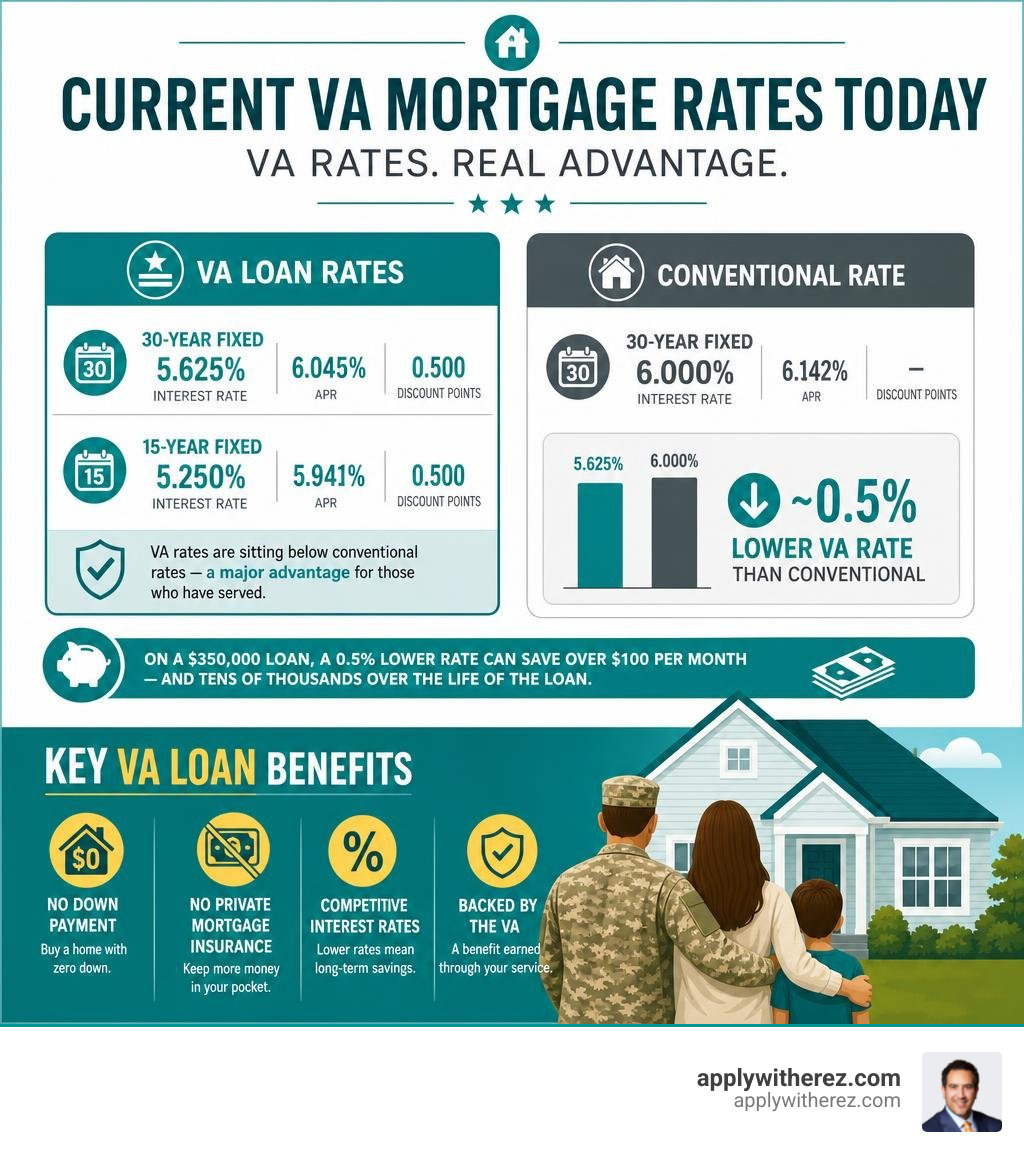
Current VA mortgage rates today (June 2026) are sitting well below conventional loan rates — a major advantage for eligible veterans and service members.
Here's a quick snapshot of where rates stand right now:
Loan Type Interest Rate APR Discount Points 30-Year Fixed VA (Purchase) 5.625% 6.045% 0.500 15-Year Fixed VA (Purchase) 5.250% 5.941% 0.500 30-Year Fixed Conventional 6.000% 6.142% — 30-Year VA (National Average) ~6.17% — —
Bottom line: Qualified borrowers can access VA purchase rates starting around 5.625% on a 30-year fixed loan, roughly 0.5% lower than comparable conventional rates.
Rates vary by lender, credit score, and loan terms. The numbers above reflect rates from mid-to-late June 2026 and can change daily — sometimes more than once.
For veterans and military families, these rate differences aren't small. On a $350,000 loan, a 0.5% lower rate can save over $100 per month — and tens of thousands of dollars over the life of the loan. Yet many eligible borrowers either don't realize they qualify for a VA loan, or they don't shop around enough to find the best rate available to them.
That's exactly what this guide is here to fix.
I'm Erez Shimoni, a mortgage broker with 26 years of experience helping veterans and service members navigate current VA mortgage rates today and find financing that fits their goals. With access to a broad range of VA loan products across multiple states, I've guided hundreds of borrowers through this exact process — and I'll walk you through everything you need to know right here.
Understanding Current VA Mortgage Rates Today
As we move through June 2026, the mortgage market continues to show a distinct advantage for those who have served. While conventional mortgage rates hover around the 6.00% mark, the current va mortgage rates today offer a breath of fresh air for military families. For example, a standard 30-year fixed VA Home Loan is currently sitting at 5.625% (6.045% APR) when paired with 0.500 discount points.
If you are looking to pay off your home faster and save even more on long-term interest, the 15-year fixed VA loan is priced even more aggressively at 5.250% (5.941% APR) with 0.500 discount points.
According to the daily market index tracked by Average 30 Year VA Mortgage Rates, the broader national average for a 30-year VA loan without customized discount points has settled around 6.17% as of mid-June 2026. This is down slightly from the same period last year when averages hovered near 6.42%, representing a year-over-year savings of about 0.25%.
To help you visualize how these different options stack up, look at this comparison of actual loan quotes available in the market as of June 2026:
Loan Option Base Interest Rate APR Required Discount Points 30-Year Fixed VA (Low-Point Option) 5.625% 6.045% 0.500 points 15-Year Fixed VA (Low-Point Option) 5.250% 5.941% 0.500 points 30-Year Fixed VA (Standard Purchase) 5.625% 6.061% 1.688 points 15-Year Fixed VA (Standard Purchase) 5.125% 5.852% 1.688 points 30-Year Fixed VA (Aggressive Lender) 5.125% 5.449% 1.922 points
What this table demonstrates is that there is no single "VA interest rate." Instead, individual lenders package their loans with different combinations of upfront discount points and interest rates. This is why working with an experienced broker who can shop multiple options is so critical to finding the best deal.
VA Loans vs. Conventional Mortgages: The Financial Impact
The single biggest reason VA loan rates are so competitive is the federal government's backing. The Department of Veterans Affairs guarantees up to 25% of each loan's value. This guarantee dramatically reduces the risk for private lenders. If a borrower defaults, the government steps in to cover a portion of the loss.
Because lenders face less risk, they can afford to offer interest rates that are typically 0.5% to 0.7% lower than conventional mortgages.
When you look at the 14 Advantages of a VA Home Loan, the savings quickly multiply:
No Down Payment: Conventional loans typically require a minimum of 3% to 5% down. On a $350,000 home, that means keeping $10,500 to $17,500 in your pocket from day one.
No Private Mortgage Insurance (PMI): If you put down less than 20% on a conventional loan, you must pay monthly PMI. VA loans require absolutely no monthly mortgage insurance, saving you an average of $100 to $250 per month.
Lower Interest Rates: As detailed by the VA vs Conventional Rates 2026: How the VA Guarantee Saves You $51,840 - Veterans Disability Guide, the interest rate gap alone translates into massive lifetime savings.
Let's look at a real-world comparison of a veteran purchasing a $350,000 home in June 2026 using a VA loan versus a conventional loan:
Conventional 30-Year Loan: With a 3% down payment ($10,500), an interest rate of 6.53%, and monthly PMI, the estimated monthly principal and interest payment sits around $2,214.
VA 30-Year Loan: With 0% down, an interest rate of 5.87%, and no PMI, the monthly principal and interest payment is approximately $2,070.
By choosing the VA option, the buyer saves $144 every single month. Over the course of a 30-year loan, that adds up to $51,840 in total savings, all while keeping their initial $10,500 down payment in their savings account.

Key Factors That Determine Your VA Loan Rate
While the VA guarantee sets a highly competitive baseline, individual lenders still determine the final rate you are offered. Several key personal and market factors will influence where your rate lands:
Credit Score: While the VA itself does not enforce a strict minimum credit score, individual lenders do. Borrowers with credit scores above 720 or 740 will unlock the absolute lowest current va mortgage rates today. If your score is in the 580 to 620 range, you can still qualify, but your interest rate may be slightly higher.
Debt-to-Income (DTI) Ratio: Lenders look at how much of your monthly income goes toward paying debts. A lower DTI ratio shows lenders you can comfortably afford your new mortgage payment.
Loan Term: Shorter terms naturally carry lower interest rates. Choosing 15-Year VA Mortgage Rates will secure a rate that is typically 0.375% to 0.5% lower than a 30-year term.
Market Conditions: Mortgage rates are directly tied to long-term financial markets, particularly 10-year Treasury bond yields. When inflation rises or the Federal Reserve adjusts monetary policy, mortgage rates shift in response.

How to Secure the Lowest Current VA Mortgage Rates Today
To ensure you are getting the most out of your hard-earned military benefits, we recommend following these steps:
Get Your Certificate of Eligibility (COE) Early: Your COE is the official document proving you qualify for the VA loan program. We can help you obtain this directly from the VA portal in just a few minutes.
Shop Multiple Lenders: Rates can vary by as much as 0.5% from one lender to the next. By comparing multiple offers, you ensure you aren't leaving money on the table.
Consider Discount Points: If you plan on staying in your home for more than five years, paying discount points upfront to lower your ongoing interest rate can save you thousands of dollars over time.
Lock in Your Rate: Once you find a rate you are happy with, lock it in immediately. Because bond markets fluctuate daily, an unlocked rate can rise before you reach the closing table.
VA Purchase Rates vs. VA Refinance Rates
If you already own a home, you might be looking to take advantage of current market conditions to lower your monthly payment or pull cash out of your equity. VA refinance rates can behave slightly differently than purchase rates, but they remain highly competitive.
There are two primary ways to refinance an existing mortgage through the VA:
VA Interest Rate Reduction Refinance Loan (IRRRL): Also known as a VA Streamline Refinance, this option is designed for veterans who already have a VA loan. It requires minimal paperwork, no home appraisal, and allows you to roll all closing costs into the loan. You can explore current pricing trends using our 30-Year VA Streamline Refinance Rates guide.
VA Cash-Out Refinance: This option allows you to refinance a non-VA loan into a VA loan, or pull cash out of your home's equity (up to 100% of its appraised value) to pay off high-interest debt, make home improvements, or cover major expenses. If you prefer a shorter payoff term, refer to our 15-Year VA Refinance Rates Guide 2026 to see how much you can save.
To find the right partner for this process, we have compiled a list of the Best VA Streamline Refinance Lenders to help you compare your options.
Navigating Refinance Options and Current VA Mortgage Rates Today
When evaluating whether to refinance, it is important to look beyond the advertised interest rate. Here are a few key concepts to keep in mind:
The No-Refi Rate Drop Option: Some specialized lenders offer a unique feature that allows borrowers to lower their interest rate if market rates drop after they close. Typically, after making six consecutive on-time monthly payments, you can request a rate reduction for a flat fee (often around $250) without going through the paperwork and cost of a full refinance.
Interest Rate vs. APR: The interest rate is the base cost of borrowing the money. The Annual Percentage Rate (APR) represents the true cost of the loan, including the interest rate, lender fees, closing costs, and the VA Funding Fee. Always compare lenders using the APR rather than the base interest rate alone.
Break-Even Analysis: To determine if a refinance makes sense, divide your total closing costs by your monthly savings. For example, if refinancing costs $3,000 and saves you $150 per month, your break-even point is 20 months. If you plan to stay in the home longer than 20 months, the refinance is financially beneficial.
Frequently Asked Questions About VA Loans
What is the difference between interest rate and APR on a VA loan?
The interest rate is the percentage of the loan amount that the lender charges you annually to borrow the money. The Annual Percentage Rate (APR) is a broader measure that includes the interest rate plus other upfront costs, such as discount points, lender origination fees, and the VA Funding Fee. Comparing APRs is the most accurate way to evaluate the true cost of loans from different lenders.
Who is eligible for a VA home loan?
VA loans are available to active-duty service members, veterans, National Guard members, Reserve members, and certain surviving spouses. Generally, eligibility requires serving 90 consecutive days of active duty during wartime, 181 days during peacetime, or more than six years in the National Guard or Reserves. You must obtain a Certificate of Eligibility (COE) to verify your service credentials.
How do discount points affect my VA mortgage rate?
Discount points are optional fees you pay to the lender at closing in exchange for a lower interest rate. One discount point is equal to 1% of your total loan amount. Typically, purchasing one point will lower your interest rate by approximately 0.25%. This is an excellent strategy if you plan to keep the home long-term, as the monthly savings will eventually surpass the upfront cost.
Conclusion
Navigating the mortgage market can feel like marching through a financial minefield, but your military service has earned you access to some of the most powerful home financing tools in existence. With current va mortgage rates today sitting significantly lower than conventional options, there has never been a better time to explore your homeownership goals.
At applywitherez.com, we are dedicated to helping military families maximize their benefits. We don't believe in one-size-fits-all solutions. Instead, we work with you to analyze your financial profile, compare multiple loan structures, and secure a personalized rate quote that fits your budget.
Ready to see how much you can save? Visit our Apply with Erez Refinance Services portal today to get started on your path to affordable home financing.