
VA IRRRL Rates: 15 vs 30 Year Streamline Options Explained
Are 30-Year VA Streamline Refinance Rates Worth It in May 2026?
If you're exploring 30 year VA streamline refinance rates, here's a quick snapshot of where rates stand right now:
Loan Type Interest Rate APR Discount Points 30-Year VA IRRRL (Standard) 5.750% 6.001% 1.25 points 30-Year VA IRRRL (Jumbo) 5.990% 6.222% 1.00 point Example 30-Year VA IRRRL Quote 5.250% 5.661% 0.50 points National Average 30-Year VA Refi 6.50% 6.54% Varies
Rates as of May 2026. Your rate will vary based on credit score, loan size, lender, and discount points.
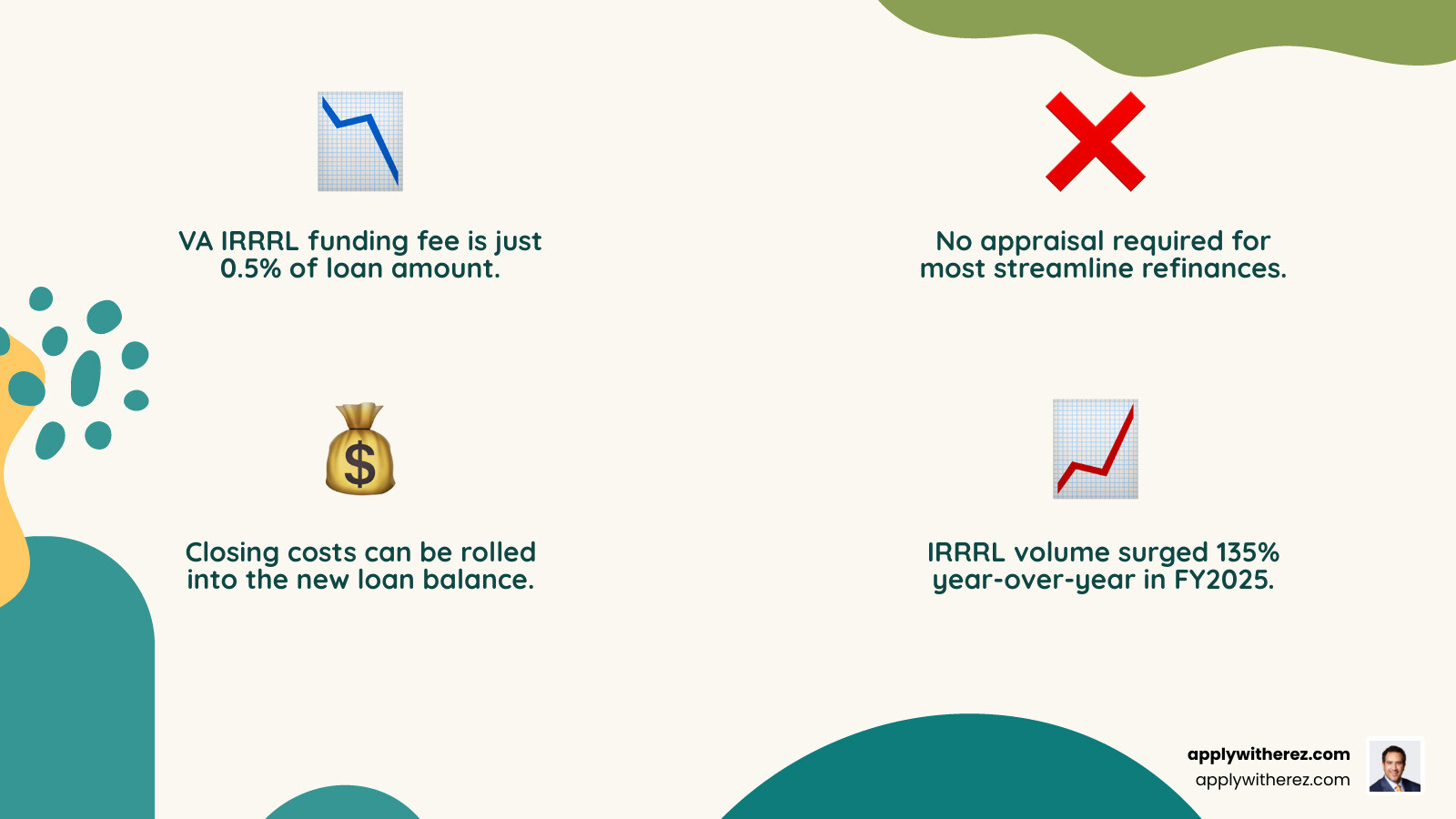
VA IRRRLs - short for Interest Rate Reduction Refinance Loans - are one of the simplest refinance tools available to veteran homeowners. No appraisal. No income verification. A funding fee of just 0.5%. And in many cases, you can roll the costs right into the loan.
It's no surprise that IRRRL volume jumped 135% year-over-year in FY2025, with nearly 120,000 loans processed - more than double the prior year. Even a modest rate drop can mean real monthly savings.
But the 30-year term isn't always the right call. Sometimes a 15-year IRRRL saves you far more over time, even if the monthly payment is higher. This guide breaks down both options so you can make the smartest choice for your situation.
I'm Erez Shimoni, a mortgage broker with 26 years of industry experience, and I've helped many veterans navigate 30 year VA streamline refinance rates to find the term and lender combination that actually saves them money. Let's walk through everything you need to know.
What a VA IRRRL Is and Who Qualifies
A VA IRRRL is a refinance program for borrowers who already have a VA loan and want a simpler way to improve that loan. The goal is usually to lower the rate, lower the monthly payment, or convert an adjustable-rate mortgage into a fixed-rate loan.
The key phrase to know is "net tangible benefit." In plain English: the refinance has to clearly help you. The VA does not want veterans refinancing just to stack fees onto a loan with little or no benefit.
What Is a VA IRRRL or VA Streamline Refinance?
IRRRL stands for Interest Rate Reduction Refinance Loan. Most people just call it a VA streamline refinance because the process is generally easier than a standard refinance.
A VA IRRRL is designed for:
Refinancing an existing VA loan into another VA loan
Reducing your interest rate
Reducing your monthly principal and interest payment
Moving from an ARM to a fixed-rate mortgage
What it is not designed for:
Pulling cash out
Refinancing a non-VA loan into a VA loan
Making major changes to ownership in most cases
So if your current mortgage is already a VA loan and your goal is rate-and-term savings, this is usually the first refinance option we look at.
Who Is Eligible for a VA IRRRL?
In general, you may be eligible if:
You currently have a VA-backed home loan
You are current on that mortgage or have a strong recent payment history
The new loan provides a net tangible benefit
Your loan meets seasoning requirements
You have made at least 6 monthly payments
At least 210 days have passed from the due date of the first payment on your current loan
That last part matters. Many borrowers ask, "Can I refinance right after closing my VA loan?" Usually, no. The seasoning rule means there is a required waiting period.
There is also a recoupment concept built into VA refinance rules. For many IRRRLs, the cost of the refinance should generally be recoverable through monthly savings within 36 months. That helps prevent "refinancing for the sake of refinancing," which is about as useful as buying an umbrella after the storm passes.
Can You Use a VA IRRRL More Than Once?
Yes. There is no lifetime cap on how many times you can use a VA IRRRL.
But each new IRRRL must still meet the rules in effect at the time, including:
A new seasoning period
A new net tangible benefit
A new recoupment test where applicable
So multiple refinances are allowed, but each one has to make financial sense. If rates drop again later, another IRRRL may be worth reviewing.
30 year va streamline refinance rates today: how 15- and 30-year options compare
When people search 30 year VA streamline refinance rates, they usually want one answer: "What will my payment look like if I refinance now?" That is the right question, but it should not be the only one.
You also want to compare:
Interest rate
APR
Discount points
Monthly payment
Total interest over time
How long you plan to keep the home

Current 30 year va streamline refinance rates and APR ranges
Based on the May 2026 research, current examples for 30-year VA streamline options include:
Standard 30-year IRRRL: 5.750% rate, 6.001% APR, with 1.25 discount points
Jumbo 30-year IRRRL: 5.990% rate, 6.222% APR, with 1.00 point
National average 30-year VA refinance: 6.50% rate, 6.54% APR
Research also showed a broader market range where VA IRRRL rates were often landing around the mid-5% range in May 2026, depending on lender pricing and borrower profile.
Here is the big lesson: the note rate is not the whole story. APR matters because it reflects certain upfront costs, including points and fees.
Term Typical Strength Tradeoff 30-Year VA IRRRL Lower monthly payment More interest paid over time 15-Year VA IRRRL Faster payoff, less lifetime interest Higher monthly payment
A 15-year option can carry a lower rate in many market environments, though exact pricing varies daily. Even when the rate difference is modest, the shorter term can dramatically cut total interest.
Why 30 year va streamline refinance rates vary by borrower
Even in the same week, two VA borrowers can receive different quotes. Common reasons include:
Credit score
Loan amount
Jumbo vs conforming balance
Discount points paid
Lock period length
Occupancy details
Lender pricing adjustments
Remaining loan term and loan-to-value profile
Research indicates credit differences can move pricing noticeably, with score gaps sometimes affecting the available rate by as much as 0.75%. That is why online averages are useful for context, but not for final decision-making.
This is also why we recommend comparing quotes on the same day. Mortgage pricing changes quickly, and a quote from Monday is not always comparable to one from Thursday.
When a 15-Year Option Beats 30 year va streamline refinance rates
A 30-year IRRRL usually wins on monthly payment. A 15-year IRRRL usually wins on total interest.
A 15-year option may be better if:
You can comfortably handle a higher payment
You want to pay off the home much faster
You plan to stay in the property for many years
You want to reduce lifetime interest, not just today's payment
A 30-year option may be better if:
Your top goal is lowering the monthly payment
You need more room in the household budget
You want to improve cash flow
You plan to move or sell before the long-term interest cost becomes the main issue
The best choice is not always the lowest rate. It is the option that creates the best overall math for your goals.
Requirements, fees, and documents for a VA streamline refinance
VA IRRRLs are known for simpler paperwork, but "streamline" does not mean "no documents ever and everyone goes home with cake."
You still need to satisfy lender and VA requirements.

Is an Appraisal, Credit Check, or Income Verification Required?
One of the biggest IRRRL advantages is that a new appraisal is generally not required.
That can be a major benefit if:
Home values in your area have softened
You do not want to wait on an appraisal appointment
You want a simpler refinance path
Income verification is also often reduced or waived compared with a standard refinance. The same is true for credit documentation.
However, borrowers should know this important detail: the VA program is flexible, but individual lenders may add their own overlays. That means a lender may still:
Pull credit
Ask for limited income documents
Request proof of occupancy history or mortgage statements
So the cleanest answer is this: VA rules make IRRRLs easier, but specific lender underwriting can still vary. If you want to review the official program guidance directly, the U.S. Department of Veterans Affairs home loans page is a reliable external resource.
VA Funding Fee for IRRRLs and Whether You Can Roll It In
For most borrowers, the VA funding fee for an IRRRL is 0.5% of the loan amount.
Example:
Loan amount: $250,000
Funding fee: $1,250
The good news is that this fee can usually be rolled into the new loan balance rather than paid out of pocket at closing. Some veterans are exempt from the funding fee, depending on disability-related eligibility status.
That ability to finance the fee is one reason streamline refinances remain so popular. It lowers the upfront cash needed to close.
What Closing Costs Are Involved and Can They Be Financed?
Beyond the funding fee, common closing costs may include:
Lender origination or processing fees
Title-related charges
Recording fees
Discount points
Prepaid interest
Escrow or prepaid taxes and insurance, where applicable
Some of these costs may be financed into the new loan depending on the structure of the refinance and lender guidelines. Discount points, however, deserve extra attention. Paying points can lower the note rate, but it raises your upfront cost.
That is where the break-even math matters. If you spend more upfront to save only a little each month, it may take too long to recover the cost.
How the VA IRRRL process works and how much you could save
The process is usually faster than a standard refinance, often around 2 to 4 weeks, though timelines vary by file complexity and lender workload.
Step-by-Step VA IRRRL Timeline
A typical IRRRL process looks like this:
Review eligibility
Compare rate quotes and APRs
Choose a lender and lock the rate
Complete the application and disclosures
Submit any required supporting documents
Move through underwriting
Sign closing paperwork
Fund the new loan
Many streamline refinances can close in about 30 days, and some move faster. The biggest delays tend to come from document requests, title work, or waiting too long to lock a favorable rate.
Example Monthly Savings on a 30-Year IRRRRL
Here is a simple payment example from the research:
Loan amount: $250,000
Old rate: 7.5%
New rate: 6.5%
Old monthly principal and interest: $1,748
New monthly principal and interest: $1,580
Monthly savings: $168
That is a meaningful monthly drop. Over 12 months, that equals $2,016 in payment savings.
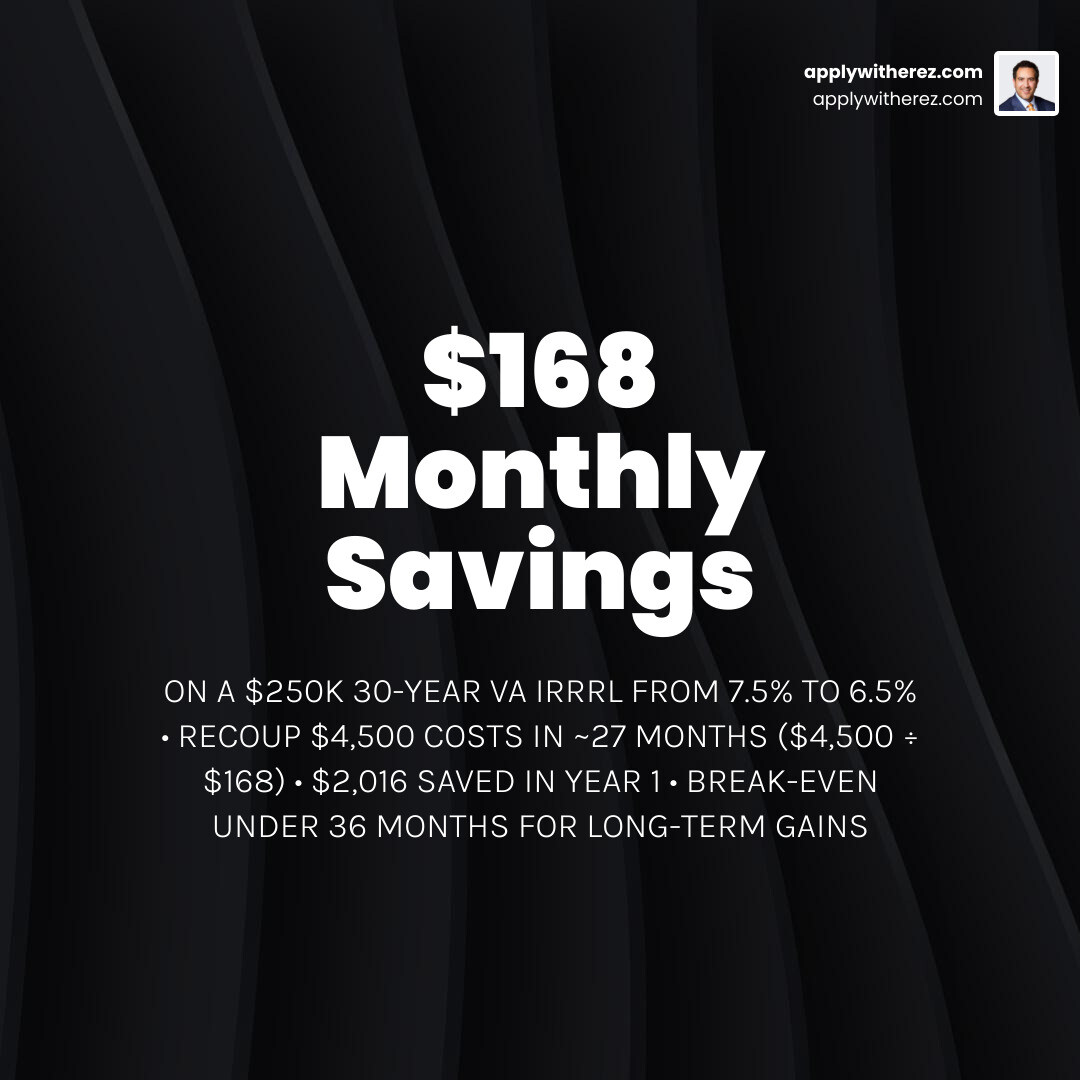
Now add recoupment math. If your refinance costs total $4,500 and you save $168 per month:
$4,500 divided by $168 = about 26.8 months
That means you recover the cost in under 36 months, which generally aligns with the recoupment concept often used in VA IRRRL analysis.
How to Shop 30 year va streamline refinance rates the smart way
The best shopping strategy is surprisingly boring, which usually means it works:
Get quotes from at least 3 lenders
Request them on the same day
Compare both rate and APR
Review discount points carefully
Ask for a formal Loan Estimate
Compare cash-to-close and total financed costs
Lock only when you are comfortable with the terms
One industry insight from the research stood out: shopping lenders on the same day may be the most controllable way to improve your outcome. Even a small rate difference can create real savings over time.
If you want to explore your own refinance options, here is more information about Refinance services.
VA IRRRL vs other refinance options
A VA IRRRL is excellent when your goal is simple: improve the terms of an existing VA loan without turning the process into a paperwork marathon.
But it is not always the right refinance type.
Pros and Cons of a 30-Year VA Streamline Refinance
Pros:
Lower monthly payment in many cases
Easier qualification process than many other refinance types
Usually no new appraisal required
Income documentation may be limited
Funding fee is relatively low at 0.5%
Funding fee can often be financed
Cons:
You may pay more total interest over time
Restarting a 30-year term can slow equity building
No cash-out allowed
Closing costs still exist
A lower rate does not always mean lower total loan cost
The biggest trap is focusing only on monthly payment while ignoring total interest. Lower today is great. Lower forever is better.
15-Year vs 30-Year VA IRRRL
Here is the practical difference:
15-Year IRRRL
Higher monthly payment
Faster payoff
Lower lifetime interest
Better for borrowers with strong monthly cash flow
30-Year IRRRL
Lower monthly payment
More flexibility in the budget
Higher lifetime interest
Better for borrowers prioritizing payment relief
Best-fit scenarios:
Choose 15-year if you want aggressive payoff and can handle the payment
Choose 30-year if you want maximum monthly savings
Compare both if your current loan balance is manageable and you are undecided
Revisit total interest, not just rate, before signing
When a VA IRRRL May Be the Better Fit
A VA IRRRL may be the best fit if:
You already have a VA loan
You want a lower rate or lower payment
You do not need cash from home equity
You want a simpler process than a standard refinance
You value limited documentation and potentially faster closing
If you need cash out for debt consolidation, home improvements, or other large expenses, a VA cash-out refinance may be the more appropriate route. If your current loan is not a VA loan, an IRRRL is not available.
For borrowers focused specifically on streamlining an existing VA mortgage, the IRRRL is often the cleanest path.
Frequently Asked Questions about 30 year va streamline refinance rates
How soon after getting a VA loan can you apply for an IRRRL?
Usually after both of these are true:
At least 210 days have passed from the due date of the first payment on your current loan
You have made at least 6 monthly payments
This is commonly called the seasoning requirement.
Can you roll closing costs into a VA IRRRL?
Often, yes, at least in part.
The 0.5% funding fee can typically be rolled into the new loan amount. Some other allowable costs may also be financed depending on lender guidelines and how the loan is structured. You should still review the Loan Estimate closely to see what is financed and what must be paid at closing.
How do I apply and get personalized VA streamline rates?
The basic process is:
Confirm you currently have a VA loan
Check that you meet seasoning requirements
Gather your most recent mortgage information
Request personalized quotes
Compare Loan Estimates side by side
Choose the option with the best combination of payment, APR, and total cost
You can learn more about our VA mortgage options here: More info about VA Home Loan services.
Conclusion
For many veteran homeowners, a 30-year VA streamline refinance is the easiest way to lower a payment and simplify the refinance process. Current 30 year VA streamline refinance rates in May 2026 remain competitive, and even modest rate improvements can produce meaningful monthly savings.
Still, the right answer is personal. A 30-year term may help your budget now, while a 15-year term may save far more over the life of the loan. The smart move is to compare both side by side, look at APR and fees, and make sure the refinance passes the common-sense test: does it actually improve your situation?
If you are ready to review your options, start by exploring more information about Refinance services.
We are happy to help you compare the numbers, avoid unnecessary costs, and choose the VA refinance structure that truly works for you.