
Finding the Best VA Loan Lenders Without the Stress
Why Finding the Best Lenders for VA Loan Programs Can Make or Break Your Home Purchase
The best lenders for VA loans aren't all the same — and choosing the right one can save you thousands of dollars over the life of your mortgage.
VA loans are one of the most powerful home financing tools available to U.S. military members and veterans. They offer zero down payment, no private mortgage insurance (PMI), and typically lower interest rates than conventional or FHA loans. Yet many eligible borrowers leave these benefits on the table simply because they don't know where to start — or which lender to trust.
Comparison shopping matters more than most people realize. According to a Freddie Mac report, borrowers who shop multiple lenders save at least $600–$1,200 per year on their mortgage. That's real money.
I'm Erez Shimoni, a mortgage professional with 26 years of experience helping borrowers navigate VA loans and other home financing options across New Jersey, New York, Pennsylvania, and Florida — and finding the best lenders for VA loans for each client's unique situation is something I do every day. Read on for a straightforward breakdown of what to look for and how to compare your options with confidence.
Understanding the VA Mortgage Benefit
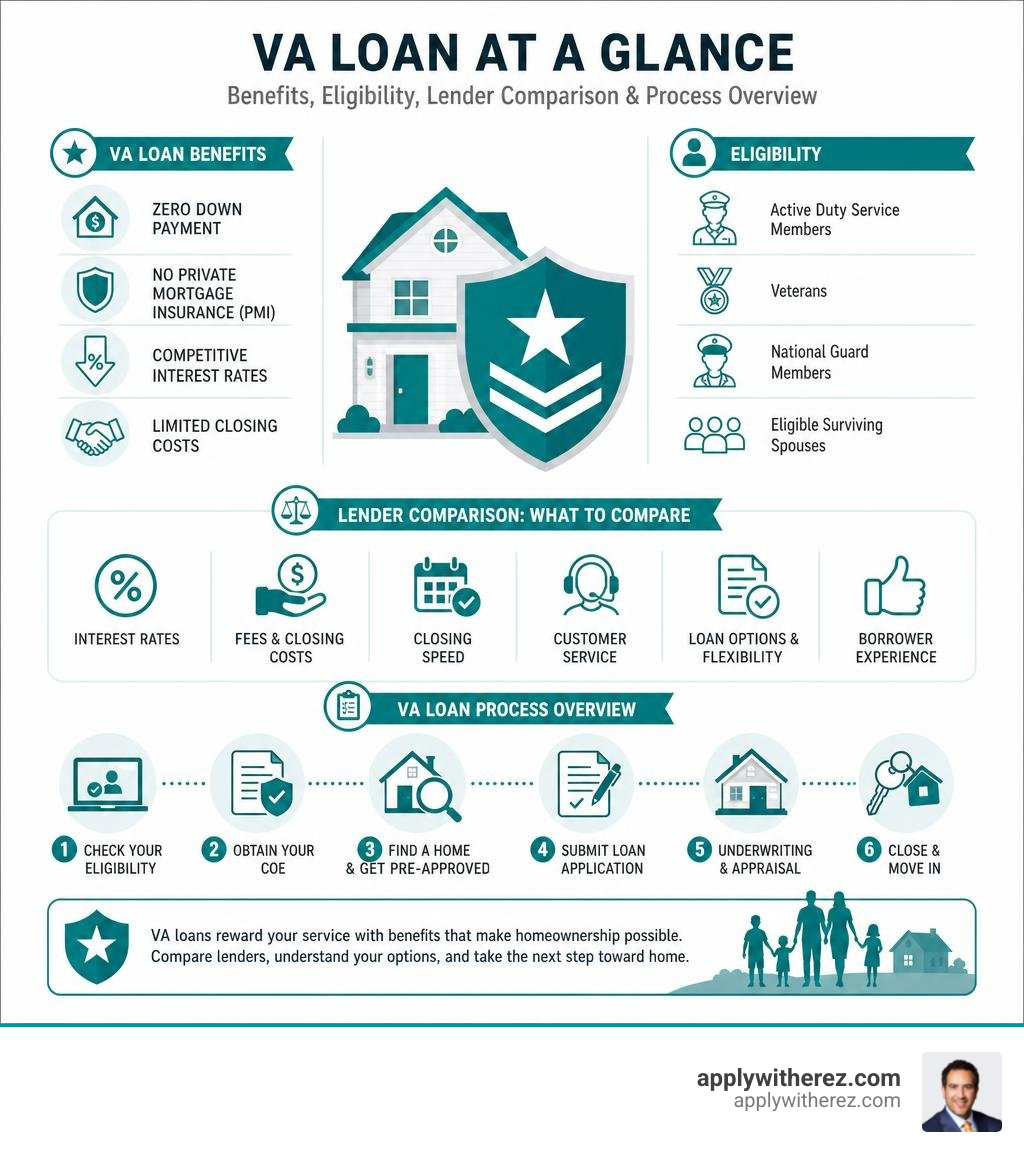
The VA home loan program is a benefit earned through service. Backed by the U.S. Department of Veterans Affairs, these mortgages are designed to make homeownership affordable and accessible for those who have served in the military. Because the government guarantees a portion of the loan, lenders are able to offer highly competitive terms that are difficult to match with conventional financing.
The primary advantages of a VA loan include:
$0 Down Payment: You can finance up to 100% of the home's purchase price without paying a single dollar upfront, provided the appraised value matches or exceeds the sale price.
No Private Mortgage Insurance (PMI): Conventional and FHA loans require monthly mortgage insurance if you put down less than 20%. VA loans completely eliminate this requirement, saving you hundreds of dollars every month.
Seller Concessions: The VA allows home sellers to pay up to 4% of the loan amount toward your closing costs, prepaids, or even paying off your personal debts at closing.
No Prepayment Penalties: You are free to pay off your mortgage early or make extra payments without facing financial penalties.
To understand how these perks stack up against other popular home financing options, consider the comparison below:
Feature VA Loan FHA Loan Conventional Loan Minimum Down Payment 0% 3.5% 3% Monthly Mortgage Insurance None Required for life of loan Required if down payment < 20% Typical Minimum Credit Score No official minimum (lenders prefer 580–620) 500–580 620 Government Backing Department of Veterans Affairs Federal Housing Administration None (Fannie Mae/Freddie Mac) Upfront Fees VA Funding Fee (1.25%–3.3%) Upfront Mortgage Insurance Premium (1.75%) None (though higher interest rates or fees may apply for lower down payments)
While the benefits are clear, it is important to understand how they apply to your specific financial situation. For a comprehensive look at how to maximize these perks, check out our guide on the 14 Advantages of a VA Home Loan.
Key Eligibility and Documentation Requirements
Before you can begin comparing the best lenders for VA loans, you must establish your basic eligibility. The Department of Veterans Affairs sets specific service requirements based on when and how long you served:
Active-Duty Service Members: Typically eligible after 90 consecutive days of active service.
Veterans: Eligibility depends on the era of service, but generally requires 90 consecutive days of active service during wartime or 181 days during peacetime.
National Guard and Reserve Members: Usually eligible after 6 years of honorable service, or after 90 days of active service under Title 10 or Title 32.
Surviving Spouses: Spouses of service members who died in the line of duty or from a service-connected disability may also qualify.
To prove your eligibility to a lender, you need a Certificate of Eligibility (COE). To obtain your COE, you will need to gather specific service records:
Veterans: DD Form 214 (Certificate of Release or Discharge from Active Duty).
Active Duty: A current Statement of Service signed by your commander or military personnel office.
National Guard/Reserves: NGB Form 22 or NGB Form 23.
Lenders can often retrieve your COE instantly through the official VA portal, which is managed via the Lenders Page - VA Home Loans portal. If you want to dive deeper into the specific timelines and military records required for your situation, you can review the official 2026 VA Loan Eligibility Requirements page or consult the comprehensive VA Home Loan Guide: Eligibility, Lenders and How To Apply .
Beyond military service, you must also qualify financially. While the VA does not enforce a strict minimum credit score or maximum debt-to-income (DTI) ratio, individual lenders do. These are known as "lender overlays." Most lenders look for a credit score of at least 620 and a DTI ratio of 41% or lower, though some specialized lenders accept credit scores as low as 540 with strong compensating factors.
How to Choose the Best Lenders for VA Loan Programs
Finding the best lenders for VA loans requires looking beyond standard marketing claims. Because interest rates, closing costs, and credit requirements vary widely by institution, a structured evaluation process is essential to getting the best deal.
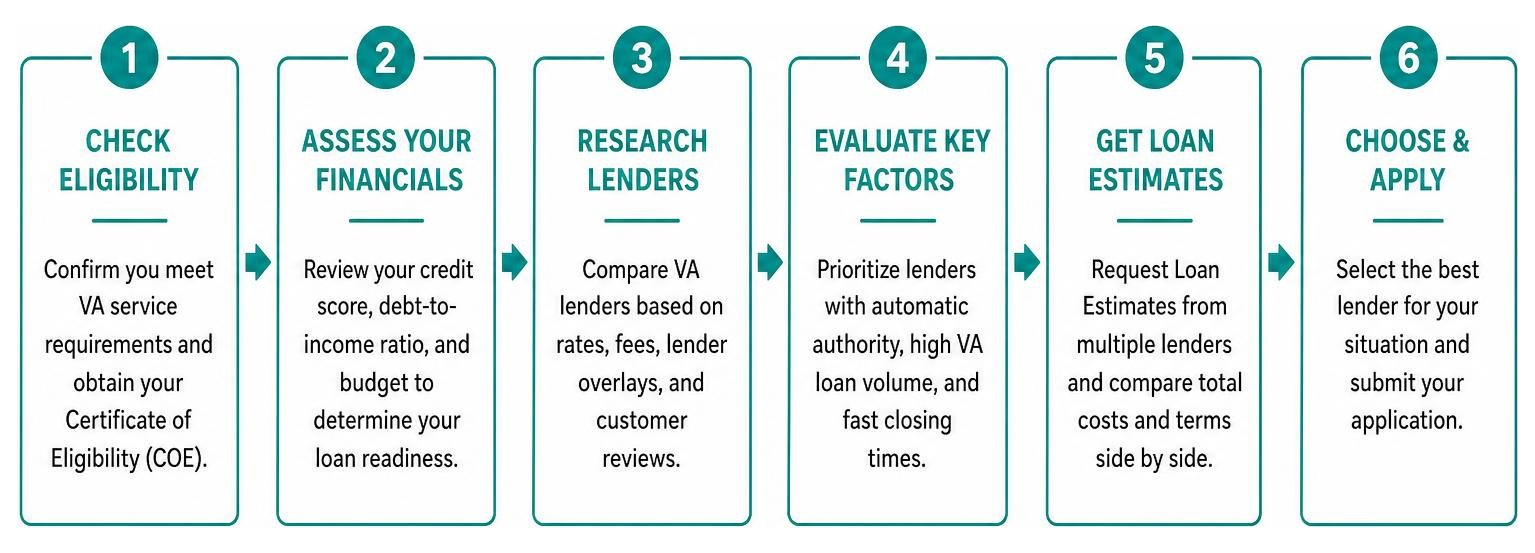
When vetting potential mortgage partners, look for these critical indicators of expertise:
Automatic Authority: Lenders with automatic authority can approve and close VA loans without sending the paperwork to the VA for prior review. This drastically speeds up your closing timeline.
VA Loan Volume: Lenders that close thousands of VA loans every year are highly familiar with military-specific documentation, BAH (Basic Allowance for Housing) income calculations, and PCS (Permanent Change of Station) relocation guidelines.
Fast Closing Times: The industry average for closing a home loan is roughly 40 to 45 days. Top-tier digital lenders can often close in 21 to 22 days, making your offer more competitive to home sellers.
To keep track of current rate trends and shifts in the market, refer to our VA Mortgage Rates Guide 2026.
Evaluating the Best Lenders for VA Loan Rates
Interest rates are highly personalized, but they are also driven by the lender's business model. To find the most competitive deal, you must request a Loan Estimate from multiple institutions and compare both the interest rate and the Annual Percentage Rate (APR). The APR reflects the true cost of the loan, including the interest rate, origination fees, and other prepaid finance charges.
When comparing rates, pay close attention to:
Discount Points: Some lenders advertise incredibly low rates that require you to pay "points" upfront (one point equals 1% of the loan amount). Ensure you are comparing "zero-point" rates to get an apples-to-apples comparison.
Lender Fees: Look closely at underwriting, processing, and origination fees. Some credit unions waive origination fees entirely, which can save you thousands of dollars at the closing table.
To see current market averages and understand how different terms affect your monthly payment, check out our breakdown of 15-Year VA Mortgage Rates.
What to Look For in the Best Lenders for VA Loan Customer Service
A low interest rate won't mean much if your lender misses your closing date or fails to communicate during the underwriting process. Excellent customer service is vital, especially when dealing with the tight timelines of a military move.
When evaluating a lender's service, consider the following:
Specialized Loan Officers: Working with an expert who understands the nuances of military life makes a massive difference. Dedicated professionals focus entirely on helping military families navigate the homebuying journey.
Military-Focused Institutions: Credit unions are highly praised by members for their deep understanding of military benefits.
On-Time Closing Guarantees: Major retail banks often offer financial incentives to keep your purchase on track.
Specialty Property Financing: If you are planning a unique project, such as building a home, buying a manufactured home, or purchasing a barndominium, you will need a lender with specialized programs.
Streamlined Digital Operations: If you prefer a fast, highly-focused regional specialist, look for companies that boast 21-day average closing times and 24/7 support structures designed to remove stress from the process.
VA Loan Refinancing Options
If you already have a VA mortgage, you can take advantage of specialized refinancing programs that are much easier to qualify for than standard conventional refinances.
The two main VA refinancing options are:
Interest Rate Reduction Refinance Loan (IRRRL): Also known as a VA Streamline Refinance, this program is designed to lower your interest rate or transition you from an adjustable-rate mortgage to a fixed-rate mortgage. The IRRRL requires no appraisal, no income verification, and very little paperwork, making it incredibly fast and affordable.
VA Cash-Out Refinance: This program allows you to replace your current mortgage (whether it is a VA loan or a conventional loan) with a new VA loan, allowing you to pull out up to 100% of your home's equity to pay off high-interest debt, fund home improvements, or cover emergency expenses.
To find the right partner for your refinance, read our guide on the Best VA Streamline Refinance Lenders. You can also track current market pricing by visiting our resources on 30-Year VA Streamline Refinance Rates and the 15-Year VA Refinance Rates Guide 2026.
Frequently Asked Questions about VA Loans
What is the minimum credit score required for a VA loan?
While the Department of Veterans Affairs does not set a minimum credit score, most mortgage lenders impose their own requirements, usually looking for a score between 580 and 620. However, some specialized lenders accept credit scores as low as 540 if the borrower has strong compensating factors, such as significant cash reserves or a low debt-to-income ratio.
Are there loan limits on VA mortgages?
As of 2026, there are no official VA loan limits for borrowers with full entitlement. This means you can borrow as much as your lender is willing to approve without a down payment. If you have active VA loans or have previously defaulted on a VA loan, your remaining entitlement may be limited, and conforming loan limits set by the FHFA will apply to determine your zero-down borrowing power.
What is the VA funding fee and who is exempt?
The VA funding fee is a one-time fee paid directly to the Department of Veterans Affairs to help sustain the loan program for future generations. The fee ranges from 1.25% to 3.3% of the loan amount, depending on your down payment size and whether it is your first time using the benefit.
You are entirely exempt from the VA funding fee if you:
Receive VA compensation for a service-connected disability.
Are eligible to receive disability compensation but receive retirement or active-duty pay instead.
Are a surviving spouse of a veteran who died in service or from a service-connected disability.
Conclusion
Finding the best lenders for VA loans doesn't have to be a stressful experience. By understanding your benefits, gathering your service documentation early, and actively comparison shopping, you can secure a mortgage that honors your service and protects your financial future.
At applywitherez.com, we are committed to making your homebuying journey as transparent and seamless as possible. Whether you are buying your first home or looking to lower your monthly payments with a refinance, we are here to help you navigate every step of the process. Ready to explore your options? Learn more about securing a VA Home Loan or get started today by visiting Apply with Erez.