
The Ultimate Guide to 15 Year Fixed VA Mortgage Rates
Why 15 Year VA Mortgage Rates Give Veterans a Powerful Advantage
15 year VA mortgage rates are among the most competitive home loan options available in May 2026 - and right now, eligible veterans can often find rates starting in the low-to-mid 5% range.
Here is a quick snapshot of what the current market is showing from published lender examples:
Example Published Offer Interest Rate APR Points Example A 4.875% 5.558% 0.500 Example B 5.375% 6.126% 1.813 Example C 5.750% 6.054% 1.932 Example D 5.990% 6.628% 1.750
Key takeaway: Rates and APR can vary significantly by lender - shopping multiple offers is essential.
For context, the national average 30-year VA rate sits at around 6.51% in May 2026. You can review general mortgage rate background from the Consumer Financial Protection Bureau. Choosing a 15-year term typically means a noticeably lower interest rate and far less total interest paid over the life of the loan - though monthly payments will be higher.
A 15-year VA loan combines two major benefits that are hard to find together anywhere else:
No private mortgage insurance (PMI) - ever
A shorter payoff timeline - building equity roughly twice as fast as a 30-year loan
This makes it an especially powerful tool for veterans who want to own their home outright sooner, reduce long-term borrowing costs, or set themselves up for a stronger financial position in retirement.
I'm Erez Shimoni, a mortgage broker with 26 years of experience helping veterans navigate 15 year VA mortgage rates and find the right loan product for their goals. In this guide, I'll walk you through exactly how these rates work, what they cost, and how to qualify for the best one available today.
Current 15 year VA mortgage rates and how to compare them
If you are comparing 15 year VA mortgage rates, the most important thing to know is that the headline rate is only the starting point. We also need to compare:
Interest rate
APR
Discount points
Lender fees
Estimated monthly payment
Whether the quote is for a purchase, refinance, or jumbo loan
The assumptions behind the quote, such as credit score, loan amount, and loan-to-value ratio
Rates can change daily, and sometimes more than once in the same day when bond markets get jumpy. That is why we always recommend comparing offers side by side instead of falling in love with the first shiny number you see.
For more background on the loan itself, see our VA Home Loan page.
What current 15 year VA mortgage rates look like in May 2026
Based on current published data in May 2026, many advertised 15-year VA offers are landing in the low-5% to upper-5% range, with APRs generally running higher once points and fees are included.
A few things stand out from current market examples:
A very competitive quote can still be under 5%, but usually includes discount points
Many market quotes are clustered around the mid-5% range
APR often lands around the mid-6% range even when the note rate looks lower
Sample quotes usually assume strong credit, solid income, and standard owner-occupied scenarios
Here is a simple comparison of term structure:
Loan Type Typical Rate Direction in May 2026 Payment Total Interest Over Time 15-year VA Usually lower than 30-year VA Higher Much lower 30-year VA Usually higher than 15-year VA Lower Much higher Conventional 15-year fixed Often competitive, but may include PMI depending on down payment Higher Lower than 30-year conventional
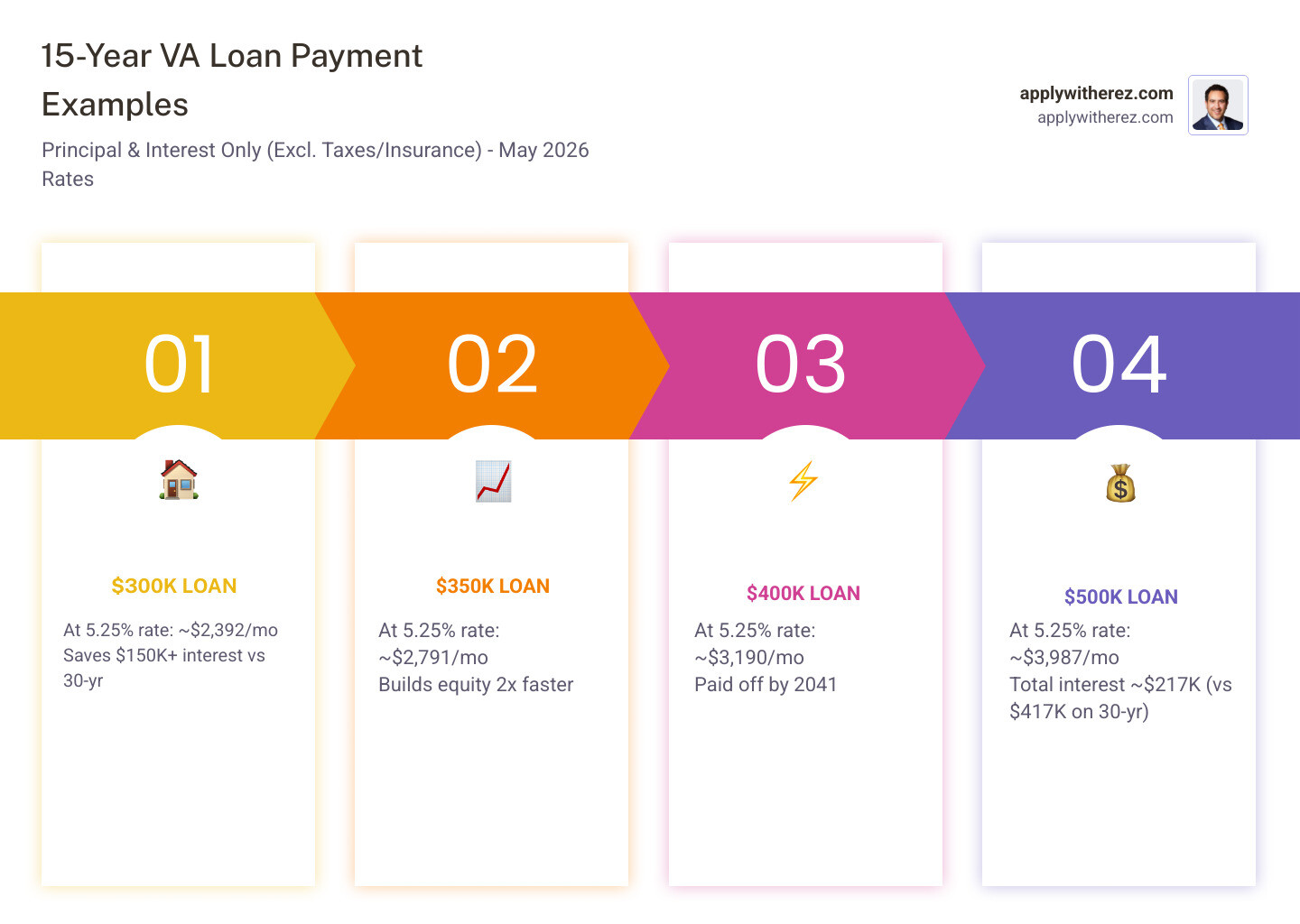
For example, one published 15-year VA payment illustration showed a $300,000 loan at 4.875% with principal and interest of about $2,352 per month, excluding taxes and insurance. Another published example for a $350,000 loan at 5.99% showed a monthly principal and interest payment of about $2,952, again before escrow.
That difference is exactly why rate shopping matters. A lower rate can save you money every month, but we also need to account for the cost to get it.
15-year VA vs 30-year VA: Choosing your term
A 15-year VA loan and a 30-year VA loan both offer the core VA benefits borrowers care about most:
No PMI
Competitive rates
Flexible down payment options
No prepayment penalty under VA rules
The big difference is how fast you repay the balance.
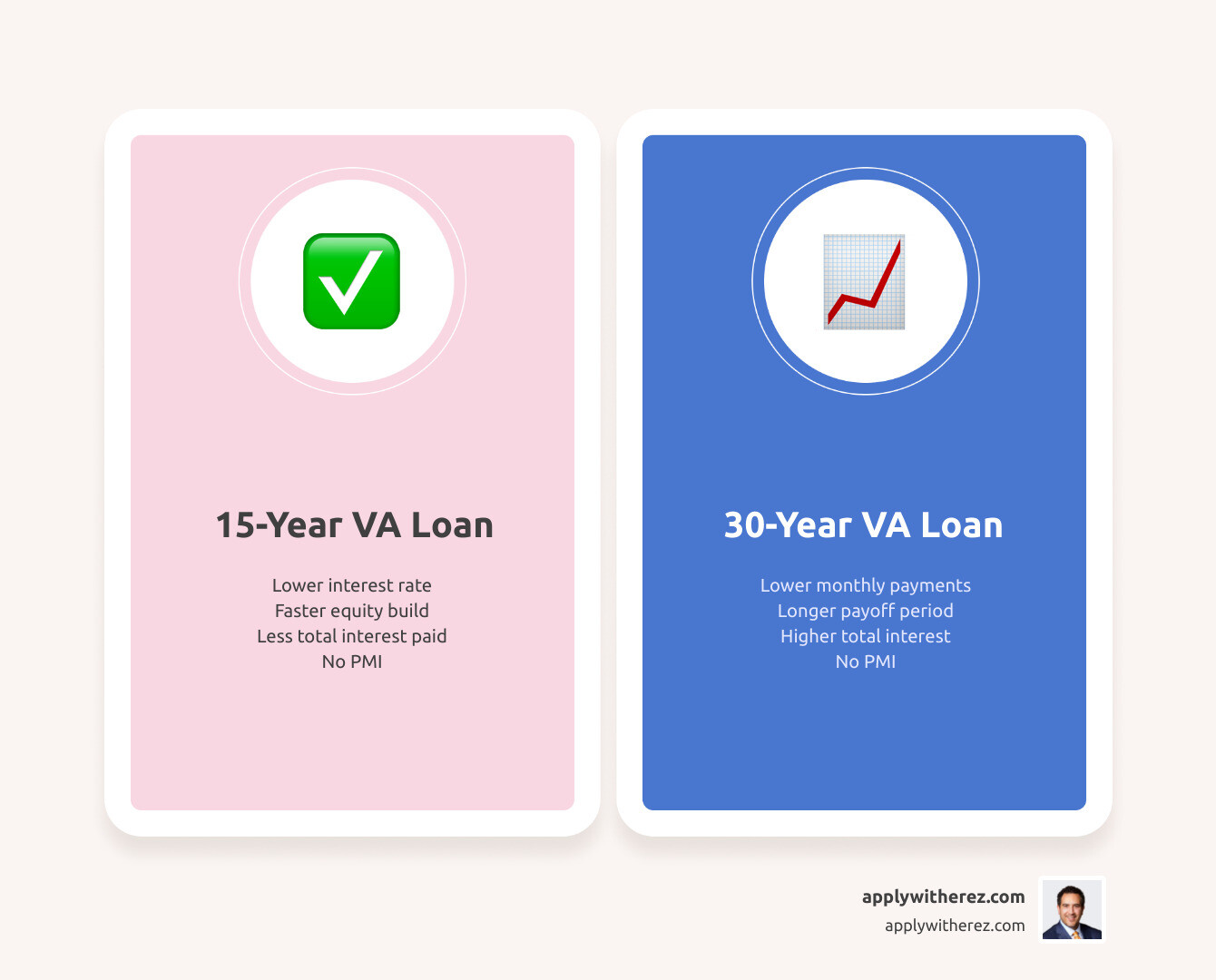
A 15-year term usually gives you:
A lower interest rate
Faster equity growth
Much lower lifetime interest cost
Debt-free homeownership sooner
A 30-year term usually gives you:
Lower monthly payment
More breathing room in your budget
Easier qualification for some borrowers
Greater cash flow flexibility
Here is the tradeoff in plain English: the 15-year loan saves more money overall, but the 30-year loan is easier to live with month to month. One is the marathon runner. The other is the comfy walking shoe.
If you can comfortably handle the higher payment, a 15-year VA loan can be a strong wealth-building tool.
Why interest rate and APR are not the same
This trips up a lot of borrowers, so let us make it simple.
Interest rate is the cost of borrowing the principal
APR is the broader cost of the loan, including certain finance charges
APR can include items such as:
Discount points
Some lender fees
Certain prepaid finance charges
That means two loans can have similar rates but very different APRs. If one lender advertises 5.375% and another advertises 5.75%, the lower rate is not automatically the better deal. If the lower-rate loan requires much higher points, its APR may end up less attractive.
APR is not perfect, but it is one of the best apples-to-apples tools we have when comparing offers.
What determines your personal 15 year VA mortgage rates
The rate you actually receive will depend less on internet headlines and more on your borrower profile. Lenders typically price VA loans based on a mix of risk and market conditions.
Key factors include:
Credit score
Debt-to-income ratio
Loan-to-value ratio
Loan amount
Occupancy
Property type
Purchase vs refinance
Whether you pay discount points
Rate lock period
Funding fee treatment

If you want to understand the loan basics first, visit our VA Home Loan guide. We also recommend reviewing 9 Mistakes That Can Affect Your Mortgage before you apply.
Eligibility rules for a 15-year VA loan
A 15-year VA loan uses the same core eligibility framework as other VA mortgages. In general, you may qualify if you are:
An eligible veteran
An active-duty service member who meets service requirements
A qualifying National Guard or Reserve member
An eligible surviving spouse in certain circumstances
You will usually need a Certificate of Eligibility, often called a COE.
Other common requirements include:
The home must generally be your primary residence
The lender must approve your income, credit, and overall file
The property must meet VA appraisal and property standards
The VA guarantees part of the loan, but lenders still underwrite the mortgage. So yes, the VA benefit is powerful, but it is not a magic wand that turns bad paperwork into instant approval.
How discount points and fees change your rate
Discount points are upfront fees paid to reduce the interest rate. One point usually equals 1% of the loan amount.
For example:
On a $300,000 loan, 1 point = $3,000
On a $500,000 loan, 1 point = $5,000
Current published 15-year VA examples in May 2026 show points ranging from roughly 0.5 to nearly 2 points. That is a big difference in upfront cost.
When points may make sense:
You expect to keep the loan for many years
The lower payment produces a reasonable break-even point
You want to maximize long-term interest savings
When points may not make sense:
You may move soon
You expect to refinance
You would rather preserve cash for savings, repairs, or reserves
VA loans also come with other possible costs, such as origination charges, title fees, and the VA funding fee unless you are exempt. Seller concessions may help in some transactions, but we always want to review the full Loan Estimate, not just the rate.
Standard loan limits vs jumbo pricing
VA borrowers with full entitlement are not boxed into a traditional hard cap the way some other loan types are, but pricing still changes as loan size grows.
In the current market, jumbo 15-year VA pricing can differ from standard-balance pricing because of:
Larger loan amounts
Reserve requirements
Different investor appetite
Tighter underwriting
Property and risk layering
One published jumbo example in May 2026 showed a 15-year VA jumbo rate of 5.49% with a 6.036% APR on a $1.1 million loan, compared with a standard 15-year VA example at 5.99% and 6.628% APR. That does not mean jumbo is always cheaper. It means you must compare the exact scenario in front of you, because pricing depends heavily on loan structure and assumptions.
Why veterans choose a 15-year VA loan
The main reason veterans choose a 15-year term is simple: they want to own more of the home, sooner.
A 15-year VA loan can help with:
Faster principal reduction
Lower total interest paid
A predictable fixed payment
Earlier debt freedom
Better positioning for retirement
Stronger equity for future refinance or sale decisions
If you want a broader look at VA benefits, our article on Fourteen Advantages of a VA Home Loan is a great next read.

How a 15-year VA loan builds equity faster
With a shorter loan term, each payment attacks the balance more aggressively. More of your payment goes to principal earlier in the schedule compared with a 30-year loan.
That matters because equity is not just a nice feeling. It can create real flexibility:
Easier refinancing options later
Better protection if home values flatten
More borrowing power for future goals
A stronger ownership position sooner
Think of amortization like a tug-of-war between interest and principal. On a 30-year loan, interest does a lot of the early winning. On a 15-year loan, principal starts pulling harder much sooner.
The biggest advantages over longer loan terms
Compared with a 30-year VA loan, the biggest advantages of a 15-year term are:
Lower interest rate in many cases
Far less total interest over the life of the loan
Faster payoff
Quicker equity growth
More certainty for long-term financial planning
This can be especially appealing for veterans who are:
Buying later in their career and want the home paid off near retirement
Refinancing from a longer term to cut interest cost
Focused on debt reduction and wealth building
Comfortable with a higher fixed monthly payment
The tradeoffs and higher monthly costs to expect
A 15-year VA loan is not automatically the best choice for every borrower.
Potential drawbacks include:
Higher monthly payment
Tighter debt-to-income ratios
Less monthly cash flow for emergencies or investing
Greater payment stress if income changes
Possible temptation to overbuy because the rate looks attractive
A lower interest rate is great, but not if the payment makes your budget squeak every month. We would rather see a borrower choose the right payment than the "best" rate on paper.
Monthly payment examples and recent rate trends
The best way to understand affordability is to look at the actual monthly payment. Just remember that principal and interest are only part of the total housing cost. Taxes, homeowners insurance, HOA dues, and maintenance all matter too.
For payment estimates on your own numbers, try our Calculator.
Payment examples for common 15-year VA loan amounts
Below are rough principal-and-interest examples using sample rates from current May 2026 market data. These estimates exclude taxes, insurance, and other escrow items.
Loan Amount Example Rate Approx. Monthly Principal and Interest $300,000 4.875% $2,352 $350,000 5.99% $2,952 $500,000 5.50% About $4,085
These examples show two important truths:
A small rate difference changes the payment meaningfully
A 15-year loan payment is much higher than a 30-year payment on the same balance
That higher payment is the price of faster payoff. The upside is that a much larger share of your money goes toward ownership instead of interest.
How 15-year VA rates have trended recently
In spring 2026, mortgage pricing has remained sensitive to:
Inflation reports
Treasury yields
Federal Reserve policy expectations
Labor market data
Investor demand for mortgage-backed securities
Mortgage rates are not set directly by the Fed, but Fed policy influences the broader rate environment. When investors expect higher inflation or a slower pace of rate cuts, mortgage rates can stay elevated or move up. When inflation cools and bond yields ease, mortgage pricing often improves.
In practical terms, that means 15-year VA rates in recent months have moved around, but they still generally price below 30-year VA rates because lenders get repaid faster and take less long-term rate risk.
When to lock in your 15 year VA mortgage rates
A rate lock can protect you from market moves while your loan is in process. The right time to lock depends on:
How soon you are closing
Whether the payment already fits your budget
How volatile the market is
Whether your lender offers a float-down option
A simple framework:
If you are within 30 days of closing and happy with the payment, locking often makes sense
If rates are rising or the market is volatile, waiting can backfire quickly
If you still need time to shop or improve your file, it may be worth holding off briefly
No one can predict every market move. A lock is less about "winning" and more about controlling risk.
How to qualify for the best 15 year VA mortgage rates
The borrowers who tend to get the best pricing often have the cleanest overall files. That does not mean perfect, but it does mean well-prepared.
If you are considering a term reduction on an existing loan, visit our Refinance page.
Best practices before you apply
Before applying, we recommend:
Check your credit and dispute any errors
Pay down revolving debt if possible
Avoid new credit inquiries unless necessary
Keep income and asset documentation organized
Build a little cash reserve, even if no down payment is required
Stay current on all obligations
Avoid major job changes right before closing if possible
The advertised best rates often assume stronger credit, such as around a 740 score, plus a debt-to-income ratio below 43%. Your exact result may vary, but those benchmarks are useful targets.
How many quotes you should compare
We generally recommend comparing at least three quotes, and preferably more if the numbers are close.
When comparing, review:
Interest rate
APR
Discount points
Origination charges
Lender credits
Total cash to close
Lock period
Estimated monthly payment
The Loan Estimate is your best friend here. It is not glamorous, but it tells the truth.
Are there special promotions or temporary rate reductions right now
Sometimes, yes. Depending on the market and loan structure, borrowers may find:
Temporary buydowns
Lender credits
Seller-paid closing costs
Relationship pricing discounts
Builder incentives on new construction
But promotions are not always a better deal than a plain-vanilla loan with cleaner pricing. A temporary rate reduction can help, but we still want to check the long-term payment and total cost. A fancy ribbon on the box does not always mean the box is cheaper.
Frequently Asked Questions about 15 year VA mortgage rates
Is a 15-year VA loan always better than a 30-year VA loan?
No. It is often better for total savings, but not always better for monthly cash flow. If the higher payment would strain your budget, a 30-year VA loan may be the smarter choice. The best loan is the one that fits your life, not just the spreadsheet.
Can I refinance from a 30-year VA loan into a 15-year VA loan later?
Yes, many borrowers do exactly that. Depending on your situation, you may use a streamlined VA refinance or a cash-out refinance to reduce your term. This can make sense if rates improve or your income rises and you want to accelerate payoff.
Do 15-year VA loans have mortgage insurance?
No. VA loans do not require monthly PMI, which is one of their biggest advantages over many conventional low-down-payment loans. However, most borrowers do pay a VA funding fee unless they qualify for an exemption, such as certain service-connected disability situations.
Conclusion
A 15-year VA loan can be one of the strongest mortgage strategies available for eligible veterans in May 2026. It offers a shorter payoff period, typically lower rates than a 30-year VA loan, no PMI, and much faster equity growth. The tradeoff is a higher monthly payment, so the right choice depends on your budget, goals, and timeline.
If you are comparing 15 year VA mortgage rates, focus on the whole picture:
Rate
APR
Points
Fees
Payment
Break-even timeline
Long-term affordability
Most important of all, compare multiple offers and make sure the loan supports your real-world goals, not just a headline number.
If you are ready to explore your options, learn more about Refinance or review your numbers with us to find the right VA strategy for your next move.