
Conventional Assumable Loan Options Survival Guide
How Mortgage Assumptions Work and the Due-on-Sale Barrier
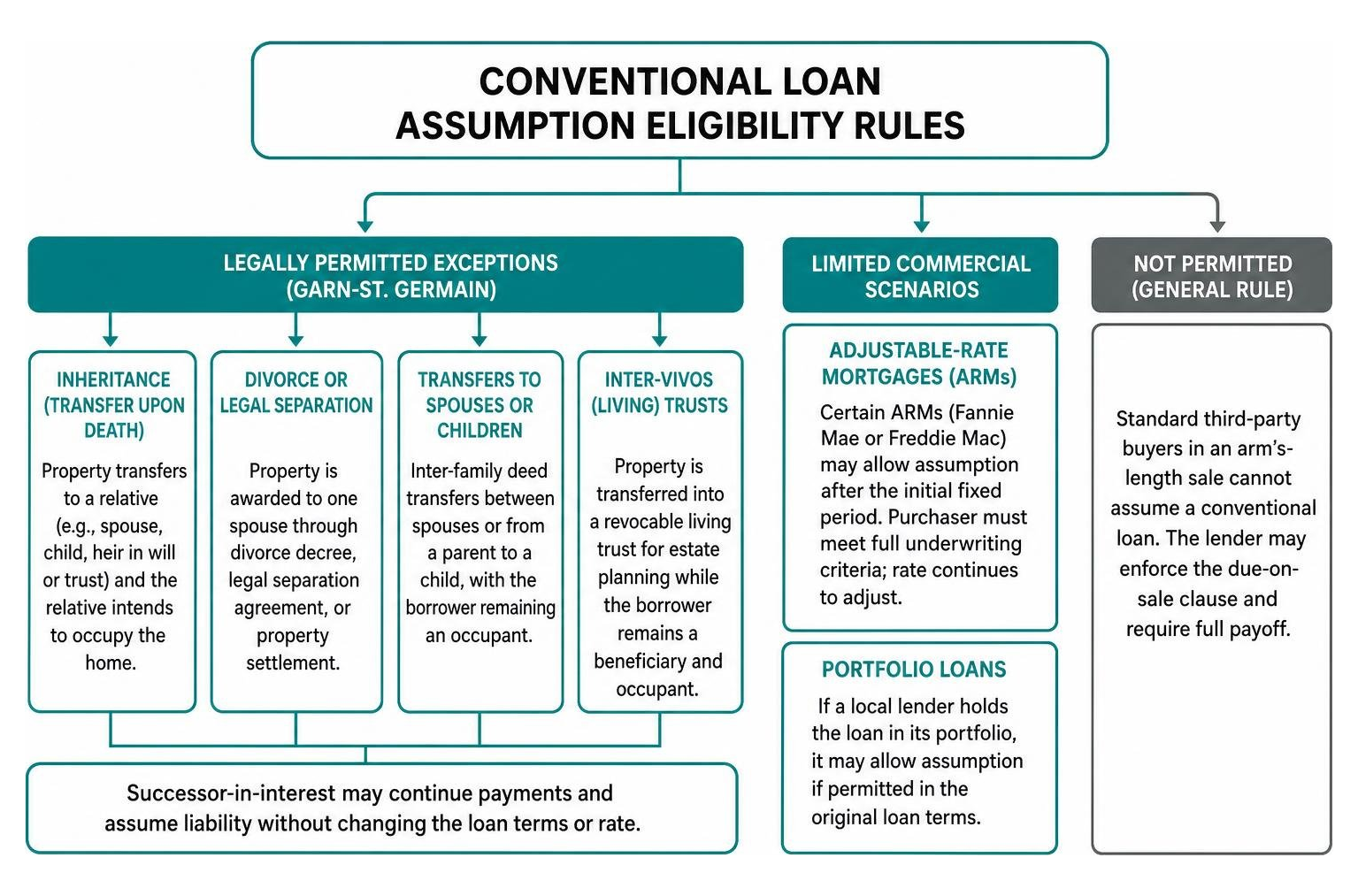
A conventional assumable loan is generally not permitted in a standard arm's-length home purchase because conventional fixed-rate mortgages enforce strict due-on-sale clauses requiring full loan payoff upon title transfer. However, a conventional mortgage can be assumed under narrow legal exceptions—such as property inheritance, divorce, or transfers into living trusts protected by federal law—as well as specific adjustable-rate mortgage (ARM) or portfolio loan provisions.
When a mortgage assumption occurs, the buyer steps directly into the original borrower's debt, retaining the existing loan balance, repayment schedule, and original interest terms. When title transfers via a recorded deed, the loan servicer is notified. Without an authorized statutory exception or contractual permission, the servicer enforces the due-on-sale provision and demands full debt acceleration.
The Due-on-Sale Clause Explained
The standard mortgage contract used across New York, New Jersey, and Pennsylvania contains a protective legal provision known as the due-on-sale clause (often referred to as an acceleration clause or due-on-transfer provision).
Under 12 U.S. Code § 1701j-3 and standard mortgage covenants, a due-on-sale clause gives the mortgage holder the legal authority to declare the entire unpaid balance of the loan due and payable immediately if the property secured by the mortgage is sold, conveyed, or transferred without the lender’s prior written consent.
This clause exists to protect the lender against interest rate risk. If a bank issued a fixed-rate loan at 3% years ago, they cannot afford to let that below-market rate pass indefinitely from buyer to buyer while market rates sit substantially higher. The acceleration clause ensures that when a property changes hands, the old loan gets paid off in full, freeing up capital for current market deployment.
Why Fannie Mae and Freddie Mac Restrict Assumptions
The vast majority of residential mortgages are conventional loans packaged and sold on the secondary mortgage market to government-sponsored enterprises (GSEs): Fannie Mae and Freddie Mac. When you secure a standard conventional loan, the servicing guidelines are strictly governed by these entities up to the local conforming loan maximum.
Fannie Mae and Freddie Mac servicing guidelines explicitly instruct loan servicers to enforce the due-on-sale provision on all conventional fixed-rate mortgages in an arm’s-length market purchase. Why? Because the GSEs manage secondary market portfolio risk for millions of securities. Allowing unrestricted mortgage assumptions would destroy the financial modeling of mortgage-backed securities (MBS) by artificially extending the lifespan of low-yield assets.
Consequently, loan servicers have no discretionary power to "waive" the due-on-sale clause for a prospective buyer looking to take over a seller's conventional fixed-rate mortgage during a normal purchase.
The Reality of the Conventional Assumable Loan: Due-on-Sale Rules and Exceptions

While standard purchases hit a brick wall, the concept of a conventional assumable loan is not entirely a myth. Federal statutory law and specific investor carve-outs create narrow pathways where an assumption or transfer of ownership can legally occur without triggering loan acceleration.
Understanding When a Conventional Assumable Loan Is Legally Permitted
The primary legal shield for conventional mortgage transfers is the Garn-St. Germain Depository Institutions Act of 1982. This federal statute preempts state laws and prevents mortgage lenders from exercising due-on-sale clauses under specific personal, family, and estate circumstances.
When a transfer qualifies under Garn-St. Germain, the person acquiring the property is recognized as a successor-in-interest. The servicer must allow the successor to continue making mortgage payments and, in many cases, formally assume legal liability for the mortgage without modifying the underlying interest rate or loan terms.
Special Circumstances: Inheritance, Divorce, and Living Trusts
The legally protected exceptions under Garn-St. Germain and GSE servicing guidelines apply almost exclusively to non-sale transfers:
Transfer Upon Death (Inheritance): If a borrower passes away and the real property transfers to a relative (such as a surviving spouse, adult child, or heir named in a will or trust), the lender cannot enforce the due-on-sale clause, provided the relative intends to occupy the home.
Divorce and Legal Separation: When marital property is dissolved through a divorce decree, legal separation agreement, or property settlement, and one spouse becomes the sole owner of the property, the departing spouse's interest can be transferred without triggering loan acceleration.
Transfers to Spouses and Children: Inter-family deed transfers from a parent to a child or between spouses during lifetime conveyances are generally protected when the borrower remains an occupant.
Inter-Vivos (Living) Trusts: Transferring a mortgaged home into a revocable living trust for estate planning purposes is fully protected, provided the borrower remains a beneficiary and retains the right to occupy the property.
Outside of these specific statutory protections, a standard third-party buyer purchasing a home on the open real estate market cannot use Garn-St. Germain to force a conventional loan assumption.
Portfolio Loans and Adjustable-Rate Mortgages (ARMs)
There are two minor commercial scenarios where conventional assumptions may appear outside of estate transfers:
Adjustable-Rate Mortgages (ARMs): Certain conventional ARMs originated under Fannie Mae or Freddie Mac guidelines contain explicit contract language permitting assumption after the initial fixed-rate period expires. However, the purchaser must meet full underwriting criteria, and the interest rate will continue adjusting according to the note's index and margin.
Portfolio Loans: If a local bank or credit union holds a loan in its private portfolio (meaning it was never sold to Fannie Mae or Freddie Mac), the bank sets its own rules. While rare, some portfolio lenders include an assumption clause in their initial loan contracts to attract high-net-worth borrowers.
Conventional vs. Government-Backed Assumptions (FHA, VA, USDA)
Unlike conventional mortgages, government-backed loans are statutorily designed to be assumable. If you are shopping for a property specifically to assume an existing low interest rate, you will almost certainly be evaluating an FHA, VA, or USDA financing structure.
Loan Feature | Conventional Loans | FHA Loans | VA Loans | USDA Loans |
|---|---|---|---|---|
Assumable in Standard Sale? | No (Barring rare ARM/portfolio clauses) | Yes (Requires servicer approval) | Yes (Open to veterans & non-veterans) | Yes (Subject to USDA approval) |
Primary Legal Barrier | Due-on-sale clause strictly enforced | HUD Reform Act of 1989 guarantees assumability | Statutory assumability under 38 U.S. Code | Permitted under USDA RD guidelines |
Credit Underwriting Required? | Yes (for permitted successors) | Yes (Servicer evaluates credit & DTI) | Yes (Full credit/capacity review) | Yes (Must meet RD income/credit rules) |
Primary Benefit to Buyer | Preserves rate for heirs/divorcees | Preserves low fixed rate on purchase | Preserves low fixed rate on purchase | Preserves low fixed rate on purchase |
Seller Liability Release | Subject to servicer review | Form HUD-92210 releases seller | Requires written release & entitlement review | Requires formal Agency release |
Funding / Transfer Fees | Servicer processing fees ($500–$1,500) | Standard processing fee caps apply | 0.5% VA Funding Fee on unpaid balance | Servicer transfer processing fee |
FHA, VA, and USDA Assumability Guidelines
Government-backed programs offer clear contractual pathways for assumption:
FHA Assumptions: Under an fha loan, any qualified homebuyer can assume the mortgage with servicer approval. The buyer must document creditworthiness (typically a 580–620+ credit score) and debt-to-income (DTI) ratios consistent with HUD underwriting. The existing monthly Mortgage Insurance Premium (MIP) remains on the loan, but upfront MIP is not re-charged.
VA Assumptions: A va home loan is uniquely flexible because it can be assumed by both veterans and non-veterans. However, sellers must proceed with caution: if a non-veteran assumes a VA loan, the veteran seller’s VA loan entitlement remains tied up in that property until the loan is paid in full. To restore full entitlement, the assuming buyer must be an eligible veteran who agrees to substitute their own entitlement.
USDA Financing: USDA Rural Development loans can be assumed, though the new borrower must meet strict household income caps and property eligibility standards.
The Equity Gap and Financing Solutions
Even on fully assumable government mortgages, buyers must address the equity gap—the difference between the agreed-upon home purchase price and the remaining unpaid principal balance on the seller's mortgage.
For instance, if a home is selling for $500,000 and the seller's existing assumable mortgage balance is $320,000, there is a $180,000 equity gap.
To bridge this gap, a buyer has three options:
Liquid Cash / Gift Funds: Pay the $180,000 out of pocket at closing.
Second Mortgage / Gap Loan: Secure a second mortgage (such as a fixed-rate second lien or HELOC) to finance the difference.
Blended Rate Strategy: When you combine a $320,000 first mortgage at 3.0% with a $180,000 second mortgage at 8.5%, your effective blended interest rate is roughly 4.98%—which remains substantially lower than prevailing market purchase rates.
Risks of Informal Assumptions and Servicer Verification
In real estate investing circles, creative financing strategies often promote acquiring properties without telling the bank. These transactions carry severe legal and financial risks.
The Dangers of "Subject-To" Transfers Without Lender Consent
A "subject-to" deal occurs when a buyer takes over the deed to a property and makes monthly mortgage payments on behalf of the seller, deliberately bypassing formal loan assumption and lender notification.
While not illegal in most jurisdictions, executing a subject-to transfer on a conventional mortgage creates acute hazards:
Mortgage Acceleration and Foreclosure: When the loan servicer discovers the unauthorized deed transfer through updated property tax records or homeowner insurance notifications, they can issue a 30-day demand letter accelerating the entire mortgage balance. If the parties cannot pay off the balance immediately, the home enters foreclosure.
Insurance and Hazard Complications: If a catastrophic property event occurs (such as a fire or flood), the insurance policy must match the named deed holder and the named mortgage holder. Mismatched insurance documentation can lead to claim denials or cancelled policies.
Seller Credit Risk: The seller remains legally liable for the promissory note. If the buyer defaults on payments, the seller’s credit score is damaged, and deficiency judgments can follow.
What to Ask Your Servicer to Verify a Conventional Assumable Loan
If you believe a conventional loan qualifies for assumption under an estate transfer or specific loan contract provision, contact the loan servicer directly. Demand clear, written answers to the following questions:
Is this mortgage legally eligible for assumption under GSE or portfolio guidelines?
What specific documentation is required to establish legal successor-in-interest status under Garn-St. Germain?
What are the underwriting criteria and minimum credit benchmarks for the assuming party?
What formal assumption fees and title update costs will be billed by the servicer?
Will the servicer issue an official Release of Liability (e.g., Fannie Mae Form 105 or equivalent) to the departing borrower upon closing?
What is the expected timeline for the servicer's assumption department to complete review and underwriting?
Practical Alternatives When a Conventional Loan Cannot Be Assumed
If an open-market home purchase involves a non-assumable conventional loan, you do not have to give up on securing competitive, affordable monthly housing payments.
Securing New Financing with Favorable Terms
The most reliable approach is structuring a brand new mortgage tailored specifically to your financial profile. Starting with a verified home loan pre-approval establishes your exact purchasing power and helps you explore the best first-time buyer mortgages 2026 or identify the best type of mortgage for first time buyers.
Whether you need conventional financing with as little as 3% down, a specialized multi-unit purchase program like a 5 down conventional loan duplex, or flexible government loan options, proper structuring can yield significant monthly savings.
Seller Concessions and Temporary Rate Buydowns
When sellers cannot offer an assumable rate, you can negotiate closing cost credits to artificially slash your interest rate.
Permanent Rate Buydowns: You can use seller concessions to purchase discount points, permanently lowering the note rate on your new loan.
Temporary Buydowns (2-1 or 3-2-1 Buydowns): With a 2-1 buydown, the seller funds an escrow account that lowers your effective interest rate by 2.00% in Year 1 and 1.00% in Year 2. This structure creates substantial payment relief during your initial years of homeownership, providing time to refinance if market interest rates ease.
Frequently Asked Questions About Mortgage Assumptions
Can a buyer assume a conventional loan in a standard market purchase?
No. In an arm’s-length market purchase between an unrelated buyer and seller, standard conventional fixed-rate mortgages cannot be assumed. The loan servicer will enforce the mortgage contract's due-on-sale clause, requiring the seller to satisfy the remaining balance in full at closing.
Does a family member have to qualify to assume a mortgage after death?
Under the Garn-St. Germain Act, a relative inheriting a property can continue making payments to prevent foreclosure without immediate credit qualification. However, if the heir wishes to formally remove the deceased relative from the loan and assume sole legal liability on the note, the loan servicer will typically require standard capacity-to-pay documentation and income verification.
What happens if a lender discovers an unapproved property transfer?
If a loan servicer detects an unapproved title transfer that is not protected by federal statute, they will issue a formal Notice of Acceleration. This notice requires the full principal balance, accrued interest, and applicable fees to be paid in full within a specified window (typically 30 to 60 days). Failure to pay or refinance the debt within that window results in judicial or non-judicial foreclosure.
Conclusion
Understanding mortgage assumption rules separates expensive mistakes from smart financing strategies. While a conventional assumable loan is not an option for standard home purchases due to mandatory due-on-sale enforcement, statutory exceptions safeguard families navigating life transitions like divorce, inheritance, and trust structuring.
For standard market buyers, government-backed loans (FHA and VA) remain the premier route for rate assumptions, while modern purchase tools—such as temporary rate buydowns, customized conventional structuring, and negotiated seller concessions—provide practical paths to affordable homeownership.
If you are evaluating purchase options, refinancing existing debt, or planning your next property acquisition across New York, New Jersey, or Pennsylvania, our team is here to help you navigate the process with complete transparency. Buy a home with confidence by connecting with our mortgage specialists to review customized lending strategies tailored to your financial goals.