
Conforming Loan Maximums and How to Navigate Them in 2026
What Is the Conforming Loan Maximum in 2026?
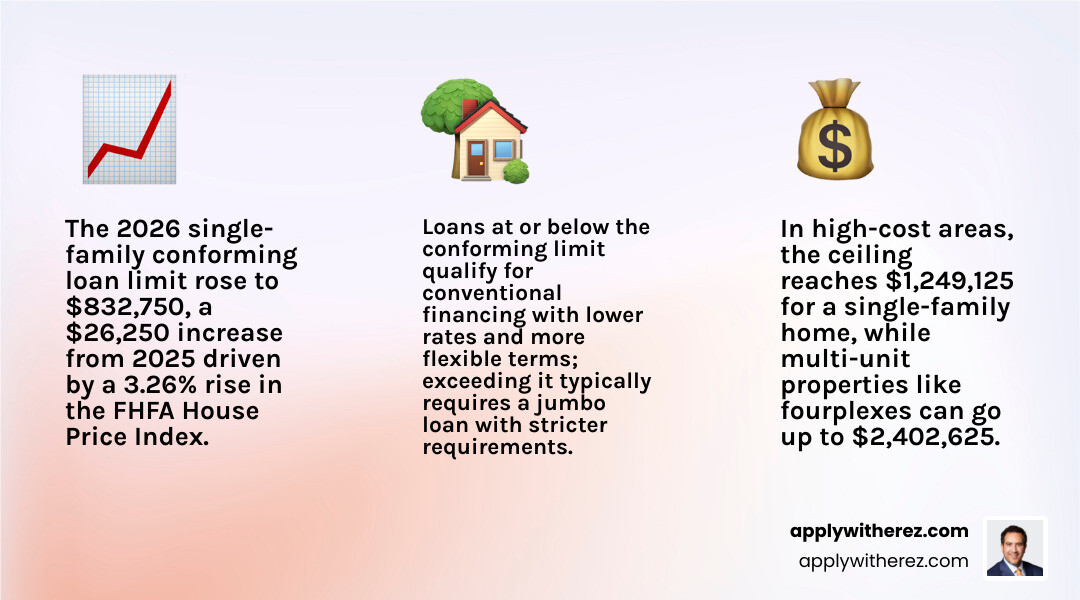
The conforming loan maximum is the highest loan amount that Fannie Mae and Freddie Mac are legally allowed to purchase from lenders — and for 2026, that number has gone up.
Here are the key limits at a glance:
Property Type Baseline (Most U.S. Counties) High-Cost Area Ceiling Alaska, Hawaii, Guam & USVI 1-unit (single-family) $832,750 $1,249,125 $1,249,125 2-unit (duplex) $1,066,250 $1,599,375 $1,599,375 3-unit (triplex) $1,289,150 $1,933,725 $1,933,725 4-unit (fourplex) $1,601,750 $2,402,625 $2,402,625
These limits took effect January 1, 2026 — and they apply to any loan delivered to Fannie Mae or Freddie Mac in 2026, even if it was originated in late 2025.
The 2026 limits represent a 3.26% increase from 2025, driven by rising home prices tracked by the FHFA's House Price Index between Q3 2024 and Q3 2025. The baseline for a single-family home went from $806,500 in 2025 to $832,750 in 2026 — a jump of $26,250.
Why does this matter? Because if your loan stays at or below the conforming limit for your area, you qualify for conventional financing with lower rates and more flexible terms. Go above it, and you're typically looking at a jumbo loan — with stricter requirements and higher costs.
I'm Erez Shimoni, a mortgage broker with 26 years of industry experience, and helping borrowers understand the conforming loan maximum — and how to stay within it — is one of the most practical ways I save clients money. In this guide, I'll walk you through everything you need to know to navigate the 2026 limits confidently.
Understanding the Conforming Loan Maximum and How It Works
To truly understand how the conforming loan maximum impacts your wallet, we have to look behind the curtain of the American mortgage machine.
When you get a mortgage, your lender doesn't usually keep that loan in a safe in their basement. If they did, they’d quickly run out of money to lend to the next person. Instead, they sell your mortgage on the secondary mortgage market.
The primary buyers on this market are two government-sponsored enterprises (GSEs): the Federal Association of National Mortgages (Fannie Mae) and the Federal Home Loan Mortgage Corporation (Freddie Mac). Together, these entities back or purchase trillions of dollars in American residential mortgages.
For Fannie and Freddie to buy a loan, it must "conform" to their strict guidelines. These rules cover everything from your credit score to the size of the loan itself. The maximum size they can legally purchase is what we call the conforming loan maximum.
When a mortgage fits neatly into these guidelines, lenders can easily package it with thousands of other conforming mortgages into Mortgage-Backed Securities (MBS). This risk-pooling distributes potential default losses so widely that a single default is barely a blip on the radar. Because of this low-risk setup, lenders can offer conventional conforming loans at highly competitive interest rates.
If you are looking to lower your housing costs, staying within these parameters is crucial. For those who already have a mortgage and are looking to optimize their payments, checking out the best mortgage refinance companies with no closing costs can help you leverage these competitive conventional terms.
The 2026 Conforming Loan Limits Explained
Every year, the Federal Housing Finance Agency (FHFA) reviews the housing market to determine whether the conforming loan maximum needs an adjustment. For 2026, the FHFA announced a 3.26% increase across the board.
This increase is calculated using the FHFA's seasonally adjusted House Price Index (HPI), which tracks average home value changes in the United States. By looking at the price jump between the third quarter of 2024 and the third quarter of 2025, the FHFA determined that home prices rose by an average of 3.26%. Consequently, the baseline limit was bumped up to keep pace with inflation.
To see how this year's limits compare to last year's across all property types in the contiguous United States, let's look at the official FHFA Conforming Loan Limit Values.
Property Units 2025 Baseline Limit 2026 Baseline Limit Dollar Increase 1-Unit (Single-Family) $806,500 $832,750 $26,250 2-Unit (Duplex) $1,032,500 $1,066,250 $33,750 3-Unit (Triplex) $1,248,000 $1,289,150 $41,150 4-Unit (Fourplex) $1,550,900 $1,601,750 $50,850
These limits are uniform across the vast majority of counties in the contiguous United States. However, the FHFA also designates certain counties as "high-cost areas" where housing prices are significantly higher than the national average.
Baseline Conforming Loan Maximum for Single-Family Homes
For a standard single-family home in most of the United States, the baseline conforming loan maximum for 2026 is $832,750.
This means that if you are buying a home in a standard-cost county and your total loan amount (not the purchase price, but the actual amount you are borrowing) is $832,750 or less, you can utilize conventional financing.
For example, if you purchase a home for $900,000 and put down a 10% down payment ($90,000), your loan amount will be $810,000. Because $810,000 is under the $832,750 threshold, your mortgage conforms to GSE guidelines. You will qualify for the competitive rates and standard underwriting associated with conventional loans.
Multi-Unit Property Limits for 2026
If you are looking to purchase a multi-unit property (such as a duplex, triplex, or fourplex), the conforming limits are significantly higher. The FHFA scales these limits because multi-unit properties naturally cost more to purchase but also generate rental income.
According to the official Fannie Mae Loan Limits guidelines, the 2026 baseline limit for a two-unit duplex is $1,066,250. For a three-unit triplex, it goes up to $1,289,150, and for a fourplex, it tops out at $1,601,750.
This structure creates an incredible opportunity for "house-hackers" and real estate investors. By purchasing a multi-unit property as a primary residence, you can live in one unit, rent out the others, and finance the entire purchase using a conventional loan with a down payment as low as 3% to 5% — all while bypassing the stricter rules of jumbo financing.
Navigating High-Cost Areas and Special Statutory Territories
Not all housing markets are created equal. Buying a home in a quiet midwestern suburb is vastly different from buying a home in downtown San Francisco or Seattle.
To prevent buyers in expensive markets from being forced into jumbo loans for average-sized homes, the Housing and Economic Recovery Act of 2008 (HERA) established a special formula for high-cost areas.
Under this formula, if 115% of the local median home value exceeds the baseline limit of $832,750, the local limit is raised to match that higher value. However, there is a statutory "ceiling" on how high these limits can go. The maximum high-cost ceiling is capped at exactly 150% of the baseline limit.
For 2026, 150% of the baseline limit ($832,750) is $1,249,125.
If you are buying a home in a designated high-cost county, your local conforming loan maximum will fall somewhere between $832,750 and $1,249,125.
High-Cost Counties in California and Washington
High-cost rules heavily impact homebuyers in states like California and Washington, where home values frequently exceed national averages.
In California, the real estate market varies dramatically by region. If you look at the California Conforming Loan Limits county-by-county breakdown, you'll see this contrast in action:
Fresno County (Baseline): The limit is the standard $832,750.
Los Angeles County (High-Cost Ceiling): Because of high median values, the limit goes all the way up to the maximum high-cost ceiling of $1,249,125.
In Washington State, a similar dynamic occurs. According to the Washington Conforming Loan Limits county tables, standard counties sit at the $832,750 baseline. However, high-cost counties in the Puget Sound region — specifically King, Pierce, and Snohomish counties — have their 2026 limit set at $1,063,750 for a single-unit home.
If you're buying a fourplex in one of these high-cost Washington counties, your conforming limit scales up to $2,045,700, compared to the standard baseline of $1,601,750.
Special Baseline Conforming Loan Maximum for Alaska and Hawaii
The FHFA treats certain parts of the country as "special statutory territories." Because of their remote locations and unique economic factors, construction costs and real estate prices are exceptionally high.
By law, Alaska, Hawaii, Guam, and the U.S. Virgin Islands have their baseline limits set 50% higher than the rest of the country.
This means that in these areas, the baseline conforming loan maximum for a single-family home starts at $1,249,125 in 2026. For high-cost pockets within Hawaii (such as Maui and Kalawao counties), the limit can push even higher, reaching up to $1,299,500 for a single-family home.
Underwriting Requirements for Conforming Mortgages
Staying under the conforming loan maximum is only half the battle; you also have to qualify for the loan. Because conventional loans conform to Fannie Mae and Freddie Mac standards, the underwriting process is highly standardized.
When we evaluate conventional conforming loans, we look at several core criteria:
Credit Score: The absolute minimum credit score required by conventional guidelines is 620. However, to secure the lowest rates, you'll typically want a credit score of 740 or higher.
Down Payment: One of the biggest advantages of conforming loans is the low down payment option. First-time homebuyers can put down as little as 3% (through programs like Fannie Mae HomeReady or Freddie Mac HomePossible). Repeat buyers can qualify with 5% down.
Debt-to-Income (DTI) Ratio: Your DTI measures how much of your monthly gross income goes toward paying debts. Conforming guidelines typically cap DTI at 45% to 50%, depending on your overall credit profile and asset reserves.
Asset Reserves: Unlike jumbo loans, which often require 6 to 12 months of mortgage payments sitting in a bank account after closing, conventional conforming loans often require minimal or no reserves for a primary residence.
Automated Underwriting: Conventional loans must be processed through an Automated Underwriting System (AUS) — either Fannie Mae’s Desktop Underwriter (DU) or Freddie Mac’s Loan Product Advisor (LPA). A manual underwriting workaround is generally not permitted under standard conventional guidelines.
If your credit profile doesn't quite fit the conventional mold, you aren't out of options. For instance, you might want to compare conventional guidelines with government-backed alternatives by checking out 30-year FHA mortgage rates today. Similarly, if you are a military member or veteran, you can explore specialized zero-down financing options using our VA mortgage rates guide 2026.
What Happens If You Exceed the Limit? Alternatives to Conforming Loans
What happens if you find your dream home, but the loan amount you need is higher than your local conforming loan maximum? If you cross that line, your mortgage is classified as "non-conforming."
Fortunately, you have several reliable paths forward:
Jumbo Financing: A jumbo loan is a mortgage that exceeds the local conforming limit. Because Fannie and Freddie cannot purchase these loans, lenders must either keep them on their own books (portfolio loans) or sell them to private investors. This makes jumbo loans riskier for lenders. As a result, jumbo loans typically require a credit score in the 700s, a down payment of at least 10% to 20%, and strict cash reserve requirements.
The "Jumbo Escape" (Piggyback Loans): If you want to avoid jumbo requirements, you can use a "piggyback" loan structure (often called an 80-10-10 loan). You secure a first mortgage for 80% of the home's value (ensuring it stays below the conforming limit), a second mortgage (HELOC or home equity loan) for 10%, and bring a 10% cash down payment.
Increase Your Down Payment: If you are only slightly over the limit, the simplest solution is to put more money down. The conforming limit applies to the loan amount, not the purchase price. Bringing a little extra cash to the closing table can pull your loan balance down into conforming territory.
If you already own a home and are looking to tap into your home's equity, the same limits apply to refinancing. We highly recommend reviewing our cash-out refinance guide 2026 to see how these maximums affect equity extraction. Additionally, eligible veterans can explore specialized high-balance refinancing options in our VA refinance complete guide 2026.
Frequently Asked Questions about Conforming Loan Limits
Do 2026 limits apply to loans originated in 2025?
Yes, they can! The conforming loan limits are determined by the delivery date of the loan to Fannie Mae or Freddie Mac, not the date the loan was originated or closed.
If a lender originated a loan in December 2025 that exceeded the 2025 limit (e.g., a $820,000 single-family loan), they can still deliver that loan as a conforming mortgage as long as the delivery to the GSEs occurs on or after January 1, 2026. This transition rule gives lenders and buyers incredible flexibility at the end of every calendar year.
How does the FHFA calculate the annual limit increases?
The FHFA calculates annual limit adjustments using a formula established by the Housing and Economic Recovery Act of 2008 (HERA).
The formula compares the average U.S. home price in the third quarter of the current year to the average price in the third quarter of the previous year. If home prices rise, the baseline limit is increased by that exact percentage. For the 2026 limits, the FHFA used the 3.26% year-over-year increase in the House Price Index (HPI) between Q3 2024 and Q3 2025 to adjust the baseline from $806,500 to $832,750.
Can you remove mortgage insurance on a conforming loan?
Yes! This is one of the premier advantages of conventional conforming loans compared to government-backed options like FHA loans.
If you put down less than 20% on a conventional conforming loan, you will be required to pay Private Mortgage Insurance (PMI). However, under federal law, once your loan-to-value (LTV) ratio drops to 80% (meaning you have built 20% equity in your home), you can request that your lender cancel the PMI. Once it drops to 78%, the lender is legally required to remove it automatically. With FHA loans, by contrast, mortgage insurance is typically permanent for the entire life of the loan.
Conclusion
Navigating the conforming loan maximum in 2026 doesn't have to be overwhelming. With the baseline limit rising to $832,750 for single-family homes — and scaling up to $1,249,125 in high-cost areas — buyers have more purchasing power than ever before to secure highly competitive conventional financing.
Whether you are a first-time homebuyer looking to buy a duplex, or a seasoned homeowner looking to strategically structure your next purchase, understanding these limits is the key to saving money on your mortgage.
Ready to take the next step and build your customized home buying strategy? Apply with Erez to Buy a Home today, and let us help you navigate the 2026 mortgage market with ease!