The Definitive Guide to Qualifying for a 5% Down Duplex
Buy an Owner-Occupied Duplex With 5% Down
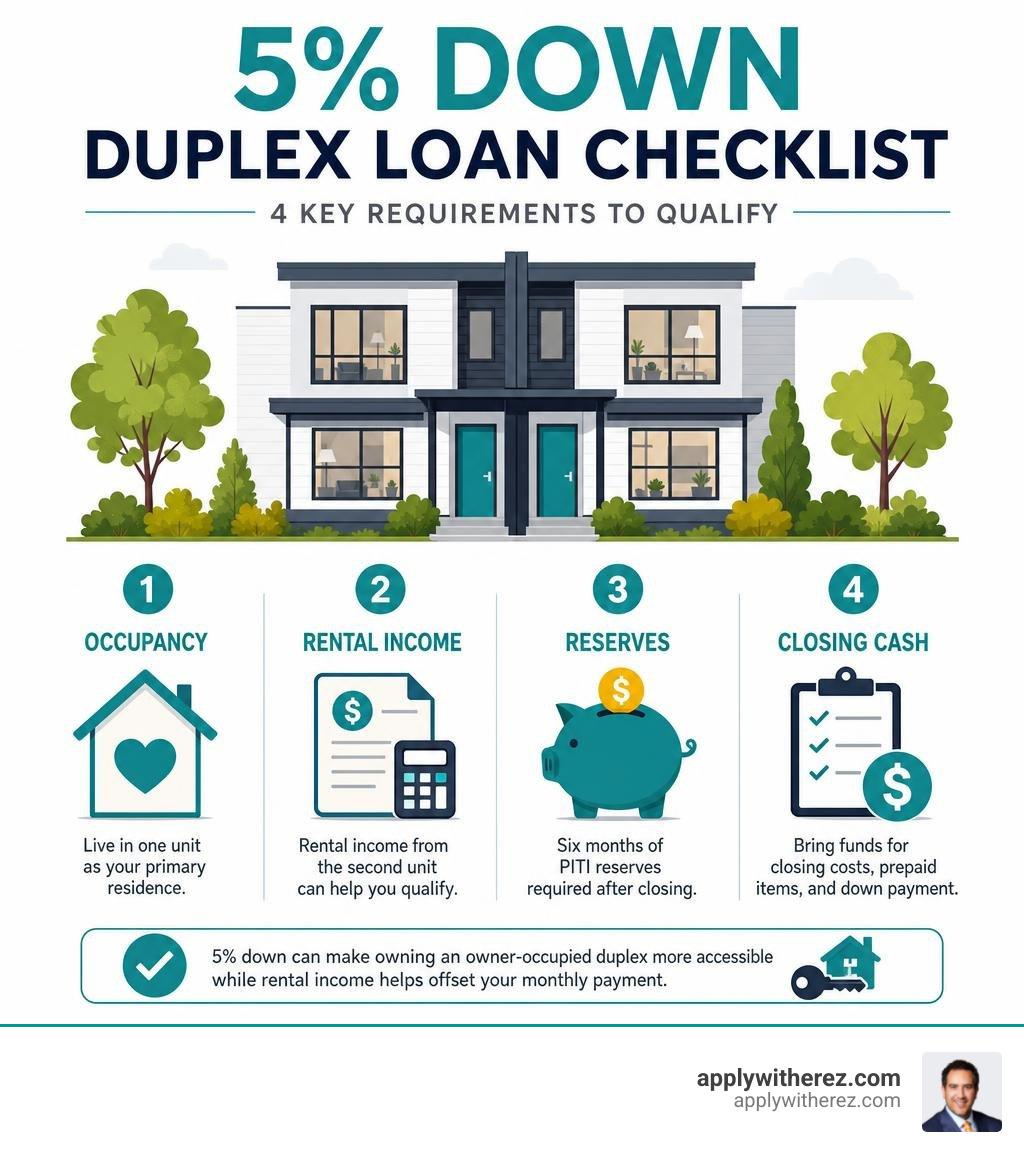
A 5 down conventional loan duplex lets an eligible buyer purchase an owner-occupied two-unit home with as little as 5% down. You must live in one unit as your primary residence, meet the lender's credit and debt-to-income standards, and keep enough verified cash for required reserves.
For a $400,000 duplex, 5% down is $20,000. That is far lower than the former 15% requirement, which would have meant $60,000 down. Buyers can often use 75% of the appraiser's projected rent from the second unit to help qualify, though the lender will also review the property appraisal, income, assets, and housing history.
The catch: the down payment is not your full cash target. Fannie Mae guidelines for this low-down-payment option require six months of PITI reserves - principal, interest, property taxes, and insurance - after closing. Closing costs, prepaid taxes, and insurance are separate.
This can be a powerful house-hacking path for buyers who want to live in one unit while rent from the other helps offset the monthly payment. Unlike FHA financing on triplexes and fourplexes, conventional financing does not impose FHA's self-sufficiency test.
I am Erez Shimoni, a mortgage professional with 26 years of experience helping borrowers understand conventional, FHA, VA, renovation, and other home-financing options. Licensed in New Jersey, New York, Pennsylvania, and Florida, I help buyers evaluate whether a 5 down conventional loan duplex fits their income, assets, rental-income plan, and long-term goals.
How the 5 Down Conventional Loan Duplex Program Works
Purchasing a multi-unit property has historically been one of the most reliable wealth-building strategies in real estate. By utilizing a conventional loan, an owner-occupant can acquire a two-unit residential property while maintaining substantial capital liquidity.

Under the modern Fannie Mae multifamily financing framework, borrowers are no longer boxed out by massive equity requirements when purchasing two- to four-unit properties. Instead of being forced into commercial lending or government-backed loan structures, you can secure standard conforming financing with a 95% Loan-to-Value (LTV) ratio.
To utilize this program, the property must serve as your primary residence. You live in one unit while renting out the other unit to generate rental income, offset monthly mortgage expenses, and build long-term equity.
Historical Down Payment vs Current Fannie Mae Guidelines
Prior to Fannie Mae's landmark guideline update, purchasing a multi-unit home with conventional financing required substantial upfront equity. Standard legacy guidelines mandated a minimum down payment of 15% for a two-unit duplex and 25% for a three- to four-unit property.
The current guidelines have leveled the playing field by reducing the minimum down payment for owner-occupied two-, three-, and four-unit properties to just 5%.
Consider the real-world financial impact on upfront capital:
On a $400,000 duplex, the required down payment dropped from $60,000 (15%) to $20,000 (5%)—saving $40,000 in upfront cash.
On a $500,000 triplex, the required down payment plummeted from $125,000 (25%) to $25,000 (5%)—a $100,000 upfront cash reduction.
This reduction allows everyday buyers and owner-landlords across New York, New Jersey, and Pennsylvania to step into multifamily real estate years earlier than previously possible.
Conforming Loan Limits for Two-Unit Properties in 2026
The Federal Housing Finance Agency (FHFA) sets annual baseline conforming loan limits that scale higher based on the number of dwelling units on the parcel. In 2026, the baseline conventional conforming loan limits are:
1-Unit (Single-Family): $832,750
2-Unit (Duplex): $1,066,250
3-Unit (Triplex): $1,288,800
4-Unit (Fourplex): $1,601,750
It is vital to note that Fannie Mae restricts the 5% down multifamily program to standard baseline conforming loan limits. High-balance or jumbo limits do not apply to this specific 95% LTV framework. However, with a two-unit cap of $1,066,250, buyers enjoy substantial purchasing power across regional housing markets.
Underwriting and Qualification Standards
Securing a mortgage on a multi-unit property involves evaluating personal creditworthiness alongside property-specific income potential. Whether you are a repeat investor or a first-time home buyer, understanding Fannie Mae's underwriting standards ensures your application moves smoothly through approval.
Following standard conventional low down payment guidelines, lenders process files through automated underwriting systems to establish loan eligibility.
Eligibility Requirements for a 5 Down Conventional Loan Duplex
To qualify for a 5% down conventional loan on a duplex, borrowers must satisfy specific credit, debt, and occupancy parameters:
Credit Score: A minimum credit score of 620 is required for fixed-rate conventional loans, though scoring 680 to 740+ secures substantially lower interest rates and reduced private mortgage insurance (PMI) premiums.
Debt-to-Income (DTI) Ratio: Automated underwriting typically caps DTI ratios at 45%, though strong files with excellent credit and reserves may receive approval up to 50%.
Automated Underwriting System (AUS): The loan file must receive an "Approve/Eligible" recommendation through Fannie Mae’s Desktop Underwriter (DU). Manual underwriting on multi-unit properties defaults to a strict 15% minimum down payment.
Owner-Occupancy Certification: The buyer must legally certify their intent to move into one of the units within 60 days of closing and occupy it as their primary residence for at least 12 months.
Using Projected Rental Income and Form 1025 to Qualify
One of the greatest advantages of buying a duplex is that lenders allow you to use the projected rental income from the second unit to help qualify for the mortgage.
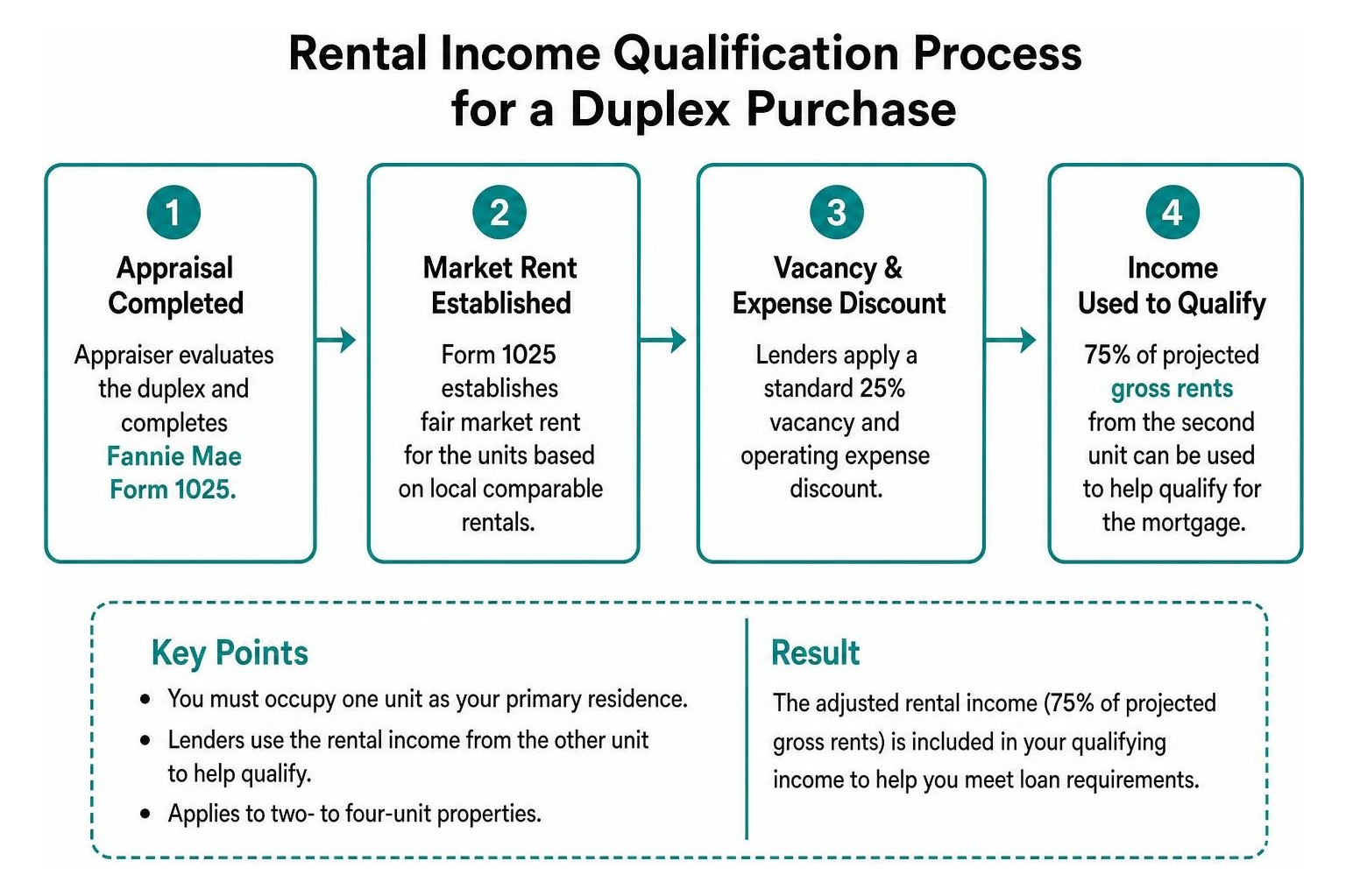
When an appraiser evaluates a two- to four-unit property, they complete Fannie Mae Form 1025 (Small Residential Income Property Appraisal Report). This document establishes fair market rent for the units based on local comparable rentals.
Lenders apply a standard 25% vacancy and operating expense discount to the gross market rent, allowing 75% of projected gross rents to count toward your qualifying income.
If the property has an existing tenant with an active, executed lease agreement, the lender can often use that documented lease figure instead of the market rent appraisal schedule.
First-time buyers can use future rental income to qualify provided they currently have a documented housing expense (such as a verified history of paying rent). Borrowers currently living rent-free generally cannot use future rental income toward qualifying metrics.
Reserve and Asset Guidelines for a 5 Down Conventional Loan Duplex
When putting only 5% down on a two-unit home, lenders require borrowers to hold post-closing cash reserves to ensure they can manage unexpected vacancies or maintenance repairs.

Fannie Mae guidelines require six months of full PITI reserves (Principal, Interest, Taxes, and Insurance) in verified liquid accounts after accounting for your down payment and closing costs.
These funds can be held in checking accounts, savings accounts, money market funds, brokerage accounts, or vested retirement accounts (such as a 401(k) or IRA).
For multi-unit properties, the buyer must contribute at least 5% of the purchase price from their own personal funds. Gift funds from family members are permitted to cover closing costs or any down payment amounts above the mandatory 5% minimum borrower contribution.
Comparing Financing Options: Conventional 5% Down vs FHA
When evaluating multi-unit financing, buyers frequently weigh conventional loans against government-insured FHA loans to determine the best type of mortgage for first time buyers.
Feature | Conventional 5% Down | FHA Multi-Unit Loan |
|---|---|---|
Minimum Down Payment | 5.0% | 3.5% (with 580+ Credit Score) |
Minimum Credit Score | 620 | 580 (or 500 with 10% Down) |
Required Reserves | 6 Months PITI | 0–2 Months (Duplex) / 3 Months (3–4 Units) |
Self-Sufficiency Test | None (Exempt on 2–4 units) | Mandatory on 3–4 unit properties |
Mortgage Insurance | Removable PMI (at 80% / 78% LTV) | Upfront MIP (1.75%) + Permanent Annual MIP |
2026 Baseline 2-Unit Limit | $1,066,250 | County-specific FHA caps |
Income Limits | None | None |
The Elimination of the FHA Self-Sufficiency Test Barrier
While FHA loans offer a slightly lower down payment of 3.5%, they impose significant hurdles when scaling into triplexes and fourplexes. HUD enforces a strict Self-Sufficiency Test on three- and four-unit FHA purchases.
Under the FHA self-sufficiency test, 75% of the total estimated market rent from all units (including the owner’s unit) must exceed the total monthly mortgage payment (PITI + MIP). In higher interest rate environments, properties in New York, New Jersey, and Pennsylvania frequently fail this test because market rents cannot overcome the monthly debt burden.
Conventional loans have no self-sufficiency test. A duplex is completely exempt under both conventional and FHA guidelines, but for buyers looking at three- or four-unit properties, conventional 5% down financing provides a streamlined path that bypasses FHA underwriting gridlock entirely.
Private Mortgage Insurance and Long-Term Cost Differences
Mortgage insurance rules represent another clear structural advantage for conventional financing.
FHA Mortgage Insurance: Requires a mandatory upfront mortgage insurance premium (UFMIP) of 1.75% added to your base loan amount, plus an annual MIP fee of 0.55% that remains for the life of the loan when putting down less than 10%.
Conventional Private Mortgage Insurance (PMI): Requires no upfront government fee. Monthly PMI rates are tied to your credit score and can be removed entirely once you reach 20% equity (80% LTV) based on original property value or market appreciation, and must automatically cancel by law at 22% equity (78% LTV).
Over a five- to ten-year ownership timeline, avoiding permanent FHA mortgage insurance saves tens of thousands of dollars in carrying costs.
Eligible Transaction Types and House Hacking Strategies
Low-down-payment multi-unit financing is widely considered the best way to buy a house for the first time because it combines personal shelter with immediate rental revenue.
Standard Purchases, Refinances, HomeReady, and HomeStyle Renovation
The 5% down conventional guidelines apply across several standard and specialized loan structures:
Standard Purchase: Acquire an existing turnkey or move-in-ready duplex with 5% down.
Limited Cash-Out Refinance: Refinance an existing multi-unit loan up to 95% LTV for rate-and-term adjustments or to eliminate higher-cost financing.
Fannie Mae HomeReady: Low- to moderate-income borrowers can pair multi-unit purchases with reduced interest rates and discounted PMI pricing.
HomeStyle Renovation: Combine the purchase price and property repair costs into a single 5% down loan. If you locate a duplex needing modern kitchens, updated bathrooms, or roof repairs, HomeStyle financing funds the improvements based on the completed future value.
Step-by-Step Strategy to House Hack a Two-Unit Property
House hacking a duplex allows you to dramatically reduce or completely eliminate your personal housing expense while building equity.

To execute this strategy successfully:
Secure Pre-Approval: Work with a licensed mortgage professional to calculate your purchasing power, verify six months of reserves, and review local 2026 loan limits.
Target High-Demand Rental Markets: Focus on duplex properties located near transit hubs, strong school systems, or employment centers across NY, NJ, or PA.
Analyze Operating Numbers: Calculate your complete monthly payment (PITI + PMI) and compare it against 75% of the projected rent from the adjacent unit to find your net out-of-pocket monthly housing expense.
Fulfill Owner-Occupancy Rules: Move into your designated unit within 60 days of closing.
Screen Quality Tenants: Market the second unit, verify prospective tenant credit, background, and income, and execute a comprehensive written lease agreement.
Reinvest Cash Savings: Channel your reduced monthly housing expenses into emergency reserves, property maintenance funds, or future real estate investments.
Frequently Asked Questions About 5% Down Duplex Loans
Can first-time buyers use projected rental income to qualify?
Yes. First-time buyers can count 75% of the projected fair market rent from the unoccupied unit toward their qualifying income. To use this income, the borrower must have a documented history of paying a regular housing expense (such as standard rental payment history).
How much total cash is needed at closing for a 5% down duplex?
Borrowers should budget for three distinct cash buckets:
Down Payment: 5% of the purchase price ($20,000 on a $400,000 duplex).
Closing Costs and Prepaids: Typically 2% to 4% of the loan balance ($8,000 to $16,000) for title insurance, lender fees, legal expenses, and prepaid tax/insurance escrows.
Cash Reserves: Six months of full PITI payments held in verified liquid accounts post-closing ($18,000 to $24,000).
On a $400,000 purchase, a buyer should generally have $46,000 to $60,000 in total liquid assets across all accounts prior to closing.
What are the occupancy requirements for a 2-unit conventional loan?
The loan program requires at least one borrower to occupy one of the units as their primary residence. The borrower must move into the home within 60 days of loan settlement and maintain continuous occupancy for a minimum of 12 months. After 12 months, the owner may legally relocate and convert the entire duplex into a full two-unit investment property.
Conclusion
Fannie Mae's 5% down multifamily framework has transformed residential real estate by breaking down the traditional 15% to 25% down payment barriers. By combining low upfront equity requirements, removable private mortgage insurance, and the ability to leverage rental income from the second unit, purchasing a duplex provides an unmatched foundation for long-term financial security.
Navigating multi-unit property appraisals, 75% rental offset calculations, and reserve verification requires experienced guidance. If you are ready to explore your options across New York, New Jersey, or Pennsylvania, take the next step and buy a home with a structured financing strategy tailored to your goals.