
How to Score the Best Bankrate Refinance Rates Right Now
Decoding Bankrate Mortgage Refinance Rates: Current Trends in July 2026
Bankrate mortgage refinance rates in July 2026 are sitting at levels that could mean real savings — or a costly mistake — depending on how well you shop.
Here's a quick look at where rates stand right now:
Loan Type Current Average Rate 30-Year Fixed Refinance 6.74% 15-Year Fixed Refinance 6.09% 5/1 ARM Refinance 6.55% Top Daily Offer (Bankrate) 5.88%
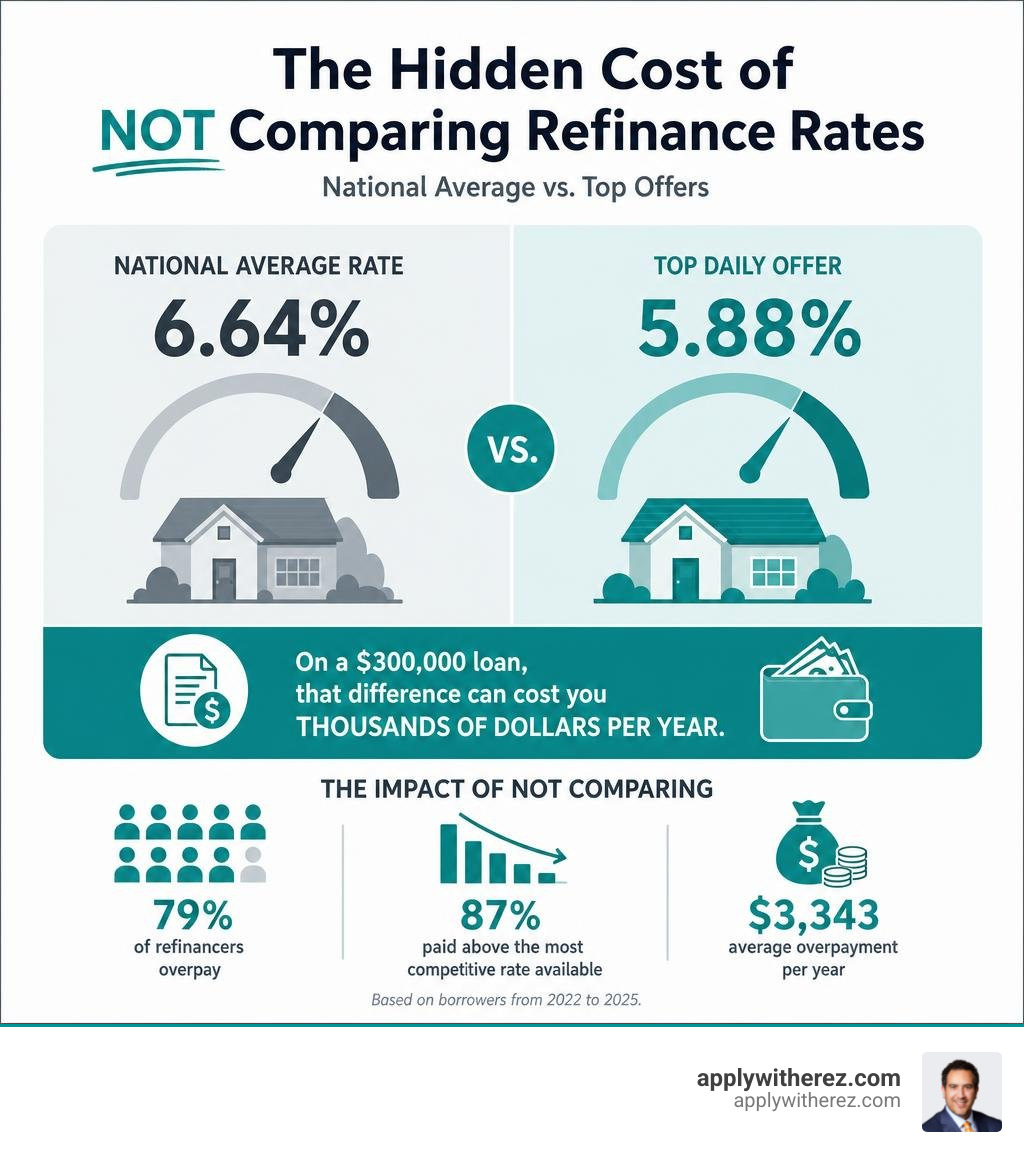
That gap between the national average (6.64%) and the top daily offer (5.88%) is not a rounding error. On a $300,000 loan, that difference can cost you thousands of dollars per year.
And most homeowners never close it.
According to recent data, 79% of refinancers overpay by skipping rate comparisons. Among borrowers from 2022 to 2025, 87% paid above the most competitive rate available — by an average of $3,343 per year. That's a quiet, ongoing drain that most people don't even realize is happening.
If you're thinking about refinancing, the most important thing to know upfront is this: the rate you see first is rarely the best rate you can get.
I'm Erez Shimoni (NMLS #460222), a mortgage broker with 26 years of experience helping homeowners navigate decisions exactly like this one — including how to evaluate Bankrate mortgage refinance rates and find the offer that actually fits your financial picture. In this guide, I'll walk you through everything you need to know to refinance with confidence, not guesswork.

To understand where bankrate mortgage refinance rates are headed, we have to look at the economic gears turning behind the scenes.
Mortgage rates don't exist in a vacuum. They are heavily benchmarked against 10-year Treasury yields, which react to inflation data and Federal Reserve policy. In May 2026, we saw inflation spike to 4.2%, and oil prices climbed past $85 per barrel. These pressures have kept mortgage rates elevated compared to the historic lows of the previous decade.
However, as we cross into July 2026, inflation has cooled slightly to 3.5%. While housing economists no longer expect rates to plunge below 6% in the immediate future without a major economic shock, the market has settled into a more stable rhythm. You can track these daily shifts directly by checking the Current Refinance Rates - Compare Rates Today | Bankrate page.
This stabilization is good news for homeowners who bought during the peak rate hikes of 2022 to 2025. If your current rate is in the mid-to-high 7s, the current market offers a genuine window of opportunity to cut your monthly overhead. To see how these broader economic forces are playing out week-by-week, take a look at the latest analysis on Mortgage Rates Stay Below 6.5% As Inflation Looms | Bankrate .
Current 30-Year, 15-Year, and ARM Benchmarks
When you browse refinance options, you'll generally find three main paths: the classic 30-year fixed, the accelerated 15-year fixed, and adjustable-rate mortgages (ARMs).
Here is how the benchmarks shape up in July 2026:
30-Year Fixed Refinance (6.74%): This remains the most popular option because it keeps your monthly payments predictable and manageable over a long timeline.
15-Year Fixed Refinance (6.09%): If you want to build equity rapidly and slash the total interest you will pay over the life of the loan, the 15-year term is highly attractive. It typically carries a rate about 10% lower than the 30-year option because the lender’s risk exposure is cut in half. You can compare daily quotes for this term on the 15-Year Refinance Rates | Compare rates today | Bankrate.com page.
5/1 ARM Refinance (6.55%): An ARM can be a strategic tool if you plan to sell or refinance again within the next five years. It offers a lower introductory rate, but you must have a clear plan for when the adjustable period kicks in. To explore these structured options further, check out Today's Adjustable-Rate Mortgage Refinance Rates | Bankrate .
How Bankrate Mortgage Refinance Rates Compare to Purchase Rates
A common question we hear at our 26 Wills Way location is: Why are refinance rates slightly higher than purchase rates?
It seems counterintuitive. After all, you already own the home, and you've proven you can make the payments. However, refinance rates generally run a bit higher than purchase rates because of how lenders evaluate risk and manage volume.
When refinance demand is elevated, lenders adjust their pricing to manage their workflow—much like a plumber who raises their rates when they are fully booked. Additionally, purchase loans are often prioritized because they have strict contractual closing deadlines, whereas refinances can take a back seat. You can see this pricing spread in real-time by comparing the Current Mortgage Rates: Compare Today's Rates | Bankrate page against refinance tables, or by reviewing the purchase averages on Compare 30-Year Mortgage Rates Today .
Analyzing the True Cost of Refinancing: APR, Points, and Fees

Many homeowners get so focused on the interest rate that they completely overlook the upfront friction of getting the loan. Refinancing isn't free. It typically costs between 2% and 5% of your total loan amount in closing costs.
On a $300,000 mortgage, that means you are looking at $6,000 to $15,000 in upfront fees. These fees include appraisals, title insurance, loan origination charges, and credit checks. To make sure you aren't caught off guard by these expenses, it is wise to study the Average Closing Costs for Cash Out Refinance so you can budget accurately.
Understanding APR vs. Interest Rate
When comparing offers, you will see two percentages: the interest rate and the Annual Percentage Rate (APR).
The interest rate is simply the cost of borrowing the principal balance. The APR, however, represents the true yearly cost of the loan because it bundles the interest rate together with lender fees, broker fees, and discount points.
If Lender A offers a 6.25% interest rate with a 6.65% APR, and Lender B offers a 6.35% interest rate with a 6.40% APR, Lender B might actually be the cheaper option because they are charging significantly lower upfront fees. Always use the APR as your primary tool for side-by-side comparisons.
The Impact of Discount Points and Closing Costs
Discount points are essentially prepaid interest. One point equals 1% of your loan amount (for example, $3,000 on a $300,000 mortgage) paid upfront at closing in exchange for a permanently lower interest rate—usually around 0.25% lower.
Buying points makes great sense if you plan to stay in your home for a long time, as the monthly savings will eventually outpace the upfront cost. However, if you plan to move or refinance again in a few years, paying for points is simply throwing money away.
For those who want to avoid out-of-pocket costs entirely, some lenders offer a "no-closing-cost" refinance, where the fees are rolled into the principal balance or traded for a slightly higher interest rate. Alternatively, if you have substantial equity, you might explore a Cash Back at Closing Refinance to handle other financial needs.
How to Determine If Refinancing Makes Financial Sense
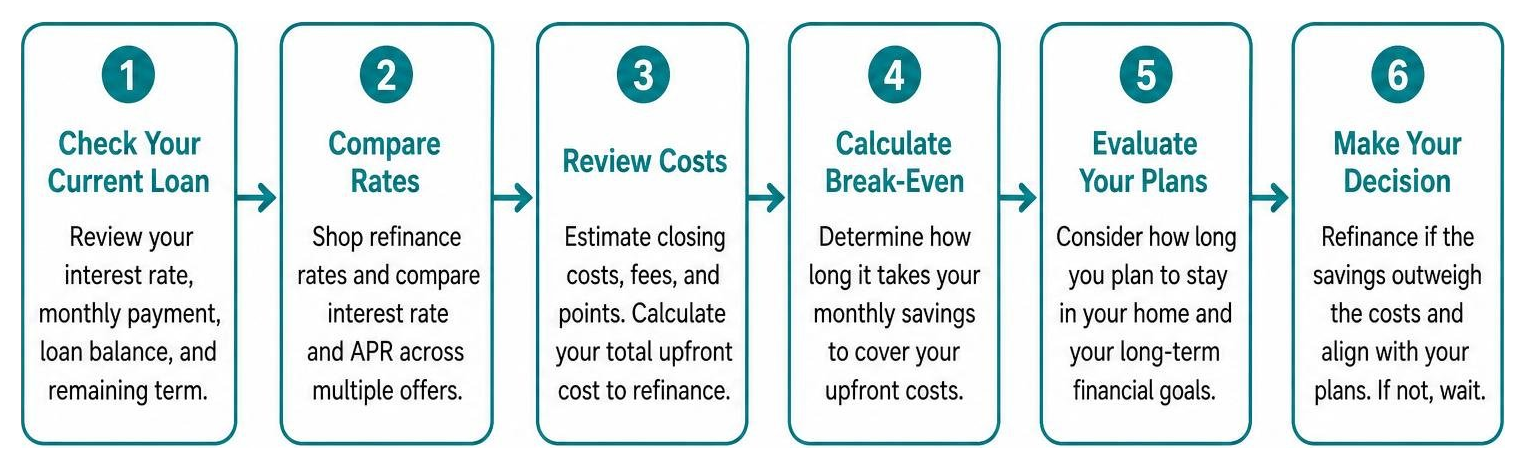
Refinancing shouldn't be a gut decision. It requires a cold, calculated look at your current terms versus what the market is offering.
Historically, the rule of thumb was to wait for a full 1.0% drop in interest rates. Today, with higher loan balances, even a 0.75% drop can provide enough monthly relief to offset the closing costs.
Right now, nearly 2.7 million homeowners could save money by refinancing at current rates. If rates drop just a bit further, that number climbs rapidly. For a deeper dive into how many people stand to benefit, read the full analysis on Nearly 2.7M Homeowners Could Save With A Refinance | Bankrate .
Before you move forward, you must verify your home equity. Lenders generally require you to hold at least 20% equity in your property to secure the most competitive rates and avoid paying Private Mortgage Insurance (PMI).
Calculating Your Break-Even Point
Your break-even point is the exact month where your cumulative monthly savings finally surpass the upfront closing costs of the loan.
The math is simple:
Total Closing Costs / Monthly Savings = Months to Break Even
For example, if your refinance costs $9,000 in closing fees and saves you $200 per month on your payment:
$9,000 / $200 = 45 months
In this scenario, it will take you 3.75 years to break even. If you plan to sell your home or relocate in 3 years, this refinance would actually cost you money rather than saving it.
To run your own scenarios, you can use the Cash Out Refinance Calculator Bankrate tool. If you are looking to extract cash for other purposes, make sure to pair your calculations with a comprehensive Cash Out Refinance Guide 2026 to understand the long-term impact on your equity.
How to Use the Platform to Find the Best Bankrate Mortgage Refinance Rates
The Bankrate platform is a powerful comparison engine, but you have to know how to navigate it to get accurate results.
When you look at the rate tables, you will see a mix of sponsored listings and local offers. Pay close attention to the "customer scores" next to each lender, which reflect real borrower experiences with communication and speed.
The "Next" buttons on the platform will guide you to input your specific zip code, credit score, and loan-to-value ratio to generate a customized quote. The generic rates displayed on the homepage assume pristine credit (740+) and a substantial equity cushion. Your actual offer will vary based on your unique financial profile.
Pros, Cons, and Alternatives to Traditional Refinancing
Every financial move has trade-offs. While refinancing can provide immediate breathing room, it is not always the best path forward for every homeowner.
Pros and Cons of Refinancing with Listed Lenders
Using a digital comparison platform to find a lender has clear advantages, but there are also pitfalls to watch out for.
Pros:
Transparency: You can compare multiple lenders side-by-side in minutes.
Competition: Lenders on these platforms know they are competing for your business, which can drive down rates.
Convenience: The digital application processes are highly streamlined.
Cons:
Bait-and-Switch Rates: The lowest advertised rates often include buying multiple discount points upfront, which might not be clear at first glance.
Customer Service Gaps: Some low-cost online lenders struggle with communication once your loan goes into underwriting.
Solitary Journey: Without a dedicated broker guiding you, it is easy to select the wrong loan product for your long-term goals.
Smart Alternatives to Home Refinancing
If the current bankrate mortgage refinance rates don't offer a clear financial benefit over your existing rate, do not force it. There are other ways to access cash or lower your interest costs without resetting your primary mortgage.
If you need cash for home renovations or debt consolidation, a Home Equity Line of Credit (HELOC) or a Home Equity Loan allows you to borrow against your equity while leaving your low-rate primary mortgage completely untouched. You can weigh these options by reading Cash Out Refinance vs Home Equity Loan and the detailed Cash Out Refinance vs Home Equity Loan Guide.
Alternatively, if your goal is simply to pay less interest over time, you can make additional principal-only payments on your current mortgage. This shortens your loan term and saves you thousands in interest without a single dollar of closing costs. For more strategies on managing your home loans, check out our Blog Category Refinance resources.
Frequently Asked Questions About Refinancing
Is it cheaper to refinance with my current lender?
Not necessarily, but it is always worth asking. Your current lender already has your file and may offer "relationship discounts" or waive certain closing costs (like the appraisal) to keep your business. However, never assume they are giving you the best deal. Always get written quotes from other sources so you have leverage to negotiate. You can also look at external options like the Refinance Rates - Today's Rates from Bank of America page to see what major institutional lenders are offering as a baseline.
Will refinancing into a new 30-year loan actually save me money?
A lower monthly payment does not automatically mean you are saving money. If you are 10 years into a 30-year mortgage and you refinance into a brand-new 30-year term, you are resetting the clock. You will be paying interest for a total of 40 years. Even with a lower interest rate, the extra decade of payments could mean you pay far more in total interest over the life of the loan. Always calculate the total lifetime interest of both options before signing.
What are the rates for a cash-out refinance?
Cash-out refinance rates are higher than standard rate-and-term refinance rates. This is because lenders view cash-out transactions as higher risk—you are increasing your debt load and shrinking your equity cushion. The risk premium varies based on your credit score and how much cash you are extracting, but you can generally expect cash-out rates to be 0.25% to 0.50% higher than traditional refinance rates.
Conclusion
Refinancing your home is one of the largest financial transactions you will ever make. While platforms like Bankrate are excellent for tracking broad market trends and checking baseline bankrate mortgage refinance rates, they cannot replace personalized, expert guidance tailored to your specific life goals.
Don't let yourself fall into the 79% of homeowners who overpay by accepting the first rate they see.
At applywitherez.com, we specialize in analyzing your entire financial picture to ensure your refinance is a true step forward, not a step backward. If you are ready to stop guessing and start saving, visit our Refinance page or explore our https://applywitherez.com/refinance platform today to connect with our team. We'll help you secure a rate that actually works for you.