FHA Rates Today: The Good the Bad and the Interest
FHA Rates Today: What You're Actually Paying in May 2026
If you're checking 30 year FHA mortgage rates today, here's the short answer:
Source Rate APR As Of FRED / Optimal Blue Index 6.125% — May 6, 2026 Mortgage News Daily (daily) 5.92% — May 6, 2026 MBA Weekly Survey 6.09% — Apr 29, 2026 Bankrate National Average 6.23% 6.28% Apr 27, 2026 The Mortgage Reports 6.291% 6.347% May 7, 2026
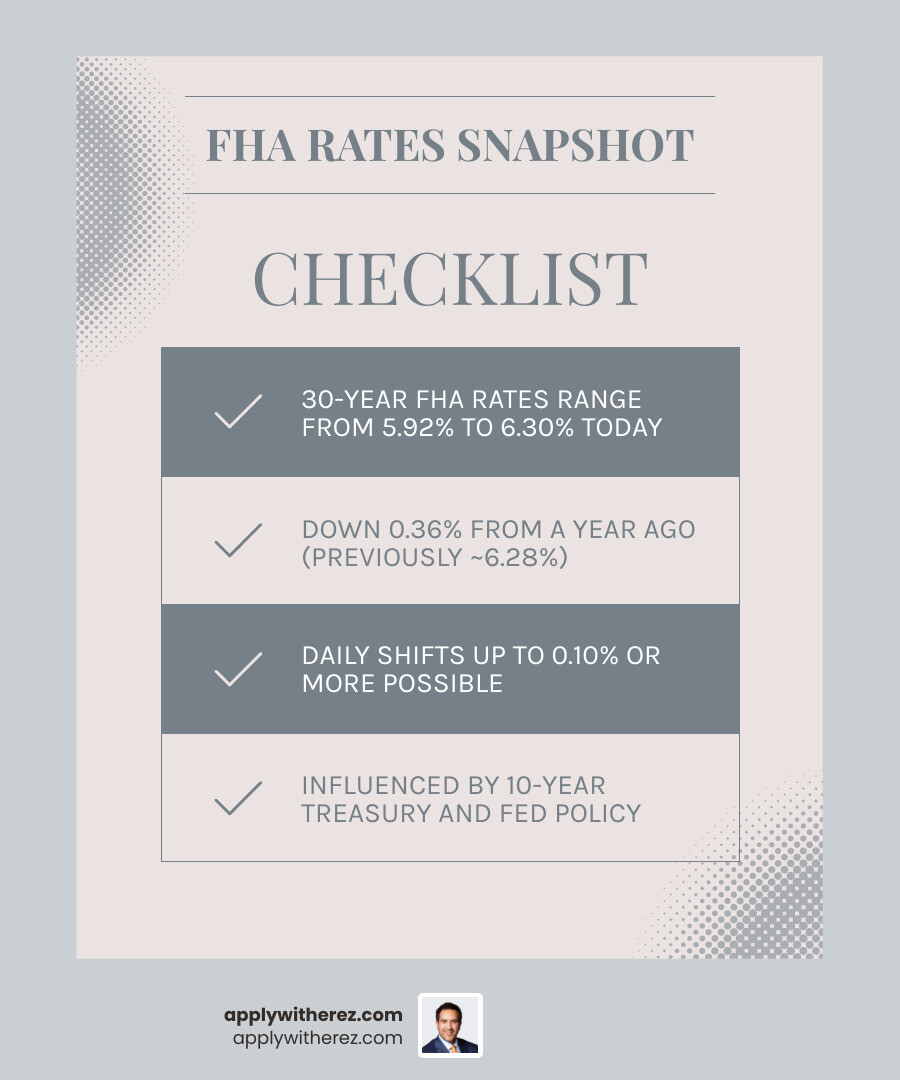
Bottom line: Depending on the lender and your borrower profile, 30-year FHA rates are currently ranging from roughly 5.92% to 6.30%. That's down about 0.36% from a year ago, when rates sat closer to 6.28% on the low end.
Rates shift daily — sometimes by 0.10% or more in a single session — so the number you see this morning may not be the same one you lock in this afternoon.
This guide walks you through everything behind those numbers: what moves them, what they'll cost you each month, and how to put yourself in the best position to qualify for the lowest rate possible.
I'm Erez Shimoni, a mortgage broker with 26 years of experience helping borrowers navigate 30 year FHA mortgage rates today and find the right loan for their situation. I'll break this all down in plain language so you can make a confident, informed decision.
Current 30 Year FHA Mortgage Rates Today
As of May 2026, the best way to think about FHA rates is as a range, not a single magic number floating in the sky like a perfectly timed open house balloon.
Here is what the latest data says:
A daily locked-rate index based on actual FHA loan locks showed 6.125% on May 6, 2026.
A daily market survey reported 5.92% for 30-year FHA on May 6, 2026, down 0.10% from the previous day.
A weekly survey showed 6.09% with 0.71 points as of April 29, 2026.
Other published market averages clustered around the low-6% range, with APRs generally above the note rate once fees and mortgage insurance are factored in.
That spread matters. A quoted rate is not always the rate most borrowers will actually get, and a rate is not the same thing as an APR.
Rate = the interest charged on the loan balance
APR = the broader cost of borrowing, including certain fees and insurance-related costs
For FHA borrowers, APR often runs noticeably higher than the note rate because FHA loans include mortgage insurance. That is one reason two loans with similar rates can have different true costs.
If you want to track live market movement, one useful external reference is FHA Mortgage Rates - 30 Year Fixed.

A few practical takeaways for today:
FHA rates are generally still competitive in May 2026.
Daily movement is real, not theoretical.
Your personal rate may differ based on credit score, debt, down payment, and pricing adjustments.
FHA mortgage insurance can make the payment feel higher than the headline rate suggests.
So when someone asks, "What are the current 30-year FHA mortgage rates as of today?" our honest answer is this: most current data points place them around 5.92% to 6.30%, with 6.125% a strong benchmark from actual lock data.
How FHA Loans Compare to Other Mortgage Types
FHA loans are often compared with conventional loans first, but they also compete with VA, USDA, and shorter-term fixed products depending on the borrower.
In general:
FHA rates are often lower than conventional rates for borrowers with moderate credit
VA rates can be lower than FHA for eligible military borrowers
USDA can also be attractive for eligible rural properties
Conventional loans may win on total cost if the borrower has stronger credit and enough down payment
Here is the simple comparison:
Loan Type Typical Rate Position Down Payment Credit Flexibility Mortgage Insurance FHA 30-year fixed Often lower than conventional for lower-score borrowers 3.5% minimum in many cases More flexible UFMIP + annual MIP Conventional 30-year fixed Can be better for strong-credit borrowers Often 3% to 5% minimum Less flexible than FHA PMI may be removable VA 30-year fixed Often among the lowest for eligible borrowers 0% possible Flexible for eligible borrowers No monthly FHA-style MIP USDA 30-year fixed Competitive for eligible areas 0% possible Moderate flexibility Guarantee fee structure 15-year fixed Lower rate than 30-year usually Varies Depends on program Higher monthly payment, less total interest
The big tradeoff is this:
FHA is easier to qualify for
Conventional may be cheaper long term if your credit is stronger
That is because FHA is designed to widen access to homeownership. The loan program helps borrowers who may not fit the clean, tidy, ultra-high-credit conventional box. But that flexibility comes at a price, mostly in the form of mortgage insurance.
If you are comparing options, it helps to run side-by-side numbers with a Calculator. A lower rate does not always mean a lower monthly payment once insurance is included.
Eligibility and the True Cost of FHA Borrowing
FHA loans are popular because the entry requirements are more forgiving than many alternatives.
At a basic level, here are the most widely cited minimums:
580+ credit score: can qualify with as little as 3.5% down
500 to 579 credit score: may qualify with 10% down
Those are program-level minimums. A lender may apply stricter standards, and your overall file still matters. Income, employment, debt-to-income ratio, reserves, and property eligibility all affect approval.

But the real headline is not just eligibility. It is cost.
FHA mortgage insurance: the part borrowers need to notice
FHA loans typically include:
Upfront Mortgage Insurance Premium (UFMIP): 1.75%
Annual Mortgage Insurance Premium (MIP): typically 0.80% to 1.05%
The upfront premium is usually financed into the loan rather than paid out of pocket. The annual premium is divided into monthly installments and added to the payment.
That means FHA borrowing has two layers of cost:
Interest
Mortgage insurance
Here is a simple example using a $350,000 purchase with 3.5% down:
Purchase price: $350,000
Down payment: $12,250
Base loan amount: $337,750
UFMIP at 1.75%: about $5,911
New loan amount if financed: about $343,661
At a note rate near 6.125%, principal and interest on the financed balance lands around the low-$2,000s monthly. Then you add monthly MIP, plus taxes and homeowners insurance.
That is why FHA can feel surprisingly expensive even when the interest rate looks reasonable.
Important cost reminders:
Monthly payment estimates published online often exclude taxes and homeowners insurance
FHA MIP raises the all-in monthly housing cost
APR is often a better comparison tool than rate alone
Conventional loans may become cheaper over time if PMI can later be removed
If you are comparing affordability, our Calculator can help you estimate the difference between interest-only thinking and real-world payment math.
Market Trends and Economic Influences
Rates do not move randomly. They react to the broader economy, bond markets, inflation expectations, and mortgage-backed securities pricing.
In May 2026, one of the more notable trends is that FHA rates are modestly lower than a year ago.
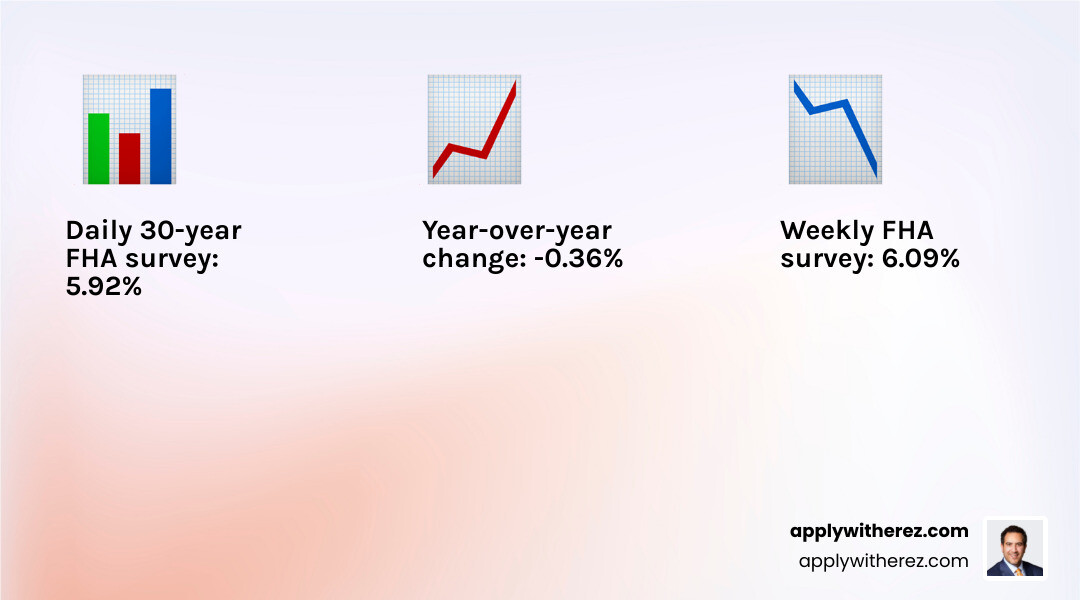
Daily 30-year FHA survey: 5.92%
Same reading a year earlier: 6.28%
Year-over-year change: -0.36%
Weekly survey data also showed a year-over-year drop:
Weekly FHA survey: 6.09%
Prior year: 6.56%
Year-over-year change: -0.47%
This does not mean rates are low in an absolute sense. It means they are somewhat improved relative to the tougher levels borrowers faced a year earlier.
Economic Drivers of 30 Year FHA Mortgage Rates Today
Several forces shape 30 year FHA mortgage rates today:
1. Inflation
When inflation stays elevated, mortgage rates tend to remain under pressure. Investors demand more yield to compensate for reduced purchasing power.
2. Federal Reserve policy
The Fed does not set mortgage rates directly, but its policy decisions influence the broader rate environment. Changes in short-term rates, guidance, and market expectations all ripple through the mortgage market.
3. Treasury yields
The 10-year Treasury is a major benchmark. Mortgage rates do not mirror it exactly, but they often move in the same general direction.
4. Mortgage-backed securities pricing
Mortgage loans are packaged into securities. When investor demand for mortgage-backed securities improves, consumer mortgage rates may fall. When demand weakens, rates can rise.
5. Market liquidity and risk appetite
In uncertain markets, lenders may widen margins. That can push offered rates or points higher even without a dramatic move in Treasury yields.
6. Housing demand and lender capacity
Strong buyer demand or swings in refinance activity can affect pricing. Lenders adjust based on pipeline volume, staffing, and competitive conditions.
For borrowers watching the market, timing matters. So does strategy. If rates drop enough, a later Refinance could make sense, especially for buyers who used FHA to get into a home sooner rather than later.
Historical Context of FHA Rate Volatility
Recent history shows why shoppers should pay attention to both daily and weekly data.
The daily market survey moved from 6.02% to 5.92% over one day in early May 2026. That is not a rounding error. Over a large loan, a tenth of a percent can change the monthly payment and long-term interest cost.
The weekly survey sat at 6.09% with 0.71 points. Points matter because they represent upfront cost paid to get a specific rate. A loan with a lower note rate but higher points is not automatically the better deal.
Historical context teaches three lessons:
Mortgage rates can move quickly
Daily averages and weekly averages may not match
Locked rates based on actual transactions can differ from public quote surveys
In other words, the market is not one number. It is a moving target wearing business casual.
Frequently Asked Questions about FHA Loans
How to Secure the Best 30 Year FHA Mortgage Rates Today
Getting the best FHA rate is partly about the market and partly about your borrower profile.
Here is how we recommend improving your odds:
Improve your credit score
Even though FHA allows lower scores, better credit usually gets better pricing. A score above the minimum can reduce rate pressure and improve lender options.
Lower your debt-to-income ratio
If too much of your monthly income is already committed to debts, lenders may see you as a higher-risk borrower. Paying down credit cards or installment debt can help.
Save beyond the minimum down payment
FHA allows low down payments, but bringing in more funds can improve your overall file and lower the financed amount.
Compare rate structure, not just the headline
Ask for:
Interest rate
APR
Points
Lender fees
Estimated monthly MIP
Total monthly payment
Watch timing and lock wisely
Rates can change midday. If you are under contract and the payment works, a lock may protect you from market swings.
Keep documentation clean
Stable income, verified assets, consistent employment, and prompt responses can all help the process move more smoothly.
If your long-term goal is payment relief, it is also smart to monitor future Refinance opportunities after closing.
What are the monthly payments for a 30-year FHA loan?
Monthly payment depends on five big pieces:
Loan amount
Interest rate
Loan term
Monthly FHA mortgage insurance
Property taxes and homeowners insurance
Here are rough examples using a 30-year FHA loan at around 6.125%, with 3.5% down, financed UFMIP, and excluding taxes and homeowners insurance unless noted otherwise. These are estimates, not quotes.
Example 1: $250,000 home price
Down payment: $8,750
Base loan: $241,250
Financed UFMIP: about $4,222
Total loan: about $245,472
Estimated principal and interest: about $1,490 per month
Estimated monthly MIP: roughly $160 to $175
Estimated total before taxes and homeowners insurance: about $1,650 to $1,665
Example 2: $350,000 home price
Down payment: $12,250
Base loan: $337,750
Financed UFMIP: about $5,911
Total loan: about $343,661
Estimated principal and interest: about $2,085 per month
Estimated monthly MIP: roughly $225 to $245
Estimated total before taxes and homeowners insurance: about $2,310 to $2,330
This aligns with the kind of pricing examples seen in the market, where a $350,000 FHA loan can show a rate in the high-5% to low-6% range but an APR materially higher.
Example 3: $450,000 home price
Down payment: $15,750
Base loan: $434,250
Financed UFMIP: about $7,599
Total loan: about $441,849
Estimated principal and interest: about $2,680 per month
Estimated monthly MIP: roughly $290 to $315
Estimated total before taxes and homeowners insurance: about $2,970 to $2,995
Once you add taxes and insurance, the real payment can jump several hundred dollars more depending on the property.
That is why we always recommend using a payment tool before you shop at the very top of your budget. Our Calculator can help you test different purchase prices and monthly payment scenarios.
When is an FHA loan better than a conventional loan?
FHA can be the better choice when:
Your credit is decent but not ideal
Borrowers with scores closer to the minimum often get more favorable treatment through FHA than through conventional pricing models.
You have limited savings
The 3.5% down option is one of FHA's biggest advantages.
You need more flexible underwriting
FHA is often more forgiving with past credit issues, higher debt ratios, or less-than-perfect borrower profiles.
You want to buy sooner
Sometimes FHA is the bridge to homeownership when waiting for conventional eligibility would mean missing a year or two of opportunity.
But conventional may be better when:
You have stronger credit
You can put more money down
You want mortgage insurance that may eventually be removed
You want lower long-term total borrowing costs
The answer is not "FHA is better" or "conventional is better." The answer is "better for whom?"
For many first-time buyers, FHA is the practical choice. For stronger-credit buyers, conventional may win on lifetime cost. For eligible veterans, VA may outperform both. The best loan is the one that matches your current finances and your next few years, not just your hopes and vibes.
If you are exploring other loan goals as well, you can also review our resources on Reverse Mortgage and the New Reverse Mortgage Calculator.
Conclusion
In May 2026, 30 year FHA mortgage rates today are generally landing in the neighborhood of 5.92% to 6.30%, with a widely cited locked-rate index at 6.125%. That is somewhat lower than a year ago, but still high enough that every fraction of a percent matters.
The good:
FHA loans remain accessible
Rates are competitive
Qualification standards are flexible
The bad:
Mortgage insurance increases the real cost
APR can be meaningfully higher than the note rate
Daily volatility means timing matters
And the interest - yes, literally:
Even a small rate change can affect monthly payment
The total cost of borrowing depends on more than the rate headline
Comparing FHA with conventional and refinance options is essential
If you want help making sense of today's market and deciding whether FHA is the right move, we are here to help. When the numbers line up, the right loan can get you into a home without turning your monthly payment into a jump scare.
Ready to explore your next step? Get Started with Refinancing