A Practical Guide to Finding a Qualified Commercial Loan Broker
Find the Right Commercial Property Loan Broker for Your Deal
A commercial property loan broker helps you find and compare financing for a commercial real estate purchase, refinance, construction project, or renovation. To choose a qualified broker, look for one who understands your property type, can explain lender options and loan terms clearly, discloses all fees in writing, and has relationships with lenders that fit your deal.
Unlike a bank, a broker does not usually lend its own money. Instead, they package your loan request and connect you with suitable banks, credit unions, agency lenders, life insurance companies, SBA lenders, CMBS lenders, or private debt funds. That can be especially helpful when the best fit depends on your timeline, leverage needs, property cash flow, and whether you can accept personal recourse.
Commercial lending conditions in August 2026 remain highly lender-specific. A strong broker can help you compare more than the headline rate, including loan-to-value, debt service coverage requirements, fees, prepayment terms, guarantees, and the lender's likelihood of closing.
I am Erez Shimoni, a mortgage professional with 26 years of industry experience serving borrowers in New Jersey, New York, Pennsylvania, and Florida. As a commercial property loan broker, I focus on making financing choices clear through hands-on guidance, modern tools, and straightforward explanations as we move into the loan options ahead.
What Is a Commercial Property Loan Broker and How Do They Work?
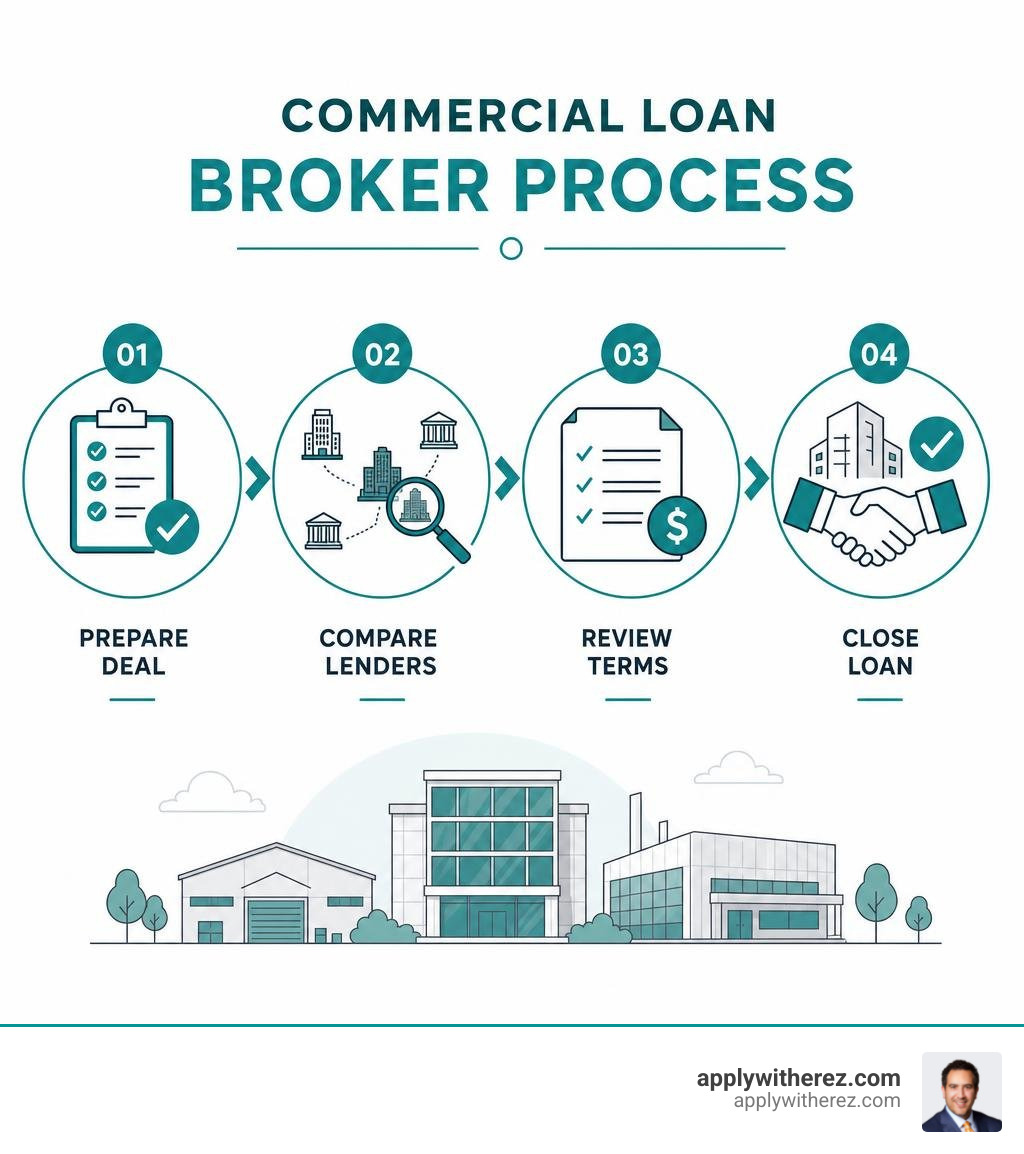
In commercial real estate, securing the right capital is rarely as simple as walking into your local retail bank branch and filling out a generic application. Commercial financing involves complex capital structures, distinct risk appetites, and diverse lending sources. A commercial loan broker acts as an independent financial intermediary who represents your interests to assemble the optimal capital stack for your real estate assets.
Rather than offering a single proprietary loan program, an intermediary evaluates the entire debt marketplace. We analyze your asset's financial performance, determine the proper leverage, model expected debt service coverage ratios, and present your financing package to institutional and private capital providers whose lending parameters directly match your deal.
Feature | Direct Lenders (Banks & Credit Unions) | Commercial Mortgage Intermediaries |
|---|---|---|
Product Selection | Proprietary internal loan menu only | Access to thousands of diverse capital sources |
Capital Sources | Balance sheet deposits | Banks, debt funds, life cos, agencies, CMBS |
Recourse Options | Frequently mandates full personal recourse | Sources both recourse and non-recourse structures |
Leverage Limits | Strict internal caps (often 60%–70% LTV) | Flexible leverage options (up to 75%–90% LTC/LTV) |
Underwriting Focus | Standard borrower balance sheet & tax returns | Net Operating Income (NOI), Debt Yield, and DSCR |
Speed & Agility | Slower credit committees (60–90+ days) | Expedited execution pipelines (30–45 days) |
The Intermediary Role in Real Estate Financing
Commercial real estate transactions rely on strategic debt advisory rather than automated credit scoring. When you partner with a seasoned commercial real estate mortgage broker, our team translates complex property financial data into clear, institutional-grade debt offering memorandums.
We highlight the property's strengths, mitigate operational concerns, and deliver your deal directly to key decision-makers. This structured positioning ensures that lenders compete for your financing mandate, driving down spreads and eliminating unfavorable terms.
Direct Lenders vs. Mortgage Intermediaries
Direct lenders are constrained by portfolio concentration limits, geographic lending boundaries, and strict regulatory capital rules. If a regional bank in New York or New Jersey already holds too much exposure in industrial warehouses or multifamily assets, they will either reject your application outright or quote wide interest rate spreads with conservative loan-to-value constraints.
In contrast, an independent debt intermediary operates across regional banks, credit unions, private debt funds, agency programs, and life insurance companies throughout New York, New Jersey, and Pennsylvania. If one lending bucket is full, we pivot your deal to liquid capital sources with active deployment targets.
Core Real Estate Loan Structures Sourced by Debt Advisors
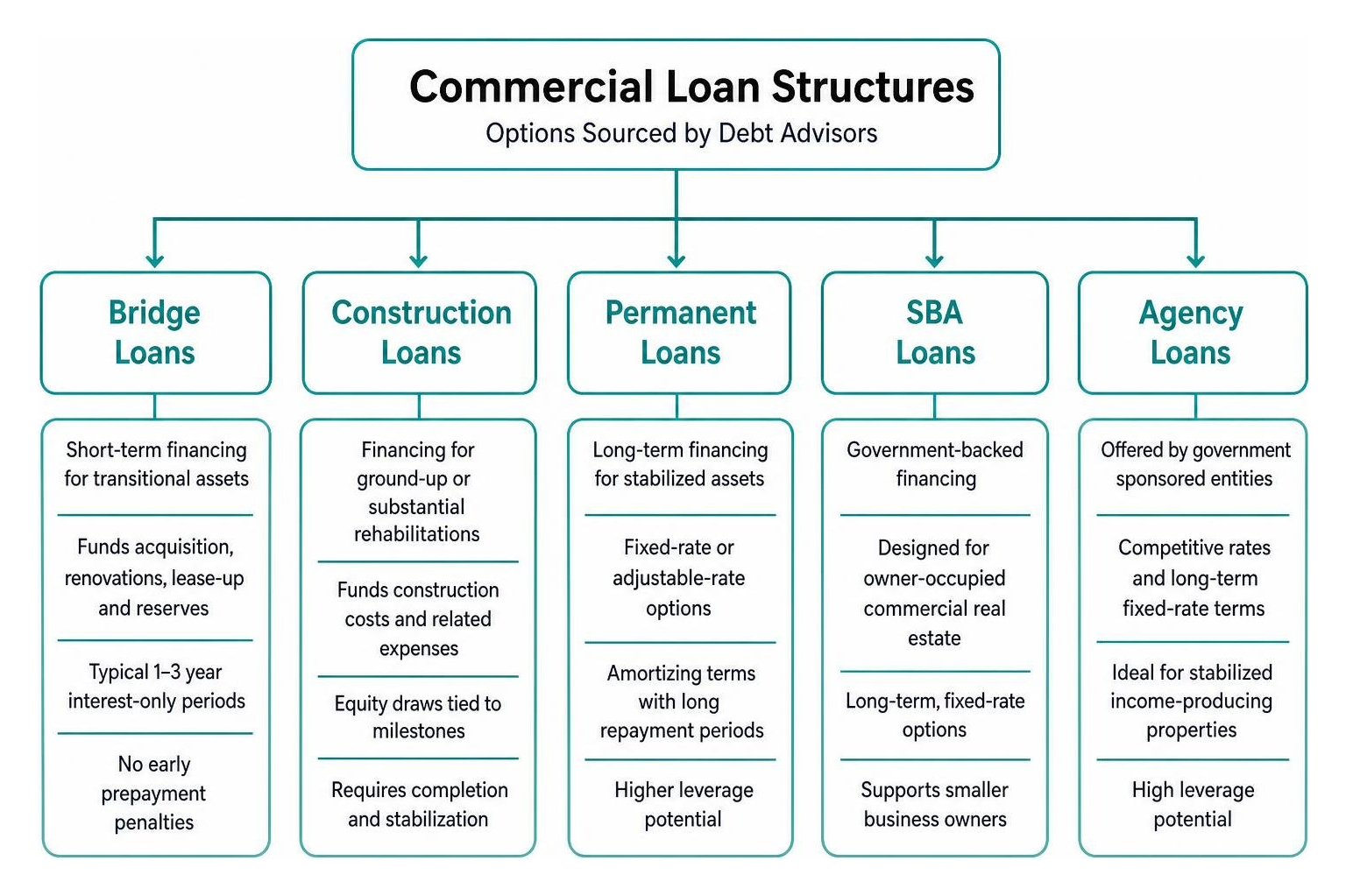
Every real estate strategy requires a specific debt instrument. Sizing a loan correctly means balancing debt yields, amortization windows, interest-only options, and leverage caps.
Structuring Bridge, Construction, and Permanent Debt
Transitional assets undergoing renovations, repositioning, or tenant lease-ups require specialized short-term liquidity. Sourcing a competitive bridge loan real estate structure allows sponsors to fund total project costs—including the purchase price, capital expenditures, tenant improvement allowances, and interest reserves—without facing early prepayment penalties. Working with specialized bridging loan brokers ensures you obtain flexible 1-to-3-year interest-only periods that provide the runway needed to stabilize the property before transitioning into long-term permanent debt.
For ground-up developments or substantial rehabilitations, debt advisors arrange construction-to-perm facilities. These facilities balance equity draws, pre-leasing requirements, and completion milestones before automatically converting into fixed-rate mini-perm or permanent financing upon stabilization.
Navigating SBA 504, Agency, and CMBS Options
For owner-occupied commercial properties—such as medical facilities, industrial warehouses, and corporate headquarters—Small Business Administration (SBA) programs offer significant leverage:
SBA 504 Loans: Combine a 50% conventional first mortgage from a certified lender with a 35%–40% second debenture backed by the SBA, requiring as little as 10%–15% equity injection from the borrower for up to 90% financing.
Agency Multifamily Debt: Fannie Mae and Freddie Mac programs deliver non-recourse permanent financing for stabilized residential properties containing five or more units, offering up to 80% LTV and 30-year amortizations.
CMBS Conduit Loans: Commercial Mortgage-Backed Securities provide fixed-rate, non-recourse debt starting at $2 million for stabilized retail, office, hospitality, and mixed-use assets, structured with 5- to 10-year balloon maturities based on 25- to 30-year amortization schedules.
How a Commercial Property Loan Broker Adds Value to Your Deal

A broker does more than forward documents; we create competitive tension among lenders to secure optimal pricing, higher leverage, and lower reserve requirements.
Capital Matching and 2026 Market Spreads
In the August 2026 financing environment, commercial real estate benchmarks require active monitoring. With the 10-year Treasury yield, the Prime Rate, and the 1-Month Term SOFR establishing baseline capital costs, lender spreads can vary significantly from one institution to the next.
By matching your asset to active capital sources across New York, New Jersey, and Pennsylvania, debt advisors secure tighter credit spreads, eliminate hidden yield maintenance traps, and secure favorable interest rate lock milestones before credit market fluctuations erode project margins.
Recourse vs. Non-Recourse Debt Structuring
Risk allocation is a central priority for commercial real estate owners. Debt advisors help you navigate between recourse and non-recourse structures:
Recourse Debt: Requires the borrower and individual guarantors to provide full personal guarantees. If the loan defaults, the lender can pursue personal assets beyond the underlying real estate. Banks frequently require full recourse in exchange for lower interest rates or higher advance rates on smaller middle-market assets.
Non-Recourse Debt: Restricts the lender’s recovery strictly to the property itself and its revenues in the event of default. The sponsor’s personal balance sheet is insulated, subject only to standard "bad boy" carve-out provisions (which trigger personal liability for fraud, voluntary bankruptcy, material misrepresentation, or environmental contamination).
We ensure that carve-out guarantor requirements remain fair, reasonable, and aligned with your operational business plan.
Fee Structures, Timelines, and Closing Schedules
Understanding commercial mortgage compensation models and realistic closing schedules ensures full transparency from engagement to funding.
Broker Compensation Models and Points
Commercial mortgage brokers earn compensation through structured origination fees, typically ranging between 0.50% and 1.50% of the gross loan amount depending on the deal's size and complexity. For large institutional placements ($10M+), fees routinely compress to 0.50%–0.75%, whereas middle-market or complex transitional bridge requests ($1M–$5M) standardly carry 1.00% to 1.50% origination points.
Reputable intermediaries operate on success-based models where broker compensation is disbursed directly at the closing table through standard settlement statements. All advisory fees should be clearly disclosed in writing within an initial mandate or engagement agreement.
Intake to Funding Execution Timelines
Navigating the commercial underwriting pipeline requires disciplined project management across multiple third-party reports.
Intake and Sizing (Days 1–7): Property financial analysis, debt yield calculations, pro-forma modeling, and debt memorandum assembly.
Lender Outreach and Term Sheets (Days 8–14): Sourcing competing quotes, negotiating covenants, and executing the chosen lender term sheet.
Underwriting and Third-Party Due Diligence (Days 15–35): Ordering the commercial appraisal, Phase I Environmental Site Assessment (ESA), property condition reports, and title searches.
Loan Committee and Closing (Days 36–45): Final credit committee approval, loan document drafting, clearing closing conditions, and wire disbursement.
How to Vet and Choose the Right Commercial Property Loan Broker
Selecting the wrong intermediary can cost you months of deal momentum, earnest money deposits, and rate-lock windows.
Essential Vetting Criteria and Key Questions to Ask
Before signing an advisory mandate, evaluate the broker's direct track record and operational depth:
Lender Network Breadth: Do they have direct access to life insurance companies, balance-sheet banks, debt funds, and agency lenders across New York, New Jersey, and Pennsylvania?
Property Type Specialization: Does the broker have hands-on experience structuring debt for your specific asset class (e.g., multifamily, industrial, mixed-use, retail, or hospitality)?
Underwriting Capabilities: Do they build custom in-house financial models, calculate debt yield thresholds, and draft comprehensive debt memorandums, or do they simply mass-blast generic summaries?
Transaction Alignment: If you are coordinating with real estate sales teams, working with an experienced estate agent mortgage advisor can help align purchase contract timelines with realistic loan underwriting requirements.
Documentation Packaging and Underwriting Preparation
To accelerate loan approval, compile a lender-ready data package before launching outreach:
Property Operating Statements: Trailing 12-month (T-12) Profit & Loss statements and past 2–3 years of property tax returns.
Certified Rent Roll: Unit-by-unit breakdown including tenant names, lease terms, square footage, base rents, reimbursements, and expiration dates.
Sponsor Financials: Personal Financial Statements (PFS), schedule of real estate owned (SREO), liquidity verification, and entity organizational charts.
Capital Improvement History: Detailed summary of recent capital expenditures, property renovations, or proposed value-add budgets.
Frequently Asked Questions About Commercial Property Financing
What Debt Service Coverage Ratio (DSCR) do lenders require in 2026?
Most commercial lenders require a minimum Debt Service Coverage Ratio (DSCR) between 1.20x and 1.35x on stabilized properties. This means the property's annual Net Operating Income (NOI) must exceed annual principal and interest payments by 20% to 35%.
Agency multifamily programs may allow DSCRs down to 1.20x in strong primary markets, whereas transitional assets or commercial properties with shorter lease terms often require 1.30x to 1.40x coverage cushions.
How much do commercial property loan brokers charge in fees?
Commercial mortgage broker fees generally range from 0.50% to 1.50% of the total loan amount. The fee is established by the complexity of the loan structure and the total transaction volume. Most qualified brokers operate on a success-fee basis, where origination points are paid at closing directly from loan proceeds, with zero upfront application or evaluation fees.
How long does the commercial mortgage underwriting process typically take?
A typical commercial real estate loan closes within 30 to 60 days from term sheet execution. Private bridge loans and debt fund facilities can close in as little as 15 to 30 days when third-party reports are expedited.
Conversely, complex bank, CMBS, or agency executions standardly require 45 to 60 days to complete property appraisals, environmental site reviews, title examinations, and final loan committee authorizations.
Conclusion
Finding the right financing structure for your commercial real estate project requires transparent guidance, broad capital access, and thorough underwriting preparation. Navigating today's lending environment across New York, New Jersey, and Pennsylvania means looking beyond headline rates to optimize loan-to-value limits, covenants, recourse exposures, and closing certainty.
Whether you are acquiring a multifamily building, refinancing an industrial warehouse, or repositioning a mixed-use commercial property, our team is here to help you structure competitive financing tailored to your goals.
Ready to review loan options for your property? Book a call with our advisory team today, or visit applywitherez.com to submit your scenario and start your financing evaluation.