
Commercial Mortgage Banking: Expert Solutions for Complex Loans
Why Working With a Commercial Real Estate Mortgage Broker Can Make or Break Your Deal
A commercial real estate mortgage broker is a licensed intermediary who connects borrowers with lenders to secure financing for income-producing and owner-occupied properties.
Quick answer — what a commercial mortgage broker does:
Shops your loan across dozens or hundreds of lenders at once
Structures your deal to meet lender requirements
Negotiates rates, terms, and loan size on your behalf
Guides you from initial inquiry through closing
Saves you time by managing lender communications and paperwork
Whether you're buying a multifamily building, refinancing a retail center, or funding a ground-up development, the right broker gives you access to loan programs that most borrowers can't find on their own. With networks reaching 900+ commercial lenders and hundreds of thousands of available loan programs in today's market, the gap between going direct and using a broker has never been wider.
Commercial real estate financing is complex. Rates, leverage, and lender appetite shift constantly — and in May 2026, borrowers are navigating a challenging environment of tighter credit, a looming refinancing wave, and uneven lender activity across property types. The stakes are high, and the wrong financing decision can cost you a deal.
I'm Erez Shimoni (NMLS #460222), a mortgage broker with 26 years of industry experience helping borrowers navigate complex financing — including commercial real estate mortgage broker services across multiple states. My hands-on, educational approach ensures you understand every option before you commit, so let's break down exactly how this works.
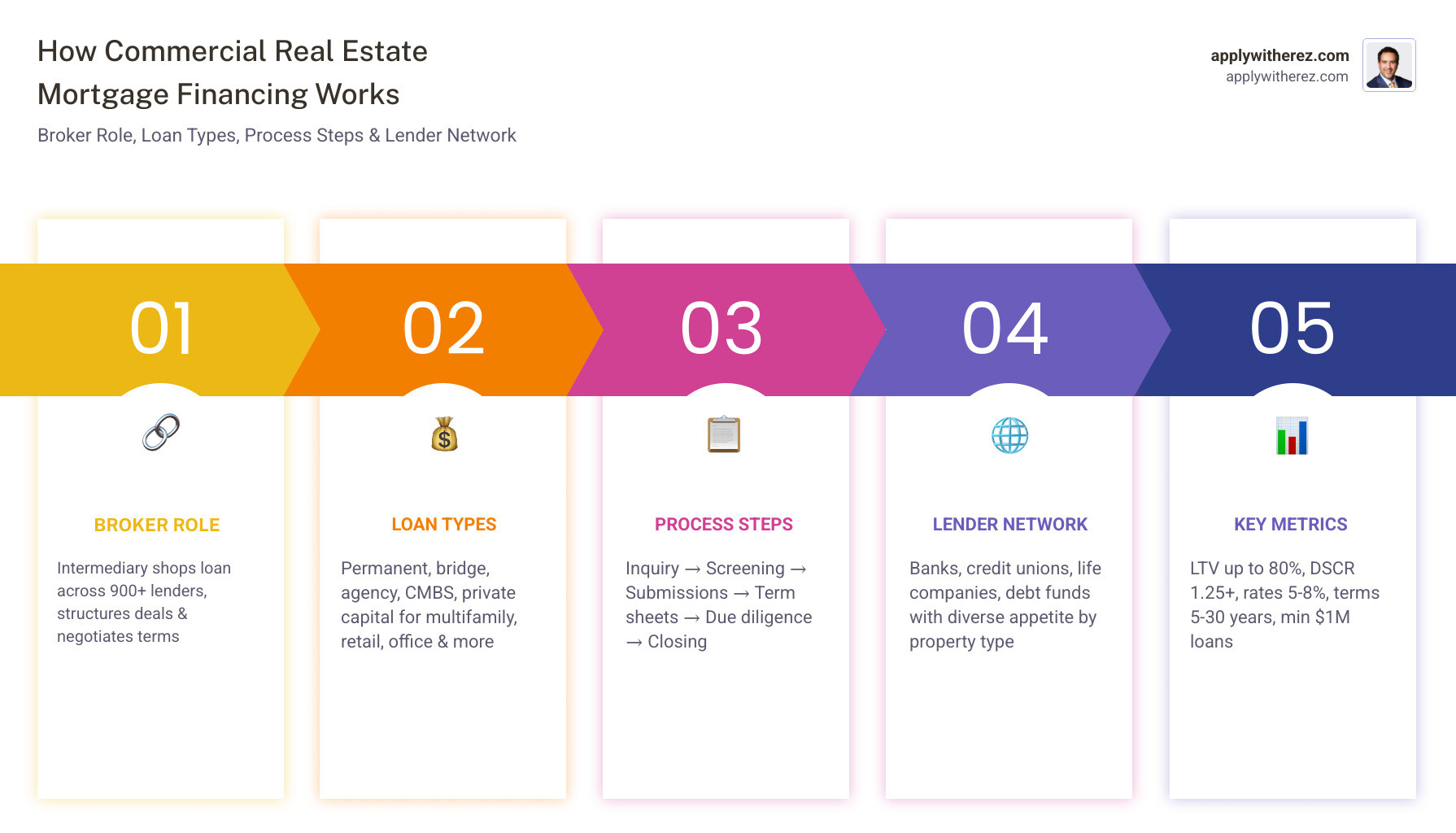
What a Commercial Real Estate Mortgage Broker Does
A commercial mortgage broker sits between borrower and lender, but that simple description undersells the job. In practice, we help shape the financing strategy, package the deal, identify the right capital source, and keep the transaction moving when commercial loans start acting like commercial loans, which is to say: rarely in a straight line.
What Is a Commercial Real Estate Mortgage Broker?
A commercial real estate mortgage broker is an intermediary who helps borrowers secure financing for commercial properties. We are not the bank funding the loan. Instead, we work across a lender network to find options that fit the property, borrower profile, timeline, and business plan.
That can include:
Bank loans
Credit union financing
Agency debt
Bridge loans
CMBS loans
Life company loans
Private capital
Small-balance commercial loans
Our role is part advisor, part analyst, part negotiator, and part project manager. We look at the deal the way lenders will look at it, then position it for the best possible execution.
Broker vs. Direct Lender: Key Differences
The biggest difference is choice.
A direct lender can offer only its own products. A broker can compare multiple lenders and structures. Sometimes going direct is fine, especially if you already know a lender is the right fit. But if your deal is complex, time-sensitive, or doesn't fit a plain-vanilla credit box, a broker often adds real value.
Factor Commercial Mortgage Broker Direct Lender Loan options Multiple lenders and programs One lender's products Flexibility High, especially for unique deals Limited to internal guidelines Pricing comparison Can compare quotes side by side No built-in comparison Property fit Can target lenders by asset type Depends on lender appetite Execution strategy Tailored across capital sources Single-lender approach Speed Fast once package is complete Can be fast if clear fit exists Certainty Improves with better lender matching Strong if lender already likes deal
A good broker does not just blast a file everywhere. We shortlist lenders strategically. Too many submissions can hurt a deal. Smart placement beats loud placement.
Services Brokers Typically Provide
Most borrowers think the broker's job is "getting rates." That's part of it, but the full service list is much broader.
Typical services include:
Initial deal screening and prequalification
Preliminary loan sizing
Cash flow and DSCR review
Guidance on LTV, debt yield, and recourse expectations
Loan package preparation
Lender outreach and quote collection
Term sheet comparison
Structuring guidance for entities, guarantors, and reserves
Coordination of appraisal, environmental, and other due diligence
Communication with attorneys, escrow, title, and lender teams
Refinance and maturity payoff strategy
For borrowers, this means less chaos and fewer surprises. For lenders, it means receiving a cleaner, more complete request. Everyone wins, and nobody has to explain a missing rent roll for the fifth time.

Property Types and Loan Programs Brokers Arrange
Commercial lending is not one market. It is many small markets wearing the same trench coat. The lender that loves self-storage may hate hospitality. The lender offering great multifamily terms may avoid mixed-use. Matching property type to lender appetite is one of the biggest reasons borrowers use a broker.
Property Types Commonly Financed by a Commercial Real Estate Mortgage Broker
A commercial real estate mortgage broker may arrange financing for a wide range of asset types, including:
Multifamily
Retail centers
Industrial buildings and warehouses
Office buildings
Mixed-use properties
Medical office
Hospitality and hotels
Self-storage
Owner-user commercial properties
Affordable housing
Student housing
Seniors housing and healthcare-related assets
In the broader industry, multifamily remains one of the most active sectors, while office continues to face more lender caution in 2026. Industrial and select retail can still attract strong interest, depending on location, tenancy, lease rollover, and sponsorship strength.
Core Loan Programs: Permanent, Bridge, Agency, CMBS, and Private Capital
Here are the main categories of financing we typically help arrange:
Permanent loans
These are longer-term loans used for stabilized properties. They often feature fixed rates, amortization, and lower-cost capital than short-term bridge debt.
Best for:
Stabilized multifamily
Retail and industrial with strong occupancy
Long-term holds
Refinance of existing debt
Bridge loans
Bridge loans are shorter-term loans designed for transition. They are common when a property needs lease-up, renovation, repositioning, or a quick close.
Best for:
Value-add deals
Properties with vacancy or operational issues
Time-sensitive acquisitions
Borrowers planning to refinance later
Agency debt
Agency execution is commonly used for qualifying multifamily and certain housing-related properties. In the current market, agency lending remains important because it can provide competitive terms for eligible assets.
Best for:
Stabilized multifamily
Affordable housing
Certain seniors housing or specialized housing assets
CMBS loans
CMBS financing can offer fixed-rate, non-recourse structures for larger stabilized properties. These loans can work well, but borrowers need to understand servicing and prepayment restrictions.
Best for:
Larger loan amounts
Stabilized cash-flowing assets
Borrowers comfortable with a more rigid structure
Bank and credit union loans
These can be excellent for owner-occupied properties, relationship banking, and smaller-balance deals. Local institutions may also be more flexible on certain structures.
Best for:
Owner-user properties
Smaller commercial transactions
Borrowers seeking relationship-based financing
Life company loans
Life company lenders often target larger, lower-leverage, high-quality properties and borrowers seeking long-term stability.
Private capital and debt funds
These lenders can move quickly and handle complexity, but pricing is usually higher. They are often useful when traditional lenders hesitate.
Construction and mezzanine debt
For ground-up projects or layered capital stacks, these structures may be part of the solution, especially when senior debt alone does not meet total funding needs.
Typical Loan Terms, Rates, LTVs, and Minimum Loan Sizes
Commercial loan terms vary widely by property and lender, but here are the general ranges borrowers should expect in May 2026:
Amortization: often 20 to 30 years
Loan term: 3, 5, 7, 10 years, or longer for some programs
Rate structure: fixed or floating
Recourse: can be full, partial, or non-recourse
LTV: often around 60% to 75%, sometimes higher or lower depending on program
DSCR: commonly 1.20x to 1.35x minimum, sometimes stricter
Minimum loan size: varies from small-balance loans to institutional executions with much larger minimums
Prepayment: may include yield maintenance, defeasance, step-downs, or simple penalties
Average transaction sizes in parts of the market run above $5 million, but many brokers also arrange smaller owner-user and small-balance loans. The right fit matters more than chasing a headline term.
For a basic payment estimate, our Calculator can help you start the analysis.

How the Commercial Mortgage Broker Process Works
The process is part underwriting, part sales, part therapy. Mostly underwriting, but still.
Step-by-Step: From Initial Inquiry to Closing
A typical commercial mortgage process looks like this:
Initial discovery call
We review the property, loan purpose, timeline, borrower strength, and business plan.Preliminary sizing and strategy
We estimate likely loan proceeds, pricing range, structure, and best-fit lender categories.Document collection
We gather the materials needed to present the loan professionally.Loan packaging
We prepare a concise summary with key strengths, risks, mitigants, and requested terms.Lender outreach
We approach targeted lenders rather than submitting blindly.Quote and term sheet review
We compare pricing, leverage, recourse, reserves, prepayment, and closing certainty.Lender selection and application
Once the borrower chooses a path, we move into formal underwriting.Third-party reports and due diligence
This may include appraisal, environmental, engineering, lease review, and entity documentation.Commitment and closing coordination
We work through conditions, legal documents, title, insurance, and final approvals.Closing
Funds are disbursed, documents are signed, and everybody exhales.
Technology is increasingly shaping this process. Some industry platforms now use AI-driven matching to connect borrowers and lenders in minutes, and large digital marketplaces report billions in closed commercial loans, broad lender networks, and very large program inventories. That does not replace human judgment, but it can improve speed and lender targeting.
Documents Needed to Submit a Loan Request
Commercial lenders want a complete picture of the property, cash flow, and borrower. The exact list varies, but these are the most common items:
Current rent roll
Trailing 12-month operating statement
Prior year profit and loss statements
Borrower or sponsor real estate schedule
Personal financial statement for guarantors
Organizational chart and entity documents
Sponsorship or borrower bio
Purchase contract, if acquisition
Existing loan statement, if refinance
Property photos
Lease summary or major leases
Recent appraisal, if available
Renovation budget and scope, if value-add
Construction plans and budget, if ground-up
Insurance information
Title or survey, if available
The cleaner the package, the faster lenders can size and quote the deal.
How Commercial Mortgage Brokers Get Paid
Compensation should be clear from the start. Commercial mortgage brokers may be paid in several ways:
Borrower-paid origination fee
Lender-paid commission
Success fee at closing
A fee expressed in basis points of the loan amount
In some cases, a combination of the above
What matters most is transparency. Borrowers should understand:
Who is paying the broker
When the fee is earned
Whether the arrangement is exclusive
Whether there are any upfront charges
Whether the broker has disclosed potential conflicts
A written engagement letter is important. If a broker gets vague when you ask about compensation, that is not sophistication. That is a warning label.
Benefits, Risks, and How to Choose the Best Broker
Using a broker can create real leverage, but not all brokers operate the same way.
Benefits of Using a Commercial Mortgage Broker
The biggest advantages include:
Broader lender access
More loan options
Better market coverage
Improved negotiating leverage
Time savings
Better fit for specialty properties or difficult scenarios
Stronger refinance planning
A broker can also help when the first idea is not the best idea. For example, a refinance may need to balance rate, prepayment flexibility, reserve requirements, and future business plans, not just proceeds. If you are exploring that path, see our More info about commercial refinancing.
Industry-wide, large lending platforms now advertise access to 900+ lenders and hundreds of thousands of loan programs. While not every borrower needs that level of scale, it shows how fragmented the commercial lending market has become. More fragmentation usually means more value in having someone compare the field.
Risks and Red Flags to Watch For
Not every broker deserves your trust. Watch for:
Overpromising on proceeds or pricing
Hidden fees
Weak underwriting upfront
Submitting your deal to everyone without strategy
Limited lender relationships
Constant retrades late in the process
Poor communication
Pressure to sign broad exclusivity without clear deliverables
Another red flag is a broker who talks only about rate and ignores execution risk. The "best" quote is not always the loan that closes.
How to Choose the Best Commercial Real Estate Mortgage Broker for Your Needs
Here is what we recommend evaluating:
Experience with your property type
Track record closing similar loans
Understanding of lender credit standards
Quality of communication
Transparency on fees
Ability to explain tradeoffs clearly
Geographic and lender reach
Process discipline
References or proof of closed transactions
Ask practical questions:
How many lenders will you approach?
Which lender categories fit my deal?
What are the likely credit issues?
What can derail this loan?
How often will I get updates?
How are you compensated?
The best broker is not the one making the biggest promises. It is the one showing the clearest path.
Licensing, Skills, and 2026 Market Trends
Commercial mortgage banking is relationship-driven, but it is also technical. Licensing, compliance, underwriting skill, and market awareness all matter.
Do Commercial Mortgage Brokers Need a License?
Licensing depends on the loan type and the laws that apply. In many cases, commercial mortgage activity is regulated differently from residential mortgage lending, especially for loans made primarily for business or investment purposes.
That said, borrowers should not assume "commercial" means unregulated. Depending on the structure, property use, collateral, and state rules, registration, licensing, or compliance requirements may apply. Because these rules can vary, legal and regulatory review matters.
The safest takeaway is simple: ask whether the broker is properly licensed or authorized for the transaction being discussed, and confirm how the loan is classified. For many professionals, you can verify credentials through the NMLS Consumer Access website.
Skills and Experience That Separate Top Brokers
The strongest brokers usually combine sales ability with analytical depth. Important skills include:
Financial statement analysis
Cash flow underwriting
Loan sizing
Capital stack knowledge
Negotiation
Market awareness
Clear borrower communication
Persistence under deadline pressure
Attention to due diligence and closing details
A good broker also knows how to frame weaknesses honestly. Every deal has rough edges. Top brokers do not hide them; we explain them and show lenders why the deal still makes sense.
Current 2026 Trends and Challenges in Commercial Mortgage Banking
In May 2026, several trends are shaping the market:
Tighter credit
Many lenders remain selective. Leverage is disciplined, reserve requirements can be heavier, and underwriting assumptions are less forgiving than in looser markets.
Refinancing wave
A large number of loans originated in earlier, lower-rate periods are reaching maturity. That creates pressure for borrowers who now face higher rates, lower values, or both.
Uneven property-type appetite
Multifamily still attracts meaningful capital, including agency activity. Office remains more challenged in many situations. Industrial and select retail can still perform well when fundamentals are strong.
Bank pullback and alternative capital growth
Some traditional lenders are more cautious, which has increased the role of debt funds, private lenders, and nonbank capital in certain deals.
More technology in loan matching
AI and digital marketplaces are becoming more common in commercial lending. Some platforms report matching loans in under three minutes and helping brokers improve pull-through rates. Tech can speed up screening and lender targeting, but it works best when paired with experienced deal judgment.
For broader reading, visit Commercial lending technology trends and Commercial property finance market overview.
Frequently Asked Questions About Commercial Real Estate Mortgage Broker Services
How long does it take a commercial mortgage broker to secure financing?
It depends on the property, lender, and complexity. Early quote collection may happen within days if the package is complete. Full closing can take a few weeks for straightforward deals or much longer for larger, more complex transactions requiring third-party reports and layered approvals.
As a rough rule:
Initial screening: 1 to 3 days
Lender quotes: several days to 2 weeks
Underwriting and due diligence: 2 to 6+ weeks
Closing: often 30 to 60+ days total
Can a broker help with small-balance and owner-occupied commercial loans?
Yes. Many brokers work on small-balance and owner-user transactions, not just large institutional loans. These deals may fit local banks, credit unions, conventional commercial financing, or other relationship-based products.
If you are also comparing consumer mortgage options for a different property need, you can explore Buy a Home, Reverse Mortgage, or the New Reverse Mortgage Calculator.
Is it better to use a broker for purchases or refinances?
Both can benefit from broker involvement.
For purchases, a broker can help maximize certainty of execution, meet contract timelines, and structure around business plans like lease-up or renovation.
For refinances, a broker can compare maturity payoff options, rate reset scenarios, cash-out structures, and prepayment tradeoffs. In a market with many loans rolling over at higher rates, refinance strategy matters more than ever.
Conclusion
Commercial real estate financing is rarely simple, but it does not have to feel impossible. A strong broker helps you understand the lender landscape, present your deal properly, compare options intelligently, and avoid costly mistakes.
If you are preparing for a purchase, refinance, or complex commercial loan request, the best next steps are straightforward:
Clarify your property and financing goals
Gather your financial and property documents
Understand likely lender concerns early
Compare execution options, not just headline rates
Work with an advisor who communicates clearly from start to finish
We believe borrowers make better decisions when they have better information. If you are evaluating your options now, start with More info about commercial refinancing or visit https://applywitherez.com.