
In-House Advice: Why Your Estate Agent Wants You to Use Their Broker
What You Should Know Before Trusting Your Estate Agent's Mortgage Advisor
An estate agent mortgage advisor is one of the first things many homebuyers encounter — often before they've even made an offer. But before you book that in-house appointment, there's something important to understand.
Quick answer: What is an estate agent mortgage advisor?
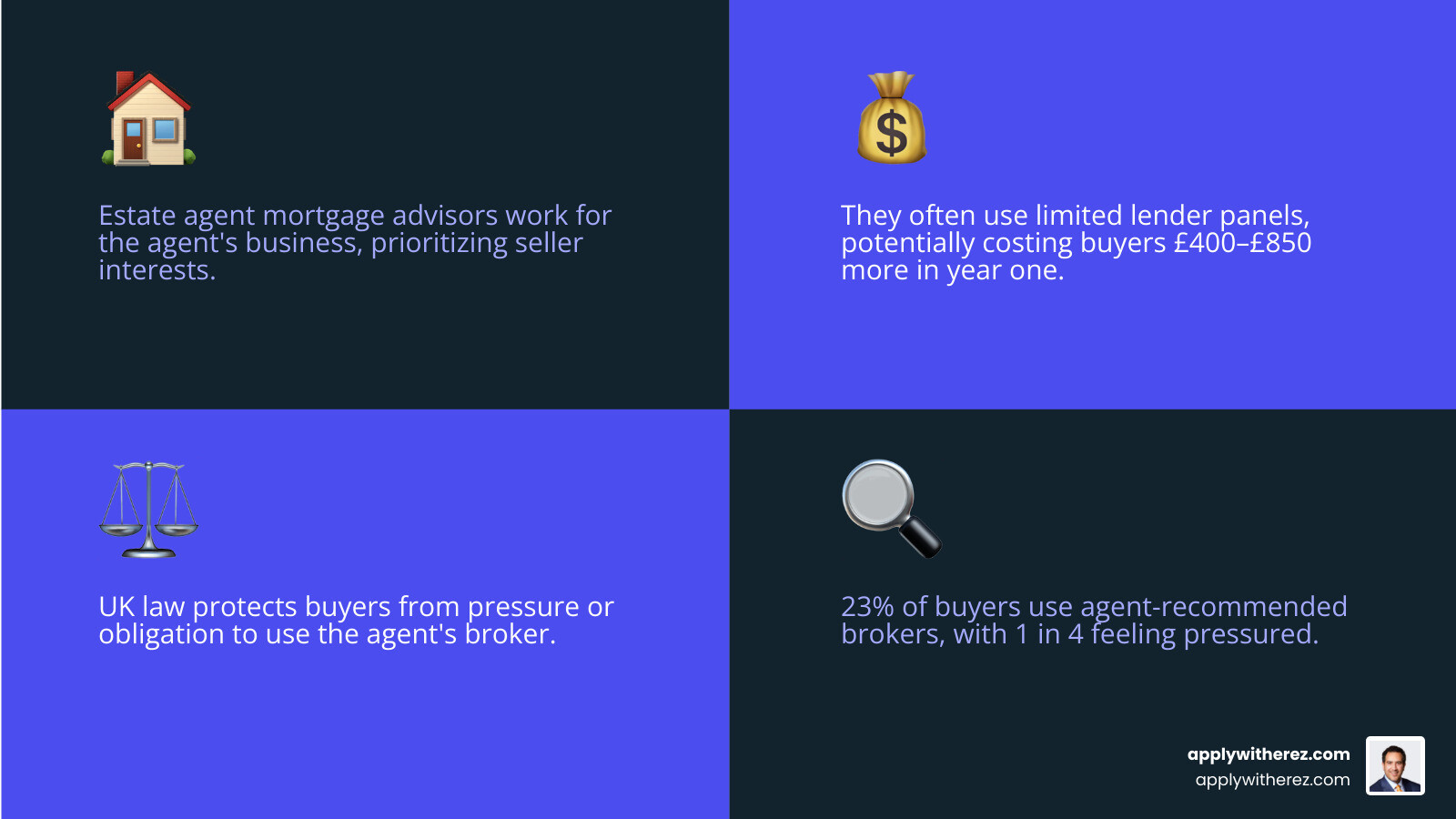
Question Answer What are they? A mortgage broker recommended, employed, or partnered with your estate agent Who do they work for? The estate agent's business — not you Are you required to use them? No — the law protects you from being forced or pressured Could it cost you more? Yes — potentially £400–£850 more in year one compared to shopping around What's the alternative? An independent, whole-of-market broker with access to more lenders and products
Estate agents act for the seller, not the buyer. Their job is to get the best price for the vendor — and the seller pays their fees. So when an agent steers you toward their preferred broker, it's worth asking: whose interests does that really serve?
According to available data, 23% of buyers use a mortgage broker recommended by their estate agent. Of those, 1 in 4 felt pressured or forced to do so. That's a pattern worth paying attention to.
I'm Erez Shimoni, a mortgage broker with 26 years of experience helping buyers navigate exactly these kinds of situations — including how to evaluate whether an estate agent mortgage advisor is the right fit or a costly shortcut. In the sections below, I'll walk you through everything you need to make a confident, informed decision.
What an estate agent mortgage advisor actually is
An estate agent mortgage advisor is usually one of three things:
an in-house mortgage adviser employed by the agency group
a preferred broker the agent refers buyers to
a panel-based adviser who works from a limited list of lenders
In plain English, this is the person the agent says can "help get things moving quickly."
Sometimes they are perfectly legitimate, FCA-regulated advisers. That part matters. Mortgage brokers in the UK should be regulated by the Financial Conduct Authority. But regulation does not automatically mean fully independent, whole-of-market, or best value for your situation.
A lot of buyers also hear terms like:
mortgage certificate
agreement in principle
decision in principle
financial qualification
These are often bundled into the same conversation. The estate agent may say they need proof that you can afford the property before they put your offer forward. That is normal. What is not normal is pretending that only their broker can provide that proof.
How the estate agent mortgage advisor relationship works
The key relationship to understand is this:
the estate agent acts for the seller
the buyer is often treated as the "applicant"
the broker may have a referral arrangement with the agent
the agent may receive an introducer fee if you go ahead
That means the recommendation is not always purely about who gives the broadest advice. It can also be about keeping the sale inside one tidy little pipeline.
From the agent's point of view, this setup can help with:
sales progression
faster chasing of documents
knowing whether the buyer is likely to proceed
managing the chain
reducing surprises before exchange
That is why agents often push hard for a meeting, even when you already have your own broker or lender lined up.
Who the advisor really works for when a sale is on the line
This is where buyers need to stay clear-headed.
The adviser may owe you regulated duties when giving mortgage advice. But the overall commercial setup still creates a conflict risk. The estate agent wants the sale to happen. The seller wants the strongest offer at the best price. The buyer wants the right mortgage at the lowest suitable cost.
Those goals overlap sometimes, but not always.
If a sale is wobbling, the pressure inside an in-house setup can lean toward:
keeping the transaction alive
moving you to a lender that can issue quickly
focusing on "proceedability" over breadth of choice
steering you toward products on a smaller panel
That does not make every in-house adviser bad. It just means we should not confuse convenience with independence.
Why estate agents push buyers toward their broker
Estate agents usually give the same reasons:
"It will speed things up."
"The seller will feel more confident."
"We need to qualify your offer."
"Our adviser can get this sorted quickly."
Some of that is fair. Some of it is salesmanship wearing a name badge.
The real drivers often include:
referral fees
better visibility over your finances
tighter control of the transaction
easier communication between agent and broker
reassurance to the seller that you can proceed

The genuine benefits of using an estate agent mortgage advisor
To be fair, there are real upsides.
Convenience
It can feel easier to keep everything under one roof. One call to the agent can lead to the viewing, offer, broker chat, and follow-up.
Faster communication
When the broker and agent already work together, they can often swap updates the same day. In a fast-moving market, speed matters.
Local knowledge
A broker closely linked to local agents may understand which lenders are comfortable with certain property types, timelines, or common issues in the area.
Smoother paperwork
An in-house or preferred broker may already know what the agent needs for proof of funds, ID checks, and memo of sale paperwork.
Better sales progression
For straightforward cases, a connected broker can help keep everyone aligned from offer to completion.
So yes, there are cases where using the recommended broker can work well. Especially if you are a simple borrower with a standard income and the deal is genuinely competitive.
The hidden downsides, costs, and risks buyers should weigh
This is the part many articles skip.
A panel broker may only access a limited slice of the mortgage market. That can mean:
fewer lenders
fewer niche options
less flexibility for unusual income
weaker pricing than a broader search
Available research suggests using an estate agent-affiliated panel broker could cost around £400 more in the first year due to higher mortgage pricing. Some affiliated brokers also charge average fees of about £450, which can mean up to £850 more in total costs compared with shopping around.
That is not pocket change. That is "there goes the sofa, blinds, and probably the toaster" money.
Other risks include:
bias toward getting the sale through
upselling insurance or protection too aggressively
pressure to share more financial detail than necessary
your offer feeling informally "managed" based on whether you cooperate
less incentive to challenge the agent if something is unfair
Here is the practical comparison:
Feature In-house or panel broker Whole-of-market broker Lender choice Often limited panel Much broader access Independence Possible conflict with agency goals Usually stronger independence Communication with agent Often very fast Can still be fast with good broker Fee transparency Varies, must be disclosed Varies, compare clearly Risk of steering Higher Lower Best for Straightforward buyers who value convenience Buyers who want wider choice and less bias
Whole-of-market vs panel broker: which gives broader choice?
In most cases, a whole-of-market broker gives broader choice. That usually means access to more lenders, more products, and more flexibility if your case is not perfectly tidy.
A useful general explainer on how brokers work is this mortgage broker guide from Bankrate.
A panel broker is not automatically poor value. But if they are limited to a smaller lender panel, they cannot recommend what they cannot access. That matters if you are:
self-employed
using bonus, commission, or variable income
buying an unusual property
dealing with credit blips
comparing long-term cost, not just speed
Wider choice does not guarantee a better deal, but limited choice can absolutely rule one out.
Can you refuse the estate agent mortgage advisor without harming your offer?
Yes, you can refuse.
You do not have to use the estate agent's adviser to have your offer submitted. You also should not be treated unfairly because you prefer your own broker or lender.
That said, buyers often worry about what happens in real life, not just in theory. The answer is: protect yourself with documents, stay polite, and keep a paper trail.
What the law says about pressure, steering, and discrimination
The important legal principle here is that estate agents must not discriminate against buyers for refusing related services, including in-house mortgage advice.
The Estate Agents (Undesirable Practices) (No 2) Order 1991 is widely cited on this point. In simple terms, agents should not make your offer less welcome because you did not take their mortgage or conveyancing referral.
So are estate agents legally allowed to pressure buyers into using their preferred advisers?
No, they should not pressure, coerce, or discriminate.
No, they should not imply your offer will be ignored for refusing tied services.
No, they should not make access to the property conditional on using their broker.
If that happens, you may have grounds to complain to Trading Standards or the relevant redress scheme.
What referral fees and commissions must be disclosed
If an estate agent receives a referral fee or commission for introducing you to a mortgage adviser, that should be disclosed clearly.
Ask for this in writing.
You want to know:
Does the estate agent get paid if I use this adviser?
How much is the referral fee?
Is the broker restricted to a panel?
Does the adviser charge me a fee as well?
Will they also earn lender commission?
Will my data be shared within the group?
Transparency matters because it helps you spot where incentives may sit.

How to push back professionally if you feel pressured
You do not need to go full courtroom drama. Calm and clear usually works best.
Try something like:
Thanks, but I already have my own mortgage arrangement in place. Please submit my offer to the seller with my agreement in principle and proof of funds.
If they keep pushing:
Repeat your position in writing.
Attach your AIP or mortgage certificate.
Ask them to confirm your offer has been passed to the seller.
Ask whether refusal to use in-house services affects how offers are handled.
Keep screenshots, emails, and call notes.
Escalate to the branch manager if needed.
If necessary, mention Trading Standards or the redress process.
Sometimes the magic phrase is simply: "Please confirm that my offer is being treated no differently because I am not using your recommended broker."
Funny how quickly things become less foggy after that.
How to prove you’re mortgage-ready without using the agent’s broker
You do not need the agent's adviser to prove you are serious. You just need proper paperwork.
The usual options are:
an Agreement in Principle
a Decision in Principle
a mortgage certificate from your own broker or lender
proof of deposit
ID and address documents
source of funds evidence
If you are preparing to purchase, our Buy a Home page and Calculator can help you get clear on budget before you start offering.
What documents agents can reasonably ask for
Estate agents can reasonably ask for documents that help verify you are proceedable and satisfy anti-money laundering checks. Common requests include:
Agreement in Principle or Decision in Principle
proof of deposit
recent bank statements
photo ID
proof of address
evidence of gifted deposit, if relevant
evidence of sale agreed on your current home, if applicable
This is normal. It protects the seller and helps the agent know your offer is credible.
What they should not do is insist that this verification can only happen through their own mortgage adviser.
Questions to ask before sharing financial details with the estate agent mortgage advisor
Before handing over documents, ask smart questions.
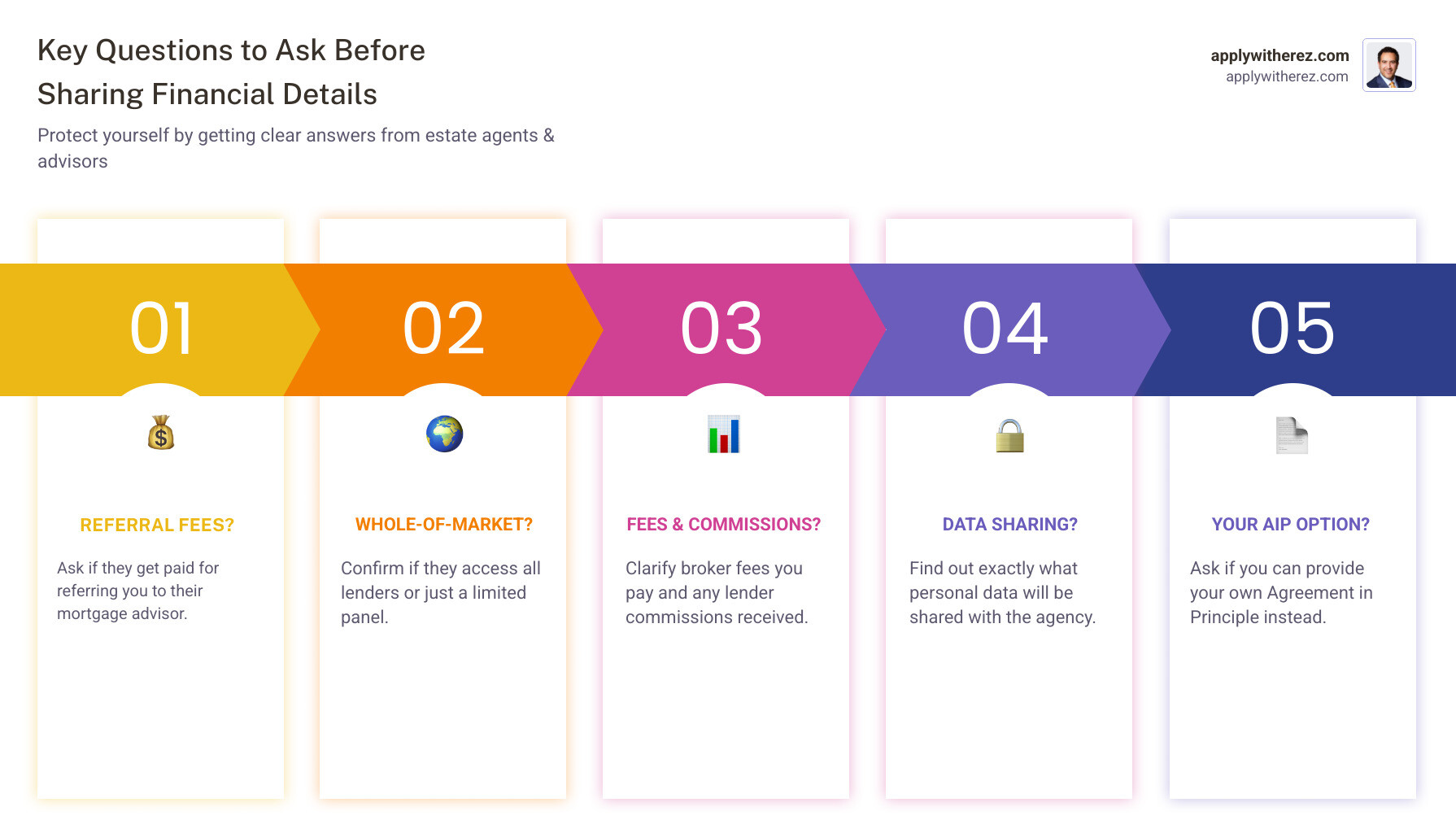
Is this meeting just for financial qualification, or full mortgage advice?
Do you receive a referral fee if I use this adviser?
Is the adviser whole-of-market or panel-based?
How many lenders can they access?
What fee will I pay, if any?
Will they receive commission from the lender too?
What personal data will be shared with the estate agency?
Can I provide my own AIP instead?
What is your complaint process if I feel pressured?
How quickly do you usually turn around an AIP or recommendation?
A good adviser will answer these clearly and without getting twitchy.
How buyers can protect themselves and choose the right broker
The safest approach is not to assume the recommended broker is bad or good. Compare them.
What we recommend is simple:
check whether the broker is FCA-authorised
ask whether they are whole-of-market or panel-based
compare broker fees
compare the mortgage rate and APRC
ask for recommendations in writing
compare at least one outside option
If you want to speak to us directly about your options, you can always Contact us.
When an independent broker is usually the better option
An independent or broader-search broker is often the better option when your case is not completely standard.
That includes:
self-employed income
multiple income sources
adverse credit history
unusual property types
gifted deposit complications
tight affordability
need for more lender flexibility
desire for lower bias and wider comparison
It can also be useful if you are exploring future moves beyond this purchase, such as Refinance, or specialist lending routes like a VA Home Loan where independent guidance matters.
A simple step-by-step process for choosing without pressure
Here is the process we suggest in 2026:
Get an AIP before you start offering.
Work out your payment comfort zone, not just your maximum borrowing.
Ask the estate agent exactly what proof they need.
Provide your own AIP and deposit evidence.
If they recommend a broker, ask whether it is whole-of-market or panel-only.
Ask for all fees and referral arrangements in writing.
Compare the recommended broker with at least one independent option.
Compare rate, APRC, fees, incentives, and flexibility.
Keep all communication in writing where possible.
Submit your offer confidently and ask for written confirmation it has gone to the seller.
That way, you stay cooperative without giving away control.
Frequently Asked Questions about estate agent mortgage advisor
Do I have to meet the estate agent mortgage advisor before my offer is submitted?
No. The agent can ask for evidence that you can proceed, but they should not force you to meet their adviser as a condition of submitting your offer. A valid AIP or mortgage certificate from your own broker or lender is usually enough.
Can an estate agent say my offer is weaker if I don’t use their mortgage advisor?
They can discuss your proceedability, but they should not unfairly downgrade or discriminate against your offer because you refused their in-house service. If you have solid proof of funds and an AIP, your offer should be presented on its merits.
Is a whole-of-market broker better than an estate agent mortgage advisor?
Often, yes, if your priority is wider lender choice and lower conflict risk. A whole-of-market broker can usually search a broader range of options. An estate agent mortgage advisor may still be fine for a straightforward case, but convenience should be weighed against cost, choice, and independence.
Conclusion
An estate agent mortgage advisor is not automatically a problem. Sometimes the setup is efficient, organised, and perfectly workable. But buyers should understand the structure before saying yes.
The estate agent works for the seller. The recommendation may involve referral fees. The broker may be limited to a panel. And in some cases, the total extra cost of going with the in-house route can be significant.
Our view is simple: verify what you need, compare your options, and do not let "speed" talk you into a mortgage decision you have not properly tested.
If you want unbiased help reviewing your mortgage options, comparing broker structures, or getting mortgage-ready before you offer, you can Book a Call with us.