
The Bridge Loan Guide: Don't Get Stuck in the Middle
When Timing Is Everything: What You Need to Know About Bridge Loans in Real Estate
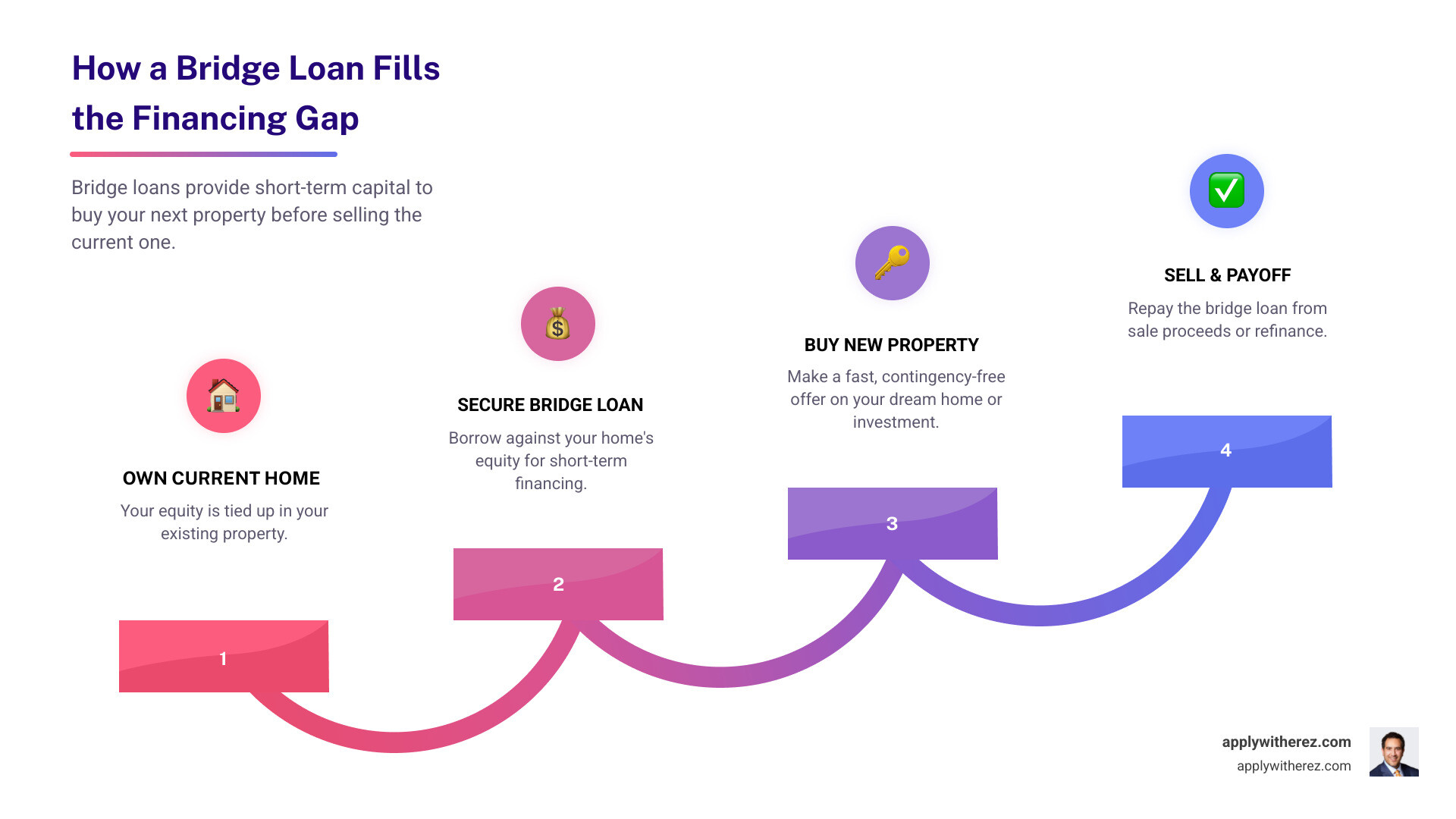
Bridge loan real estate financing is a short-term lending solution that helps buyers and investors cover the gap between purchasing a new property and selling — or stabilizing — an existing one.
Quick answer: Here's what a bridge loan does in plain terms:
Question Answer What is it? A short-term loan (typically 6–12 months) secured by your existing property Who uses it? Homebuyers, move-up buyers, fix-and-flip investors, commercial investors Why use it? To buy a new property before your current one sells How is it repaid? Usually from sale proceeds or a permanent refinance What does it cost? Rates typically run about 2% above prime, plus origination fees How much can you borrow? Up to 80% of your current home's value
Timing is one of the hardest parts of any real estate transaction. You find the right home — or the right deal — but your money is tied up in a property you haven't sold yet. That gap between where your money is and where you need it to be is exactly the problem a bridge loan is designed to solve.
About 20% of homeowners say that mistiming a home sale with a new purchase is one of their biggest fears. And with the average homeowner sitting on nearly $140,900 more in home equity than five years ago, more people are looking for smart ways to put that equity to work — without waiting months for a sale to close.
A bridge loan isn't the right tool for every situation. But when it fits, it can be a powerful move.
I'm Erez Shimoni (NMLS #460222), a mortgage broker with 26 years of experience helping buyers and investors navigate complex financing decisions — including bridge loan real estate scenarios across New Jersey, New York, Florida, and Pennsylvania. In this guide, I'll walk you through everything you need to know to decide if a bridge loan is the right move for you.
What Is a Bridge Loan in Real Estate?
A bridge loan is short-term financing secured by real estate that gives you access to capital before a sale, refinance, or permanent loan is in place. Think of it as temporary financing with a very specific job: get you from Point A to Point B without missing the deal in the middle.
In residential real estate, that often means using equity from your current home to help buy the next one before the old home sells. In investment or commercial real estate, it often means funding a property that is in transition, such as a building that needs renovation, lease-up, or stabilization before it qualifies for long-term financing.
Unlike a standard mortgage, a bridge loan is not meant to stick around for 30 years and watch your kids grow up. It is meant to solve a timing problem, then leave.
How bridge loan real estate differs from a traditional mortgage
A bridge loan and a traditional mortgage are both secured by real estate, but they serve different purposes.
A traditional mortgage is long-term financing. It is built for stability, predictable payments, and a property that already meets standard lending guidelines.
A bridge loan is temporary funding. It is built for speed, flexibility, and situations where the borrower or property is in transition.
Here are the biggest differences:
Feature Bridge Loan Traditional Mortgage Purpose Short-term gap financing Long-term homeownership or permanent financing Typical term 6 to 36 months, often 3 to 12 months 15 to 30 years Underwriting focus Equity, exit plan, property transition Income, credit, long-term repayment ability Rate Higher than conventional financing Usually lower Repayment Sale proceeds or refinance Monthly amortizing payments over many years Speed Often faster Usually slower
Bridge lenders also spend a lot of time looking at your exit strategy. They want to know exactly how the loan gets repaid. That could be a home sale, a permanent refinance, or another clear liquidity event.
Residential vs. commercial bridge loans
Residential bridge loans usually help homebuyers who want to buy before selling. The borrower may be a move-up buyer, someone relocating, or a homeowner who wants to avoid a sale contingency in a competitive market.
Commercial bridge loans are often used by investors buying multifamily, office, retail, or mixed-use properties that are not yet ready for permanent financing. For example, the property may have high vacancy, unfinished improvements, or below-market rents. In those cases, the loan provides transitional capital until the asset is stabilized.
A key commercial benchmark: many agency permanent loans after a bridge period require 90% or greater occupancy for the trailing 90 days. That is why bridge financing is common for value-add and lease-up strategies.
For a deeper industry look at that path, see resources from agency lenders, commercial mortgage associations, and educational real estate finance publications such as the Mortgage Bankers Association.
When a Bridge Loan Makes Sense
A bridge loan makes sense when timing matters more than waiting for the perfect sequence of events. If a delay could cost you the home, the deal, or the financing window, this type of loan may be worth considering.

Common situations include:
Buying a new home before your current home sells
Making a cleaner, non-contingent offer in a competitive market
Closing quickly on a time-sensitive investment opportunity
Funding renovations before refinancing into permanent debt
Covering a lease-up period until a commercial property stabilizes
Common residential use cases
For homeowners, the classic use case is simple: you found the next home, but your current home has not sold yet.
A bridge loan can help you:
Access equity for a down payment
Avoid rushing into a lower sale price on your current home
Compete with stronger offers that are not contingent on another sale
Move once instead of juggling temporary housing and storage
This can be especially helpful for move-up buyers, families with school or work deadlines, or relocation situations where timing is not negotiable.
If you are actively planning your purchase, our Buy a Home page can help you explore broader financing options alongside bridge scenarios.
Common investor and commercial use cases
Investors use bridge loans for properties that are not yet financeable with conventional or permanent debt.
Examples include:
Fix-and-flip projects
Distressed or underperforming assets
Properties with vacancy issues
Buildings that need rehab before stabilization
Multifamily assets in a lease-up period
Bridge-to-perm strategies where a refinance is expected after improvements
Commercial bridge loans often cap around 75% to 80% loan-to-cost and about 65% to 70% of as-stabilized value, based on the research. That reflects the lender's focus on transition risk and future takeout financing.
For more investor-focused reading, look for educational resources from commercial lending publications, accounting and advisory firms, and real estate finance organizations.
How bridge loan real estate works from application to payoff
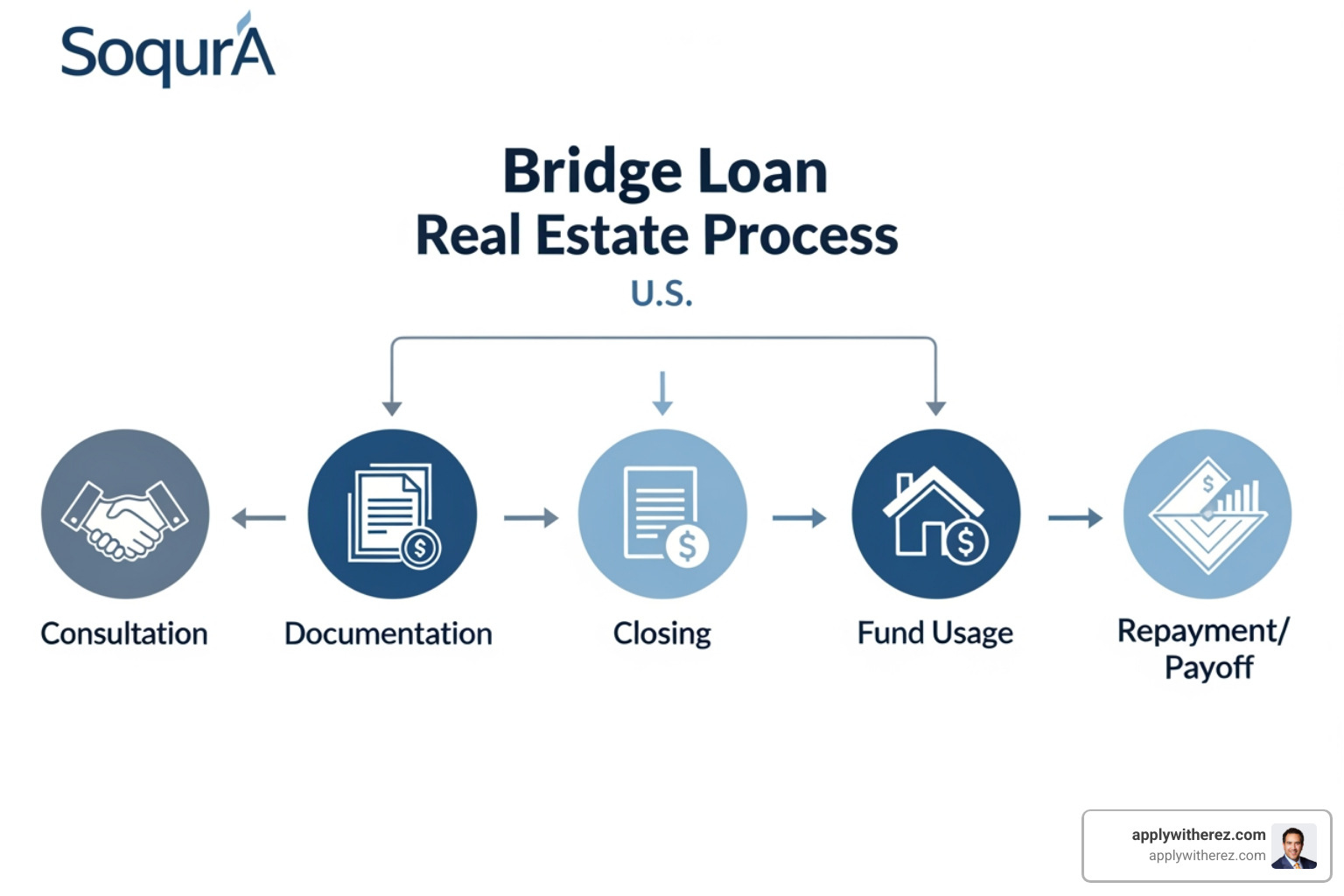
At a high level, the process is straightforward: apply, document the property and your finances, close quickly, use the funds for the transition, then repay the loan through a sale or refinance.
Typical process and timeline
While every loan is different, the usual process looks like this:
Initial consultation
We review the property, the amount of equity available, your target purchase or business plan, and your repayment strategy.
Application and documentation
Expect requests for credit information, income or asset documentation, mortgage statements, property details, and proof of funds or reserves.
Valuation and title review
The lender evaluates the collateral, often through an appraisal or valuation review, and checks title for existing liens.
Underwriting
The lender analyzes your credit profile, equity position, liquidity, debt obligations, and most importantly, the exit plan.
Approval and closing
Bridge loans can often close faster than traditional loans because they are designed for urgent transactions. Exact timelines vary, but speed is one of the product's major advantages.
Loan term
During the bridge period, borrowers may make interest-only payments, or in some structures, have deferred interest with a balloon payoff at the end.
Repayment
The loan is usually paid off from sale proceeds, a refinance into permanent financing, or another approved exit event.
Typical terms run 6 months to 3 years, with 3 to 12 months being the most common range.
Exit strategies lenders want to see
Bridge lenders care deeply about one question: "How are you getting us paid back?"
Strong exit strategies include:
Sale of your current home
Cash-out refinance after repairs or stabilization
Permanent mortgage after occupancy or financial performance improves
Sale of the investment property
Verified liquidity from another source
A strong exit plan usually has these traits:
Realistic timeline
Conservative sale or refinance assumptions
Backup plan if the first option takes longer
Enough reserves to cover overlap and carrying costs
For commercial borrowers, lenders may look at projected DSCR, lease-up pace, renovation budget, and whether the property can qualify for takeout financing once stabilized.
What current rates and terms look like in 2026
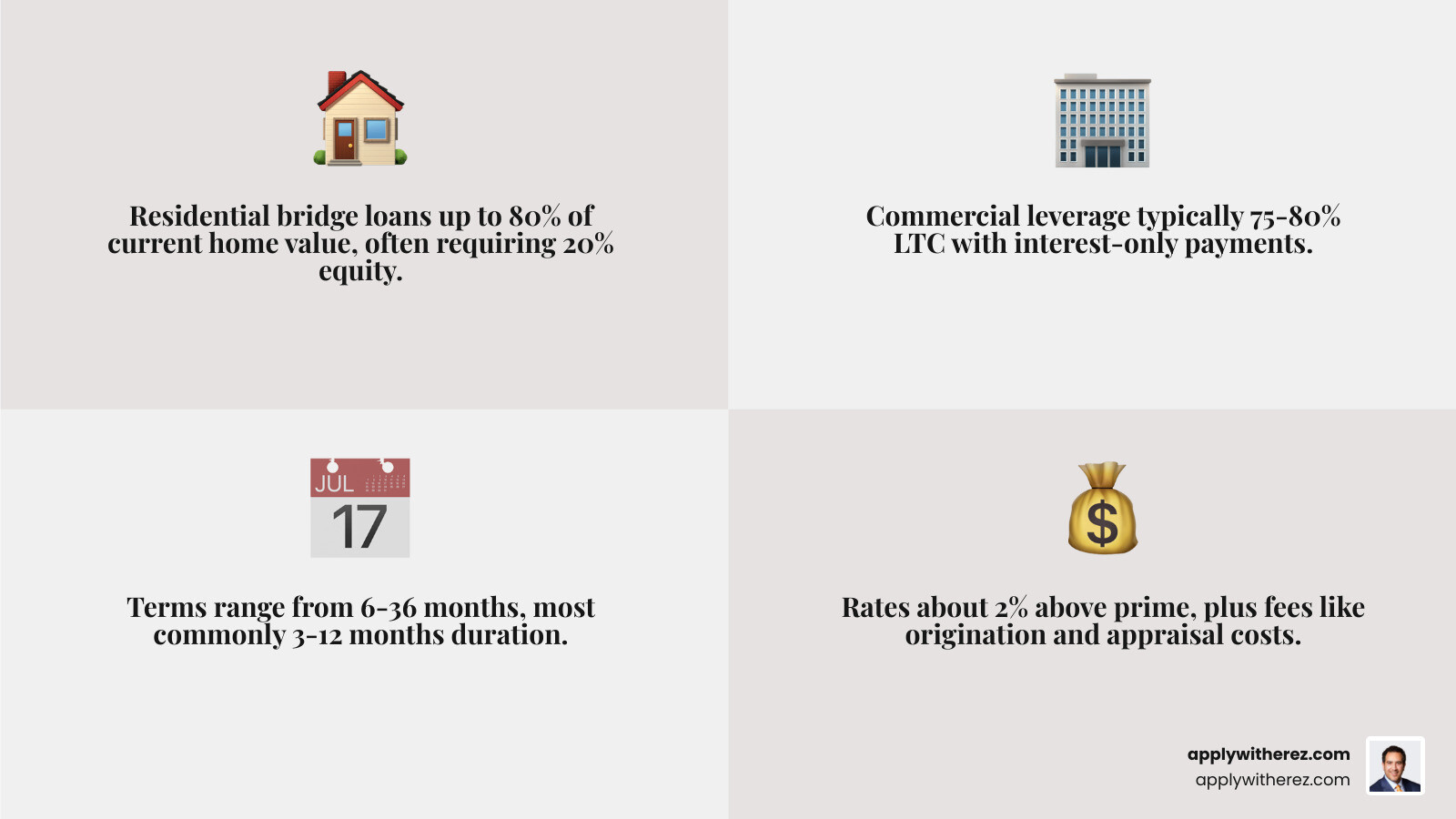
In 2026, bridge loan pricing still tends to be meaningfully higher than conventional mortgage pricing. Based on the research, rates often run about 2% above prime, though actual pricing depends on the borrower, property, leverage, and exit risk.
Common 2026 bridge loan features include:
Terms from 6 to 36 months
Most common duration of 3 to 12 months
Interest-only payment structures
Balloon payoff at maturity
Residential leverage up to 80% of current home value
Many lenders requiring at least 20% equity
Commercial leverage around 75% to 80% LTC
Fees that may include origination charges, appraisal costs, title fees, and other closing costs
Costs, qualifications, and risks to understand before you borrow
Bridge loans can be extremely useful, but they are not cheap money. Convenience and speed usually come with higher rates and fees.
Here are the main cost categories to plan for:
Interest rate
Origination fee or points
Appraisal or valuation fee
Title and settlement costs
Legal or underwriting fees
Reserve requirements
Potential prepayment or extension fees, depending on structure
Who qualifies for a bridge loan real estate program
Qualifications vary by lender and transaction type, but borrowers generally need to show a combination of:
Sufficient equity in the current property
Often at least 20% equity, with borrowing capped around 80% LTV
Acceptable credit profile
Income, assets, or reserves to support the debt
Manageable total debt obligations
Clear property value support
Strong exit strategy
For investors, lenders may also evaluate:
Experience with similar projects
Rehab scope and budget
Property type and marketability
Stabilization plan
Expected refinance or sale path
In other words, bridge loan approval is not just about "Can you borrow?" It is also about "Can you exit safely?"
Biggest pros and cons for buyers and investors
Here is the honest version.
Pros
Faster access to capital
Can help you buy before selling
Can strengthen your offer in competitive markets
More flexible than permanent financing for transitional situations
Useful for renovation, lease-up, and value-add strategies
Lets you unlock equity without waiting for a sale to close
Cons
Higher interest rates than traditional mortgages
More fees
Risk of carrying two properties at once
Repayment pressure if the sale or refinance takes longer than expected
More sensitive to market changes
Not ideal if your budget is already tight
The product can solve a timing problem, but it can also magnify a cash flow problem if you enter it without enough reserves.
Main alternatives to consider first
Before committing to a bridge loan, compare it with other options.
Option Best For Pros Cons Bridge loan Fast timing gap solution Speed, flexibility, competitive offers Higher cost, short term HELOC Ongoing access to home equity Lower cost potential, revolving line Slower setup, qualification limits Home equity loan Fixed lump sum against equity Predictable structure Less flexible timing Cash-out refinance Replacing current mortgage with more cash Potentially lower rate than bridge Resets mortgage, slower, may not fit timing Savings or sale proceeds Avoiding debt No loan cost Ties up liquidity Delaying purchase Reducing risk Simpler You may lose the property
If you want to compare refinance paths, visit Refinance. If you want to run payment scenarios, our Calculator can help.
For broader consumer overviews, it can also help to review educational materials from major personal finance publishers, banks, credit unions, and housing-focused financial education sites.
Bridge loans in competitive markets: how to use them wisely
In competitive markets, bridge loans can create a real advantage. Sellers often prefer offers with fewer contingencies and a faster closing path. If your offer is not dependent on selling another property first, it can look stronger, cleaner, and less risky.
That matters in bidding wars.
When inventory is tight, buyers using equity strategically can move faster and negotiate from a position of confidence. With home equity having risen significantly in recent years, more borrowers now have the raw material that makes bridge financing possible.
How to avoid common bridge loan mistakes
The biggest mistakes are usually not about the loan itself. They are about unrealistic planning.
Avoid these traps:
Overborrowing based on an aggressive sale price
Assuming your current home will sell instantly
Underestimating carrying costs
Ignoring taxes, insurance, utilities, and repairs during overlap
Choosing a loan term that is too short for the real timeline
Starting a value-add project without a realistic contractor schedule
Assuming refinance approval before the property is truly stabilized
A bridge loan works best when your assumptions are a little boring. Boring is good. Boring gets paid off.
Smart planning checklist before closing
Before closing on a bridge loan, we recommend checking all of the following:
Do we know exactly how the loan will be repaid?
Is the sale price assumption reasonable?
Do we have a backup plan if the sale is delayed?
Can we comfortably handle overlapping payments?
Have we budgeted for taxes, insurance, utilities, and repairs?
Do we have enough reserves for surprises?
If this is an investment deal, is the rehab timeline realistic?
If this is commercial, what occupancy or DSCR is needed for takeout financing?
Have we compared the bridge loan against a HELOC or refinance?
Are we using the loan to solve a timing problem, not a budget problem?
Frequently Asked Questions About Bridge Loan Real Estate
How much can you borrow with a bridge loan?
It depends on your equity, the lender's leverage limits, and the full transaction structure. In many residential cases, bridge loans allow borrowing up to 80% of your current home's value. Closing costs, existing liens, and the strength of your exit plan can reduce the usable amount.
Do bridge loans require monthly payments?
Often, yes, but not always in the same way as a standard mortgage. Some bridge loans are structured with interest-only monthly payments. Others may allow deferred interest with a balloon payoff at maturity. The exact structure depends on the lender and the transaction.
Is a bridge loan better than a HELOC or cash-out refinance?
Not universally. A bridge loan is usually better when speed and timing are the top priorities. A HELOC or cash-out refinance may be better when you want lower cost and have more time to plan. The best choice depends on urgency, available equity, monthly payment tolerance, and how certain your exit timeline is.
Conclusion
A bridge loan can be a smart solution when your real estate timeline refuses to behave. It can help you buy before selling, move quickly in a competitive market, or fund a property through a transition period until long-term financing is available.
But the key is not just getting the loan. The key is planning the exit.
If you are considering bridge loan real estate financing, we recommend comparing costs, reviewing alternatives, and stress-testing your repayment plan before you commit. When the structure fits the situation, a bridge loan can turn a frustrating timing gap into a workable strategy.
If you are ready to explore your options, start with Buy a Home or visit https://applywitherez.com to connect with us.