
Average Time to Refinance a Mortgage: A Guide to Beating the Clock
Average Time to Refinance a Mortgage: Industry Benchmarks
When evaluating the overall turnaround for a home loan restructuring, market conditions and operational capacity play major roles. The Federal Reserve Bank of New York found that the median closing time for mortgage transactions was 30 days in 2022. For refinances specifically, underwriting and processing workflows have become noticeably leaner over time.
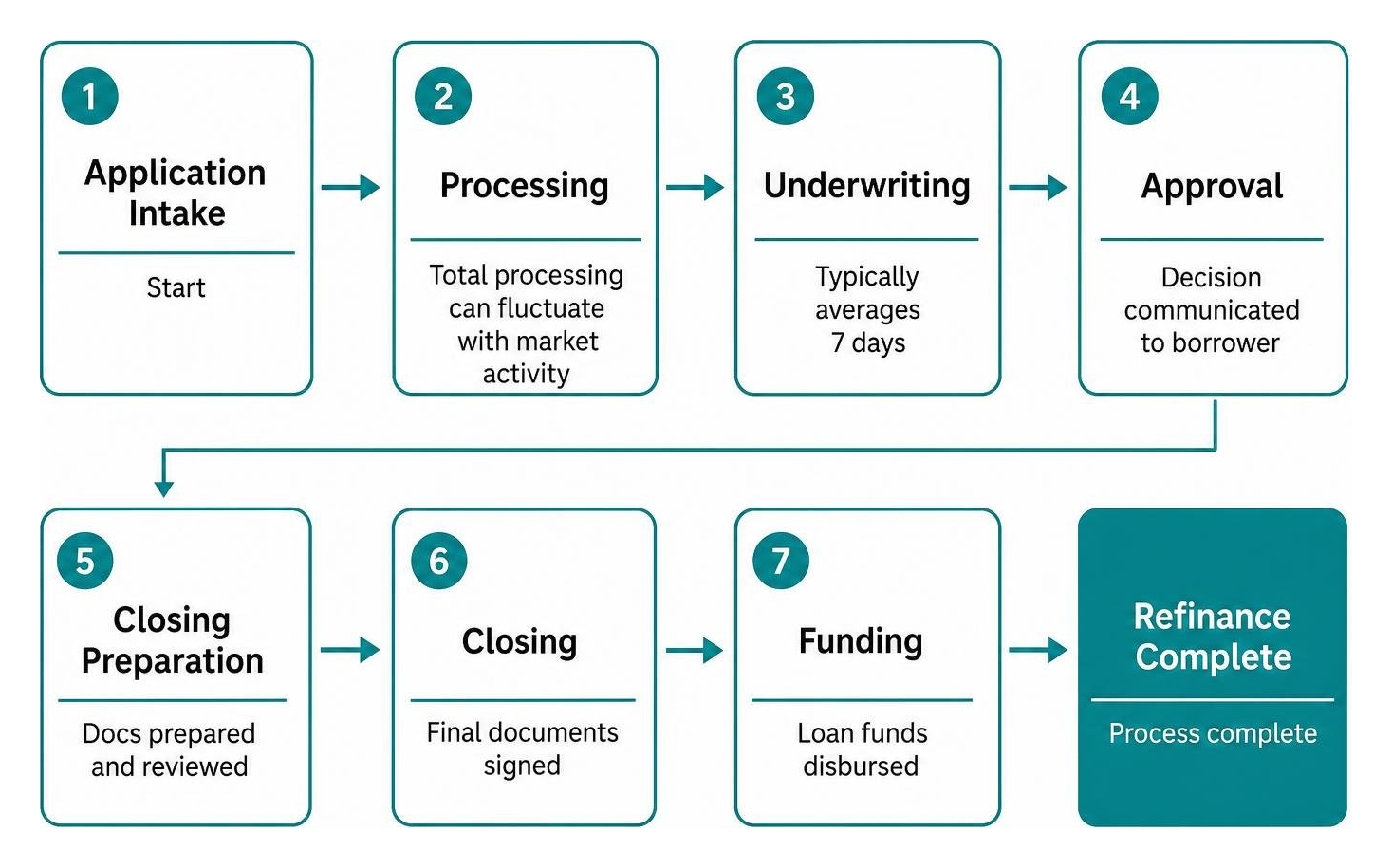
Underwriting alone typically averages 7 days across standard residential files. Total processing cycles can fluctuate depending on whether market activity is surging or quiet. While operational teams handle routine tasks smoothly during balanced cycles, a sudden drop in rates can spark heavy application volume that stretches turn times across the board. Borrowers who understand these benchmarks can set realistic expectations and avoid unnecessary delays when they decide to move forward.
Historical Shifts in the Average Time to Refinance a Mortgage
The mortgage landscape has witnessed significant operational adjustments over recent years. In 2021, when refinancing demand hit historic highs, the average processing time reached 22 days. As loan volumes normalized and lenders refined digital processing systems, the average processing time dropped to 18 days in 2022. Data from the Federal Reserve Bank of St. Louis also revealed that the broader mortgage application cycle time averaged 20 days in 2021 for refinance applications.
Refinance application volume represented 66.8% of all mortgage applications in February 2021 before tapering as market rates adjusted. To manage market volatility, lenders expanded rate-lock windows; the average rate lock duration increased from 30 days in 2021 to 45 days in 2022. These shifts reflect how quickly lender capacity and borrower demand can reshape the average time to refinance a mortgage from one season to the next. For deeper insights into industry metrics and market shifts, explore Mortgage Refinance Industry Statistics.
The 3-7-3 Rule for Mortgage Refinancing
The 3-7-3 rule is an industry framework tied to federal disclosure rules and standard operational workflows:
3 Business Days for Disclosure Review: Federal law requires that you receive your initial Loan Estimate within three business days of submitting a completed application. Later in the process, you must receive your Closing Disclosure (CD) at least three business days before signing your loan documents. This waiting window gives you time to review final rates, monthly payments, and cash-to-close figures without pressure.
7 Days for Underwriting and Processing: Once your documentation is submitted, underwriters typically require about 7 business days to evaluate your credit history, verify your employment and income, and clear initial loan conditions.
3 Business Days for Settlement and Rescission: For a primary residence refinance, federal regulations enforce a mandatory three-business-day right of rescission following closing. You retain the legal right to cancel the agreement during this window. Once this period expires, loan proceeds disburse and the transaction officially funds.
Step-by-Step Milestones in the Refinance Process
Navigating your loan restructuring involves several clearly defined steps:
Application Intake: You submit your loan application alongside initial tax, asset, and income records.
Initial Disclosures and Rate Lock: Your lender delivers a Loan Estimate detailing your terms, and you determine whether to lock your interest rate.
Processing and Appraisal Setup: The processing team orders title work, verifies employment, and schedules a property valuation.
Underwriting Review: An underwriter examines property data and borrower credit to issue a conditional approval.
Clearing Conditions: You provide any final updated bank statements, insurance binders, or explanations required by underwriting.
Closing and Funding: You sign your final closing package, navigate the three-day rescission period, and finalize your new loan.
Each milestone carries its own typical duration, and delays at any single point can extend the overall average time to refinance a mortgage. Knowing what happens at each stage helps you prepare documents in advance and respond quickly when your loan officer requests additional information.
Factors That Impact the Average Time to Refinance a Mortgage
Turnaround times often depend on the specific loan program you choose, your equity position, and property characteristics. When looking to tap into your home equity or replace your existing loan, the choice between traditional underwriting and specialized government programs will directly shape your closing schedule.
Homeowners exploring streamline options can review our VA Refinance Complete Guide 2026 or consult our Best FHA Streamline Refinance Guide 2026 to see how reduced paperwork speeds up approval.
Refinance Loan Type | Typical Processing Window | Appraisal Requirement | Key Timeline Drivers |
|---|---|---|---|
Conventional Rate-and-Term | 20 to 35 Days | Standard appraisal or automated valuation model (AVM) | Clear title history, credit documentation, automated underwriting findings |
FHA / VA Streamline | 15 to 25 Days | Usually waived | No physical appraisal, simplified income verification, clean mortgage history |
Cash-Out Refinance | 30 to 45 Days | Full interior and exterior appraisal required | Strict equity calculations, detailed property inspection, title updates |
Navigating Closing Costs and Break-Even Timeframes

Closing costs on a residential refinance typically range from 2% to 5% of the total loan amount. On a $300,000 mortgage balance, total settlement expenses commonly fall between $6,000 and $15,000. These expenses cover lender origination, appraisal charges, settlement fees, title insurance, and local recording fees.
To determine whether refinancing makes financial sense, calculate your break-even point—the time it takes for your monthly savings to fully offset your closing costs:
$$\text{Break-Even Period (Months)} = \frac{\text{Total Refinancing Closing Costs}}{\text{Monthly Payment Savings}}$$
If your closing costs total $6,000 and your new rate saves you $200 per month, your break-even period is 30 months (2.5 years). If you intend to stay in the home well beyond that date, refinancing offers a clear net benefit. That the average time to refinance a mortgage also affects your break-even calculation, since a longer closing process can mean additional accrued interest on your existing loan before the new terms take effect.
For a complete breakdown of potential fees and zero-out-of-pocket alternatives, check out our Refinance Mortgage Cost Guide 2026 and our No Cost Refinance Guide 2026. Homeowners weighing overall timing can also read Is it time to refinance your mortgage? for helpful perspectives on interest rate shifts.
Proven Strategies to Fast-Track Your Closing

Borrowers who want to avoid underwriting bottlenecks can take several proactive steps:
Assemble Your Documents Early: Gather two years of W-2s, 30 days of paystubs, two months of bank statements, and your current homeowners insurance policy before applying.
Respond Immediately to Requests: Underwriters frequently ask for updated statements or clarification letters. Supplying requested items within 24 hours keeps your file moving through the queue.
Avoid New Credit Activity: Do not open new credit cards, finance large purchases, or shift large sums of money between accounts during underwriting.
Opt for Digital Valuations When Eligible: Roughly 65% of mortgage lenders utilize automated valuation models (AVMs) or appraisal waivers when permitted by Fannie Mae or Freddie Mac, shaving days off the schedule.
Clarify Your Goals Upfront: If your goal is extracting equity for major improvements, reviewing our Cash Out Refinance Guide 2026 will help you prepare the right equity documentation ahead of time.
Taking these steps before you submit your application can meaningfully reduce the average time to refinance a mortgage. A well-prepared file moves through processing and underwriting with fewer stops, which helps you lock in your target rate without worrying about expiration deadlines.
Frequently Asked Questions About Refinancing Timelines
What is the 2% rule for refinancing a mortgage?
The 2% rule is a traditional guideline suggesting that refinancing is most beneficial when you can reduce your interest rate by at least 2 percentage points. While a 2% drop delivers rapid savings, modern rate-reduction strategies often make financial sense with reductions of 0.75% to 1%, depending on your loan size and how long you plan to keep the property.
How long should you wait after buying a home to refinance?
Most conventional and government-backed loan programs require a "seasoning period" of at least six months from your original closing date before you can refinance with the same or a new lender. This seasoning ensures an established track record of on-time monthly payments and stable property equity.
What are the main disadvantages of refinancing?
Potential drawbacks include paying 2% to 5% in upfront settlement expenses, restarting your amortization schedule if you extend your loan term, and experiencing a temporary minor drop in your credit score from the initial inquiry. Balancing these factors against your projected monthly savings helps determine if refinancing aligns with your long-term plans.
How can I estimate my own refinance timeline?
Your personal timeline depends on your loan type, property appraisal requirements, and how quickly you respond to document requests. A conventional rate-and-term refinance with clean documentation often closes in 20 to 35 days, while a cash-out refinance with a full appraisal may take 30 to 45 days. Working with an experienced broker who understands the average time to refinance a mortgage can help you set a realistic closing date from the start.
Conclusion
Understanding the refinance timeline helps you plan ahead and close without unnecessary delays. While the industry average ranges from 30 to 45 days, organized documentation and proactive communication can help you close your loan in as little as 2 to 4 weeks.
As an independent mortgage broker, we shop across top wholesale lenders to find competitive rates and efficient turnaround times for homeowners across New Jersey, Pennsylvania, and New York. When you are ready to evaluate your options, explore our customized Refinance solutions to get started.