
The Definitive Guide to Comparing Current Refinance Rates
Compare Average Refi Rates Before You Apply
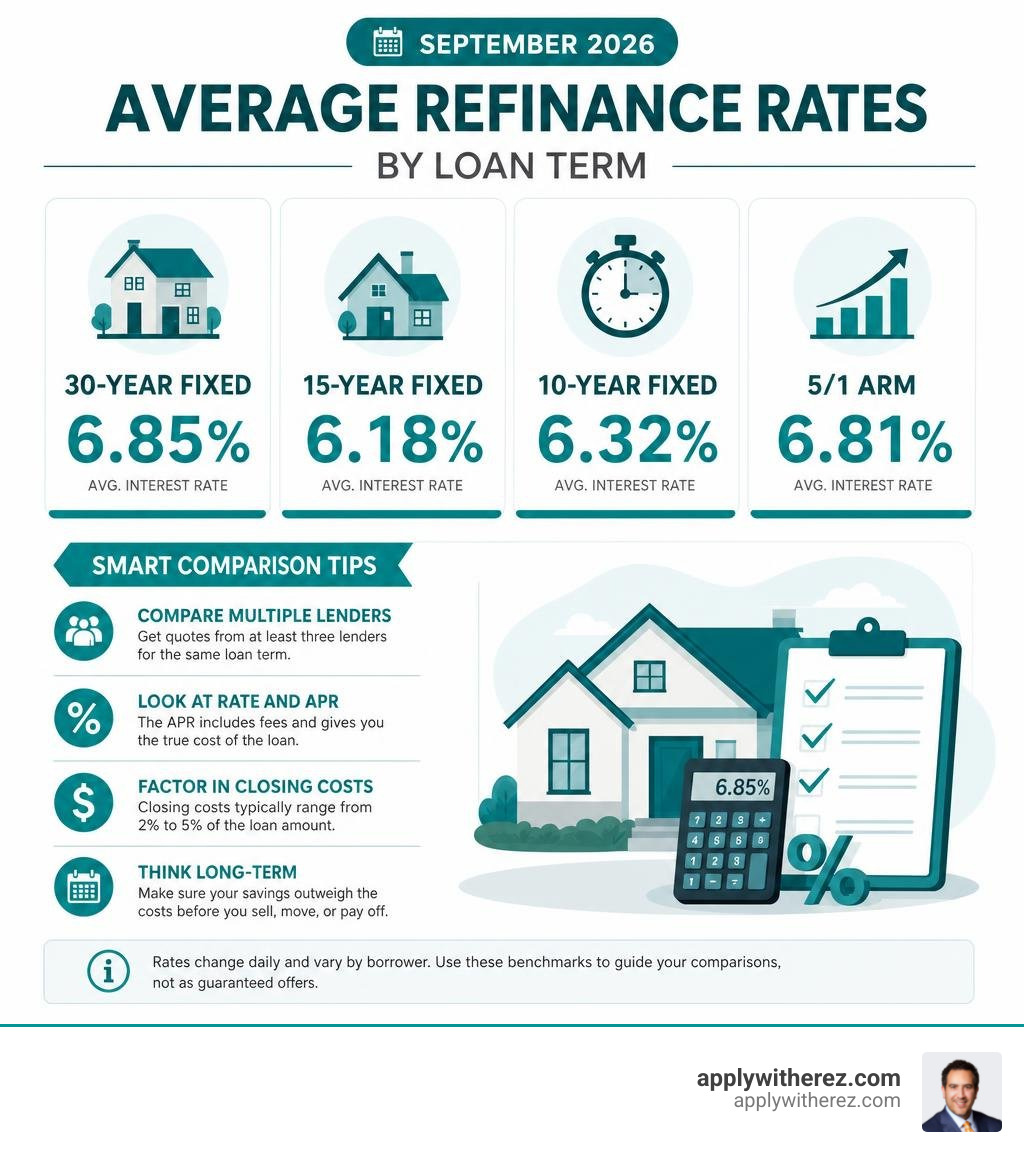
As of September 2026, average refi rates are about 6.85% for a 30-year fixed refinance and 6.18% for a 15-year fixed refinance. A 10-year fixed refinance averages roughly 6.32%, while a 5/1 ARM refinance is near 6.81%.
These are useful benchmarks, not guaranteed offers. Your actual rate can move higher or lower based on your credit score, home equity, loan type, points, and lender fees. Compare the same loan term from at least three lenders, and look at both the interest rate and APR.
Today's rate environment is modestly higher than a year ago. Freddie Mac's purchase-mortgage benchmark was 6.66% for a 30-year fixed loan on August 27, 2026, versus 6.56% a year earlier. Its 15-year average was 5.98%, up from 5.69%. Refinance quotes can differ from these purchase-loan benchmarks, often by a small amount.
The right refinance is not always the lowest advertised rate. Closing costs commonly run 2% to 5% of the loan amount, so the savings need to outweigh the cost before you plan to sell, move, or pay off the loan.
I’m Erez Shimoni, a mortgage professional with 26 years of industry experience helping borrowers compare average refi rates, closing costs, and payment options. Let’s start with the current rate benchmarks and what they can mean for your loan.
Current Average Refi Rates: 30-Year, 15-Year, and ARM Breakdown
Navigating the mortgage market means understanding that national averages serve as your financial compass. While individual quotes depend on personal underwriting factors, seeing the broad baseline gives you immense leverage when shopping. Based on real-time market surveys and historical rate reports, the refinance market in late 2026 reflects steady, resilient pricing across all major loan categories.
Loan Program | Average Interest Rate | Average APR | Standard Down Payment / Equity Req. |
|---|---|---|---|
30-Year Fixed Refinance | 6.85% | 6.94% | 20% (Conventional) |
15-Year Fixed Refinance | 6.18% | 6.31% | 20% (Conventional) |
10-Year Fixed Refinance | 6.32% | 6.16% | 20% (Conventional) |
5/1 ARM Refinance | 6.81% | 7.12% | 20% (Conventional) |
30-Year Fixed FHA Refi | 6.79% | 6.83% | 3.5% to 2.25% Equity |
30-Year Fixed VA Refi | 6.23% | 6.34% | 0% Equity (Eligible Veterans) |
30-Year Jumbo Refinance | 6.94% | 6.98% | 15% to 20% Equity |
How 30-Year and 15-Year Average Refi Rates Compare Today
When we look at market APR benchmarks, the spread between a 30-year and a 15-year fixed loan is substantial. Choosing between them comes down to a classic financial trade-off: monthly flexibility versus lifetime wealth building.
A 30-year fixed refinance currently sits at an average of 6.85% (6.94% APR). This product keeps your monthly mandatory payment lower by stretching repayment across 360 months. It is the go-to structure for homeowners seeking immediate cash-flow relief, breathing room in their household budget, or stability against future inflation.
In contrast, the 15-year fixed refinance averages 6.18% (6.31% APR)—a noticeable 67 basis-point discount in base interest. Because the amortization schedule is cut in half, your monthly payment will be noticeably higher, but the principal reduction accelerates from month one. Instead of spending your first decade paying primarily interest, a 15-year loan builds home equity rapidly and can save you well over $100,000 in lifetime financing charges on a typical home in New York, New Jersey, or Pennsylvania.
Understanding Survey Data vs. Daily Average Refi Rates
Why do the rates you see on the morning news often differ from the rate quote on your screen? It comes down to how data is gathered:
Weekly Survey Averages (e.g., Freddie Mac PMMS): Freddie Mac compiles data from thousands of purchase loan applications through its Loan Product Advisor (LPA) platform. These numbers are published weekly every Thursday at noon Eastern Time. Because they look backward at the prior week's applications, they reflect a slight lag and assume prime borrower profiles with standard conforming balances.
Daily Rate Indices (e.g., Mortgage News Daily): Daily benchmarks track real-time rate sheets published by active wholesale and retail lenders around 4:00 PM Eastern. As of September 1, 2026, daily tracking registered the 30-year fixed at 6.89%, the 15-year fixed at 6.39%, and 30-year jumbo products at 6.92%.
The Role of Mortgage-Backed Securities (MBS): Mortgage rates do not change directly because of Federal Reserve meetings. Instead, they move dynamically throughout the day as Mortgage-Backed Securities (MBS) trade on Wall Street. When bond yields spike due to inflation data or geopolitical shifts, lenders re-price their daily rate sheets upward within minutes.
Understanding this difference allows you to time your rate lock effectively rather than waiting on lagging weekly headlines.
Key Factors Influencing Refinance Costs and Break-Even Timelines
Refinancing is not free money; it is a business transaction. Every new mortgage comes with closing fees, legal requirements, and administrative costs. To ensure your new rate truly puts money back in your pocket, you need to understand both the upfront expenses and the timeline required to recoup them.

Calculating Your Break-Even Point
Closing costs on a residential mortgage refinance typically range from 2% to 5% of the total loan balance. For a $400,000 home loan, you can expect closing fees between $8,000 and $20,000, depending on county recording fees, title charges, and whether you choose to purchase discount points.
Your break-even point is the exact month where your cumulative monthly payment savings surpass the total closing costs of the new loan.
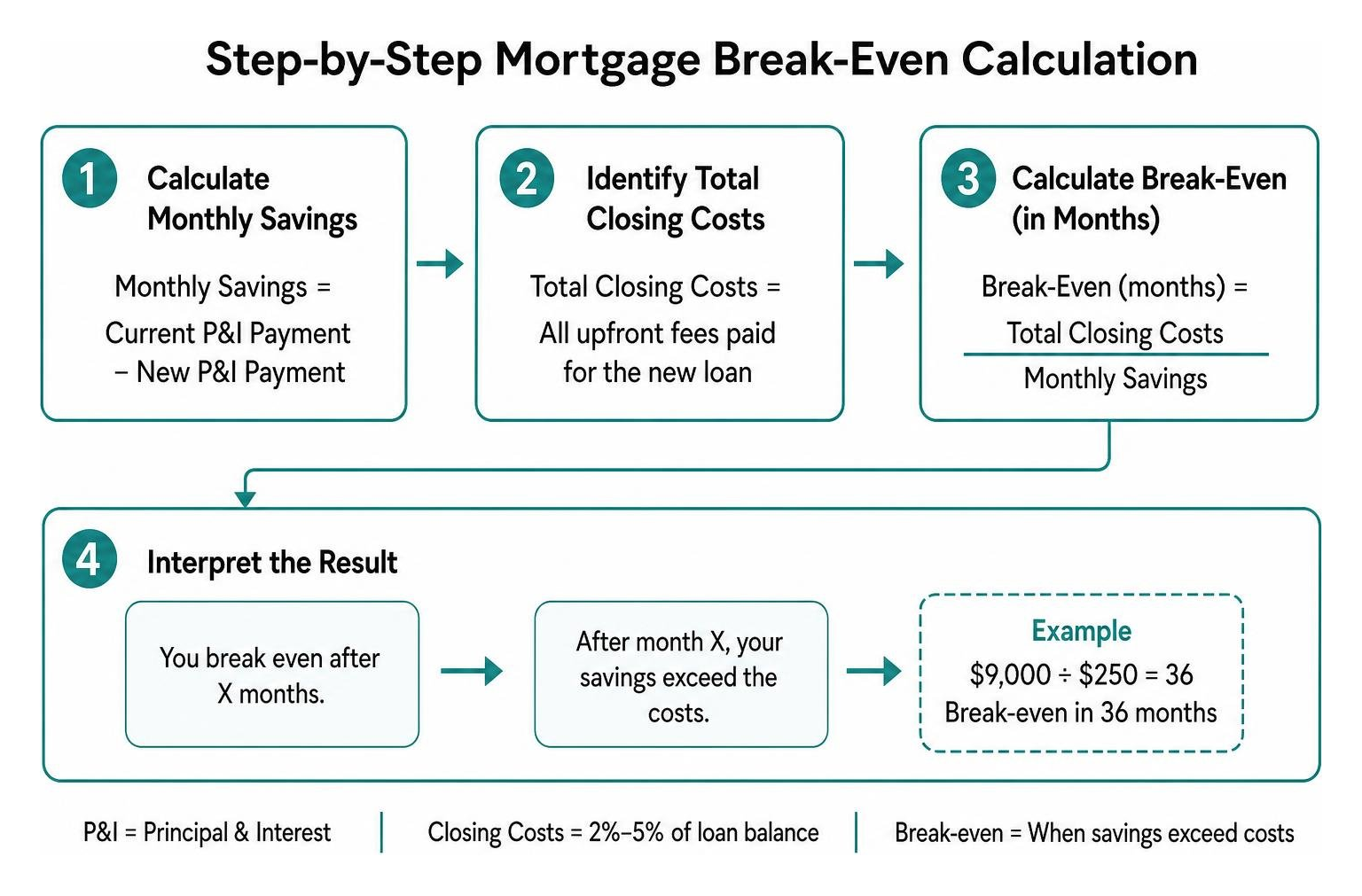
Consider this practical scenario:
Current Monthly Principal & Interest: $2,650
New Monthly Principal & Interest: $2,400
Monthly Savings: $250
Total Closing Costs: $9,000
Break-Even Calculation: $9,000 ÷ $250 = 36 months (3 years)
If you plan to live in your home for five years or more, this refinance is a clear win. If you plan to sell and move in two years, refinancing would actually cost you $3,000 in net losses ($9,000 fees minus $6,000 savings). Always run the net math before signing.
Credit Scores, Loan-to-Value, and Pricing Adjustments
Lenders price loans using risk-based pricing matrices. Your final rate quote is determined by three core components:
Credit Score (FICO): Borrowers with credit scores of 740 to 780+ qualify for the top-tier advertised rates. A credit score below 660 can add 0.50% to 1.00% or more to your interest rate via loan-level price adjustments.
Loan-to-Value (LTV) Ratio: Lenders want to see a safety cushion. Maintaining at least 20% equity (an LTV of 80% or lower) eliminates the need for private mortgage insurance (PMI) and secures the lowest rate pricing.
Closing Structure: Some borrowers choose no-closing-cost loans to preserve cash. While this avoids paying out of pocket, lenders offset those fees by either raising the interest rate or rolling the fees into the principal. You can review how this structure operates by reading our guide to the best mortgage refinance companies with no closing costs.
Exploring Loan Types: Rate-and-Term, Cash-Out, and Streamlines
No two financial situations are identical. Depending on your current mortgage balance, equity level, and long-term objectives, you will choose one of three primary refinancing pathways.
Rate-and-Term vs. Cash-Out Strategies
Rate-and-Term Refinance: The most common refinance structure. Its primary goal is simply to change the interest rate, adjust the loan duration (e.g., switching from 30 years to 15 years), or remove monthly mortgage insurance. The principal balance remains essentially unchanged outside of rolling in standard closing costs.
Cash-Out Refinance: This structure replaces your existing mortgage with a larger loan, allowing you to pocket the difference in cash at closing. Because lenders take on higher risk when equity is withdrawn, cash-out transactions carry a modest interest rate premium over standard rate-and-term loans. Check our review of average cash-out refinance rates to understand this spread, and read our comprehensive cash-out refinance guide 2026 to determine maximum LTV caps.
Government Streamline Refinancing Options
If your current loan is backed by a government agency, you may have access to "streamline" programs designed to lower your rate with minimal paperwork, no income verification, and often no formal appraisal:
FHA Streamline Refinance: Available to current FHA borrowers who are up to date on their payments. The transaction must demonstrate a "tangible net benefit," meaning it must drop your combined principal, interest, and mortgage insurance payment by at least 5%.
VA Interest Rate Reduction Refinance Loan (IRRRL): Designed exclusively for eligible military veterans holding an existing VA loan. The IRRRL allows you to move to a lower interest rate with minimal underwriting and zero out-of-pocket costs required. Learn the full eligibility requirements in our VA refinance complete guide 2026.
Strategic Alternatives to a Full Mortgage Refinance
If you secured a mortgage between 2020 and 2021 with an interest rate near 3% or 4%, giving up that first lien to get cash or adjust payments might not make mathematical sense. We regularly explore alternative lending strategies for our clients across our refinance blog category.
Home Equity Lines of Credit and Second Mortgages
Rather than replacing your low-rate primary mortgage, you can keep your existing loan intact and take out a second lien:
Home Equity Line of Credit (HELOC): Works like a credit card secured by your home. You gain access to a revolving line of credit with a variable interest rate, paying interest only on the money you actually draw.
Home Equity Loan: Provides a lump-sum payout with a fixed interest rate and fixed monthly payments over a 10- to 20-year term.
The "Blended Rate" Advantage: If you have a $300,000 primary mortgage at 3.25% and need $50,000 for a home remodel, taking a second loan at 8.5% creates an overall "blended" interest rate of roughly 4.00% across your total debt. That is far more cost-effective than refinancing the entire $350,000 balance into a fresh single loan at 6.85%!
Principal Curtailment and Loan Modifications
If your goal is simply to pay less lifetime interest or eliminate your mortgage faster, you do not necessarily need a formal refinance:
Principal Curtailment (Prepayment): Making one extra mortgage payment per year or adding $150 to your principal payment each month achieves nearly the same amortization speed as a 15-year refinance, without paying a single dollar in lender closing costs or resetting your loan terms.
Loan Modification: For homeowners experiencing severe, documented financial hardship, lenders can sometimes modify original loan terms, extend repayment periods, or reduce interest rates through dedicated loss mitigation programs.
Frequently Asked Questions About Refinancing
Are refinance rates typically higher than purchase mortgage rates?
Yes, refinance rates often carry a slight premium—typically between 0.10% and 0.25% higher than purchase mortgage rates. Lenders prioritize purchase transactions because they represent time-sensitive home sales with strict contractual closing dates. Furthermore, cash-out refinances carry higher risk-based pricing adjustments from Fannie Mae and Freddie Mac due to reduced equity cushions.
How do I know if refinancing makes financial sense?
As a general benchmark, refinancing makes sense if you can:
Lower your interest rate by 0.75% to 1.00% below your current mortgage rate.
Shorten your loan term without exceeding your comfortable monthly budget.
Eliminate private mortgage insurance (PMI) because your property value has increased.
Recoup your closing costs through monthly payment savings well before you plan to sell the property.
What closing costs should I expect when refinancing?
You should plan for closing expenses ranging from 2% to 5% of your loan amount. In our service areas of New York, New Jersey, and Pennsylvania, standard closing fees include:
Lender Origination & Processing: Underwriting, document preparation, and credit checks ($1,000 - $2,500).
Third-Party Services: Professional home appraisal ($500 - $900) and title insurance search/policies ($1,200 - $2,500).
Government Taxes: County recording fees and state-specific mortgage recording taxes (which are particularly notable on New York transactions unless structured via a CEMA assignment).
Prepaid Items: Initial deposits for your property tax and homeowners insurance escrow accounts.
Conclusion
Mortgage rates in late 2026 offer valuable opportunities for borrowers looking to reduce monthly payments, accelerate equity payoff, or restructure debt. However, the biggest mistake a homeowner can make is accepting the first rate quote they receive without shopping around. Industry research shows that the vast majority of borrowers overpay by thousands of dollars over the life of their mortgage simply by failing to compare multiple lender estimates.
Whether you are evaluating a 30-year fixed loan, transitioning into a 15-year term, or tapping your home's equity, we are here to provide clear numbers, transparent fee breakdowns, and personalized loan comparisons.
Take control of your home financing today. Visit our main portal to refinance your mortgage, explore custom rate scenarios, and lock in the most competitive terms available for your unique financial profile.