Where to Plant Your Roots Without Going Broke
The Best Places to Buy a First Home in 2026 (And Why It Matters More Than Ever)
Finding the best place to buy first home is one of the most important financial decisions you'll ever make — and in 2026, it's also one of the hardest.
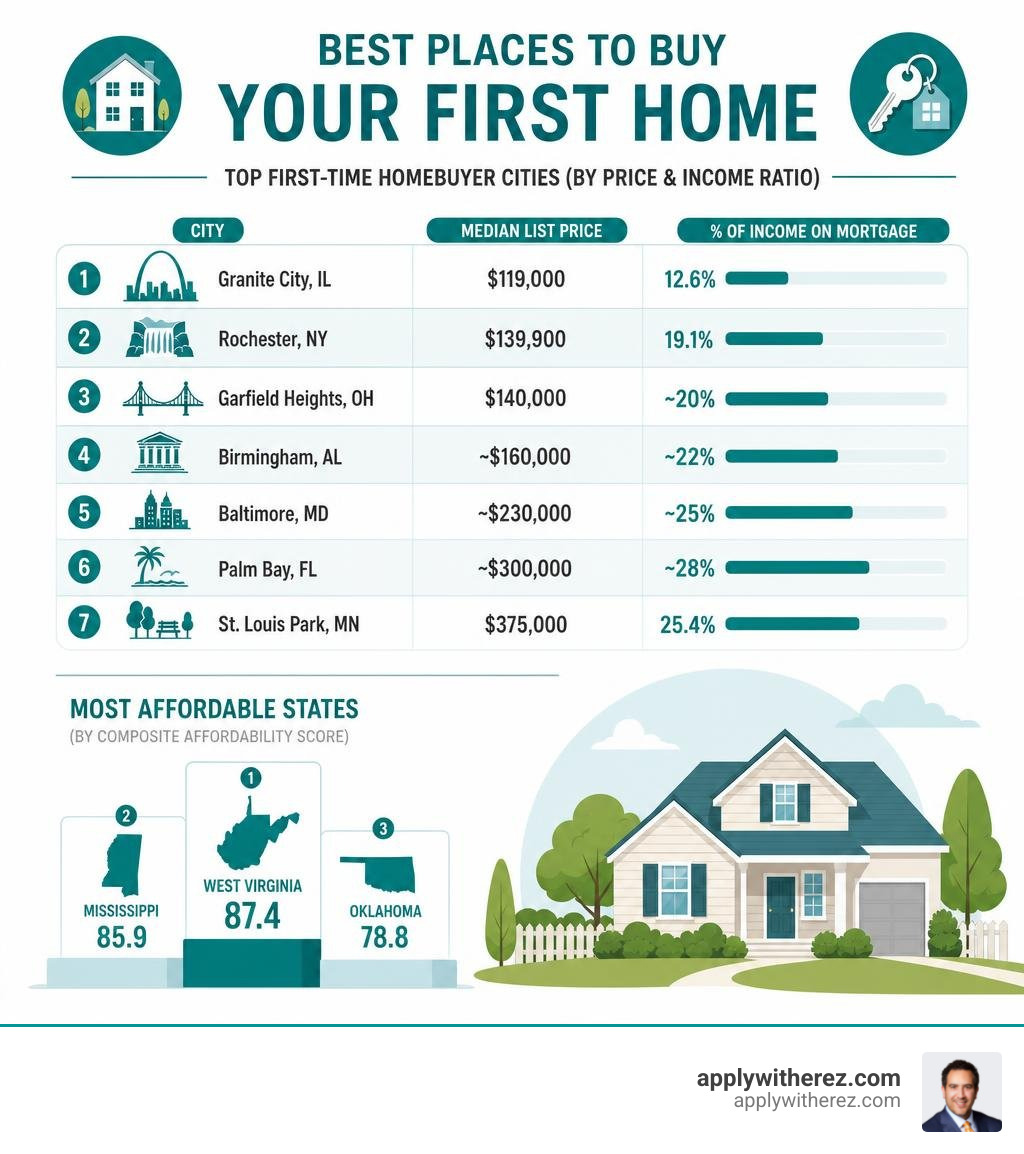
Here's a quick look at the top markets for first-time buyers right now:
City Median List Price % of Income on Mortgage Granite City, IL $119,000 12.6% Rochester, NY $139,900 19.1% Garfield Heights, OH $140,000 ~20% Birmingham, AL ~$160,000 ~22% Baltimore, MD ~$230,000 ~25% Palm Bay, FL ~$300,000 ~28% St. Louis Park, MN $375,000 25.4%
By state, the most affordable options are:
West Virginia — composite affordability score of 87.4
Mississippi — score of 85.9
Oklahoma — score of 78.8
The numbers tell a sobering story. The national median home price now tops $400,000. Meanwhile, the typical first-time buyer is now 40 years old — an all-time high. Their share of all home purchases dropped to just 21% in 2025, also a record low.
Why is it so hard? Home prices rose 56.5% between 2000 and 2023. Median household income grew only 8.5% in that same period. That gap is the affordability crisis in two numbers.
And the supply of smaller "starter" homes hasn't kept up. One- and two-bedroom homes made up 24% of new construction in the mid-1980s. By 2023, that share had collapsed to just 5%.
But here's the thing: where you buy can change everything. In some markets, a mortgage payment takes up more than 70% of a renter's monthly income (looking at you, Hawaii). In others, it's under 15%.
I'm Erez Shimoni, a mortgage professional with 26 years of experience helping buyers navigate exactly this kind of complex market — and I've put together this guide to help you find the best place to buy your first home without stretching your finances past the breaking point. Whether you're comparing cities, loan programs, or down payment strategies, this article gives you the data-backed answers you need to move forward with confidence.
What Makes a Market the Best Place to Buy First Home?

When we set out to find the best place to buy first home, we have to look beyond just the sticker price of the property. A cheap house in an area with no jobs, failing schools, and sky-high property taxes isn't actually a bargain—it's a financial trap.
To identify the markets that genuinely set first-time buyers up for long-term wealth and stability, we evaluate locations using a mix of key metrics:
Price-to-Income Ratio: This is the ultimate test of local affordability. It measures how many years of median household income it takes to purchase a median-priced home in that area.
Cost of Living: If your groceries, utilities, and gas cost a fortune, you'll have less money left over to make your monthly mortgage payments.
Job Market Strength: A robust local economy ensures you have the income stability needed to support homeownership and means your home's value is more likely to grow over time.
School Systems: Even if you don't have children, buying in a highly rated school district protects your property value and makes your home much easier to sell when you're ready to move.
Property Taxes and Insurance: These ongoing costs vary wildly by state and city, and they can add hundreds of dollars to your monthly housing bill.
Finding the Best Place to Buy First Home: Affordability vs. Amenities
Nationally, the monthly mortgage payment for a typical starter-size home consumes 38.4% of the median income for renter households. This means that in the average American city, first-time buyers are "house poor"—spending well over the recommended 30% of their income on housing.
However, when you dig into the data, you find incredible regional differences. For instance, in states like Kansas, Oklahoma, and West Virginia, starter home mortgage payments consume only 26.0%, 28.2%, and 29.0% of the median renter's income, respectively.
By utilizing a detailed Analysis of starter home markets, we can see that the most successful buyers are those who strike a balance between affordability and local amenities. You don't have to sacrifice your quality of life to afford a home. Many midsize and smaller metros offer vibrant downtowns, excellent parks, and short commutes alongside incredibly reasonable home prices.
To make this transition successfully, you need a clear strategy. Learning the Best Way to Buy a House for the First Time involves setting realistic expectations, understanding your local market's price-to-income dynamics, and getting pre-approved before you start shopping.
Why Location Matters When Choosing the Best Place to Buy First Home
Location doesn't just dictate your daily commute; it dictates your financial future. In real estate, we look closely at three major indicators of market health: home appreciation rates, active listings per capita, and building permits.
Home Appreciation: Buying in a market with steady, healthy appreciation builds your net worth. For example, cities like Palm Bay, Florida, have seen stellar appreciation rates over the last decade, turning starter homes into powerful wealth-building engines.
Active Listings (Inventory): A market with high active listings gives you negotiating power. When inventory is low, you face bidding wars that drive up prices.
Building Permits: A high number of new residential building permits indicates that the local housing supply is growing. This helps keep home prices stable and gives you more modern housing options to choose from.
Even in high-cost states, there are pockets of opportunity. For example, if you are looking at the West Coast, researching the Best Places to Buy a New Home in California can help you identify specific master-planned communities and emerging suburbs that offer better value, builder incentives, and modern energy-efficient features compared to dense coastal urban cores.
Top U.S. Cities for First-Time Buyers in 2026
If you want to break into homeownership this year, several standout cities combine historically low entry prices with strong local economies. Let's look at the top markets where your dollar goes the furthest.
Affordable Urban Gems Under $200,000
Yes, you can still buy a home for under $200,000 in America. In fact, some of the absolute best markets for first-time buyers sit well below this threshold, offering short commutes and solid economic foundations.
Rochester, NY: Topping the charts as one of the premier markets for first-time buyers, Rochester boasts a median listing price of just $139,900. Even better, buyers here spend an average of only 19.1% of their income on mortgage payments. With a short 21-minute average commute and a steady influx of young professionals, it's an incredibly stable place to plant roots.
Granite City, IL: Located just across the river from St. Louis, Granite City offers the lowest median listing price among top first-time buyer markets at an astonishing $119,000. Buyers here spend a mere 12.6% of their income on mortgage payments, leaving plenty of room in the budget for savings, travel, and home improvements.
Garfield Heights, OH: With a median list price of $140,000, this Cleveland suburb offers highly affordable housing stock, mature tree-lined streets, and easy access to major employment hubs.
According to the latest industry data on the 10 Best Markets for First-time Home Buyers in 2026, these affordable urban cores are outperforming traditional distant suburbs because they allow younger buyers to enjoy city amenities without taking on overwhelming debt.
High-Growth Metros with Strong Quality of Life
If you have a slightly larger budget and want to prioritize rapid home appreciation, strong job markets, and coastal or metropolitan lifestyles, these high-growth areas are worth your attention.
Palm Bay, FL: Ranked as one of the very best cities for first-time buyers, Palm Bay features the fifth-highest millennial homeownership rate in the country and the third-highest home appreciation rate. It offers a perfect blend of job opportunities in the aerospace and tech sectors, beautiful weather, and active housing development.
Baltimore, MD: Representing the cheapest major city on many affordability lists, Baltimore offers a median home list price of approximately $230,000. It’s an excellent option for buyers who want big-city culture, world-class medical institutions, and historic architecture at a fraction of the cost of nearby Washington, D.C. or Philadelphia.
Pittsburgh, PA: Regularly ranking as the number-one large metro area for starter home availability and affordability, Pittsburgh combines a booming tech and healthcare economy with incredibly resilient neighborhood real estate markets.
For those looking near major metropolitan areas, exploring tools like the 2026 Best Places to Buy a House in New York City Area can help you locate affordable suburban pockets and transit-friendly towns that keep you connected to major job markets without the NYC price tag.
Key Financial Factors for First-Time Buyers

Buying your first home isn't just about finding the right address; it's about preparing your finances so that the mortgage process goes smoothly. Lenders look at your complete financial profile to determine how much they are willing to lend you and at what interest rate.
Getting Your Finances in Order
Before you start browsing real estate websites, you need to take an honest look at your financial health. We recommend focusing on three main pillars:
Your Credit Score: Your credit score is the single biggest factor determining your interest rate. A higher score can save you tens of thousands of dollars over the life of your loan.
Your Debt-to-Income (DTI) Ratio: This is the percentage of your gross monthly income that goes toward paying debts (like student loans, car payments, and credit cards). Lenders generally prefer a DTI ratio below 43%, though some loan programs allow higher.
Your Down Payment and Cash Reserves: While you don't necessarily need 20% down, you will need cash for your down payment, closing costs, and an emergency fund to cover unexpected home repairs.
To help you get started, we've outlined a clear path in our guide on Five Simple Steps to Get Your Finances in Order. Once you have a handle on your monthly income and debts, you can use our interactive Mortgage Calculator to test different home prices, down payment amounts, and interest rates to see what your actual monthly payment would look like.
Understanding the True Cost of Homeownership
One of the most common mistakes first-time buyers make is assuming their monthly housing cost will just be the mortgage principal and interest. When you own a home, you are also responsible for:
Property Taxes: These are assessed by your local government and can vary wildly. A $200,000 home in a high-tax state can cost more per month than a $250,000 home in a low-tax state.
Homeowners Insurance: This protects your home against damage from fire, storms, and other disasters. It is required by all mortgage lenders.
Maintenance Costs: As a renter, you call the landlord when the AC breaks. As an owner, that $5,000 replacement bill is yours. We recommend budgeting 1% to 2% of your home's purchase price annually for ongoing maintenance.
Homeowners Association (HOA) Fees: If you buy a condo, townhome, or a house in a planned subdivision, you may have to pay monthly or annual HOA fees to maintain common areas and community amenities.
Financing Options and Assistance Programs
The mortgage landscape can feel overwhelming, but there are several specialized loan options designed specifically to help first-time buyers break into the market with minimal cash out of pocket.
Low and No Down Payment Mortgages
You do not need a 20% down payment to buy a home. In fact, the median down payment for first-time buyers sat at 10% in 2025. There are several highly accessible loan programs available:
Conventional 3% Down Loans: Many conventional mortgage programs allow qualified first-time buyers to put down as little as 3% of the purchase price.
FHA Loans: Backed by the Federal Housing Administration, these loans require just 3.5% down and have much more flexible credit score requirements (often allowing scores down to 580).
VA Loans: For active-duty military, veterans, and surviving spouses, VA loans offer 0% down payment options and do not require monthly private mortgage insurance (PMI).
USDA Loans: Backed by the U.S. Department of Agriculture, these loans offer 0% down for homes located in designated rural and suburban areas.
To help you decide which path is right for your unique financial situation, read our breakdown of the Best Type of Mortgage for First Time Buyers. If you are looking for creative financing paths, you can also explore our comprehensive list of 100 Mortgages for First Time Buyers to compare your options side-by-side.
Grants and Down Payment Assistance
Many buyers don't realize that states, counties, and cities offer local down payment assistance (DPA) programs. These programs provide grants or low-interest secondary loans that can be used to cover your down payment or closing costs.
For example, some cities (like Rochester, NY) offer up to $8,000 in direct home purchase assistance grants for qualifying buyers. Other programs offer forgivable second mortgages that completely disappear if you live in the home for a set number of years (usually 5 to 10 years).
To maximize your savings, check out our guide on the Best First Time Buyer Mortgages 2026, which highlights current grant programs, tax credits, and lender incentives that can help you keep more cash in your pocket at the closing table.
Frequently Asked Questions about Buying a First Home
What is the absolute cheapest state to buy a starter home?
Based on composite scores measuring home availability, price-to-income ratios, and supply, West Virginia ranks as the best and most affordable state to buy a starter home, followed closely by Mississippi and Oklahoma. In these states, a typical starter home mortgage payment consumes less than 30% of the median renter's monthly income, compared to over 73% in Hawaii and 64% in California.
How much down payment do I really need in 2026?
While the median down payment for first-time buyers reached 10% recently, you can buy a home with as little as 3% down using a conventional first-time buyer program, or 3.5% down using an FHA loan. If you qualify for a VA or USDA loan, or if you utilize a local down payment assistance grant, you may be able to buy a home with 0% down.
Is it better to buy in a rapidly growing or established market?
It depends on your goals and risk tolerance:
Rapidly Growing Markets (e.g., Palm Bay, FL): Offer higher potential for rapid home appreciation and equity growth, but they come with higher competition, bidding wars, and rising property taxes.
Established Markets (e.g., Rochester, NY or Pittsburgh, PA): Offer incredible stability, lower entry prices, and predictable housing costs, making them safer options for buyers focused on steady, long-term budgeting.
Conclusion
Finding the best place to buy first home is all about matching your personal budget with a market that offers room to grow. While the national housing market presents real challenges, cities like Rochester, Granite City, and Baltimore prove that affordable homeownership is still very much within reach if you know where to look.
Successful homeownership doesn't start with a house hunt—it starts with a plan. By getting your finances in order, calculating your true monthly costs, and choosing the right mortgage program, you can plant your roots and build lasting wealth without going broke.
When you're ready to take that exciting first step, we are here to help. Explore your options, calculate your purchasing power, and start your journey to homeownership today by visiting our Buy a Home portal.