From 5 to 100 Mortgages for First Time Buyers Explained
Why 100 Mortgages for First Time Buyers Are Worth Understanding
Finding 100 mortgages for first time buyers — loans that cover the full purchase price with zero down payment — is more possible in 2026 than many people think.
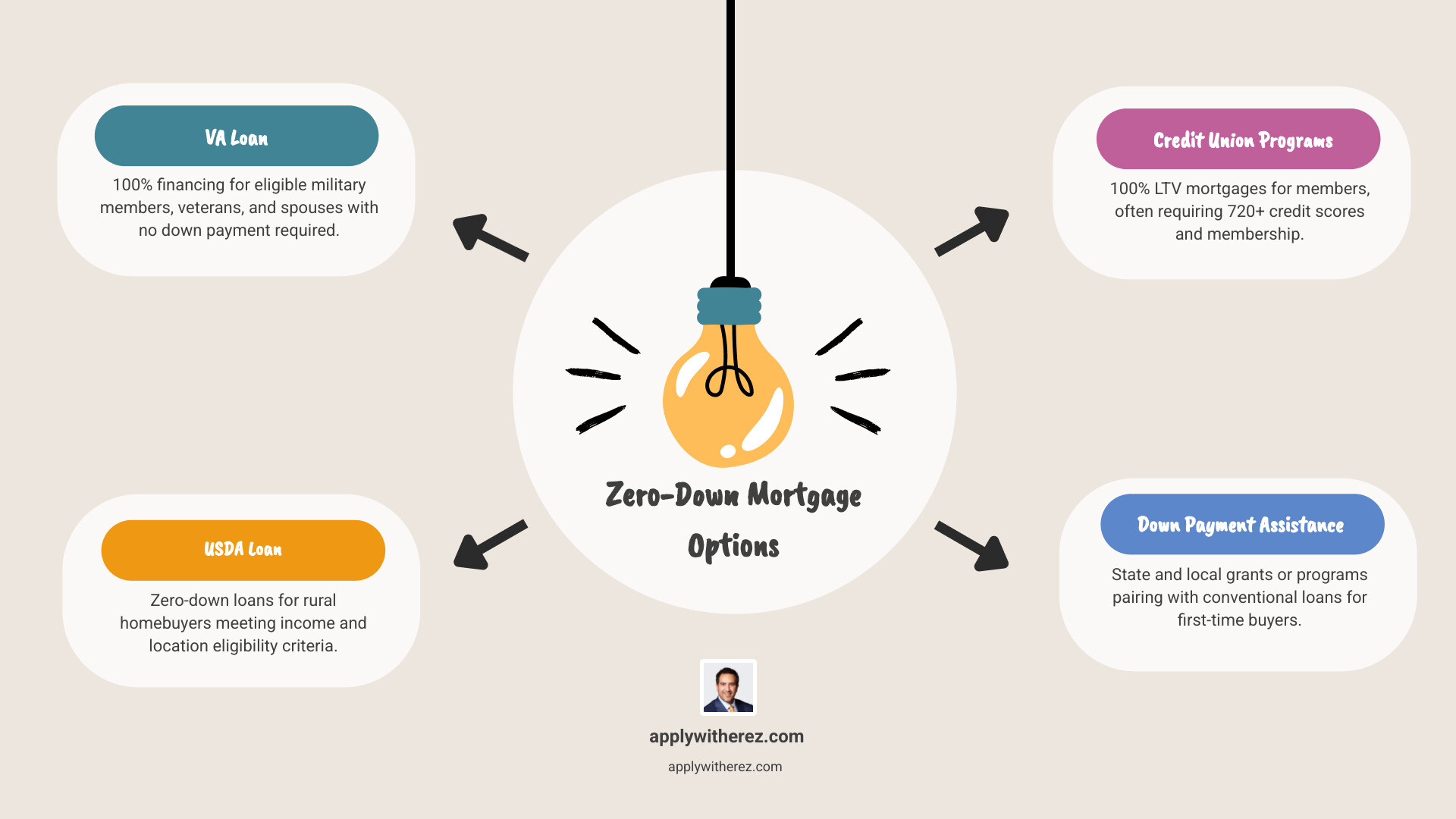
Here's a quick look at your main zero-down options:
Option Who It's For Key Requirement VA Loan Military/veterans VA eligibility USDA Loan Rural buyers Location + income limits Credit union 100% programs Eligible members 720+ credit score (varies) Down Payment Assistance (DPA) Income-qualifying buyers State/local program rules Guarantor/Track Record mortgage Renters with solid payment history UK market specific
The biggest hurdle to homeownership isn't always income — it's the down payment. Saving 10% or 20% can take years, especially with rising rents eating into monthly budgets.
That's exactly why 100% financing programs exist. They let qualified buyers skip the down payment entirely and get into a home now.
But these loans come with trade-offs. Higher interest rates, stricter credit requirements, and limited property eligibility are all part of the picture. Understanding the full landscape — before you apply — is what separates a smart move from a costly mistake.
I'm Erez Shimoni, a mortgage professional with 26 years of experience helping buyers navigate complex financing options, including 100 mortgages for first time buyers across New Jersey, New York, Florida, and Pennsylvania. I'll walk you through everything you need to know so you can make a confident, informed decision.
Understanding 100 Mortgages for First Time Buyers

When we talk about 100 mortgages for first time buyers, we are referring to a 100% Loan-to-Value (LTV) ratio. In plain English, this means the lender is willing to lend you the entire purchase price of the home. If the house costs $400,000, the loan is for $400,000. You bring $0 to the closing table for the down payment itself.
This is a massive shift from the traditional "20% down" rule that dominated the market for decades. In 2026, lenders recognize that many young professionals have the income to support a mortgage but lack the liquid savings due to student loans and high cost of living.
However, zero deposit doesn't mean zero equity forever. While you start with no equity (your debt equals the home's value), you begin building equity the moment you make your first payment or if the property value increases. It’s a way to stop paying a landlord and start investing in your own future. For more details on the journey, check out our guide on how to buy a home.
Current Market Rates for 100 Mortgages for First Time Buyers
In May 2026, interest rates for 100% financing are slightly higher than those for buyers putting 20% down. Lenders view a zero-down loan as higher risk, so they charge a "risk premium" in the interest rate.
Fixed Rates: Most 100% loans come in 15, 20, or 30-year fixed terms. As of now, a 30-year fixed rate for a zero-down credit union loan might hover around 6.625% to 7.0%, depending on your credit profile.
Variable Rates: These can offer lower initial payments but carry the risk of rising later. Some specialty 100% products use "discounted variable" structures, which are common in specific niche markets.
Rate Drop Options: Some innovative lenders now offer a "No-Refi Rate Drop." If rates fall significantly within a few years of your purchase, you might be able to lower your interest rate for a small flat fee (around $250) without going through a full, expensive refinance.
To see how these rates impact your wallet, use our Mortgage Calculator to run the numbers.
Eligibility for 100 Mortgages for First Time Buyers with Low Credit
Can you get a 100% mortgage with less-than-perfect credit? It’s a challenge, but not impossible. Most "true" 100% conventional or credit union loans want to see a FICO score of 720 or higher. However, there are pathways for others:
Specialist Lending: Some programs look at "nontraditional" credit data, like your history of on-time rent and utility payments.
Self-Employed Applicants: If you work for yourself, you'll generally need two years of tax returns showing stable or increasing income. Lenders will use your net income (after deductions) to calculate what you can afford.
Credit Repair: If you're sitting at a 640, it might be worth waiting six months to boost that score. A higher score doesn't just help you qualify; it can save you tens of thousands of dollars in interest over the life of the loan.
Ready to see where you stand? You can start your application here.
Top 100% LTV Deals and Lender Requirements in 2026
Lenders offering 100 mortgages for first time buyers usually have very specific "playbooks." Here is a comparison of what you might find in the current market:
Program Type Max Loan Amount PMI Required? Property Type Credit Union 100 Up to $832,750 No Primary Residence Only VA Home Loan No Limit (with entitlement) No Stick-built, Condos, Multi-unit USDA Rural Varies by County No (Monthly fee instead) Rural/Suburban Only Specialist FTB Varies No New Builds/Primary
Most of these programs share one strict rule: the home must be your primary residence. You cannot use 100% financing to buy an investment property or a vacation home. If you want to dive deep into these deals, Book a Call to Compare Deals.
Credit Score and Income Thresholds
While 720 is the "gold standard" for the best rates on 100 mortgages for first time buyers, some programs are more flexible.
Debt-to-Income (DTI) Ratio: Lenders generally want your total monthly debts (including the new mortgage) to be under 43% to 45% of your gross monthly income.
Income Multiples: In some markets, lenders limit the loan to about 4 to 4.5 times your annual salary.
Employment History: You typically need a two-year consistent work history in the same field, though exceptions are made for recent graduates entering high-paying professions (like medicine or law).
Property Types and Regional Restrictions
Not every house qualifies for 100% financing.
Single-Family Homes: These are the easiest to finance.
Warrantable Condos: The condo association must meet certain financial and occupancy standards.
Acreage: Some credit union programs limit the property to 10 acres or less.
Geography: USDA loans are strictly limited to areas designated as "rural" by the government. You can check specific addresses on the USDA Eligibility Map (though many surprisingly suburban areas still qualify!).
Pros, Cons, and Total Costs of No-Down-Payment Loans

Choosing a no-down-payment mortgage is a major financial decision. Let's look at the reality of these loans:
The Pros:
Buy Sooner: You don't have to wait 5 years to save $50,000.
Keep Your Cash: You can use your savings for furniture, repairs, or an emergency fund.
No PMI: Many 100% programs specifically eliminate Private Mortgage Insurance, which can save you hundreds per month.
The Cons:
Negative Equity Risk: If home prices drop even 1%, you owe more than the house is worth. This makes it hard to sell or refinance quickly.
Higher Payments: Since you're borrowing more money at a potentially higher rate, your monthly check to the bank will be larger.
Stricter Standards: It is harder to qualify for 100% financing than a standard 3.5% down FHA loan.
If you find yourself in a high-rate 100% loan now, you can always look into refinance options later once you've built up some equity.
Avoiding Private Mortgage Insurance (PMI)
Usually, if you put down less than 20%, you have to pay PMI. This insurance protects the lender, not you. However, many 100 mortgages for first time buyers offered by credit unions or through the VA use "Lender-Paid Mortgage Insurance" (LPMI) or simply waive it.
How it works: The lender takes on the risk themselves but usually charges a slightly higher interest rate to compensate.
The Benefit: Your monthly payment is more predictable, and you don't have to worry about "canceling" PMI once you reach 20% equity.
Long-term Interest and Fees
Don't forget the closing costs! Even with 0% down, you still have to pay for the appraisal, title insurance, and government taxes.
Origination Fees: Usually around 1% of the loan amount.
Funding Fees: VA loans and some 100% programs have a "funding fee" (around 1.75% to 2.15%) that can often be rolled into the loan amount.
Discount Points: You can sometimes "buy down" your interest rate by paying extra upfront. If you plan to stay in the home for 10+ years, this is often a smart move.
Alternatives and Government Support Schemes
If a "standard" 100% mortgage doesn't fit, there are other ways to reach the goal of zero out-of-pocket for a down payment.
VA Home Loans: If you are a veteran or active-duty service member, this is almost always your best bet. It offers 100% financing, no PMI, and very competitive rates. Learn more about the VA Home Loan.
USDA Rural Development: For homes in eligible areas, these loans offer 100% financing with very low monthly fees. They are designed for low-to-moderate-income buyers.
FHA with DPA: You can take a standard FHA loan (which requires 3.5% down) and pair it with a Down Payment Assistance (DPA) grant to cover that 3.5%. This effectively creates a 100% financing scenario.
Non-Occupant Co-Borrowers
Sometimes, you have the credit but not quite enough income to satisfy the lender's ratios. In these cases, a "non-occupant co-borrower" (usually a parent or close relative) can join the loan.
Affordability Boost: Their income is added to yours, helping you qualify for a higher amount.
Risk: They are equally responsible for the debt. If you miss a payment, their credit is damaged too.
Exit Strategy: Many buyers use a co-borrower to get the house, then refinance a few years later to remove the relative once their own income has grown.
Down Payment Assistance (DPA) Programs
DPA programs are the "hidden gems" of the mortgage world. These can be grants (which don't have to be repaid) or "silent second" mortgages (which are repaid only when you sell the house).
Gifted Funds: Most 100% programs allow 100% of your closing costs to be covered by a gift from a family member.
Seller Concessions: In 2026, many sellers are willing to contribute up to 3% of the purchase price toward your closing costs to get the deal done.
If you're feeling overwhelmed by the options, the best step is to Consult with an expert.
Frequently Asked Questions about 100% Mortgages
Can I get a 100% mortgage for a new build or investment property?
For new builds, yes—many 100% programs allow for the purchase of a newly constructed primary residence. However, investment properties are almost universally excluded from 100% LTV programs. Lenders typically require at least 15-25% down for properties you don't intend to live in.
How long does the 100% mortgage application process take?
The timeline is similar to standard loans. You can often get pre-qualified in 24 hours. Once you have a contract on a home, the full approval and closing process usually takes between 21 and 45 days.
Do 100% mortgages require Private Mortgage Insurance (PMI)?
While most low-down-payment loans do, many specific 100 mortgages for first time buyers (like those from VA, USDA, or certain credit unions) are structured to avoid traditional monthly PMI. Always check the "fine print" to see if the insurance is built into the interest rate instead.
Conclusion
Getting into your first home doesn't have to mean draining every penny of your life savings. 100 mortgages for first time buyers offer a powerful bridge to homeownership, provided you understand the responsibilities that come with a higher loan amount.
Financial readiness starts with a clear plan. Check your credit, stabilize your income, and explore the programs available in your specific area. Whether it's a VA loan, a USDA rural grant, or a credit union's zero-down program, the door to homeownership is open wider than you might think.
Ready to take the first step toward your front door?
Book a Call to discuss your specific situation.