
Finding the Best 15 Year VA Refinance Rates for Your Budget
Why Finding the Best 15-Year VA Refinance Rates Can Save You Thousands
The best 15-year VA refinance rates available right now offer eligible veterans and service members a powerful way to cut their total interest costs and build home equity faster. Here's a quick snapshot of where rates stand as of June 2026:
Loan Type Interest Rate APR Discount Points 15-Year VA Refinance 5.250% 5.941% 0.500 30-Year VA Refinance 5.625% 6.045% 0.500 15-Year Fixed (National Avg.) 6.11% - - 30-Year Fixed VA (National Avg.) 6.51% 6.54% -
Key takeaways at a glance:
The 15-year VA refinance rate is currently well below the national average for 15-year fixed loans
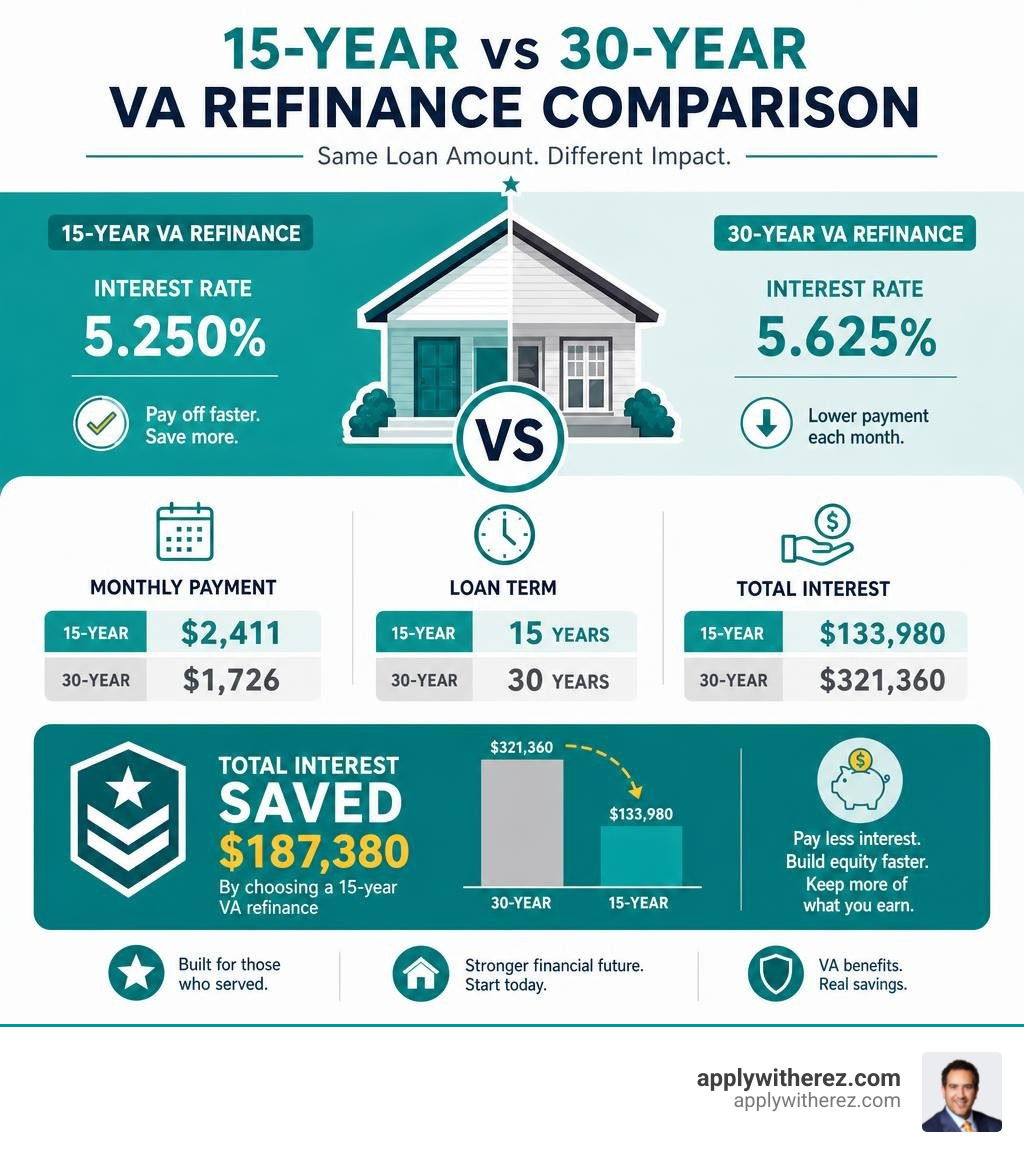
A $300,000 VA loan at 5.250% over 15 years results in a monthly payment of approximately $2,411
The same loan over 30 years at 5.625% drops the monthly payment to $1,726 — but costs far more in total interest
Veterans with service-connected disabilities may qualify for a VA funding fee waiver, lowering upfront costs even further
Choosing between a 15-year and 30-year VA refinance isn't just about the monthly payment. It's about the total cost of borrowing over time — and the difference can run into tens of thousands of dollars.
Whether you're looking to shorten your loan term, lock in a lower rate, or eliminate mortgage insurance by switching from a conventional loan, a 15-year VA refinance is one of the most cost-effective tools available to eligible borrowers today.
I'm Erez Shimoni, a mortgage broker with 26 years of experience helping veterans and service members navigate VA loan options — including finding the best 15-year VA refinance rates for their specific financial situations. I'll walk you through everything you need to make a confident, informed decision.
Understanding 15-Year VA Refinance Loans

When we talk about refinancing a mortgage, most homeowners automatically think of the standard 30-year fixed loan. It’s familiar, comfortable, and keeps your monthly payment as low as possible. But if your goal is long-term wealth building and minimizing the amount of money you hand over to a lender, a 15-year term is where the real magic happens.
A 15-year VA refinance loan functions similarly to any other fixed-rate VA loan, but with a compressed timeline. Because you are paying off the principal over 180 months instead of 360, your monthly payments will naturally be higher. However, in exchange for that larger monthly commitment, lenders reward you with significantly lower interest rates.
Historically, and in today's June 2026 market, the interest rates on 15-year mortgages hover around 0.50% to 0.75% lower than their 30-year counterparts. When combined with the unique backing of the Department of Veterans Affairs, the 15 Year VA Mortgage Rates are often some of the most competitive interest rates in the entire financial sector.
Another major advantage of a shorter term is how quickly you build equity. In a standard 30-year mortgage, the vast majority of your payments during the first ten years go directly toward paying off the interest. With a 15-year term, a much larger portion of your very first payment goes directly toward reducing your principal balance. If you plan on staying in your home long-term or want to enter retirement completely debt-free, shortening your term is a highly effective strategy. To see how these terms compare on a broader scale, you can check out the national average trends on Compare Current 15-Year Mortgage Rates.
Comparing the Best 15 Year VA Refinance Rates to 30-Year Options
To understand why so many veterans actively seek out the best 15-year VA refinance rates, we have to look closely at the math. Let's compare a $300,000 VA refinance loan under both a 15-year and a 30-year term using real-world market rates from June 2026.
Metric 15-Year VA Refinance 30-Year VA Refinance Loan Amount $300,000 $300,000 Interest Rate 5.250% 5.625% Monthly Payment (P&I) $2,411 $1,726 Total Payments Over Life of Loan $433,980 $621,360 Total Interest Paid $133,980 $321,360 Lifetime Savings $187,380 -
By choosing the 15-year option, your monthly payment is $685 higher. For many households, that is a substantial difference that requires careful budgeting. However, look at the bottom line: you save $187,380 in interest payments over the life of the loan. You also own your home free and clear 15 years sooner.
If you prefer the security of a lower monthly payment but still want the option to pay off your home early, you can explore 30 Year VA Streamline Refinance Rates and simply make extra principal payments whenever your budget allows. However, you won't get the built-in benefit of the lower interest rate that comes automatically with a dedicated 15-year term.
VA IRRRL vs. 15-Year VA Cash-Out Refinance
If you decide to move forward, you must choose between two primary types of VA refinances:
VA Interest Rate Reduction Refinance Loan (IRRRL): Often called the "VA Streamline," this option is designed strictly for borrowers who already have an active VA loan. The primary goal is to lower your interest rate or transition from an adjustable-rate mortgage (ARM) to a fixed-rate loan. The beauty of the IRRRL is its simplicity. In most cases, we do not need a new home appraisal, income verification, or extensive underwriting. The closing costs are minimal, and the VA funding fee is reduced to just 0.50%.
VA Cash-Out Refinance: Despite the name, you do not actually have to take cash out to use this program. A VA Cash-Out refinance is required if you are refinancing a non-VA loan (such as a conventional or FHA mortgage) into a VA loan. It is also the correct choice if you want to tap into your home’s equity to pay off high-interest debt, fund home improvements, or cover major life expenses. This option allows you to borrow up to 100% of your home's appraised value. Because it carries more risk for the lender, it requires a full appraisal, complete income verification, and has a higher VA funding fee.
To determine which path aligns with your current home equity and financial goals, you can explore our comprehensive breakdown of the Refinance process.
How to Secure the Best 15 Year VA Refinance Rates
Securing the absolute lowest rate on the market requires some preparation. While the VA guarantees a portion of the loan, private lenders still set the interest rates and terms. They will evaluate your financial profile to determine how much risk you present.
To position yourself as a top-tier applicant, we recommend focusing on three key areas:
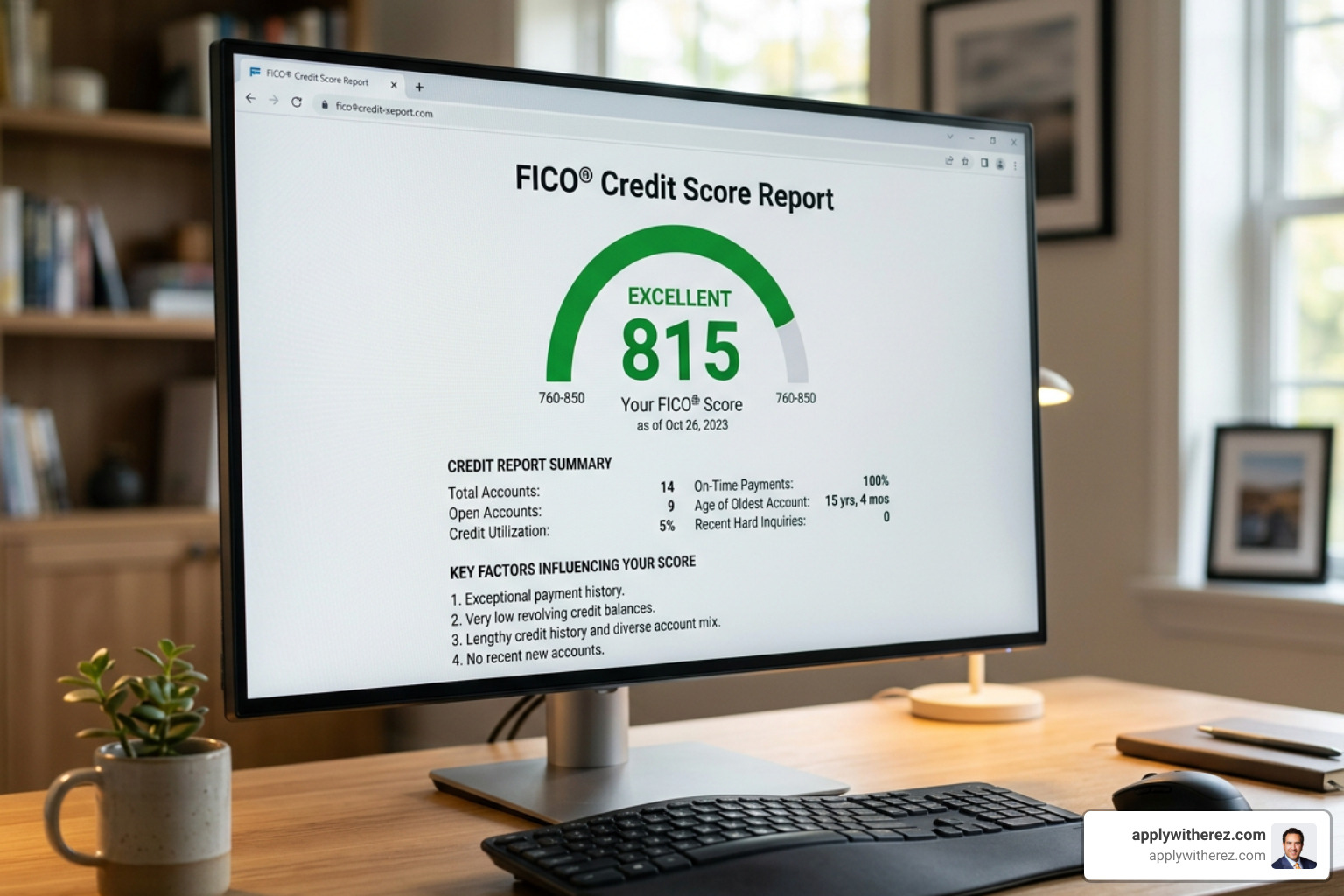
Your Credit Score: Although the VA does not enforce a strict minimum credit score, most lenders establish their own "overlays." For the absolute best rates, aim for a credit score of 740 or higher, though highly competitive options are still available for scores above 620.
Debt-to-Income (DTI) Ratio: This ratio compares your monthly debt payments to your gross monthly income. Lenders prefer to see a DTI below 43%, especially for a 15-year term where the higher monthly payment naturally pushes your debt obligations higher.
Loan-to-Value (LTV) Ratio: Having equity in your home reduces the lender's risk. While the VA allows up to 100% financing, keeping your LTV lower can sometimes help you secure better terms.
To see how your current credit profile aligns with standard industry expectations, you can review the guidelines on Compare Current 15-Year Refinance Rates.
Key Factors That Determine the Best 15 Year VA Refinance Rates
Mortgage rates are dynamic and change daily based on broader economic forces. Understanding these factors can help you time your refinance perfectly:
The Federal Reserve & Inflation: While the Fed doesn't directly set mortgage rates, its monetary policy heavily influences them. When inflation is high, the Fed raises benchmark rates, which pushes mortgage rates upward. Conversely, when inflation cools, rates tend to drop.
10-Year Treasury Yields: Mortgage rates track very closely with the yield on the 10-year U.S. Treasury note. When investor confidence shifts, these yields move, dragging mortgage rates along with them.
Lender Competition: Different financial institutions have different profit margins and risk tolerances. This is why shopping around is so critical — one lender might offer a rate that is a quarter-percent lower than another for the exact same scenario.
The Impact of Discount Points, APR, and Closing Fees
When comparing quotes, never look only at the advertised interest rate. You must evaluate the Annual Percentage Rate (APR) and the breakdown of closing costs.
Interest Rate vs. APR: The interest rate is the cost to borrow the principal balance annually. The APR is a broader measure that includes the interest rate, loan origination fees, discount points, and other closing costs. Comparing APRs gives you a much more accurate picture of the true cost of the loan.
Discount Points: One discount point equals 1% of your loan amount. Paying points upfront permanently lowers your interest rate. For example, on a $300,000 loan, paying 0.50 points ($1,500) might lower your rate by 0.125% or 0.25%. If you plan to stay in the home long enough to pass the "break-even point," buying points is an excellent strategy.
Closing Costs: Refinancing typically costs between 2% and 5% of the loan amount. Make sure to calculate how many months of savings it will take to recover these upfront costs.
To run the numbers on your specific scenario, you can compare current national trends using the 15-Year Refinance Rates comparison tool.
Eligibility and the VA Funding Fee
To qualify for a 15-year VA refinance, you must meet the standard service requirements established by the Department of Veterans Affairs. Generally, this includes active-duty service members, veterans, National Guard and Reserve members, and eligible surviving spouses.
To prove your eligibility, you will need a Certificate of Eligibility (COE). If you don't have yours on hand, don't worry — we can quickly pull this document for you through the official VA portal. To learn more about the specific service requirements and how the program works, check out our guide on the VA Home Loan.
One of the defining characteristics of a VA loan is the absence of private mortgage insurance (PMI). However, the VA charges a one-time "funding fee" to help sustain the program for future generations of veterans. You can compare how this fee impacts overall borrowing costs by visiting Compare Current VA Loan Rates Today.
Funding Fee Exemptions and Financing Options
The VA funding fee varies depending on the type of refinance and whether you have used your VA loan benefit before:
VA IRRRL (Streamline): The funding fee is a flat 0.50% of the loan amount, regardless of prior usage.
VA Cash-Out Refinance: The fee is 2.15% for first-time use and increases to 3.30% for subsequent uses.
The good news? You might not have to pay it at all. The VA waives the funding fee entirely for:
Veterans receiving disability compensation for a service-connected disability.
Veterans who would be entitled to receive disability compensation if they didn't receive retirement pay.
Surviving spouses of veterans who died in service or from a service-connected disability.
If you are not exempt, you do not need to pay this fee out of pocket at closing; the VA allows you to roll the funding fee directly into your total loan balance. To explore more about how state-specific guidelines and credit tiers affect these fees, you can refer to VA 30 Year Refinance Rates & Cash Out.
Choosing the Right Lender for Your 15-Year VA Refinance
Not all VA lenders are created equal. While many institutions offer VA loans, their rates, fees, and level of customer service vary dramatically.
Credit Unions: Often offer some of the lowest interest rates and minimal fees because they operate as non-profit cooperatives. However, they usually require membership.
Online Lenders: Typically provide highly streamlined, digital application processes and rapid closing times, though they may lack personalized service.
Traditional Banks: Offer the convenience of face-to-face service if you already have a checking or savings account with them, but their rates and fees can sometimes be higher.
When shopping for the best 15-year VA refinance rates, we recommend getting official Loan Estimates from at least three different lenders on the same day. This allows you to compare their rates, closing costs, and APR side-by-side.
To help you narrow down your options, we've compiled a list of the Best VA Streamline Refinance Lenders.
Frequently Asked Questions about 15-Year VA Refinancing
Can I refinance a conventional loan into a 15-year VA loan?
Yes! This is a highly popular option for veterans who currently have a conventional or FHA loan. By refinancing into a 15-year VA loan, you can eliminate monthly private mortgage insurance (PMI) and take advantage of the lower interest rates unique to the VA program. This transition is processed as a VA Cash-Out refinance, meaning it will require a standard appraisal and full income verification.
How soon can I refinance my existing VA loan?
To prevent predatory lending practices, the VA enforces strict "seasoning" requirements. You must wait at least 210 days from the date of your first monthly payment, and you must have made at least six consecutive monthly payments on your current loan before you are eligible to refinance.
Is a 15-year VA refinance right for me?
It depends entirely on your cash flow and long-term goals. If your income is stable and your primary goal is to pay off your home quickly, eliminate debt, and save the maximum amount of interest, a 15-year term is an exceptional choice. However, if you prefer to have a lower, more flexible monthly commitment so you can invest your extra cash elsewhere, a 30-year term might suit your lifestyle better.
Conclusion
Refinancing your home is a highly personal decision. While the mathematical savings of a 15-year term are undeniable, the higher monthly payment must comfortably fit within your household budget.
If you are ready to explore your options, compare personalized quotes, and find the best 15-year VA refinance rates for your financial goals, we are here to help. Our team specializes in helping veterans maximize their hard-earned benefits.
Take the next step toward financial freedom today. Book a Call with us to discuss your goals, or start your quick online application via our Refinance CTA portal.