
Beginner's Guide to Mortgage Brokers
What Is a Mortgage Broker and How Do They Work?
A mortgage broker acts as a licensed intermediary between homebuyers and wholesale lenders. Instead of lending their own capital, an independent broker shops across an extensive wholesale mortgage marketplace to secure competitive terms tailored to your unique financial profile.
When you apply directly with a retail financial institution, you are restricted exclusively to their in-house menu. If their specific underwriting parameters do not match your debt-to-income (DTI) profile or credit background, your application is denied, forcing you to begin the process again elsewhere. In contrast, an independent broker originates, structures, and processes your loan application before placing it with the wholesale lender that offers the best pricing, fastest underwriting, and most favorable terms.
Working with an independent expert allows you to manage critical financing milestones efficiently, from locking in competitive interest rates during fluctuating market cycles to navigating government-backed programs through a licensed FHA loan broker.
Lending Feature | Independent Mortgage Broker | Direct Retail Bank / Depository Institution |
|---|---|---|
Product Selection | Broad access to dozens of wholesale lenders | Limited strictly to proprietary internal products |
Rate Sourcing | Wholesale pricing channels with flexible margin options | Retail markup pricing set by corporate headquarters |
Underwriting Flexibility | Can switch lenders without restarting your entire file | Rigid internal overlays; denial ends the transaction |
Licensing Requirements | Individual NMLS license with mandatory state testing | Federal registration only; individual state testing not required |
Target Loan Types | Conventional, Jumbo, FHA, VA, Non-QM, Reverse | Standard conventional and select in-house portfolio products |
The Role of a Mortgage Broker in Home Financing
The role of a broker extends beyond quoting interest rates. We serve as your strategic advisor and project manager throughout the entire home acquisition journey.
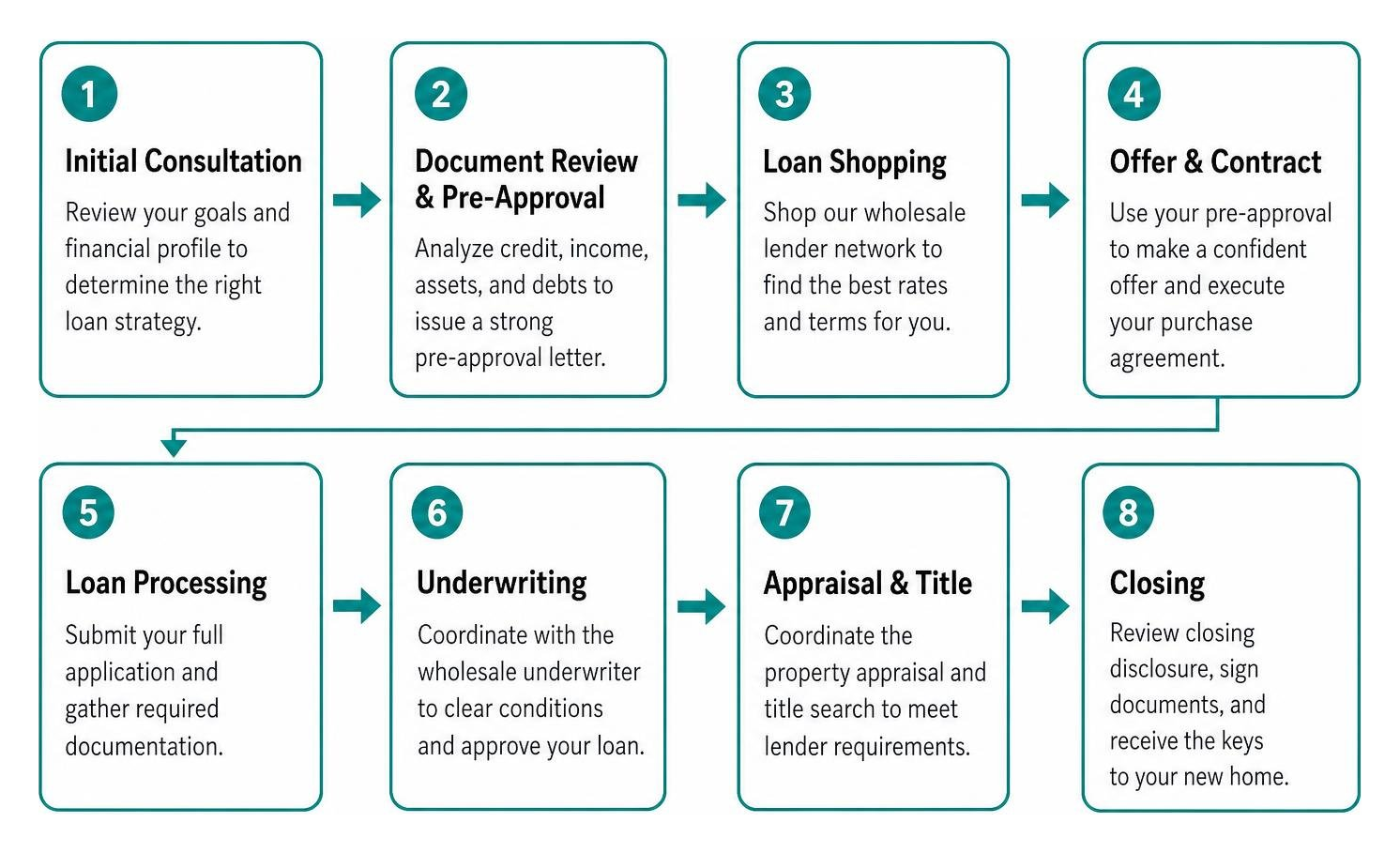
From the initial consultation, we analyze your credit reports, income documentation, and asset statements to structure a robust pre-approval letter that strengthens your offer in competitive housing markets across New Jersey and Pennsylvania. Once your purchase contract is executed, we manage rate lock periods, coordinate third-party property appraisals, handle title search requirements, and communicate directly with wholesale underwriters to clear conditions swiftly.
Mortgage Broker Compensation and Fee Structures
Understanding broker compensation is straightforward because federal lending laws enforce strict transparency. Under the Dodd-Frank Act and Truth in Lending Act (TILA), brokers cannot charge hidden fees or steer borrowers toward higher-interest products to increase their earnings.
Mortgage brokers typically earn a flat fee equal to 1% to 2% of your total loan cost. This compensation is structured in one of two distinct ways:
Lender-Paid Compensation: The wholesale lender pays the broker's fee directly upon loan funding. This fee is factored into wholesale pricing and does not require an out-of-pocket payment from the borrower at the closing table.
Borrower-Paid Compensation: The homebuyer pays the origination fee directly as part of their standard closing costs, which often allows the broker to secure an even lower wholesale interest rate from lenders that do not offer lender-paid margins.
Federal regulations strictly prohibit dual compensation: a broker cannot collect fees from both the lender and the borrower on the same transaction. Every penny of compensation is itemized clearly on page 2 of your official Loan Estimate and Closing Disclosure forms.
Mortgage Broker Services: A Detailed Comparison
Choosing the right financing vehicle requires weighing speed, product depth, and total long-term borrowing costs. While some borrowers prefer dealing directly with their local depository institution, others benefit from the broader marketplace access provided by an independent professional.
Lending Channel | Typical Turn Time | Loan Variety | Ideal Borrower Profile |
|---|---|---|---|
Wholesale Broker | Fast (often 21 days or less) | Wide (Conventional, Jumbo, Government, Non-QM) | Buyers wanting custom loan structures and wholesale pricing |
Retail Commercial Bank | Moderate to Slow (30 to 45+ days) | Standard (Conventional, select proprietary) | Buyers with simple W-2 income seeking existing customer discounts |
Online Direct Lender | Variable (25 to 40 days) | Moderate (Standard consumer loan programs) | Tech-first shoppers comfortable with call-center communication |
When to Choose an Independent Broker
An independent broker is particularly valuable when your financial situation calls for specialized loan programs or rapid execution. If you need access to niche financing solutions—such as jumbo loans that exceed conforming loan limits, flexible financing through an estate agent mortgage advisor, or non-qualified mortgage (Non-QM) options—a broker can match your scenario with an investor who specializes in that specific asset class.
Brokers are also ideal for time-sensitive purchases. In hot regional markets, wholesale channels can frequently complete mortgage deals in 21 days or less, giving your purchase offers a substantial advantage over buyers using slower retail institutions.
When a Single-Lender Approach Makes Sense
Working directly with a traditional bank or credit union can make sense under specific circumstances. If you maintain substantial liquid assets with a private wealth management group, your depository bank may offer proprietary relationship discounts, such as waiving origination fees or shaving a quarter-point off your interest rate.
Additionally, if a local community bank holds unique portfolio loans on its balance sheet for properties requiring unconventional structural repairs, their direct in-house lending team might provide a single-party approval path.
How to Choose the Best Mortgage Professional for Your Needs

Selecting the right professional requires careful verification of licensing, local market expertise, and operational transparency. Begin by verifying your loan originator's credentials through the NMLS Consumer Access registry. Working with a dedicated professional who has decades of experience navigating regional housing markets ensures your loan application avoids costly processing delays.
Essential Questions to Ask Before Hiring
Before signing an agreement or submitting your application, conduct a brief interview with your prospective mortgage professional:
How many wholesale lenders do you actively work with on your lending panel?
What are your average underwriting turn times from application submission to clear-to-close?
Will you provide a full, itemized breakdown of your compensation structure and closing costs upfront?
What are your specific policies regarding rate lock periods and float-down options if market rates improve?
Who will be my direct point of contact when underwriting conditions need to be cleared?
Required Documentation and Application Prep
Organizing your financial documentation early accelerates the pre-approval process and eliminates last-minute closing delays. When preparing to work with a broker, assemble the following records:
Income Verification: W-2 statements from the past two years, year-to-date pay stubs covering at least 30 consecutive days, and 1099 or complete federal tax returns (personal and business) for self-employed applicants.
Asset Statements: Two to three months of complete checking, savings, investment, and retirement account statements demonstrating seasoned down payment and reserve funds.
Credit Records: Identification verification, explanations for any historic credit inquiries, and divorce decrees or child support documentation if applicable.
Property Details: The executed purchase contract, real estate tax sheets, and contact details for your homeowners insurance agent.
Frequently Asked Questions About Home Loans and Brokers
Can a broker help if I have non-traditional income?
Yes. Independent brokers have direct access to specialized Non-QM lenders who cater to self-employed professionals, 1099 contractors, and business owners. While traditional banks rely strictly on net taxable income shown on tax returns—which often reflects substantial legal write-offs—a broker can leverage bank statement loan programs. These products qualify borrowers using 12 to 24 months of gross business or personal deposits, asset depletion models, or debt-service coverage ratios (DSCR) for real estate investments.
How long does the loan process take from application to closing?
While national retail lenders often require 30 to 45 days to underwrite a standard loan file, an efficient broker working with streamlined wholesale channels frequently closes purchase transactions in 14 to 21 days. The exact timeline depends on how quickly you provide documentation, the turnaround speed of the independent property appraiser, and how rapidly the local municipal title search is completed.
Does working with a broker cost more than going straight to a lender?
No. Wholesale lenders do not incur the massive retail overhead, branch maintenance expenses, and national advertising budgets associated with large consumer banks. Consequently, wholesale rates are offered at lower base margins. Even after factoring in the standard 1% to 2% broker compensation, the total loan pricing and interest rates secured through an independent broker are frequently equal to or lower than retail bank offerings.
Conclusion
Finding the right residential financing requires balancing transparent fee structures, broad loan product availability, and responsive, local expertise. By partnering with an independent professional, you gain access to wholesale rates and flexible underwriting options that traditional single-lender institutions cannot match. When you are ready to evaluate your buying power with clear, straightforward guidance, start your home financing with Apply with Erez to secure the ideal mortgage structure for your future home.