
How to Find the Best FHA Loan Broker for Your First Home
Why Working with an FHA Loan Broker Can Make or Break Your First Home Purchase
Finding the right FHA loan broker is one of the most important steps you can take toward buying your first home — especially if your credit isn't perfect or your savings are limited.
Quick answer: What does an FHA loan broker do?
What They Do Why It Matters Shop your file across dozens of lenders You get competing offers, not just one option Navigate lender overlays Find lenders whose rules match your credit profile Access wholesale loan pricing Often lower rates than retail banks Guide you from pre-approval to closing One point of contact throughout the process Match you to FHA-approved lenders Ensures your loan meets HUD standards
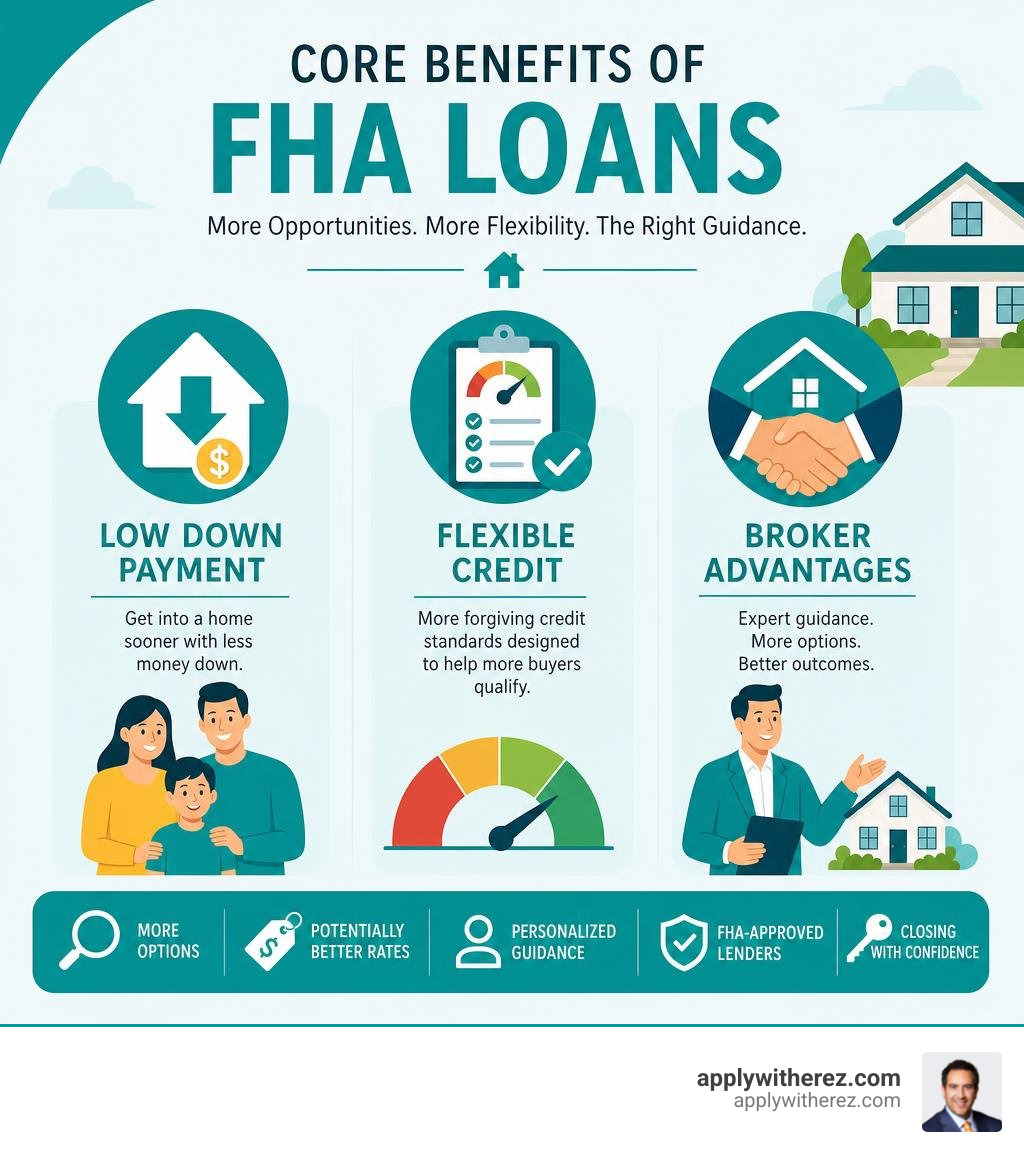
The Federal Housing Administration (FHA) has been helping people become homeowners since 1934. The program was built for buyers who need a more flexible path — lower down payments, more forgiving credit standards, and higher tolerance for debt.
But here's what most people don't realize: the FHA doesn't lend money directly. It insures the loan. That means you still need to find the right lender — and who you work with can significantly affect your rate, your costs, and whether you even get approved.
Many first-time buyers go straight to their bank, get one offer, and assume that's the best they can do. It often isn't.
I'm Erez Shimoni (NMLS #460222), a mortgage broker with 26 years of experience helping borrowers navigate the FHA loan process across New Jersey, New York, Florida, and Pennsylvania. As an FHA loan broker, I work with a wide network of wholesale lenders to find the program that actually fits your situation — not just the one my employer happens to offer.
What is an FHA Loan and How Does It Work?

At its core, an FHA loan is a federal program designed to make homeownership accessible. Because these loans are backed and insured by the Federal Housing Administration (a division of HUD), private lenders feel much more comfortable taking on borrowers who might not fit the rigid box of a conventional mortgage.
If a borrower defaults, the government steps in to protect the lender. This insurance reduces the risk for financial institutions, allowing them to offer highly competitive interest rates and much more lenient qualifying guidelines.
To learn more about the various options available through federal programs, you can explore the official guide on Government-backed home loans and mortgage assistance.
One fundamental rule of the FHA program is the primary residence requirement. You cannot use an FHA loan to buy a vacation home or a straight investment property that you plan to leave vacant. You must intend to occupy the home as your primary residence within 60 days of closing and live there for at least one full year.
Credit Score and Down Payment Requirements
The most famous benefit of the FHA loan program is its low down payment requirement. However, the exact amount you need to put down is tied directly to your credit score:
580 Credit Score or Higher: You qualify for the minimum down payment of just 3.5% of the purchase price.
500 to 579 Credit Score: You can still qualify for an FHA loan, but you must provide a 10% down payment.
For many young families and first-time buyers, saving up even 3.5% can feel like a mountain to climb. Fortunately, FHA guidelines are incredibly generous when it comes to where that money comes from. Unlike conventional programs that often require you to prove the funds are entirely your own, FHA allows 100% of your down payment and closing costs to come from gift funds provided by family members, employers, or approved housing assistance programs.
If you are just starting your journey to homeownership, check out our comprehensive guide for a Post/First Time Home Buyer to learn how to prepare your finances.
2026 FHA Loan Limits and Multi-Unit Properties
Every year, the Department of Housing and Urban Development (HUD) adjusts the maximum amount you can borrow using an FHA loan based on local home value trends. For the current year of July 2026, the single-family loan limits are structured as follows:
The Floor (Standard Areas): $541,287
The Ceiling (High-Cost Areas): $1,249,125
These limits are even higher if you are looking at multi-unit properties. FHA guidelines allow you to purchase a 1 to 4 unit property (such as a duplex, triplex, or fourplex) using the exact same low down payment of 3.5%, provided you live in one of the units as your primary residence.
This opens up a massive wealth-building strategy known as "house-hacking." You can purchase a multi-family building, move into one unit, and rent out the other units. The rental income from the other tenants can be used to help you qualify for the loan and, in many cases, will cover your entire monthly mortgage payment.
FHA Loans vs. Conventional Loans
When you are ready to buy a home, you will almost certainly find yourself choosing between an FHA loan and a conventional loan. Understanding how these two paths compare will help you make the smartest financial decision.
Feature FHA Loan Conventional Loan Minimum Credit Score 500 (with 10% down) / 580 (with 3.5% down) Typically 620 Minimum Down Payment 3.5% 3% (for highly qualified first-time buyers) / 5% standard Max Debt-to-Income (DTI) Up to 50% (sometimes higher with compensating factors) Typically capped at 43% to 45% Mortgage Insurance Required (Upfront + Monthly for life of loan in most cases) Required if down payment is under 20% (Can be cancelled) Pricing Structure No risk-based pricing adjustments on interest rates Risk-based pricing (lower credit scores pay higher rates) Seller Concessions Up to 6% of purchase price Typically capped at 3% for low down payment loans
One of the biggest differences lies in the debt-to-income (DTI) ratio tolerance. Your DTI is the percentage of your gross monthly income that goes toward paying debts (like student loans, credit cards, auto loans, and your future mortgage). While conventional loans get highly restrictive if your DTI climbs above 43%, FHA loans routinely accept DTIs up to 50%—and sometimes even higher if you have strong compensating factors like solid cash reserves.
Furthermore, FHA loans do not utilize risk-based pricing. On a conventional loan, if your credit score is 640, you will be hit with heavy pricing adjustments that drive your interest rate up. On an FHA loan, a borrower with a 640 credit score can secure virtually the same highly competitive interest rate as a borrower with a 740 credit score.
To see which path matches your personal goals, take a look at our detailed breakdown of the Post/Best Type Of Mortgage For First Time Buyers.
Understanding the Costs of an FHA Loan

While FHA loans are incredibly accessible, they are not free. The government backing that makes these loans possible is funded by mortgage insurance premiums (MIP) paid by the borrower. There are two types of mortgage insurance associated with every FHA loan:
Upfront Mortgage Insurance Premium (UFMIP): This is a one-time fee equal to 1.75% of your total loan amount. The good news is that you do not have to pay this out of pocket at closing; FHA allows you to roll this cost directly into your total loan balance.
Annual Mortgage Insurance Premium (MIP): Despite the name "annual," this fee is divided by 12 and paid as part of your monthly mortgage payment. For most standard borrowers putting 3.5% down, this premium is approximately 0.55% of the remaining principal balance.
It is vital to understand the MIP cancellation rules. If you put less than 10% down on an FHA loan, the monthly MIP remains on the loan for its entire life. The only way to get rid of it is to eventually refinance into a conventional loan once you have gained 20% equity. However, if you make a down payment of 10% or more, the monthly MIP will automatically drop off after 11 years.
For a complete and detailed breakdown of these rules, you can consult the official FHA Single Family Housing Policy Handbook.
Beyond mortgage insurance, you will also face standard closing costs (such as lender fees, title insurance, and escrow setup). Fortunately, FHA guidelines allow sellers to contribute up to 6% of the home's purchase price toward your closing costs. This is double the 3% cap found on most conventional loans and can dramatically reduce the amount of cash you need to bring to the closing table.
Why You Should Work with an FHA Loan Broker
When you decide to apply for an FHA loan, you have two primary paths: you can walk into a direct retail bank, or you can partner with an independent mortgage broker.
A direct lender or bank can only offer you the specific loan products, interest rates, and underwriting rules that their single institution supports. If your financial profile doesn't perfectly fit their internal box, they will simply deny your application.
An independent FHA loan broker, on the other hand, acts as a matchmaker. We do not fund the loan with our own money. Instead, we take your unique financial application and shop it across dozens of different wholesale lenders. This wholesale market access allows us to compare multiple offers simultaneously, ensuring you receive the absolute best interest rates and lowest fee structures available.
To keep an eye on how current market conditions are shifting, you can review our tracker on Post/30 Year Fha Mortgage Rates Today.
How an FHA Loan Broker Navigates Lender Overlays
One of the most confusing parts of the mortgage industry is the concept of "lender overlays." While HUD sets the baseline rules for FHA loans (such as a 580 credit score for a 3.5% down payment), individual banks are allowed to create their own stricter rules on top of those guidelines. These extra rules are called overlays.
For example, a traditional bank might decide that even though the government allows a 580 credit score, their bank will not approve anyone with a score below 620. If you apply with them and have a 590 score, they will turn you down.
This is where an FHA loan broker becomes your greatest asset. Because we work with many different wholesale lenders, we know exactly which institutions have zero overlays. If you have a credit score of 580 or a higher debt-to-income ratio, we will bypass the restrictive banks and send your file directly to a wholesale lender that strictly follows the standard, flexible FHA guidelines.
Steps to Choose the Right FHA Loan Broker
Not all brokers are created equal. When you are looking for the right professional to handle your first home purchase, follow these steps:
Verify FHA Approval: Ensure the broker is officially FHA-approved and registered with the Nationwide Multistate Licensing System (NMLS).
Ask About Wholesale Variety: Ask how many different wholesale lenders they work with. A healthy broker shop should have access to dozens of options.
Check Local Market Expertise: Work with a broker who understands local property taxes, homeowners insurance trends, and regional closing costs.
Compare Loan Estimates: A great broker will lay out your options side-by-side, explaining the interest rate, APR, and estimated monthly payments clearly without any high-pressure sales tactics.
The FHA Loan Process from Pre-Approval to Closing
Navigating the mortgage process can feel overwhelming, but breaking it down into clear steps makes the journey highly manageable.
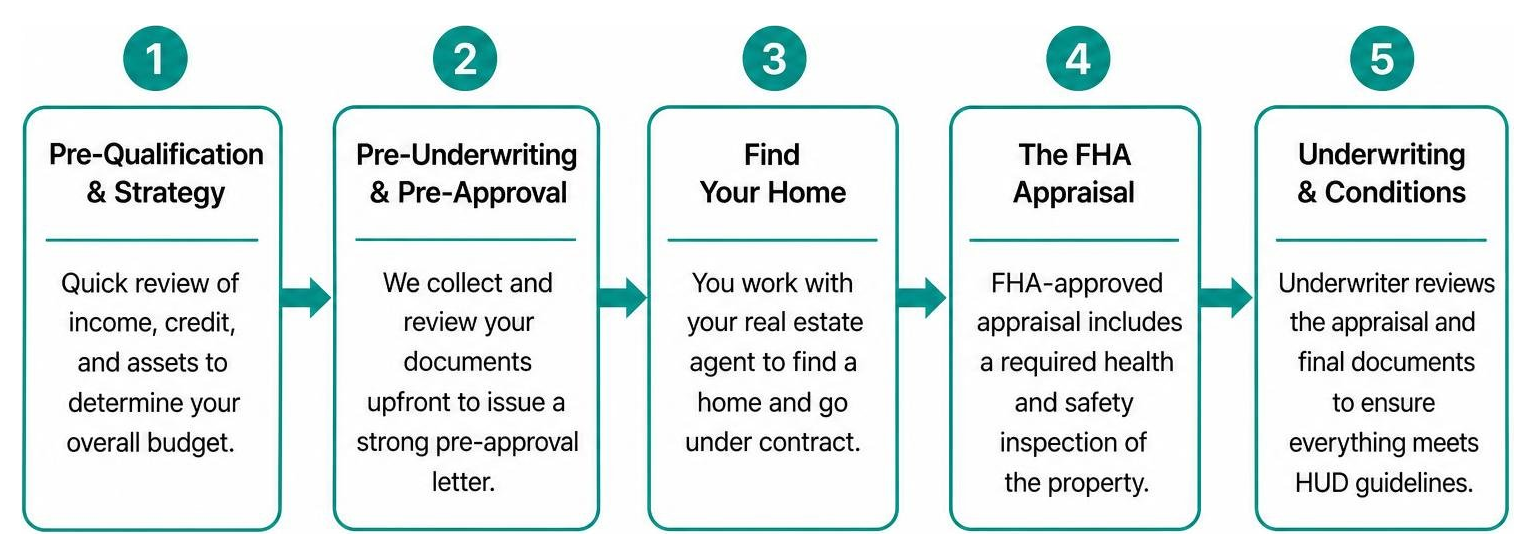
Pre-Qualification & Strategy: We begin with a quick review of your income, credit, and assets to determine your overall budget.
Pre-Underwriting & Pre-Approval: We collect your actual W-2s, tax returns, and bank statements. Pre-underwriting your file upfront ensures that your pre-approval letter is rock-solid when you make an offer. To play with the numbers yourself and see how different purchase prices affect your monthly budget, try out our online mortgage calculator.
Find Your Home: Armed with your pre-approval letter, you work with your real estate agent to find a home and go under contract.
The FHA Appraisal: The lender will order an FHA-approved appraisal. Unlike a standard conventional appraisal, an FHA appraisal includes a mandatory health and safety inspection. The appraiser will check for basic safety hazards, such as peeling lead-based paint, exposed electrical wiring, missing handrails, or a failing roof. Any safety issues must be repaired by the seller before the loan can close.
Underwriting & Conditions: The underwriter reviews the appraisal and any final financial updates to ensure everything meets HUD guidelines.
Clear to Close: Once all conditions are met, we receive the "Clear to Close." We will coordinate your final numbers, and you will sign your closing documents to receive your keys!
Qualifying After Bankruptcy or Foreclosure
One of the most compassionate aspects of the FHA program is how quickly it allows borrowers to rebuild and buy a home after a major financial setback. If you have a past bankruptcy or foreclosure on your record, you do not have to wait seven years like you would with a conventional loan:
Chapter 7 Bankruptcy: You can qualify for an FHA loan just 2 years after your discharge date, provided you have re-established clean credit history since the discharge.
Chapter 13 Bankruptcy: You can actually qualify for an FHA loan while still in bankruptcy, as soon as you have made 12 months of consecutive, on-time court payments and receive approval from the bankruptcy judge.
Foreclosure: The waiting period to buy a home after a foreclosure is only 3 years under FHA guidelines, compared to the standard 7-year wait for conventional mortgages.
Frequently Asked Questions about FHA Loans
Can I use an FHA loan to buy an investment property?
No, FHA loans are strictly designed for primary residences. However, you can use the multi-unit "house-hacking" strategy. As long as you occupy one of the units in a 2 to 4 unit property for at least a year, you are fully permitted to rent out the remaining units as investment income.
How do I remove mortgage insurance from an FHA loan?
If you put less than 10% down, the MIP stays for the life of the loan. The most common exit strategy is to make your 3.5% down payment, watch your home's value grow over a few years, and then refinance into a conventional loan once your outstanding balance is 80% or less of the home's current market value.
Is there a maximum income limit for FHA loans?
Unlike certain regional down payment assistance programs, FHA loans have no maximum income limits. Whether you make $40,000 or $400,000 a year, you can qualify for an FHA loan as long as you meet the standard credit and debt-to-income requirements.
Conclusion
Buying your first home is a monumental milestone, and you shouldn't have to navigate the complex mortgage landscape alone. At applywitherez.com, we specialize in building highly personalized mortgage strategies that fit your real life—not just a bank's rigid checklist.
Whether you are looking to purchase a single-family home with a low down payment or build wealth through a multi-unit property, we are here to guide you every step of the way.
Ready to see what you qualify for? Book A Call with us today, or visit https://applywitherez.com to start your journey home.