New Jersey Reverse Mortgage Requirements, Payout Options, and Rules
Understanding How a Reverse Mortgage New Jersey Program Works
A reverse mortgage is a specialized financial product that flips the traditional mortgage process on its head. Instead of paying down a mortgage principal each month to build equity, an eligible homeowner receives payments from the lender backed by their accumulated home equity.
For the vast majority of borrowers, this takes the form of a Home Equity Conversion Mortgage (HECM), the federally insured reverse mortgage program sponsored by the U.S. Department of Housing and Urban Development (HUD) and backed by the Federal Housing Administration (FHA). HECM loans feature built-in consumer safeguards, including non-recourse protections. This means neither you nor your heirs can ever owe more than the home’s fair market value at the time of sale, even if home prices drop.
In modern originations, adjustable-rate HECMs track standard market benchmark rates, specifically the CME Term SOFR (Secured Overnight Financing Rate) index, which officially replaced older LIBOR standards. By consulting our reverse mortgage solutions, borrowers can choose the structure that aligns best with their retirement goals.
HECM vs. Proprietary Jumbo Reverse Mortgages
While HECM loans represent the bulk of the market, they are subject to federal maximum claim limits. In high-value New Jersey real estate markets—such as Bergen, Monmouth, Morris, or Somerset counties—homes often exceed the national FHA lending limit.
Feature | FHA HECM Loan | Proprietary (Jumbo) Reverse Mortgage |
|---|---|---|
Government Backing | Insured by FHA / HUD | Privately funded and insured |
Loan Limit | Capped by FHA maximum claim limit | Available up to $4 million or more |
Minimum Age | 62 years old | Often available starting at age 55 or 60 |
Mortgage Insurance | Upfront & annual FHA MIP required | No FHA MIP charged |
Property Types | FHA-approved properties only | Includes luxury estates & non-FHA condos |
For homeowners with multi-million dollar properties, a proprietary reverse mortgage provides a private-lending alternative that taps into substantial equity without being restricted by federal caps.
How Home Equity and Age Determine Available Proceeds
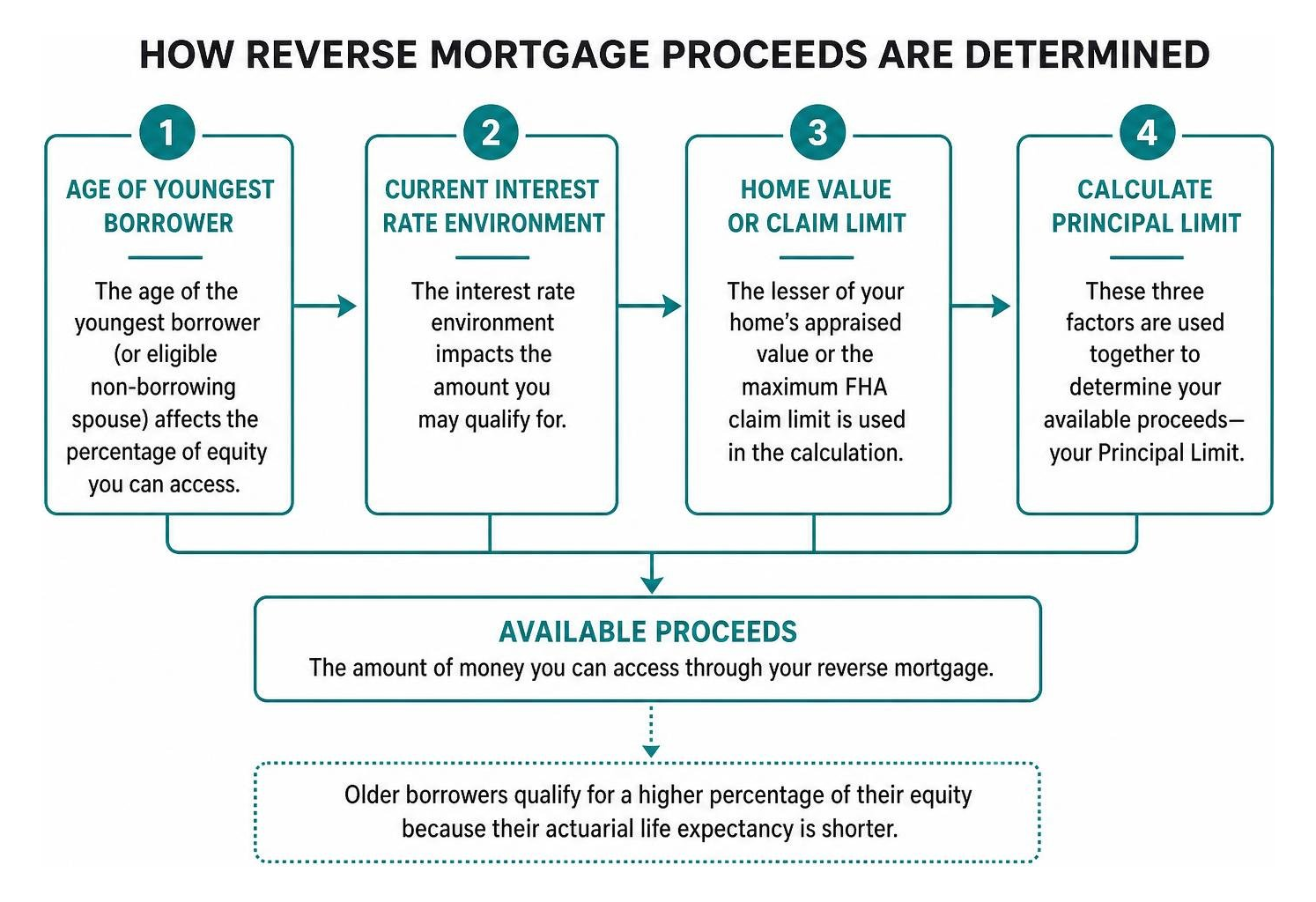
The amount of money you can access—known as the Principal Limit—is determined by three primary components:
The age of the youngest borrower (or eligible non-borrowing spouse).
The current interest rate environment.
The lesser of your home's appraised value or the maximum FHA claim limit.
As outlined in our age of reverse mortgage guide 2026, older borrowers qualify for a higher percentage of their equity because their actuarial life expectancy is shorter.
Eligibility Criteria and Disbursement Payout Options
A reverse mortgage requires careful planning to match payout structures to your day-to-day retirement cash flow needs.
Disbursement Option | How It Works | Ideal For |
|---|---|---|
Lump Sum | Single upfront payout (fixed-rate) | Paying off large existing liens or urgent repairs |
Tenure Plan | Guaranteed monthly payments for life | Supplementing fixed retirement income |
Term Plan | Fixed monthly payments for a set duration | Bridging income before Social Security/pension |
Line of Credit | Flexible draw facility that grows over time | Emergency funds and long-term liquidity |
Modified Combo | Mix of line of credit + monthly payouts | Customized ongoing cash management |
Eligibility Guidelines for a Reverse Mortgage New Jersey Homeowners Must Meet
To qualify for a HECM in the Garden State, you must satisfy basic federal and property-level criteria:
Age Requirement: The primary borrower must be at least 62 years of age.
Primary Residency: The home must be occupied as your principal residence for the majority of the calendar year.
Eligible Property Types: Single-family homes, 2-to-4 unit owner-occupied properties, HUD-approved condominiums, and manufactured homes meeting FHA standards.
Financial Assessment: Borrowers must demonstrate the financial capacity and willingness to keep property taxes, homeowners insurance, flood insurance (if applicable), and HOA dues current.
Clear or High Equity: Existing liens and conventional mortgages must be paid off at closing using the reverse mortgage proceeds or combined with outside funds.
Choosing the Right Disbursement Plan for Your Reverse Mortgage New Jersey Property
More than 60% of borrowers choose the reverse mortgage line-of-credit option. One unique feature of the HECM line of credit is its growth factor: the unused portion of your credit line grows independently at the note rate plus the mortgage insurance premium rate, expanding your available borrowing capacity over time regardless of market fluctuations.
Whether you are seeking to consolidate existing debt, manage healthcare costs, or eliminate an existing monthly mortgage payment, evaluating your numbers is essential. You can run customized estimates with our reverse mortgage calculator to view potential proceeds.
New Jersey Reverse Mortgage Regulations, Senate Bill S264, and Counseling Rules
New Jersey maintains a strong consumer protection environment to ensure that seniors are fully aware of loan terms and alternatives.

Under legislative initiatives such as S264, New Jersey establishes clear requirements designed to safeguard older homeowners against predatory terms and uninformed decisions. These measures emphasize thorough disclosure and mandatory counseling before entering into binding agreements.
Mandatory HUD-Approved Counseling and State Disclosures
Every reverse mortgage applicant must complete a comprehensive counseling session with an independent, HUD-approved housing counseling agency.
Lenders cannot steer borrowers to specific counselors and must provide a list of independent agencies.
The counseling session covers alternatives, tax ramifications, estate impacts, and the total cost breakdown.
Once completed, the counselor issues a Certificate of HECM Counseling, which is valid for 180 days.
New Jersey rules require that counseling certifications be executed before closing documents are signed to ensure adequate time for review.
Borrowers can find qualified local counseling services through the Reverse Mortgages - New Jersey State List.
Borrower Rights, Protections, and 7-Day Rescission Rules
New Jersey consumer protections build upon federal rules to provide extra peace of mind:
Right of Rescission: Federal law grants borrowers a 3-day right of rescission after closing to cancel the loan without penalty. State legislative frameworks expand these cooling-off periods to ensure clear commitment timelines.
Clear Disclosures: Mandatory disclosures must be provided in accessible, clear formats (such as 12-point font notices) explaining default triggers, tax responsibilities, and non-borrowing spouse rights.
Non-Borrowing Spouse Safeguards: Modern HECM rules protect eligible non-borrowing spouses, allowing them to remain in the home even after the borrowing spouse passes away, provided they maintain the property and pay required taxes and insurance.
Impact on Taxes, Heirs, Medicaid, and Senior Living Alternatives
Understanding how a reverse mortgage intersects with other elements of your financial plan is vital:
Income Taxes: The IRS considers reverse mortgage proceeds to be loan advances, not earned income. Consequently, the funds are non-taxable and do not increase your adjusted gross income or affect Social Security brackets.
Estate and Heirs: When the last borrower vacates the home, the heirs can choose to repay the loan balance, sell the home and keep any remaining equity, or walk away under the non-recourse FHA rule (paying 95% of the appraised value if the balance exceeds the market value).
Medicaid and SSI: While reverse mortgage proceeds do not count as income, liquid funds sitting in a standard checking account at the end of a calendar month could count toward asset limits for needs-based programs like Medicaid. Using a line of credit to draw funds only as needed helps prevent asset disqualification.
Alternatives to Consider: Seniors should evaluate alternative paths, such as traditional home equity loans, standard HELOCs, downsizing, or local New Jersey property tax relief and senior freeze programs.
Frequently Asked Questions About New Jersey Reverse Mortgages
Does the lender take ownership of my home in New Jersey?
No. You retain the deed and title to your home just as you would with any traditional mortgage. The lender simply places a lien against the property to secure the loan. As long as you fulfill basic loan conditions—living in the property as your primary residence and paying taxes and insurance—you maintain complete ownership.
What happens to the reverse mortgage balance when the homeowner passes away?
When the last surviving borrower passes away or moves into long-term care permanently, the estate receives a notification from the loan servicer. The heirs typically have six months (with available extensions up to 12 months) to decide whether to refinance the balance, sell the home and retain the excess equity, or deed the property to the lender with no personal liability beyond the home's value.
Can I use a reverse mortgage to buy a new home in New Jersey?
Yes. Through the HECM for Purchase program, seniors can purchase a new primary home and obtain a reverse mortgage in a single transaction. This allows you to downsize, relocate closer to family, or move into a single-story home without taking on ongoing monthly principal and interest payments.
Conclusion
A reverse mortgage is a flexible financial tool that can help Garden State seniors unlock their home equity while remaining in the communities they love. Because every retirement plan is unique, navigating the loan options, closing costs, and payout structures requires careful, personalized evaluation.
As an independent mortgage broker based in Piscataway, NJ, Erez Shimoni (NMLS 460222) shops across multiple wholesale lenders to find the right loan program for your specific financial picture. Contact us today to explore your options and receive professional, transparent guidance for your retirement financing.