
The Magic Number for Your Home Equity
The Magic Number: What Age Unlocks a Reverse Mortgage?
Understanding the age of reverse mortgage eligibility is simpler than most people think. Here's the quick answer:
Loan Type Minimum Age Notes HECM (FHA-backed) 62 Federal standard, unchanged for 2026 Proprietary / Jumbo 55 Select states and private lenders only Maximum age None Borrowers can qualify in their 80s, 90s, or older
The bottom line: For the most common reverse mortgage, you must be at least 62 years old. If you're younger, some private loan options may still be available depending on your state.
For many homeowners approaching retirement, the question isn't just whether a reverse mortgage works — it's when they become eligible and how much their age actually affects what they can borrow. Those two questions have very different answers depending on your loan type, your spouse's age, and the state you live in.
Getting the timing right can mean thousands of dollars more in available home equity. Getting it wrong — or misunderstanding the rules — can delay your plans or leave money on the table.
I'm Erez Shimoni, a mortgage professional with 26 years of industry experience, and the age of reverse mortgage requirements are one of the most common points of confusion I help clients work through. In this guide, I'll break down exactly how age affects your eligibility and your loan proceeds — so you can make a confident, informed decision.
What Is the Minimum age of reverse mortgage for 2026?
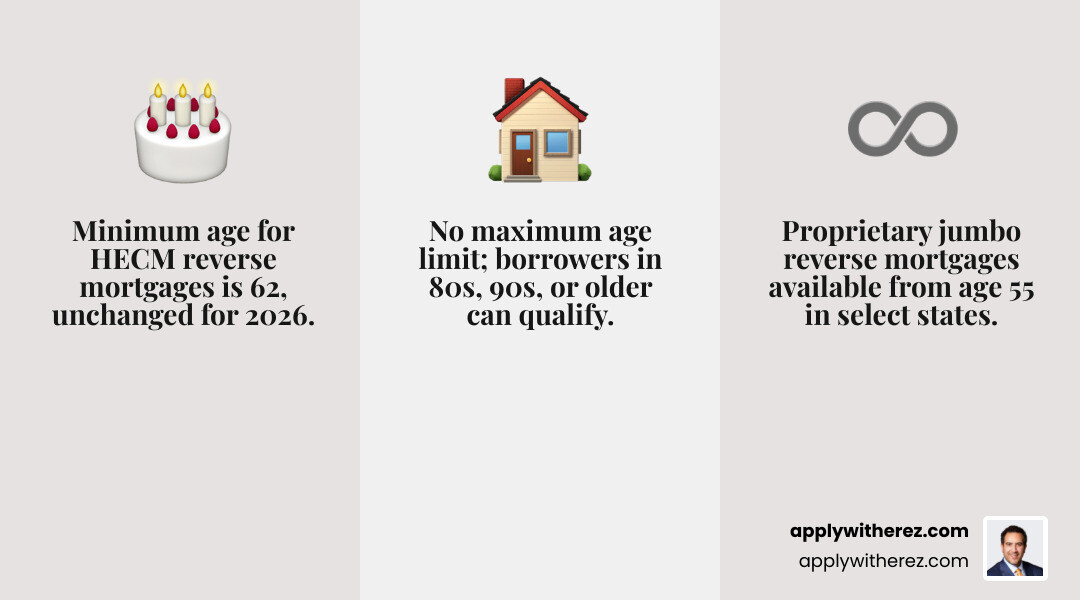
In 2026, the minimum age for a standard Home Equity Conversion Mortgage, or HECM, is still 62. That rule has not changed.
A HECM is the most common reverse mortgage because it is FHA-backed and follows federal guidelines. If you are asking about the usual reverse mortgage age requirement, 62 is the number you need to remember.
The key detail many people miss is this: age is based on the youngest borrower used for qualification. So if one borrower is 67 and the other is 61, the HECM age test is not met yet.
Standard HECM age of reverse mortgage requirement
For a standard HECM reverse mortgage in 2026, the baseline rules include:
At least one qualifying borrower must meet the age requirement, and the youngest borrower counted for eligibility must be 62 or older
The home must be your primary residence
You must have enough equity in the property
You must complete HUD-approved counseling
You must show the ability to keep paying property taxes, homeowners insurance, and home upkeep
There is no disability exception to the federal HECM age rule. Being on Social Security Disability or having a permanent disability does not lower the age threshold below 62.
If you want a broader overview of eligibility, these resources are useful: 2026 Reverse Mortgage Eligibility Requirements Are Here , Reverse Mortgage Eligibility , and Reverse Mortgage Qualifications 2026 — Age, Equity, Income, Credit & Citizenship Requirements .
Is there a maximum age limit?
No. There is no upper age cap for reverse mortgages.
Borrowers can qualify in their 80s, 90s, and sometimes beyond. In fact, older age often helps with reverse mortgage calculations because it may increase the percentage of home equity available to borrow.
So if you are wondering whether someone can be "too old" for a reverse mortgage, the answer is generally no. Age can affect the amount available, but not by disqualifying you for being older. For more on that point, see Can You be Too Old for a Reverse Mortgage? - HSH.com .
Other eligibility rules that matter with age
Age gets the headlines, but it is not the only rule. Even if you are 62 or older, you still need to satisfy other requirements.
These commonly include:
HUD-approved counseling before the loan can close
A financial assessment
Current property taxes and insurance, or enough proceeds to handle them
Adequate home maintenance
No unresolved federal debt, unless it can be paid off at closing
Some borrowers may also need a Life Expectancy Set-Aside, often called a LESA. This is a reserve from loan proceeds used to cover future taxes and insurance if the financial assessment shows that extra protection is needed.
For a consumer-protection overview, review Reverse Mortgages | Consumer Advice .
How age of reverse mortgage changes how much you can borrow
Age does not just decide whether you qualify. It also plays a major role in how much money may be available.
That is where many homeowners get surprised. Two people with the same home value can receive very different reverse mortgage amounts based on age alone.
Why older borrowers usually qualify for more
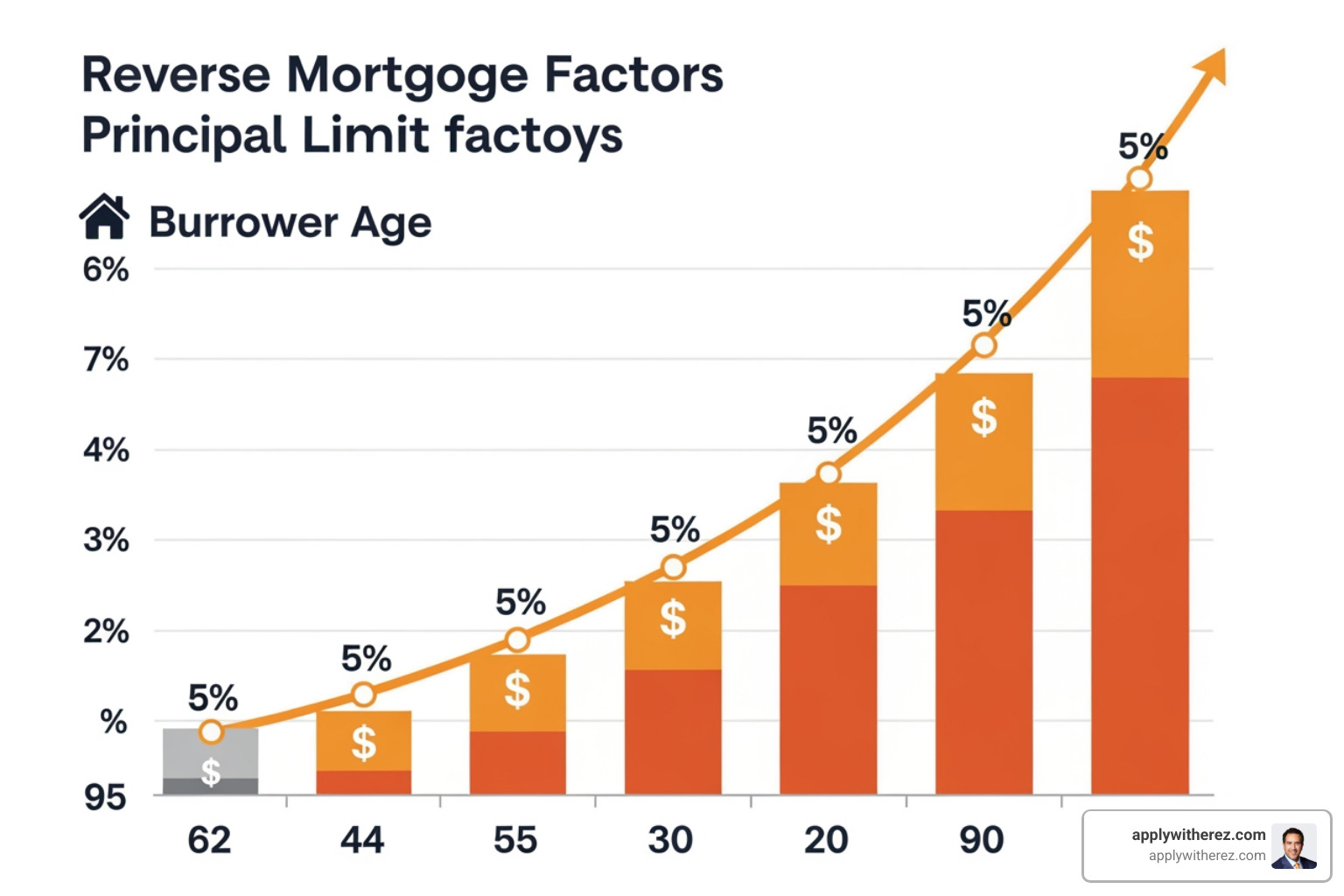
Reverse mortgage proceeds are based in part on life expectancy and risk. In simple terms, lenders and FHA expect that an older borrower will use the loan over a shorter remaining time horizon than a younger borrower. That usually allows for a higher principal limit.
For HECMs, this is reflected in Principal Limit Factors, or PLFs.
Based on the research provided:
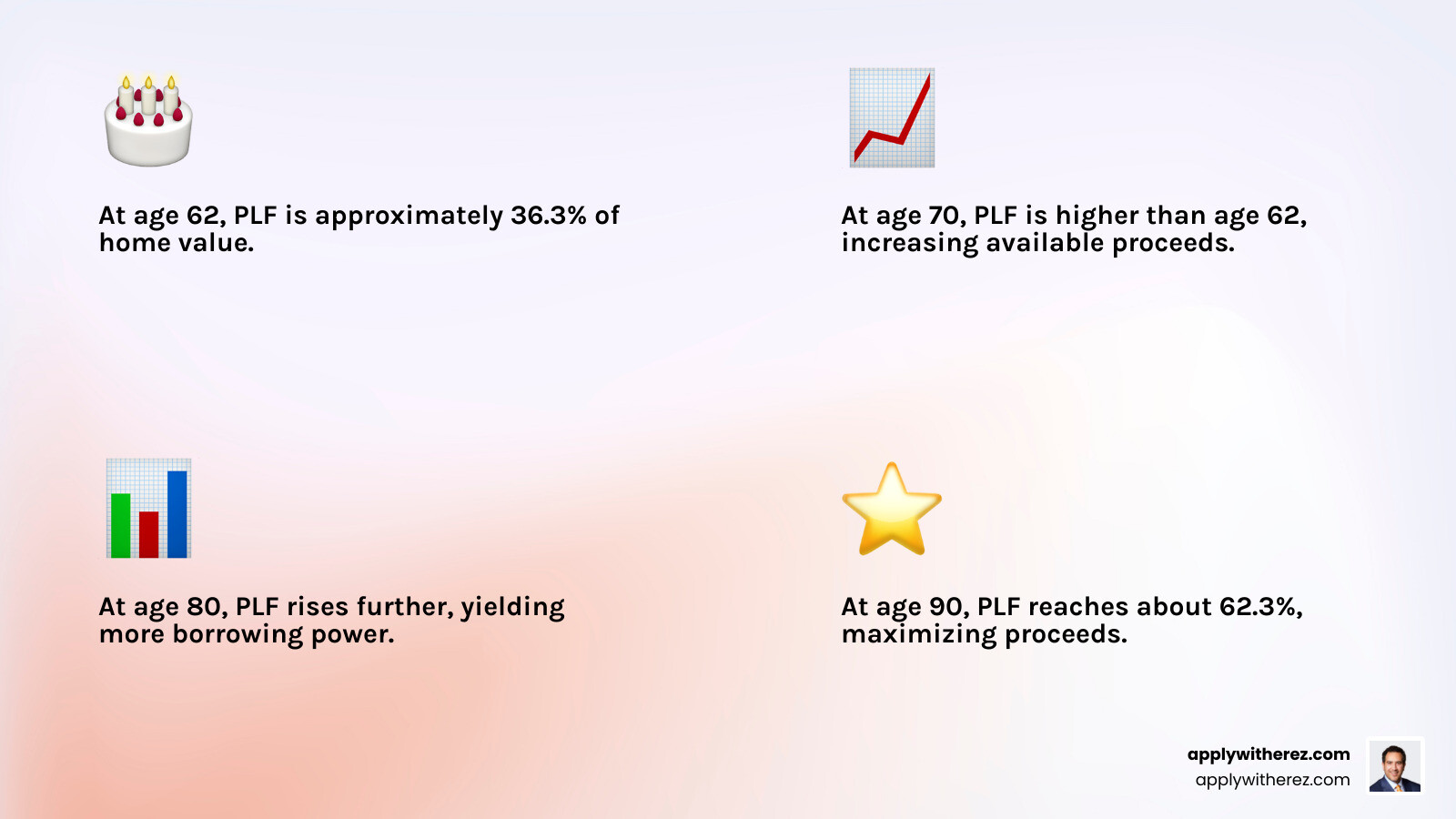
At age 62, the HECM PLF is 36.3% of home value, subject to the 2026 lending limit
At age 90, the HECM PLF rises to 62.3%
That is a huge difference.
Using the 2026 HECM maximum claim amount of $1,249,125, age can materially change the amount available before accounting for rates, existing mortgage payoff, closing costs, and any set-asides.
Here is the basic takeaway:
Younger eligible borrowers generally access a smaller share of equity
Older borrowers generally access a larger share of equity
Interest rates also affect proceeds, so age is important, but not the only factor
The age of the youngest borrower matters most
When there are two borrowers, the younger age typically drives the calculation. This is one of the most important planning points in the entire age of reverse mortgage conversation.
If one spouse is 75 and the other is 63, the loan is usually priced and structured based on the younger spouse's age, not the older spouse's. That can reduce available proceeds compared with a single older borrower.
This rule exists because the loan must account for the longest expected occupancy.
That is why spouse planning matters so much. A couple may qualify, but the younger spouse can lower the available principal limit. Sometimes that is fine. Sometimes it leads to a decision to wait.
Example ranges by age and home value
Let us use simplified examples based on the research figures. These are illustrations, not loan offers.
Age Approx. PLF Home Value Used Approx. Gross Principal Limit 62 36.3% $500,000 $181,500 70 Higher than 62 $500,000 More than age 62 80 Higher than 70 $500,000 More again 90 62.3% $500,000 $311,500
And if the home value is above the 2026 HECM lending cap, calculations are limited by that cap rather than the full market value.
For homeowners with higher-value properties, a proprietary reverse mortgage may sometimes provide access beyond the HECM lending limit.
To estimate your own numbers, use our Reverse Mortgage Calculator.
For additional context on age and proceeds, see Factoring Age into the Reverse Mortgage Equation .
Can You Get a Reverse Mortgage If Your Spouse Is Under 62?
Yes, sometimes. But the answer depends on the loan type, how the application is structured, and the legal protections available to a younger spouse.
This is where people often hear half a rule and think it is the whole rule. Reverse mortgage rules love fine print almost as much as tax forms do.
How non-borrowing spouse rules work
For HECMs, a spouse under 62 may be treated as an eligible non-borrowing spouse rather than a co-borrower.
That can matter a lot.
If properly identified and the loan remains in good standing, an eligible non-borrowing spouse may be allowed to stay in the home after the borrowing spouse dies or permanently leaves the home, even though that younger spouse was not a borrower on the loan.
Important points include:
The younger spouse usually does not get the same borrowing power as being an older co-borrower
The available loan proceeds may be lower or structured differently
The spouse must continue to meet occupancy and other program rules
The loan terms and servicing requirements must be followed carefully
This protection improved over time and is one of the major ways reverse mortgage age rules have become more flexible for married couples.
Do both spouses need to be 62 in every state?
Not in every state, but state law can affect title, spousal rights, and how loans are structured.
One example from the research is Texas, where all borrowers, including both spouses, must be at least 62 years old. Because state-specific requirements can matter, couples should review title and legal issues carefully before deciding whether one spouse should remain off the loan.
The larger point is simple: federal HECM rules are the baseline, but legal and property rules can still shape the best structure for a married couple.
When it makes sense to wait until the younger spouse is older
Sometimes waiting makes a lot of sense.
If the younger spouse is close to 62, waiting may offer:
More available proceeds
Stronger long-term flexibility
Better alignment with estate or inheritance goals
Less dependence on non-borrowing spouse protections
A short wait can sometimes produce a noticeably better outcome, especially when the younger spouse's birthday is near and there is no urgent need for funds today.
That said, waiting is not always best. If the immediate goal is to eliminate a required monthly mortgage payment, handle medical costs, or create retirement cash flow now, acting sooner may still be the right move.
Reverse Mortgage Options for Homeowners Under 62
If you are under 62, a standard HECM is off the table. But that does not necessarily mean every reverse mortgage option is unavailable.

Proprietary and jumbo loans with lower age minimums
Some proprietary or jumbo reverse mortgages are available starting at age 55 in select states.
These are private loans, not FHA-insured HECMs, so lenders can set different product rules. They are often designed for higher-value homes and may allow larger loan amounts than the HECM cap.
The research provided one helpful benchmark:
At age 55, a jumbo reverse mortgage may offer about 39.10% loan-to-value on a $1 million home
That example would equal about $391,000 in available proceeds before adjustments
These loans can be useful for homeowners who:
Are younger than 62
Own high-value homes
Need access to more equity than HECM limits allow
But because these are private products, eligibility, age minimums, and state availability can vary.
HECM vs proprietary reverse mortgage age rules
Here is the big picture:
Feature HECM Proprietary / Jumbo Minimum age 62 Sometimes 55 Backing FHA-insured Private lender product Federal standard Yes No Lending limit Subject to HECM cap May exceed HECM cap Availability Broadly standardized Varies by lender and state
So if your main concern is the age of reverse mortgage eligibility, HECMs are stricter, while private products can be more flexible.
For more detail, see Reverse Mortgage Age Requirements for 2026 with Chart/Examples .
Alternatives if you are not yet eligible
If you are not old enough for a HECM and a proprietary loan does not fit, you still have options.
Common alternatives include:
Waiting until you reach eligibility
A HELOC
A cash-out refinance
Downsizing
Looking into local assistance or tax relief programs
Each alternative has tradeoffs. A HELOC or refinance usually requires monthly payments, which is very different from a reverse mortgage. Downsizing may free equity but requires moving. Waiting may improve both eligibility and loan proceeds.
For a neutral consumer view of alternatives, see Can anyone take out a reverse mortgage loan? .
Should You Apply Now or Wait Until You Turn 62?
Timing matters more than many borrowers expect.
If you are 61 and turning 62 soon, the choice may be less about yes versus no and more about now versus a slightly better later.
If you are close to 62, should you wait?
Usually, if you are not yet 62, you must wait for a HECM. There is no federal exception for being almost 62.
If you are already 62 but close to another birthday, waiting could still modestly improve proceeds because PLFs generally increase with age. Whether that matters enough depends on:
How urgently you need the money
Whether you need to pay off an existing mortgage right away
Current interest rates
Your long-term plan for staying in the home
In practice:
If you need immediate cash flow relief, applying as soon as eligible may be best
If your need is flexible and another birthday is near, waiting may produce a slightly larger principal limit
This is one place where numbers beat guesswork. We recommend running both scenarios through our Reverse Mortgage Calculator.
How age requirements have changed over time
For 2026, the standard HECM minimum age remains 62. That has not changed.
What has improved over time is not the minimum age itself, but the surrounding rules and product choices:
Better protections for eligible non-borrowing spouses
More awareness of financial assessment and LESA planning
Expansion of some proprietary products with age minimums as low as 55 in certain markets
So while the magic number for HECM is still 62, the planning landscape around that age is more flexible than it used to be.
Questions to ask before locking in a reverse mortgage
Before moving forward, we suggest asking:
How long do we plan to stay in this home?
How old is the younger spouse?
Would waiting improve proceeds enough to matter?
Can we comfortably keep paying taxes, insurance, HOA dues, and maintenance?
Do we want to preserve as much equity as possible for heirs?
Are we comparing HECM and proprietary options correctly?
You can start with our Reverse Mortgage page for a practical next step.
Frequently Asked Questions About age of reverse mortgage
Can a disabled homeowner under 62 qualify for a HECM?
No. Disability does not create an exception to the federal HECM age rule. For a standard FHA-backed reverse mortgage, the minimum age is still 62.
Does applying at 62 vs 63 make a meaningful difference?
It can, but usually not as dramatically as 62 versus 70 or 80. A one-year age difference may modestly increase available proceeds through the PLF calculation. Whether that is meaningful depends on home value, rates, existing mortgage payoff, and your financial goals.
Can one spouse be on the loan and the other stay off?
Yes, in some cases. A younger spouse may be treated as a non-borrowing spouse on certain HECM structures. That can preserve occupancy rights if the borrowing spouse dies, but it comes with rules and may affect the amount available. This should always be reviewed carefully before application.
Conclusion
The short answer to the age of reverse mortgage question is simple: 62 is the minimum for a standard HECM in 2026, some proprietary options may start at 55, and there is no maximum age limit.
The smarter answer is a little more nuanced:
Age affects eligibility
Age affects proceeds
The youngest spouse matters
Waiting can sometimes improve the outcome
Under-62 homeowners may still have private-loan alternatives
More than 1.3 million Americans have used reverse mortgages as part of retirement planning, but the right timing depends on your household, your home equity, and your long-term goals.
If you want to explore your options, learn more about our reverse mortgage services.