
How to Hack Your First Mortgage with a Buy to Let
Why Buy to Let as a First-Time Buyer Could Change Your Property Strategy
Being a buy to let first time buyer means purchasing your first property as a rental investment - not as a home to live in. It's an unconventional path, but one that more people are seriously considering in 2026.
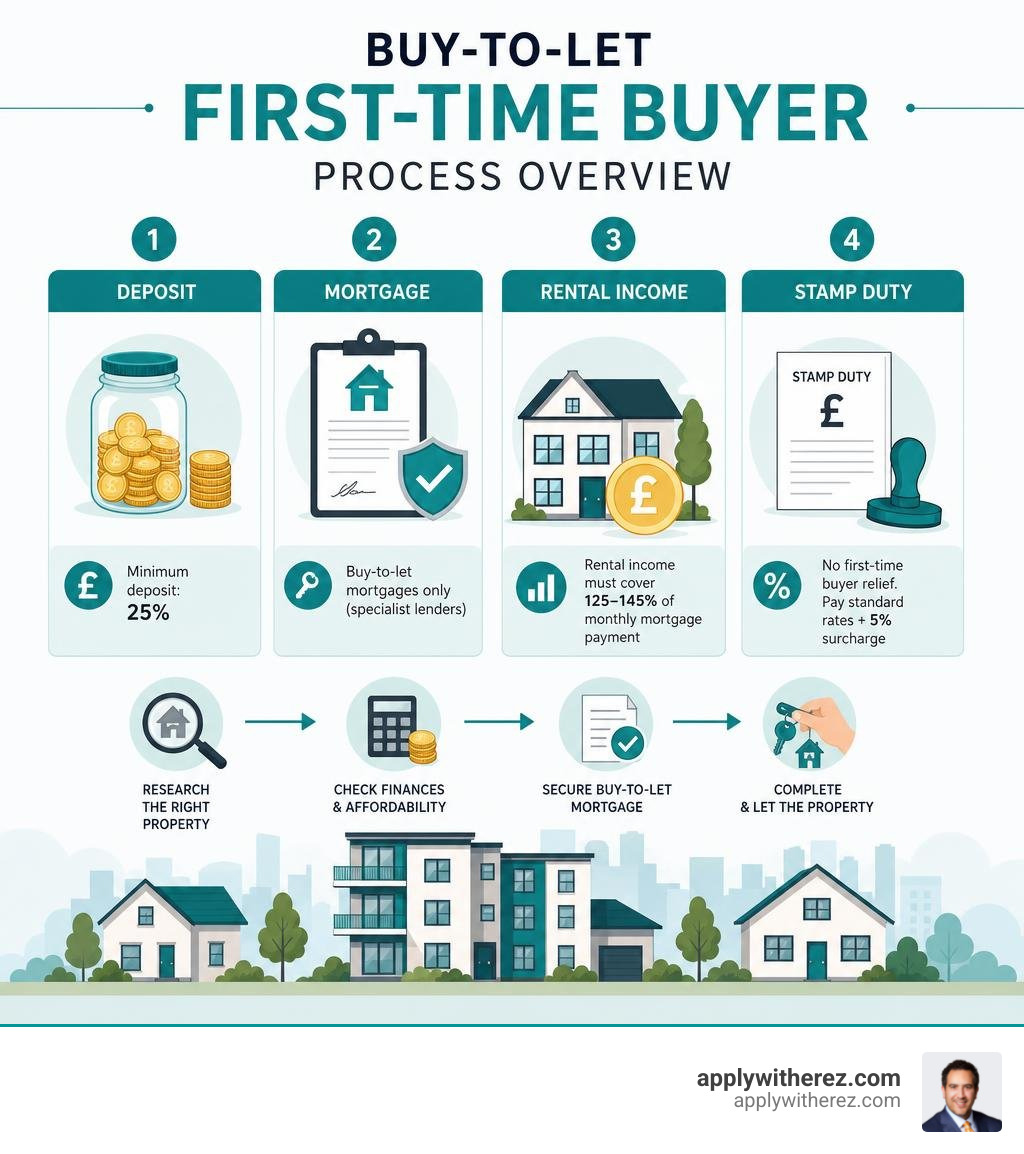
Here's what you need to know at a glance:
Yes, you can get a buy-to-let mortgage as a first-time buyer - but only through specialist lenders, not mainstream banks
Minimum deposit: 25% (compared to 5% for a standard residential mortgage)
Rental income must cover: at least 125-145% of your monthly mortgage payment
Minimum personal income: most lenders require £25,000+ per year
Stamp duty: you do not qualify for first-time buyer relief on a buy-to-let. If this is your only property and you buy personally, the additional dwelling surcharge may not apply, but it can apply if you already own property or buy through a company - always check the latest official rules
Government schemes like the Lifetime ISA and First Homes scheme cannot be used for buy-to-let properties
This strategy appeals to people who can't afford to buy where they live - think renting in a major city - but can afford to buy in a more affordable area and generate rental income in the process.
It's not simple. The mortgage options are limited, the upfront costs are higher, and the tax rules are stricter than ever. But with the right setup, it can be a real foothold on the property ladder.
I'm Erez Shimoni, a mortgage professional with 26 years of industry experience, and I've helped many clients navigate complex scenarios just like the buy to let first time buyer route - where getting the structure right from day one makes all the difference. In this guide, I'll walk you through everything you need to make an informed decision.
What is a Buy to Let First Time Buyer?

A buy to let first time buyer is someone who buys their first property with the intention of renting it out to tenants instead of living in it.
That makes you two things at once:
A first-time buyer, because you have not owned property before
A first-time landlord, because the property is being used as an investment
This is very different from the traditional route of buying a home, moving in, decorating it, and arguing with yourself over whether the kitchen really needs a breakfast bar. With buy-to-let, the property is a business asset. The main questions become:
Will tenants want to live there?
Will the rent cover the mortgage stress test?
Will the numbers still work after tax, repairs, insurance, and void periods?
Will the property grow in value over time?
Many first-time buyers consider this route because they are priced out of the area where they live, but can afford a rental property elsewhere. For example, someone renting in an expensive city may choose to buy a lower-cost property in a strong rental market instead.
That can be smart. But it can also be risky if the property only looks profitable on paper.
Buy to Let vs Residential Mortgages
A residential mortgage is for a property you intend to live in. A buy-to-let mortgage is for a property you intend to rent out.
That one difference changes almost everything.
Feature Residential mortgage Buy-to-let mortgage Main purpose Your own home Rental investment Typical deposit From 5-10% Usually 20-25% minimum Affordability basis Your income and outgoings Rental income plus personal financial strength Mortgage type Usually repayment Often interest-only Rates and fees Usually lower Usually higher First-time buyer stamp duty relief May be available Not available Can you live there? Yes No, not without changing the mortgage
Most buy-to-let mortgages are interest-only. That means your monthly payments cover the interest, but the original loan does not reduce. If you borrow £200,000 on an interest-only mortgage, you still owe £200,000 at the end of the term unless you repay it another way.
That is not automatically bad. Many landlords prefer interest-only because it improves monthly cash flow. But you need a repayment strategy, such as selling the property, using savings, or refinancing later.
If you are still comparing mortgage basics, our guide to the Best Type of Mortgage for First Time Buyers is a useful starting point.
Can You Rent Out Your First Home?
Yes, but only if the mortgage and legal setup allow it.
If you buy a property with a residential mortgage, the lender expects you to live there. Renting it out without permission can breach your mortgage terms. In serious cases, it can be treated as mortgage fraud. That is not a “small-print oopsie”; it can have major consequences.
If you already own or are buying a home to live in and later want to rent it out, you usually need one of the following:
Consent to let: temporary permission from your residential lender to rent the property
A buy-to-let remortgage: switching the mortgage to a proper rental product
A let-to-buy arrangement: keeping your current home as a rental while buying another home to live in
Consent to let is often temporary and may come with fees or a higher interest rate. It is not usually designed as a long-term landlord strategy.
The simple rule: if you plan to rent the property from day one, do not use a normal residential mortgage.
Can a buy to let first time buyer Get a Mortgage in 2026?

Yes, a first-time buyer can get a buy-to-let mortgage in 2026, but it is harder than getting a standard residential mortgage.
Many lenders prefer buy-to-let borrowers who already own their own home. Why? Because they have a track record of paying a mortgage and usually have more property experience. As a first-time buyer and first-time landlord, you are a higher-risk applicant in the lender’s eyes.
That does not mean “no”. It means you need a stronger application.
Specialist lenders may consider you if you have:
A strong deposit
Clean credit history
Stable income
Good employment record
A property with strong rental demand
Rent that passes the lender’s stress test
A clear reason for buying an investment property before your own home
Some first-time buyers do this because they live with family, have employer-provided accommodation, live with a partner, or cannot yet afford a home in their preferred area. Your own eligibility will depend on lender criteria at the time you apply.
Lender Requirements for a buy to let first time buyer
Lenders vary, but common requirements in 2026 include:
Deposit: usually at least 25%
Personal income: often £20,000-£25,000+ per year
Age: many lenders require applicants to be at least 21
Credit history: clean or strong credit is preferred
Employment: stable employed or self-employed income
Rental income: must meet the lender’s interest coverage ratio
Property type: standard houses and flats are usually easier than unusual properties
Experience: not always required, but lack of landlord experience can limit options
Documents you may need include:
Proof of ID and address
Bank statements
Payslips or accounts if self-employed
Proof of deposit
Credit commitments
Rental valuation from a letting agent or surveyor
Details of the property being purchased
If you are also considering buying a home to live in, our Best First Time Buyer Mortgages 2026 guide explains what residential lenders tend to look for.
Deposit Requirements and Affordability Stress Tests
Buy-to-let deposits are much larger than residential deposits.
A first-time buyer might buy a residential home with a 5% or 10% deposit, depending on the product. With buy-to-let, most lenders want at least 20-25%, and many prefer 25% or more.
Here is what that means in real money:
Purchase price 25% deposit 75% mortgage £150,000 £37,500 £112,500 £200,000 £50,000 £150,000 £250,000 £62,500 £187,500 £300,000 £75,000 £225,000
Then comes the affordability test.
Buy-to-let lenders usually do not calculate borrowing mainly by multiplying your salary. Instead, they look at whether the expected rent covers the mortgage payment by enough of a margin.
This is called the Interest Coverage Ratio, or ICR.
Typical ICR requirements are:
125% for some basic-rate taxpayers or limited company applications
145% for many higher-rate taxpayers
Sometimes higher depending on the lender, product, and stress rate
Example:
If the stressed mortgage payment is £800 per month:
At 125% ICR, rent needs to be at least £1,000 per month
At 145% ICR, rent needs to be at least £1,160 per month
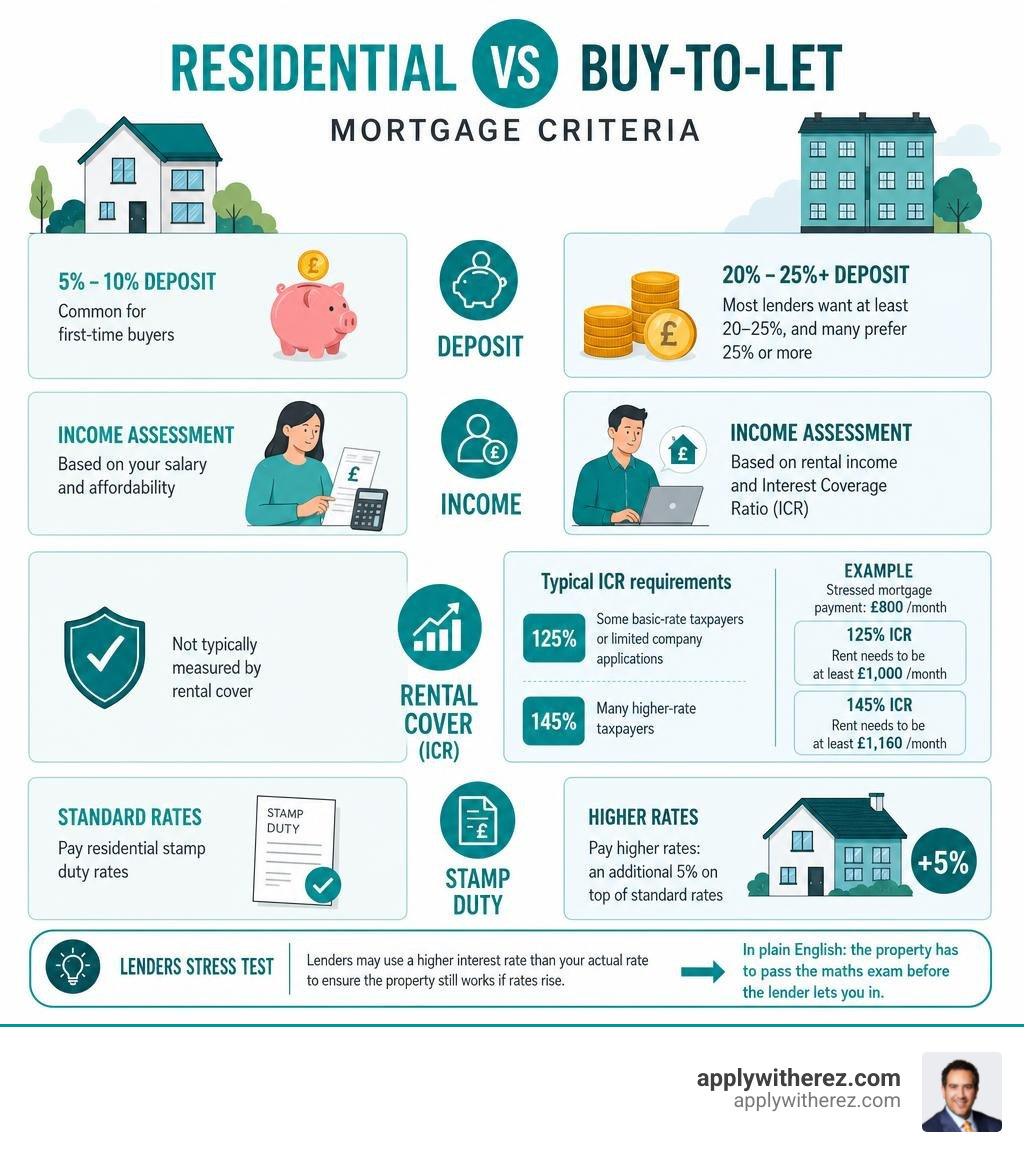
Lenders may also stress test the mortgage using a higher interest rate than your actual pay rate. This is to check whether the property still works if rates rise.
In plain English: the property has to pass the maths exam before the lender lets you into the classroom.
The Pros and Cons of Entering the Property Market as a Landlord
Buy-to-let can be a clever strategy, but it is not a magic property hack where tenants pay for everything while you sip coffee and watch the value rise. It is an investment, a business, and occasionally a plumbing emergency.
Advantages of Starting with an Investment Property
The benefits can include:
1. You can enter the property market sooner
If you cannot afford to buy where you live, buying a rental property in a more affordable area may give you exposure to property ownership earlier.
2. Rental income can support the investment
If the property is well chosen, rent may cover the mortgage and some costs. Average UK rental yields are often around 5%, with 5-8% generally considered a solid range for buy-to-let, depending on the area and property type.
3. Potential capital growth
If the property rises in value over time, you may benefit from capital growth. This is never guaranteed, but it is one of the main reasons people invest in property.
4. You build landlord and property experience
You learn how mortgages, tenants, agents, insurance, repairs, and tax work. That experience can be valuable if you want to build a portfolio later.
5. It can diversify your financial plan
Property can become one part of a wider investment strategy. Before doing that, though, we strongly recommend getting your overall finances organised. Our guide on Five Simple Steps to Get Your Finances in Order can help you prepare.
The downsides are equally important:
Higher deposit
Higher stamp duty
Fewer mortgage options
Landlord legal duties
Void periods with no rent
Repairs and maintenance
Tax on rental profits
Potential capital gains tax when selling
Reduced flexibility when buying your own home later
How Investing Affects Buying Your Own Home Later
Buying a buy-to-let first can affect your ability to buy your own home later.
Here is how:
Your deposit may be tied up
A 25% deposit plus stamp duty and costs can use a lot of cash. That may delay your ability to save for your own residential home.
Your future lender will assess the buy-to-let mortgage
Even if the rental property pays for itself, a residential lender may still include the mortgage in affordability calculations. Some lenders are more flexible if the rent covers the payment well, but it can still affect borrowing.
You may lose first-time buyer benefits
Once you own a buy-to-let, you are no longer a first-time buyer for most purposes. That can affect future stamp duty treatment and scheme eligibility.
Credit conduct matters
If tenants stop paying and you miss mortgage payments, your credit score can be damaged. That could make your next mortgage harder or more expensive.
This is why we always look at the “next move” before the first purchase. The right question is not just, “Can I buy this rental?” It is, “Will buying this rental help or hurt my bigger plan?”
Tax Rules, Stamp Duty, and Government Schemes
Buy-to-let tax is one of the biggest areas first-time investors underestimate.
You are not just buying a property. You are creating taxable rental income and a potential capital gains tax position. It is worth speaking to a qualified tax adviser before you choose whether to buy personally or through a limited company.
Stamp Duty and Tax Implications for a buy to let first time buyer
In England and Northern Ireland, buy-to-let purchases are normally subject to standard Stamp Duty Land Tax rules. A key point for first-time buyers is that you do not get first-time buyer stamp duty relief when buying a buy-to-let property, because that relief is intended for people buying a main residence.
The additional dwelling surcharge is separate. From 31 October 2024, the Higher Rate for Additional Dwellings surcharge increased from 3% to 5% where it applies. For an individual buying their first and only property personally, the surcharge may not apply simply because the property is a buy-to-let. However, it can apply if you already own another property, buy jointly with someone who does, or buy through certain company structures.
For buy-to-let first-time buyers, stamp duty can still be a major upfront cost because first-time buyer relief is not available. The commonly referenced standard SDLT bands include:
2% on the portion from £125,001 to £250,000
5% on the portion from £250,001 to £925,000
Plus the applicable additional property surcharge where relevant
Rules and rates can change, and Scotland and Wales have different property tax systems, so always check the latest official position before committing. You can use the GOV.UK Stamp Duty Land Tax calculator as a starting point for England and Northern Ireland.
Other tax issues include:
Income tax on rent
Rental income is taxable. You can deduct allowable expenses such as letting agent fees, repairs, landlord insurance, service charges, and some professional fees.
Mortgage interest relief restrictions
Section 24 rules mean individual landlords cannot deduct all mortgage interest from rental income in the old way. Instead, they receive a basic-rate tax credit. This can make buy-to-let less profitable, especially for higher-rate taxpayers.
Capital gains tax
If you sell a buy-to-let property for more than you paid, you may owe Capital Gains Tax after allowances and allowable costs. The annual CGT allowance is much lower than it used to be, so this needs planning.
Limited company ownership
Some landlords use a limited company for tax or borrowing reasons. This may help some higher-rate taxpayers, but it adds costs, administration, accountancy fees, and different mortgage pricing. It is not automatically better.
In short: do not choose the ownership structure based on a social media post. Speak to a tax professional. Preferably one who does not start every sentence with, "My mate Dave did this."
Can You Use a Lifetime ISA or First Homes Scheme?
Generally, no.
Government first-time buyer schemes are designed to help people buy homes to live in, not investment properties.
Lifetime ISA
A Lifetime ISA can usually be used penalty-free when buying your first home, but the property must be your main residence and meet scheme rules. You cannot use it to buy a standard buy-to-let investment property without triggering withdrawal penalties.
First Homes scheme
The First Homes scheme is for eligible first-time buyers purchasing a discounted home to live in as their main residence. Letting the whole property is restricted and usually only allowed temporarily, subject to conditions, council notification, and lender permission.
Shared ownership and similar schemes
These are also designed for owner-occupiers, not landlords.
So if your plan is buy-to-let from day one, assume government first-time buyer support is off the table.
Landlord Responsibilities and Extra Costs to Budget For
The mortgage is only one part of the cost. Becoming a landlord means taking on legal, financial, and practical responsibilities.
Budget for upfront costs such as:
Deposit
Stamp duty
Valuation fee
Survey
Conveyancing
Mortgage arrangement fee
Broker or advice fees where applicable
Initial repairs or furnishing
Safety certificates
Landlord insurance
Budget for ongoing costs such as:
Mortgage payments
Letting agent fees
Full property management, often around 10-15% plus VAT of rent
Maintenance and repairs
Service charges and ground rent for leasehold property
Buildings insurance
Landlord insurance
Accountancy
Licensing if required
Void periods
Rent arrears
Legal responsibilities may include:
Gas safety
If the property has gas appliances, you need an annual Gas Safety Certificate from a registered engineer.
Electrical safety
Rental properties generally require an Electrical Installation Condition Report, known as an EICR, at least every five years.
Energy Performance Certificate
You need a valid EPC. In 2026, most private rental properties in England and Wales must meet at least EPC rating E, with future policy direction pushing toward higher standards.
Smoke and carbon monoxide alarms
You must comply with smoke alarm and carbon monoxide alarm rules.
Deposit protection
Tenant deposits must be protected in a government-approved scheme within the required timeframe. Failure can lead to penalties and can restrict your ability to regain possession.
Right to Rent checks
In England, landlords must check that tenants have the legal right to rent.
Licensing
Some properties, especially HMOs, need a licence. Some councils also operate selective or additional licensing schemes.
Repairs and habitability
You must keep the property safe and in good repair. “The tenant can just use a bucket under the leak” is not a maintenance strategy.
You should also hold a contingency fund. A sensible target is at least three to six months of mortgage payments and running costs. This protects you if the property is empty or a tenant stops paying.
Frequently Asked Questions About First-Time Buy-to-Let
Is buy-to-let still worth it for first-time buyers in 2026?
It can be, but only if the numbers genuinely work.
Buy-to-let in 2026 is not as easy as it was years ago. Mortgage rates are higher than the ultra-low-rate era, tax relief is less generous, stamp duty is more expensive, and landlord regulation is stricter.
But rental demand remains strong in many areas, and well-selected properties can still produce income and long-term growth.
A buy-to-let may be worth considering if:
You have at least a 25% deposit
You can afford stamp duty and setup costs
The rental yield is strong, ideally around 5-8% depending on the market
The property passes lender stress testing
You have a cash buffer
You understand the tax position
You are comfortable being a landlord
It does not block your future home-buying plans
It may not be suitable if:
You need quick profit
You are using all your savings
You cannot handle void periods
You do not want landlord responsibilities
You plan to buy your own home soon and need every pound of deposit
Can I live in my own buy-to-let property?
No, not under a standard buy-to-let mortgage.
A buy-to-let mortgage is priced and approved on the basis that the property will be rented to tenants. If you move in without telling the lender, you can breach your mortgage conditions.
If your circumstances change and you want to live in the property, speak to the lender first. You may need to switch to a residential mortgage, and the lender will reassess affordability based on your personal income and outgoings.
The same applies in reverse. If you buy with a residential mortgage and later want to rent the property out, you need lender permission or a suitable remortgage.
What happens if my tenant stops paying rent?
You are still responsible for the mortgage.
The lender does not pause your payments because your tenant is late. This is one of the biggest risks of buy-to-let.
To protect yourself:
Keep a cash buffer of three to six months
Reference tenants properly
Use a professional tenancy agreement
Consider rent guarantee insurance
Act quickly if arrears start
Keep records of all payments and communication
Understand the legal process for possession if needed
A letting agent can help with tenant finding and management, but the legal responsibility remains yours as the landlord.
Conclusion
Becoming a buy to let first time buyer can be a smart way to enter the property market, especially if buying where you live is out of reach. But it is not a shortcut around affordability, tax, or responsibility.
The winning formula is simple to understand, even if it takes planning to execute:
Buy in an area with strong rental demand
Put down a realistic deposit
Make sure the rent passes stress testing
Budget for stamp duty, tax, repairs, and voids
Protect your future ability to buy your own home
Get mortgage and tax advice before committing
At applywitherez.com, we help buyers think through the full picture, not just the first mortgage application. If you are weighing up buy-to-let against buying your own home first, start with a clear plan.
You can explore your next step here: Buy a Home.