Why Your Real Estate Timing Might Be Historically Bad
Is 2026 a Bad Time to Buy a Home? Here's What You Need to Know
Right now is widely considered a bad time to buy a home — and the numbers back that up.
Quick answer: Signs it's a bad time to buy a home in 2026
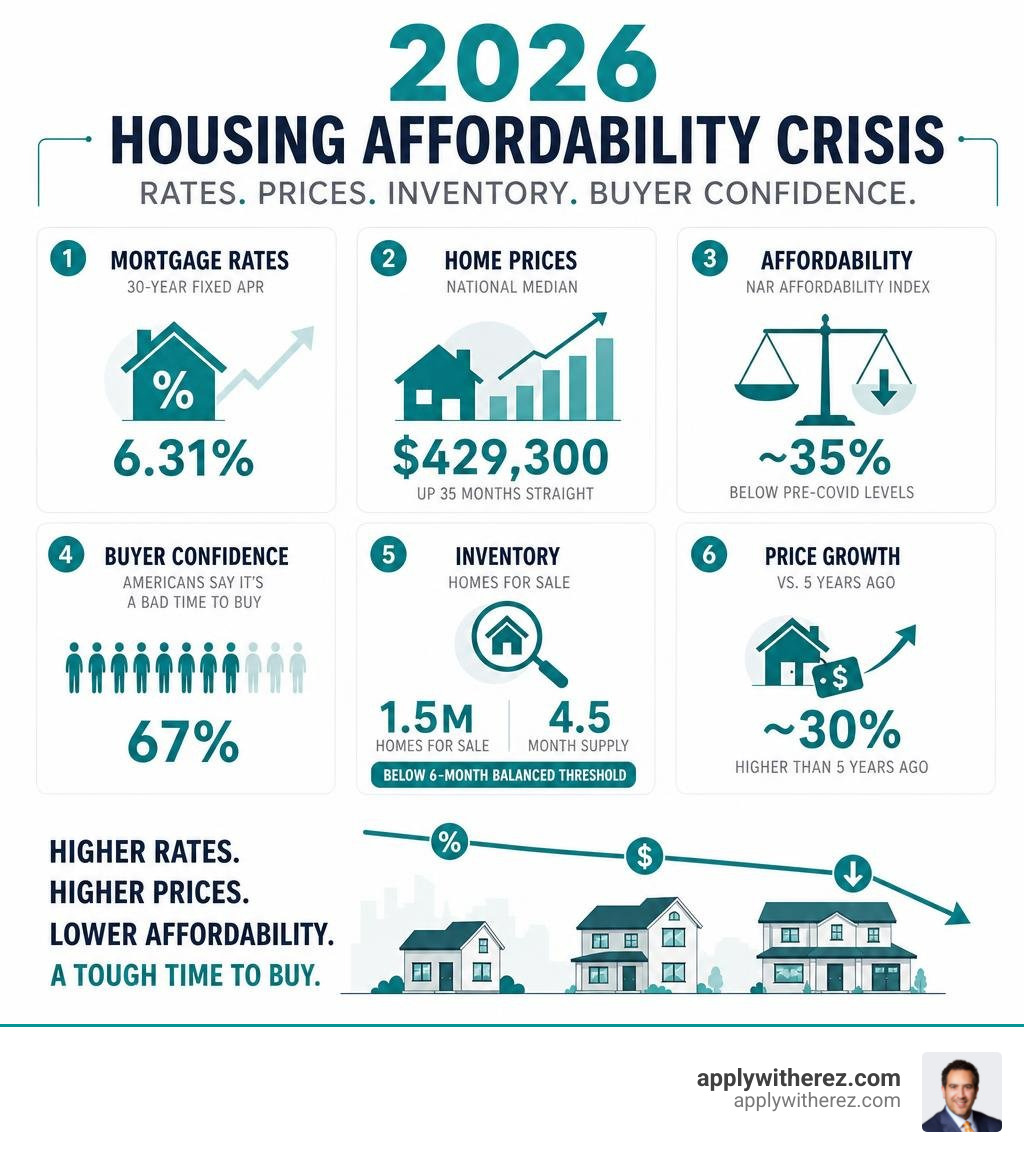
Warning Sign Current Reality High mortgage rates 30-year fixed averaging 6.31% APR Elevated home prices National median $429,300 — up 35 months straight Low affordability NAR affordability index ~35% below pre-COVID levels Low buyer confidence 67% of Americans say it's a bad time to buy Tight inventory 1.5M homes for sale; 4.5-month supply (below 6-month balanced threshold) Price growth vs. history Prices nearly 30% higher than five years ago
If any of those numbers made your stomach drop, you're not alone.
The spring and summer of 2026 have hit buyers with a rare combination of problems: rates that refuse to fall, prices that refuse to cool, and an economy that refuses to behave. It's the kind of market that makes even experienced buyers hesitate — and for good reason.
This isn't just about bad headlines or jittery markets. The math of buying a home right now is genuinely painful for most households. And while some buyers are still finding ways to make it work, understanding why this moment is so difficult is the first step to making a smart decision.
I'm Erez Shimoni, a mortgage professional with 26 years of experience helping buyers navigate markets exactly like this one — and in my career, I've rarely seen a confluence of factors that make the case for caution around a bad time to buy a home as clearly as 2026 does. Below, I'll walk you through what's really driving the difficulty so you can decide what the right move is for your situation.
Why June 2026 is a Historically Bad Time to Buy a Home
When we look at the real estate landscape in June 2026, we see a market that defies traditional economic gravity. Usually, when mortgage rates rise, home prices fall to compensate. Instead, we are living through a prolonged standoff where both rates and prices remain stubbornly elevated.
The national median price for existing homes sold in May reached a staggering $429,300. This is up 1.3% from May 2025, marking an unbelievable 35 straight months of year-over-year price growth. Overall, home prices are nearly 30% higher than they were just five years ago.
This environment has decimated affordability. The National Association of Realtors (NAR) affordability index is still roughly 35% below pre-COVID levels. It is no surprise, then, that 67% of Americans believe it is currently a bad time to buy a home.
So, why aren't prices dropping? The answer lies in our historically low housing inventory. We currently have only 1.5 million homes for sale nationwide. While this represents a slight improvement to a 4.5-month supply, it remains well below the 6-month supply required for a balanced real estate market. Sellers who secured 3% mortgage rates during the pandemic are refusing to move, creating a "lock-in" effect that keeps supply incredibly tight.
The summer of 2026 combines peak seasonal pricing with intense macroeconomic volatility. We are seeing a market where buyers have almost no room to negotiate, yet they are paying premium prices for limited options. For more details, see Why Current Events Make This Summer a Bad Time to Buy a House.
The Brutal Math of High Rates and Sky-High Prices
To truly understand why this is a challenging market, we have to look at the monthly payment numbers. When you pair record-high home prices with interest rates that have hovered between 6.3% and 6.56%, your purchasing power is drastically reduced.
Let's look at how interest rates change your monthly mortgage payment. In the table below, we compare buying a median-priced home of $429,300 today versus what that same home would have cost to finance at pre-pandemic rate levels, assuming a standard 20% down payment ($85,860 down payment, leaving a loan balance of $343,440).
Mortgage Interest Rate Loan Amount Monthly Principal & Interest Payment Total Interest Paid Over 30 Years 4.0% (Historical Average) $343,440 $1,639.63 $246,827 6.31% (Current June 2026 Rate) $343,440 $2,127.89 $422,600 Difference — +$488.26 / month +$175,773
As you can see, the difference is not pocket change. Paying nearly $500 more every single month just in interest means you are spending an extra $175,773 over the life of a 30-year loan without buying a single extra square foot of real estate. This extra cost forces many buyers to settle for smaller homes, less desirable neighborhoods, or to stretch their monthly budgets to dangerous limits. For a deeper breakdown of how these rates shape your purchasing power, check out the guide on Is It a Good Time to Buy a House?.
Why High Mortgage Rates Make This a Bad Time to Buy a Home
Mortgage rates averaged 6.31% APR for a 30-year fixed-rate mortgage as of June 18, 2026. While this is slightly lower than the peaks of late 2023, rates remain highly volatile due to persistent economic uncertainty.
Many buyers are tempted to buy now with the mindset of "marrying the house and renting the rate" — assuming they can simply refinance when rates drop. However, this strategy carries significant risks:
Refinancing is not free: Refinancing typically costs between 2% and 5% of the loan amount in closing fees.
No guarantee of rate drops: If inflation remains sticky, rates could stay at 6% or higher for years.
Risk of falling home values: If prices correct in your local market, you could end up with negative equity, making it impossible to refinance.
For first-time buyers, navigating these high interest costs requires finding specialized loan programs that offer competitive terms. Exploring options like the Best First Time Buyer Mortgages 2026 can help you identify structures that minimize upfront fees and protect your long-term financial health.
Macroeconomic Headwinds Squeezing the Housing Market

The housing market does not exist in a vacuum. What happens on the global stage directly impacts what you pay for a home. Right now, international conflicts, stubborn domestic inflation, and fears of a broader economic slowdown are creating massive volatility in the financial markets.
When global tension rises—such as the ongoing conflicts in the Middle East—investors seek safe-haven assets. This back-and-forth flow of global capital causes regular swings in the 10-year Treasury yield, which is the primary driver of 30-year mortgage rates. This constant volatility makes it incredibly difficult for buyers to lock in a rate with confidence.
How Tariffs and Inflation Signal a Bad Time to Buy a Home
Closer to home, supply chain policies are keeping the cost of housing artificially high. Recent trade tariffs—including a 15% tariff on Canadian lumber and up to 50% tariffs on imported steel and aluminum—have driven up the cost of building materials.
This has a direct double-whammy effect on the market:
New construction is more expensive: Homebuilders are passing these higher material costs directly onto buyers, keeping the prices of brand-new homes elevated.
Renovation costs are soaring: If you buy a "fixer-upper" to save money, you will find that remodeling costs are significantly higher than they were a few years ago.
These supply chain pressures mean that we are seeing slower construction timelines and fewer affordable entry-level homes being built, further exacerbating the inventory shortage.
Personal Financial Red Flags: When the Market Isn't the Only Problem
While macro market conditions are tough, sometimes the signs that point to a bad time to buy a home are entirely personal. Buying a home when your personal finances are stretched is one of the fastest ways to jeopardize your financial future.
Before entering the market, we advise checking for these critical red flags:
A Credit Score Below 740: While you can qualify for a mortgage with a lower score, you will not secure the best interest rates. In a high-rate environment, even a 0.5% rate difference can cost you tens of thousands of dollars.
A Debt-to-Income (DTI) Ratio Above 36%: Your DTI is the percentage of your gross monthly income that goes toward paying debts. If your housing costs plus credit cards, student loans, and auto loans exceed 36% of your income, you have very little breathing room for unexpected expenses.
Low Emergency Savings: If you empty your savings account to cover your down payment and closing costs, you are putting yourself at risk. You should always maintain a 3-to-6-month emergency fund after your closing costs are paid.
Job Instability: If your company is restructuring or your industry is facing layoffs, taking on a massive 30-year debt obligation is highly risky.
If you recognize any of these red flags in your financial profile, it is wise to take a step back. We recommend following these Five Simple Steps to Get Your Finances in Order to build your credit score, pay down revolving debt, and establish a solid savings cushion. You can also use our interactive Calculator to see exactly how your current debts and income translate into a comfortable monthly housing payment.
Frequently Asked Questions About Market Timing
Is 2026 a bad time to buy a home compared to previous years?
Yes, from a pure affordability standpoint, 2026 is one of the most challenging years on record. Home prices have risen nearly 30% over the last five years, while mortgage rates are more than double what they were during the pandemic. This combination has pushed housing affordability to its lowest level in decades.
Should I wait for mortgage rates to drop before buying?
Waiting for rates to drop is a double-edged sword. While lower rates will reduce your monthly payment, they will also bring millions of sidelined buyers back into the market. This surge in demand could spark intense bidding wars, driving home prices even higher and wiping out any savings you would have gained from the lower interest rate.
What are the risks of buying a home during the summer rush?
Summer is historically the most expensive and competitive time to buy a home. Families want to move before the new school year begins, which leads to peak buyer competition. This environment often results in emotional bidding wars, waived home inspections, and buyers overpaying significantly above listing prices.
Conclusion
Deciding whether this is a bad time to buy a home comes down to balancing current market realities with your personal financial health. While the national housing market in June 2026 presents historic challenges, the right time to buy is always when you are personally, professionally, and financially ready.
If you have stable employment, a strong credit score, a low debt-to-income ratio, and plan to hold onto the property for at least 5 to 10 years, you can safely navigate even a tough market. Over a long holding period, real estate historically appreciates, helping you build equity and outpace inflation.
If you want to explore your options, determine your actual purchasing power, or get pre-approved to see what terms you qualify for, we are here to guide you. Visit us at Buy a Home to start planning your homeownership journey with clarity and confidence.